
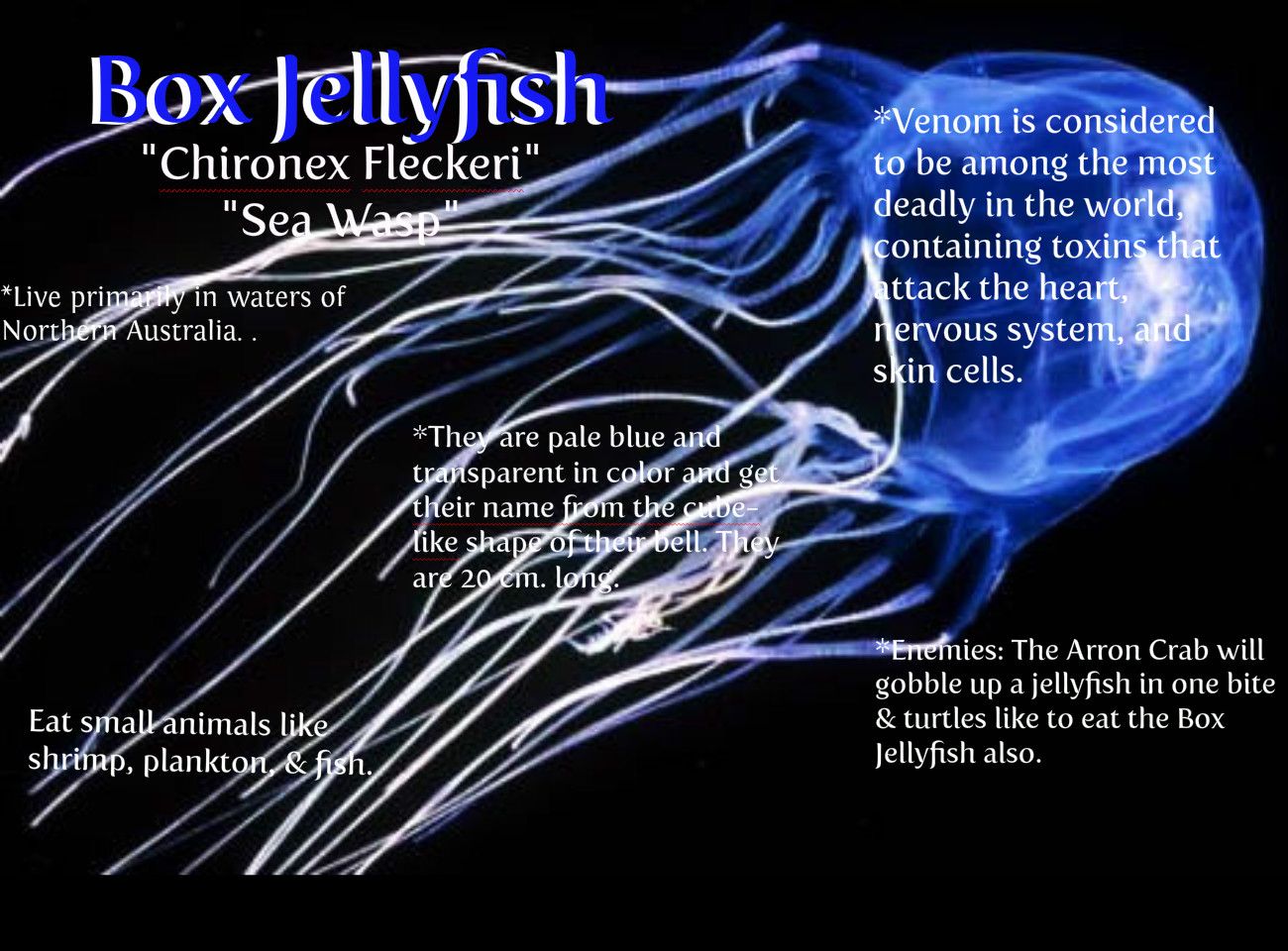
The box jellyfish is widely regarded as the most venomous marine animal on Earth. Unlike the familiar dome-shaped jellyfish drifting in temperate seas, members of the class Cubozoa have a cube-shaped bell, active swimming behaviour, sophisticated sensory organs, and venom capable of killing an adult human in minutes.
The Australian box jellyfish Chironex fleckeri is the most iconic and dangerous member of the group - a near-transparent predator patrolling the shallow tropical waters of northern Australia and the Indo-Pacific.
This guide covers every aspect of box jellyfish biology and ecology: taxonomy and diversity, anatomy, the chemistry of its venom, the astonishing sensory system of an animal with 24 eyes and no brain, its life cycle, hunting behaviour, the public health burden of box jellyfish stings, Irukandji syndrome, first aid protocols, and the strange facts that make the Cubozoa one of the most remarkable and feared lineages in the animal kingdom.
It is a reference entry, not a summary - so expect specifics: centimetres, milliseconds, molecules, and medical outcomes.
Etymology and Classification
The scientific name Chironex fleckeri honours Dr Hugo Flecker, the Australian physician who first described the sea wasp's medical significance in 1945, combined with a genus name from Greek roots meaning 'hand murderer'. Early European settlers in northern Australia used many informal names for the animal: sea wasp, marine stinger, and fire medusa, each reflecting a different encounter with its sting.
Indigenous Australian communities along the northern coast had recognised the animal and its seasonal dangers for millennia before colonial contact, and traditional knowledge about when and where to swim safely predates any scientific description by thousands of years.
Box jellyfish belong to the phylum Cnidaria, which also contains sea anemones, corals, hydras, and the true jellyfish (Scyphozoa).
They are placed in their own class, Cubozoa, which contains roughly 50 described species distributed across two orders: Carybdeida (single-tentacle-per-corner forms, including the Irukandji-causing genera) and Chirodropida (multi-tentacle-per-corner forms, including the largest and most dangerous species).
Chironex fleckeri sits within Chirodropida, family Chirodropidae, alongside its slightly smaller but still dangerous Pacific relatives.
Cubozoa diverged from the other cnidarian classes hundreds of millions of years ago. Genetic and morphological evidence suggests they represent an ancient branch that evolved active predation and complex vision independently of bilaterian animals, making their sensory systems one of the most interesting cases of parallel evolution in biology.
Size and Physical Description
A mature Chironex fleckeri is a formidable animal despite looking like almost nothing at all. The bell is roughly cubic, measuring 20 to 30 centimetres across in adults, and the whole medusa can weigh up to 2 kilograms when fully grown. The body is pale blue and almost perfectly transparent, which is why so many victims never see the animal before they are stung.
Bell and body:
- Bell width: 20-30 cm
- Bell shape: four-sided cube with rounded corners
- Body weight: up to 2 kg
- Colour: pale blue, near-transparent
- Bell pulse rate: up to several pulses per second during active swimming
Tentacles:
- Tentacles per animal: approximately 60 (15 per corner)
- Tentacle length: up to 3 m each when fully extended
- Combined tentacle length: can exceed 180 m
- Nematocysts per tentacle: approximately 500,000
- Total nematocysts per animal: approximately 30 million
The four corners of the bell are each extended into a fleshy structure called a pedalium, from which a bundle of 15 tentacles emerges. When the jellyfish is relaxed and hunting, the tentacles trail behind the animal for the full 3 metres, creating a curtain-like web through which small fish swim and are stung. When disturbed, the tentacles retract rapidly toward the bell.
Unlike typical jellyfish, box jellyfish have a shelf-like structure called the velarium at the bottom of the bell that enhances water jetting and gives them the precise, directional propulsion that distinguishes Cubozoa from their drifting relatives. The velarium is a key evolutionary innovation separating the box jellyfish from scyphozoans.
Active Swimming and Movement
Where most jellyfish drift, box jellyfish swim. Chironex fleckeri can reach speeds of up to 2 metres per second in short bursts and cruise steadily against moderate currents. They are not passive plankton - they are active predators that navigate, hunt, and avoid obstacles on purpose.
Swimming and movement:
| Metric | Value |
|---|---|
| Top swimming speed | up to 2 m/s (approx. 7.2 km/h) |
| Cruising speed | 0.1-0.5 m/s |
| Daily active period | Daytime-biased; slows at night |
| Obstacle avoidance distance | Several body lengths |
| Typical depth | 0-3 m in shallow tropical shorelines |
Field observations and laboratory video show that Chironex can detect and actively steer around dark vertical objects such as mangrove roots and swimmers' legs. They orient themselves relative to the mangrove canopy by keeping that canopy visible in their upward-facing eyes.
If wind and waves push them too far from shore, they correct course back toward the shallow, sheltered waters where their prey concentrates. Slow-pulse and fast-pulse swimming modes allow them to switch between energy-efficient cruising and rapid escape.
This purposeful, guided swimming behaviour is rare in cnidarians and explains why simple beach closures based on drift patterns fail to predict box jellyfish presence reliably - the animals choose where to be.
The Visual System: 24 Eyes, No Brain
Perhaps the single strangest feature of the box jellyfish is its vision. Adult Chironex fleckeri carry 24 eyes distributed across four sensory structures called rhopalia, one at the midpoint of each side of the bell. Every rhopalium carries a stack of six eyes in four anatomical types.
Eye types per rhopalium:
- Upper lens eye. A camera-type eye with a spherical lens, cornea, and retina. Oriented upward to track the sky and mangrove canopy. Surprisingly under-focused, which biologists suspect deliberately blurs out fine details and preserves big landmarks like tree silhouettes.
- Lower lens eye. A second camera-type eye, smaller than the upper, oriented downward into the water column.
- Pit eyes (two per rhopalium). Cup-shaped simple photoreceptors that detect direction and intensity of light.
- Slit eyes (two per rhopalium). Narrow slit-shaped photoreceptors for detecting contrast.
The absence of a centralised brain is what makes this sensory architecture so unusual. Signals from all 24 eyes feed into a ring-shaped nerve net encircling the bell margin. The ring integrates visual, mechanical, and chemical input and coordinates swimming, tentacle contraction, and nematocyst discharge. Each rhopalium contains a statocyst - a gravity sensor - that keeps the camera eyes correctly oriented even as the bell pulses and rotates.
The upward-facing lens eyes appear specialised for one job above all others: keeping the animal within sight of the mangrove canopy, and therefore within the narrow coastal zone where prey is abundant. Laboratory experiments in tanks painted to simulate mangrove silhouettes show that box jellyfish will preferentially swim toward the painted canopy edge, confirming a visual behaviour unprecedented among brainless animals.
Venom Chemistry and Cardiovascular Effects
Box jellyfish venom is a complex protein cocktail optimised by hundreds of millions of years of evolution to paralyse fast, slippery prey - small fish and shrimp - in fractions of a second so the jellyfish can consume them without damaging its fragile tentacles.
Key toxin components:
- CrTX-A (cardiotoxin A). A pore-forming protein that inserts into heart muscle cell membranes, rapidly disrupting ion balance and electrical conduction.
- Haemolysins. Disrupt red blood cell membranes, causing intravascular haemolysis.
- Neurotoxic peptides. Affect sodium-channel gating and peripheral nerve function.
- Tissue-necrotic enzymes. Cause the characteristic scarring whiplash-pattern wounds.
A severe sting from Chironex fleckeri - typically requiring tentacle contact of 2 to 4 metres across bare skin - can induce cardiovascular collapse within two to five minutes. The heart, destabilised by CrTX-A, develops arrhythmia and may arrest. Blood pressure crashes. Red blood cells lyse. Pain is described by survivors as the worst they have ever felt, often accompanied by hyperventilation, disorientation, and loss of consciousness.
Treatment protocols in northern Australia include immediate vinegar flushing to prevent further nematocyst discharge, intravenous morphine or fentanyl for pain, cardiovascular support, intravenous magnesium sulfate (which blocks CrTX-A activity in laboratory studies), and a sheep-derived antivenom developed in the 1970s.
The antivenom's effectiveness remains debated: it works well against some venom components but may not fully counteract the rapid cardiotoxic effects, and time to treatment is the single largest predictor of survival.
Human Mortality and Public Health Burden
Precise mortality figures for box jellyfish are hard to gather because many rural and coastal deaths in the Indo-Pacific are never formally attributed. The best available estimates indicate that box jellyfish kill more people each year than sharks globally, possibly by a large margin.
Reported and estimated annual fatalities:
| Region / species | Estimated annual deaths |
|---|---|
| Philippines (multiple box species) | approximately 60 |
| Northern Australia (Chironex fleckeri) | 0-2 (since antivenom) |
| Thailand (multiple box species) | 5-15 |
| Malaysia, Indonesia, PNG combined | 10-30 (estimated) |
| Global total (conservative estimate) | roughly 100+ per year |
In Australia, mortality dropped sharply after the introduction of antivenom, vinegar first aid, stinger nets, and public education campaigns from the 1960s onwards. Between 1884 and 2021 only about 70 confirmed Australian fatalities have been recorded. In contrast, the Philippines and parts of Southeast Asia lack coordinated public health responses and sting deaths remain common, especially among children.
Irukandji syndrome, caused by several smaller box jellyfish species led by Carukia barnesi, adds an additional burden of severe but usually non-fatal hospitalisations. Northern Queensland hospitals see dozens to hundreds of Irukandji cases per year.
Tentacles and the Nematocyst Mechanism
The nematocyst is one of the most extraordinary pieces of cellular machinery in the animal kingdom. Each is a single-cell organelle the size of a bacterium, containing a coiled hollow thread tipped with barbs and loaded with venom. A trigger hair (cnidocil) on the cell surface waits to be bumped.
Firing sequence:
- Prey contact depresses the cnidocil.
- Calcium gates open and osmotic pressure inside the capsule spikes toward 150 atmospheres.
- The operculum pops open.
- The coiled thread everts - effectively turning itself inside out - and shoots outward at acceleration that has been measured in the millions of g in some cnidarians.
- The barbed harpoon penetrates the skin or cuticle of the prey.
- Venom is injected through the hollow tube.
The entire cycle takes around 0.7 milliseconds. No other animal weaponry fires faster. Each nematocyst can fire only once, which is why a box jellyfish carries so many - roughly 500,000 per tentacle and around 30 million per animal. A single sting involves thousands of nematocysts firing in parallel along the contact zone, creating the signature whip-pattern marks that can scar survivors for life.
Life Cycle and Reproduction
Despite its fearsome reputation, each individual box jellyfish has a remarkably brief life. The free-swimming medusa stage - the animal swimmers encounter in the ocean - lives only a few months, typically a single tropical wet season.
Life cycle stages:
- Gamete release. Mature medusae release eggs and sperm into the water, typically in late summer.
- Planula larva. Fertilised eggs develop into ciliated planula larvae that swim for a few days.
- Polyp settlement. Planulae settle on hard surfaces - rocks, shells, mangrove roots - and transform into sessile polyps a few millimetres tall.
- Polyp cloning. Polyps can bud off additional polyps asexually, persisting across dry seasons and slowly building a reservoir population.
- Metamorphosis. Under favourable conditions (rising water temperature, salinity changes), each polyp fully metamorphoses into a tiny juvenile medusa and swims away.
- Medusa growth. Juveniles grow rapidly in coastal shallows, reaching full size and reproductive maturity within a few months.
This alternation of generations means the adult population observed each wet season is seeded by a hidden, long-lived polyp community attached to substrates along the coast. Efforts to 'remove' box jellyfish from a beach are effectively impossible because the polyp stage is invisible and widespread.
Diet and Hunting
Chironex fleckeri is a carnivore specialised for small, fast prey. Its diet is dominated by shrimp and small fish - both animals capable of moving fast enough to damage or detach a jellyfish's fragile tentacles if given the chance. The extreme potency of the venom is, in evolutionary terms, a response to exactly this problem: prey must be immobilised instantly or the whole strategy fails.
Typical prey:
- Small schooling fish (including juvenile mullet, herring, hardyheads)
- Penaeid shrimp and other coastal crustaceans
- Occasional small invertebrates
Hunting is passive-aggressive. The jellyfish swims slowly through a shrimp- or fish-rich area with tentacles trailing. When a prey animal blunders into a tentacle, nematocysts discharge en masse, the prey is immobilised in a fraction of a second, and the tentacle contracts to bring the meal up to the bell's oral arms. The gastrovascular cavity digests the prey over a period of hours, and undigested remains are expelled through the same single opening that serves as both mouth and anus.
Irukandji Syndrome
The Irukandji jellyfish Carukia barnesi is one of the strangest animals in the Cubozoa. A mature adult is roughly the size of a fingernail - the bell measures about 1 centimetre across - yet its sting triggers one of the most distinctive medical syndromes in envenomation medicine.
Irukandji syndrome typically unfolds in two phases:
- Initial sting: often barely felt, leaving only a tiny red mark or nothing visible at all. Many victims do not realise they have been stung.
- Delayed cascade (20-40 minutes later): severe lower back pain, cramping of major muscle groups, nausea, vomiting, profuse sweating, severe hypertension (blood pressure readings of 200/120 or higher are common), tachycardia, pulmonary oedema, and a striking psychological feature that clinicians call 'a sense of impending doom'.
The syndrome is driven by a massive surge of endogenous catecholamines - adrenaline and noradrenaline - released as a consequence of the venom acting on the sympathetic nervous system. Blood pressure control (phentolamine, magnesium, nitrate infusions) and strong analgesia are the core treatments.
Two confirmed Australian fatalities from Irukandji occurred in 2002, both from intracranial haemorrhage secondary to extreme hypertension. Non-fatal hospitalisations number in the dozens to hundreds annually in northern Queensland alone.
First Aid and Treatment
Effective box jellyfish first aid has been refined over decades and differs meaningfully from the first aid for other marine stings.
Recommended sequence:
- Remove the victim from the water and call emergency services. Do this first. Every second matters.
- Do not rinse with fresh water, alcohol, or urine. These osmotic shocks can trigger mass discharge of any nematocysts still clinging to the skin.
- Flood the affected area with household vinegar for at least 30 seconds. Acetic acid inactivates unfired nematocysts without causing them to fire. This is the single most important step after calling for help.
- Remove visible tentacles carefully with tweezers or gloved hands.
- Begin CPR immediately if the victim is unresponsive or has no pulse. Cardiac arrest can follow major stings within minutes.
- Transport to hospital for antivenom, magnesium sulfate, pain management, and cardiovascular monitoring.
Hot water immersion - the standard first aid for many marine stings - is not recommended for Chironex, though it can help with pain relief after vinegar has been applied.
Distribution and Seasonality
Cubozoa as a class reach their greatest abundance and species diversity in the tropical Indo-Pacific. The distribution of Chironex fleckeri is broadly similar to the Indo-Pacific mangrove belt, since mangrove estuaries appear critical to the polyp stage.
Regional distribution:
| Country / region | Primary species present | Peak season |
|---|---|---|
| Northern Australia | Chironex fleckeri, Carukia barnesi | November-May (wet) |
| Philippines | Chironex yamaguchii, related taxa | Year-round, peak wet |
| Indonesia and Malaysia | Multiple Chirodropids | Year-round |
| Thailand (Andaman and Gulf coasts) | Morbakka, Chironex spp. | Wet season dominant |
| Vietnam coast | Chirodropid spp. | Summer and wet |
| Papua New Guinea | Chironex spp., Carukia spp. | Year-round |
The seasonality in Australia is driven by freshwater inflow into estuaries during the monsoon, which apparently triggers mass metamorphosis of the polyp population into medusae. In regions closer to the equator, freshwater and temperature inputs vary less, and jellyfish can appear year-round.
Coexistence With Humans
Coastal communities across the Indo-Pacific have lived alongside box jellyfish for as long as humans have occupied the region. Indigenous Australian knowledge identified dangerous seasons, safe swimming times, and treatment plants centuries before scientific medicine arrived. In parts of northern Australia, traditional first aid used specific plant juices whose chemistry is now known to interact with nematocyst discharge.
Modern management in Australia combines scientific monitoring, community education, and infrastructure:
- Stinger nets. Large mesh enclosures deployed at popular beaches from November to May. They block adult Chironex effectively but have limited effect on the small Irukandji species.
- Lycra stinger suits. Full-body lightweight fabric suits that prevent nematocyst contact. Standard for lifeguards, divers, tour operators, and beach swimmers during the wet season.
- Vinegar stations. Public, clearly marked vinegar dispensers at beach entrances.
- Warning flags and signage. Standardised purple stinger-warning flags at lifeguard stations.
- Active monitoring. Trained observers conduct tow-net surveys to detect blooms before they reach swimming areas.
In the Philippines and parts of Southeast Asia, infrastructure is less systematic. Protective measures rely heavily on local knowledge, seasonal avoidance, and rapid informal first aid. International public health efforts have begun to share the Australian model in recent decades, with gradual improvements in treatment access and vinegar availability in remote coastal communities.
Related Reading
- Jellyfish: Ancient Drifters, Modern Survivors
- Irukandji Syndrome: The Fingernail Jellyfish That Triggers Impending Doom
- Cnidarians of the Indo-Pacific
- Most Venomous Animals in the Ocean
References
Relevant peer-reviewed and governmental sources consulted for this entry include Australian Venom Research Unit publications, Surf Life Saving Australia marine stinger guidelines, published research in Toxicon, Diving and Hyperbaric Medicine, Medical Journal of Australia, Current Biology (for cubozoan vision studies by Nilsson and Garm), and World Health Organization regional reports on marine envenomation in the Western Pacific.
Specific mortality figures reflect peer-reviewed estimates and should be understood as conservative given under-reporting in remote coastal communities.
Frequently Asked Questions
How dangerous is the box jellyfish?
Chironex fleckeri is widely regarded as one of the most venomous animals on Earth. A severe sting can trigger cardiovascular collapse within two to five minutes, faster than cobra or funnel-web spider envenomations. The toxin includes a cardiotoxin called CrTX-A that forms pores in heart muscle cell membranes, disrupting the electrical rhythm of the heart. A single tentacle contact of 3 to 4 metres can deliver enough venom to kill an adult.
Conservative estimates put annual global deaths in the dozens to low hundreds, with the Philippines reporting roughly 60 fatalities per year. Survivors often carry severe scarring from the tentacle imprint for life.
Why do box jellyfish have 24 eyes but no brain?
Box jellyfish belong to the class Cubozoa, a cnidarian lineage with unusually sophisticated sensory biology. The 24 eyes are clustered on four sensory structures called rhopalia, one at each side of the bell. Each rhopalium carries six eyes of four different types, including two camera-type eyes with a lens, cornea, retina, and even a form of focus.
Instead of a centralised brain, the visual signals feed into a ring-shaped nerve net at the bell margin that coordinates swimming direction, obstacle avoidance, and the bell pulse. The upward-facing eyes appear specialised for tracking the mangrove canopy overhead, which helps the animal remain close to shore where small fish and shrimp congregate.
Where do box jellyfish live?
The Cubozoa class contains roughly 50 described species distributed across tropical and subtropical oceans, with the highest diversity and greatest human impact in the Indo-Pacific. The iconic Australian box jellyfish Chironex fleckeri inhabits coastal waters from the Exmouth Gulf in Western Australia across the Northern Territory and Queensland, as well as the Philippines, Indonesia, Vietnam, Thailand, and Papua New Guinea.
Adults favour shallow, calm, turbid waters near river mouths, estuaries, and mangroves during the wet season from November to May. They retreat to deeper waters or disappear from the beach habitat during the dry months, though the sessile polyp stage persists year-round on hard substrates.
What do you do if you are stung by a box jellyfish?
Call emergency services immediately and get the victim out of the water without rubbing the sting site. Flood the affected area with household vinegar for at least 30 seconds - acetic acid prevents unfired nematocysts still stuck to the skin from discharging additional venom. Do not use fresh water, alcohol, or urine, any of which can trigger mass nematocyst discharge. Remove visible tentacles with tweezers or a gloved hand.
Begin CPR if the victim stops breathing or loses a pulse. Paramedics may administer intravenous antivenom produced from sheep immunised against Chironex venom, along with magnesium sulfate, opioid pain relief, and cardiovascular support. Rapid treatment is critical because severe envenomations can kill within minutes.
How fast can box jellyfish fire their stingers?
The stinging cell, called a nematocyst, is one of the fastest biomechanical systems known. When a trigger hair called a cnidocil is touched by prey or a predator, internal osmotic pressure - in the range of 150 atmospheres - drives the coiled harpoon out of the capsule in roughly 0.7 milliseconds. The acceleration during firing has been measured at more than five million g in some cnidarian species.
Each tentacle carries approximately 500,000 such cells arranged in bands. With around 60 tentacles per animal, a single Chironex fleckeri can carry around 30 million nematocysts. The harpoon penetrates skin and injects a cocktail of cardiotoxins, neurotoxins, and haemolysins in a fraction of a second.
What is Irukandji syndrome?
Irukandji syndrome is a severe medical condition caused by the stings of several small box jellyfish species, most notably Carukia barnesi - an animal roughly the size of a fingernail. The initial sting is often so mild that victims barely notice it.
Twenty to forty minutes later, symptoms cascade: intense lower back pain, muscle cramps, nausea, vomiting, sweating, severe hypertension, tachycardia, pulmonary oedema, and a striking psychological symptom that clinicians call ‘a sense of impending doom’. The syndrome is driven by a massive release of stress hormones called catecholamines.
Two confirmed Australian fatalities occurred in 2002, and dozens of severe hospitalisations are reported each year in northern Australia. Treatment focuses on blood pressure control, opioid analgesia, and magnesium.
How long do box jellyfish live?
The visible, free-swimming medusa stage of Chironex fleckeri lives only a few months - typically a single wet season. Adults reproduce by releasing eggs and sperm into the water. Fertilised eggs develop into planula larvae, which settle on hard surfaces like rocks, shells, or mangrove roots and transform into a sessile polyp. The polyp can persist for much longer and can clone itself asexually, budding off additional polyps.
When conditions become favourable, each polyp metamorphoses entirely into a juvenile medusa and swims away. This life cycle means a single beach can be seeded by a small, long-lived population of hidden polyps that releases vast numbers of adults each wet season.
How do people stay safe from box jellyfish?
In northern Australia, coastal councils deploy mesh stinger enclosures - often called stinger nets - at popular swimming beaches from November through May. These fine-mesh enclosures block adult Chironex and large Chirodropids, though smaller Irukandji species can still slip through. Lifeguards maintain vinegar stations, warning flags, and emergency radios.
Full-body lycra stinger suits are standard for divers, snorkellers, and beach swimmers in the wet season because nematocysts cannot penetrate the fabric. Public health campaigns stress avoiding swimming in turbid, shallow, calm water near river mouths during the wet season. In the Philippines and Southeast Asia, protective measures are less consistent and fatalities remain significantly higher per capita.