
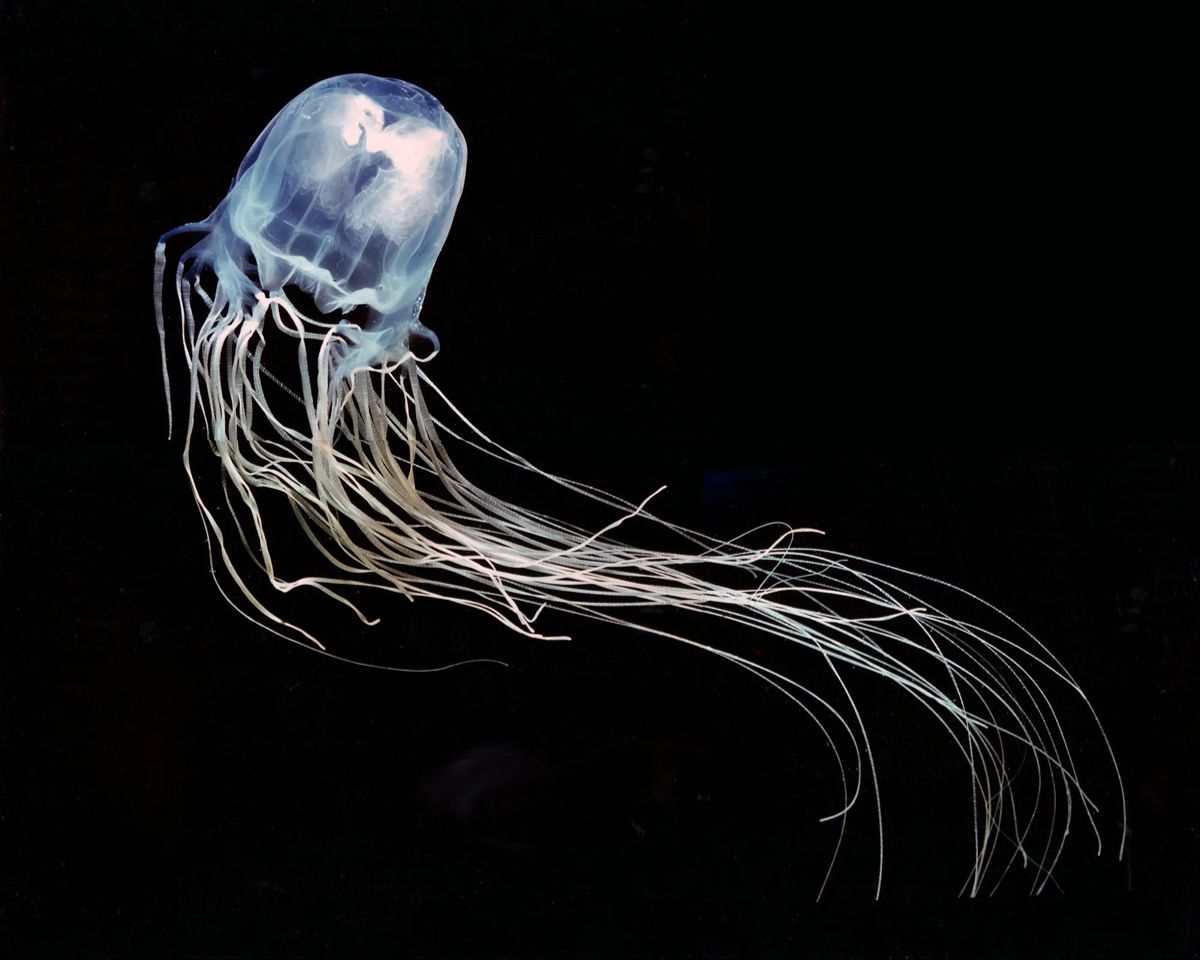
What is the most venomous sea creature?
The Australian box jellyfish (Chironex fleckeri), also called the sea wasp, is the most venomous sea creature and one of the most venomous animals on Earth. Its venom contains toxins that attack the heart, nervous system, and skin cells simultaneously, causing death within 2-5 minutes of a serious envenomation.
The Killer With 24 Eyes and No Brain
In the warm coastal waters of northern Australia, Southeast Asia, and the tropical Pacific lives an animal that can kill a human in under five minutes. It is almost invisible in the water - a nearly transparent cube of jelly with long trailing tentacles. It has no brain. It has 24 eyes. It produces venom capable of stopping a human heart on contact, and it exists in the same waters where millions of people swim every year.
The Australian box jellyfish (Chironex fleckeri) is the most venomous marine animal on Earth and one of the most venomous creatures in the animal kingdom. Understanding why requires abandoning most of what seems obvious about how venom works and what jellyfish are.
Why "Box" Jellyfish?
The name refers to the shape. Unlike the familiar bell-shaped jellyfish most people have seen, box jellyfish have a distinctly cube-shaped body (medusa). Four flat sides, each with eyes and sometimes tentacles at the corners, form the box structure.
The Australian box jellyfish reaches:
- Bell size: up to 30 cm (1 foot) across
- Tentacles: up to 60 per animal, each 3 meters (10 feet) long
- Weight: up to 2 kg
- Lifespan: approximately 1 year
Smaller box jellyfish species (including the deadly Irukandji) are less than 2 cm across but can still deliver life-threatening stings.
All box jellyfish belong to the class Cubozoa, a group of approximately 50 known species distributed across tropical and subtropical coastlines worldwide. Not all box jellyfish are dangerously venomous - most are harmless to humans. A handful of species produce venom serious enough to cause human fatalities.
The Venom
Box jellyfish venom contains a cocktail of toxins that together produce the fastest-acting envenomation in the animal kingdom.
Cardiotoxins. Proteins that attack heart muscle cells, causing potassium to leak out and preventing the heart from maintaining normal rhythm. At serious doses, cardiotoxins cause cardiac arrest within minutes.
Neurotoxins. Peptides that interfere with nerve signaling, causing paralysis and preventing breathing.
Cytotoxins. Compounds that destroy skin and muscle tissue at the sting site, producing extreme pain and tissue damage that can persist for months.
Dermonecrotic toxins. Proteins that cause the skin damage characteristic of box jellyfish stings - red, swollen, whip-like marks that leave permanent scars in survivors.
Proteases. Enzymes that break down cellular structure and enhance the spread of other toxins through tissue.
Together, these compounds attack multiple organ systems simultaneously. Without treatment, a full envenomation by a large Australian box jellyfish kills a healthy adult in 2-5 minutes through cardiac arrest.
The venom yield is terrifying. A single adult Chironex fleckeri contains enough venom to kill approximately 60 adult humans. Its 60 tentacles each carry hundreds of thousands of venomous stinging cells.
Nematocysts: The Delivery System
Box jellyfish do not bite, sting like a wasp, or need to inject venom with fangs. They deliver venom through microscopic harpoon-like structures called nematocysts.
How nematocysts work:
Each nematocyst is a spring-loaded capsule containing a coiled, barbed filament. When the capsule's trigger is activated by touch or chemical signal, the filament shoots out at extraordinary speed - measured at up to 2 meters per second with accelerations of 5 million g-forces (one of the fastest biological movements ever recorded).
The filament pierces skin, tissue, or cell membranes, and venom flows through the filament into the target.
Density:
A single box jellyfish tentacle contains roughly 500,000 nematocysts. An entire animal has tens of millions. When a human brushes against a tentacle, millions of nematocysts fire simultaneously in less than a second.
Trigger conditions:
Nematocysts discharge on contact with chemicals found in vertebrate skin and mucus. They respond to pressure as well, but the chemical trigger is primary. This is why box jellyfish stings human swimmers but does not automatically sting inanimate objects that brush against it.
Fresh water and alcohol trigger discharge. This is why beach first-aid protocols explicitly forbid rinsing box jellyfish stings with fresh water, alcohol, or urine (despite myths to the contrary). These substances cause remaining embedded nematocysts to fire, injecting additional venom into the victim.
The correct treatment is vinegar, which deactivates nematocysts before they can fire.
24 Eyes, No Brain
Box jellyfish have one of the most remarkable sensory systems in the animal kingdom. Their bodies contain 24 eyes arranged in four clusters of six.
The four eye types:
Type 1: Upper lens eye. A sophisticated camera-type eye with a retina, lens, and iris-like pupil. Similar in complexity to human eyes, but much smaller.
Type 2: Lower lens eye. Another camera-type eye, positioned to look downward. Between the upper and lower lens eyes, each box jellyfish cluster can see both upward (toward the surface) and downward (toward the seafloor).
Type 3: Pit eye. A simpler light-detecting organ.
Type 4: Slit eye. Another simple light detector.
The clusters are positioned at the four corners of the box-shaped body, so the jellyfish has eyes looking in essentially all directions simultaneously.
What the box jellyfish can see:
Research by Dr. Anders Garm at the University of Copenhagen has demonstrated box jellyfish can:
- Identify specific objects (mangrove roots, which they use for navigation)
- Avoid obstacles while swimming
- Orient their body position based on visual information
- Track movement of other animals
No brain:
Box jellyfish have no centralized brain. They process visual information through a distributed nerve network - a ring of neurons around the bell called the rhopalial nerve ring. Each of the four eye clusters connects to its own portion of this nerve ring, and the rings coordinate swimming behavior based on the visual inputs.
This is the only known example of an animal with sophisticated camera-type eyes and no central brain to process the visual information. How the jellyfish translates visual input into behavior without a central processor is still being studied.
Active Swimming
Most jellyfish drift passively, pushed by ocean currents. Box jellyfish are different - they actively swim and navigate deliberately.
Swimming mechanics:
Box jellyfish propel themselves by contracting their bell, forcing water out the bottom. They can reach speeds of 4 knots (7.4 km/h) - fast enough to swim upstream in moderate currents and to actively pursue prey.
Navigation:
Box jellyfish use their camera-eyes to navigate relative to landmarks. Specifically, they orient relative to mangrove forest canopies - they can see the dark outlines of mangrove roots against bright surface light and use these landmarks to maintain position within feeding areas.
In experiments, box jellyfish oriented correctly relative to artificial landmarks placed in controlled environments, demonstrating they use visual information for navigation decisions.
Hunting:
Box jellyfish hunt small fish and shrimp by swimming slowly with tentacles extended. When prey contacts a tentacle, nematocysts fire and immobilize the prey within seconds. The jellyfish then contracts the tentacle, bringing the prey toward the central mouth.
This is active predation, not passive filter feeding. The fast-acting venom is essential because box jellyfish cannot physically restrain prey. Without extreme toxicity, captured fish would escape before the jellyfish could consume them.
Human Fatalities
Box jellyfish have killed humans since before recorded history, but accurate statistics are only available for developed countries with modern medical systems.
Australia: Approximately 100 confirmed fatalities since 1883, with additional probable deaths in remote areas. Australian authorities now track stings systematically, but most sting incidents are not fatal thanks to modern antivenom and first aid.
Southeast Asia: The true death toll is unknown but likely much higher than Australia's. Thailand, the Philippines, Malaysia, and Indonesia all have waters with dangerous box jellyfish species. Most stings in these regions occur among subsistence fishers and rural populations without quick access to hospitals.
Global estimates: Research published in Conservation Biology in 2022 estimated global box jellyfish fatalities at 40-100 per year, though the true number could be higher due to underreporting. This makes box jellyfish more dangerous to humans than sharks, crocodiles, and most other charismatic dangerous animals combined.
Irukandji Syndrome
The larger Australian box jellyfish is not the only dangerous cubozoan. A smaller relative, the Irukandji jellyfish (Carukia barnesi and related species), produces a different and equally dangerous syndrome.
The Irukandji jellyfish:
- Size: 1-2 cm across
- Nearly invisible in water
- Tentacles: 4 short tentacles, much shorter than Chironex
- Range: tropical waters globally, concentrated off northern Australia
The syndrome:
Unlike the immediate death-threat of a large box jellyfish sting, an Irukandji sting initially feels like a minor nick or insect bite. Victims often do not realize they have been stung.
Twenty to thirty minutes later, symptoms begin:
- Severe lower back pain
- Muscle cramps throughout the body
- Vomiting
- Extreme anxiety and a sense of impending doom
- Rising blood pressure (sometimes to dangerous levels)
- Rapid heart rate
- Difficulty breathing
The pain is described as one of the worst experiences possible. Blood pressure can spike high enough to cause stroke or heart failure. Untreated severe cases have resulted in at least two confirmed fatalities in Australia, with additional suspected deaths in other regions.
Why so dangerous from such a small jellyfish:
Irukandji venom is chemically different from Chironex venom. It contains compounds that trigger massive catecholamine release - adrenaline and noradrenaline flooding the body at abnormal levels. The resulting hypertensive crisis drives the systemic symptoms.
Irukandji syndrome was identified by Dr. Jack Barnes in 1964. Barnes famously stung himself, his son, and a lifeguard with a captured Irukandji to definitively link the species to the syndrome. All three survived after hospital treatment.
Treatment Protocol
Box jellyfish sting treatment follows a specific protocol that has been refined over decades:
Step 1: Get out of the water.
Move to a boat or shore immediately. Pain, shock, and potential paralysis make drowning a major cause of death. Rescuers must be cautious not to contact tentacles still in the water or on the victim.
Step 2: Flush with vinegar.
Pour liberal amounts of vinegar (standard household 5 percent acetic acid) over the sting site. Continue flushing for at least 30 seconds. This deactivates undischarged nematocysts, preventing additional envenomation.
Step 3: Do NOT use fresh water, alcohol, urine, or pressure.
All of these trigger additional nematocyst discharge, worsening the envenomation. The popular advice to urinate on jellyfish stings is specifically wrong for box jellyfish and should never be done.
Step 4: Remove visible tentacles.
Use a stick, gloved hand, or credit card edge to remove visible tentacles. Do not use bare hands, and do not rub the area.
Step 5: CPR if needed.
Serious envenomations cause cardiac arrest within minutes. If the victim becomes unresponsive, begin CPR immediately and continue until emergency services arrive.
Step 6: Emergency medical care.
Transport to a hospital as rapidly as possible. Australian box jellyfish antivenom (developed in 1970 by the Commonwealth Serum Laboratories) can reverse severe envenomation if administered quickly.
Step 7: Ongoing monitoring.
Surviving victims require monitoring for delayed reactions, scarring, and psychological effects. Severe stings often leave permanent scars, and post-traumatic stress from near-death experiences is common.
Australia's Safety Infrastructure
Northern Australian beaches have developed extensive box jellyfish safety infrastructure during the jellyfish season (November-May).
Stinger nets. Many beaches deploy mesh nets that enclose swimming areas, preventing box jellyfish from entering. These nets reduce but do not eliminate risk.
Vinegar stations. Emergency vinegar is posted at beach entries and lifeguard stations throughout northern Queensland.
Protective suits. "Stinger suits" made of thin lycra prevent tentacle contact with skin. Suits are widely available in coastal towns and recommended during peak season.
Patrols. Australian Lifesaving Society volunteers patrol beaches for dangerous jellyfish and manage stings when they occur.
Public awareness. Warning signs at beaches, mandatory briefings on tourist boats, and educational campaigns have dramatically reduced fatality rates compared to historical levels.
These measures have reduced box jellyfish fatalities in Australia from an average of one or two per year during the mid-20th century to rare events in the 21st century. Most modern deaths involve tourists unfamiliar with local protocols or subsistence fishers in remote areas without safety infrastructure.
The Enigma of Jellyfish Intelligence
Box jellyfish raise profound questions about the nature of animal intelligence and cognition.
These creatures have complex camera-type eyes capable of identifying specific visual patterns. They navigate using landmarks. They actively hunt prey using coordinated swimming and tentacle deployment. They avoid obstacles. They respond to their environment in ways that look deliberate and purposeful.
They do all of this without a brain.
Conventional biology assumed that sophisticated behavior required centralized neural processing. The box jellyfish demonstrates that this assumption is wrong, or at least incomplete. A ring of distributed neurons connected to 24 eyes can produce behaviors that, in vertebrates, would require a brain.
What this means for our understanding of consciousness, perception, and the relationship between neural architecture and behavior is still being worked out by researchers. The box jellyfish is not just a dangerous animal - it is a natural experiment in the minimum requirements for complex behavior.
And it is still killing humans, steadily, in waters where people swim. One of the most alien and mysterious animals alive shares beaches with tourists every year, and most of those tourists have no idea what is in the water with them.
Comparative Venom Lethality Among Cnidarians
The class Cubozoa (box jellyfish) and the class Scyphozoa (true jellyfish) together include the most venomous cnidarians, but the ranking of toxicity among species is not intuitive. Our research team assembled a comparative table using published LD50 data where available. LD50 values are expressed in micrograms per kilogram of mouse body weight, with lower numbers indicating higher toxicity.
| Species | Common Name | Mouse LD50 (mcg/kg) | Human Deaths Reported |
|---|---|---|---|
| Chironex fleckeri | Australian box jellyfish | 40-100 | 80+ historical, ~1/yr modern |
| Malo kingi | Common Irukandji | Data limited | Multiple in Australia |
| Carukia barnesi | Barnes's Irukandji | Data limited | Two confirmed 2002 |
| Chiropsalmus quadrigatus | Asian box jellyfish | 150-250 | Philippines, annual |
| Chiropsoides buitendijki | Indo-Pacific box | 200-400 | Asia, occasional |
| Physalia physalis | Portuguese man o' war | 5,000 | Rare, usually elderly |
| Chrysaora fuscescens | Pacific sea nettle | 15,000 | None documented |
| Cyanea capillata | Lion's mane | 25,000 | One historical, disputed |
The difference between Chironex fleckeri and relatively harmless species such as the moon jellyfish is roughly 1,000-fold in venom potency. Chironex venom contains multiple pore-forming proteins that attack cardiac muscle cell membranes, causing catastrophic calcium influx and myocardial cell death within minutes of envenomation.
Venom Biochemistry and Medical Research
The primary lethal component of Chironex fleckeri venom is a 43 kilodalton protein named CfTX, which punches pores in cell membranes, particularly in cardiomyocytes. A 2014 study by Brinkman and colleagues at James Cook University identified at least 170 distinct venom proteins in Chironex extract, representing one of the most complex animal venoms characterized to date.
"Box jellyfish venom is not a simple cocktail. It is a precisely coordinated chemical weapon system targeting circulatory, nervous, and respiratory function simultaneously. The evolutionary pressure producing such complexity is the jellyfish's need to instantly incapacitate prey that would otherwise tear the fragile body apart." - Dr. Diane Brinkman, Australian Institute of Marine Science [1]
Researchers at the University of Sydney published findings in 2019 describing a potential small-molecule antidote that blocks cholesterol-dependent steps in the CfTX pore-formation pathway. In mouse models, the antidote, based on zinc chelation, dramatically reduced cardiac damage when administered within 15 minutes of envenomation.
The Box Jellyfish Visual System
Box jellyfish possess 24 eyes arranged in four clusters called rhopalia, with each cluster containing six visual sensors of four distinct types. Four of the six are image-forming camera-type eyes with lenses, corneas, and retinas - a level of visual complexity previously thought impossible without a centralized brain to process the signals.
"The box jellyfish challenges our fundamental assumptions about the relationship between neural complexity and visual sophistication. It has camera eyes that any vertebrate would recognize, yet no structure we would call a brain. How it integrates visual information from 24 eyes distributed around its body remains one of the most fascinating open questions in comparative neurobiology." - Dr. Anders Garm, University of Copenhagen [2]
Garm's laboratory has documented that the upper lens-eye of each rhopalium is stabilized by a ballast structure that keeps it pointed upward regardless of how the bell orients, allowing the jellyfish to navigate by sighting the silhouettes of mangrove canopies against the sky. This visual-terrestrial navigation is unmatched among non-cephalopod invertebrates.
Why Do Venomous Animals Live in Warm Climates?
Venomous animals concentrate in tropical and subtropical regions primarily because venom chemistry requires a biosynthetic infrastructure that performs best at higher ambient temperatures - cold-blooded animals in warm climates have sustained metabolic activity year-round, supporting constant venom production.
The Australian box jellyfish (Chironex fleckeri), found along northern Australia, Southeast Asia, and tropical Pacific coasts, is one example. Tropical ecosystems also host higher biodiversity, which drives arms-race evolution between venomous predators and resistant prey. Australia, Southeast Asia, South America, and tropical Africa hold the highest concentrations of venomous species worldwide.
Box jellyfish belong to class Cubozoa, with roughly 50 species, and Chironex fleckeri carries up to 60 tentacles each 3 meters long - enough venom in a single large specimen to kill up to 60 adult humans. Colder regions like New Zealand have almost no native venomous fauna.
References
- Brinkman, D. L., Jia, X., Potriquet, J., et al. (2015). Transcriptome and venom proteome of the box jellyfish Chironex fleckeri. BMC Genomics, 16, 407. DOI: 10.1186/s12864-015-1568-3
- Garm, A., Oskarsson, M., & Nilsson, D.-E. (2011). Box jellyfish use terrestrial visual cues for navigation. Current Biology, 21(9), 798-803. DOI: 10.1016/j.cub.2011.03.054
- Lau, M. T., Manion, J., Littleboy, J. B., et al. (2019). Molecular dissection of box jellyfish venom cytotoxicity highlights an effective venom antidote. Nature Communications, 10, 1655. DOI: 10.1038/s41467-019-09681-1
- Fenner, P. J., & Williamson, J. A. (1996). Worldwide deaths and severe envenomation from jellyfish stings. Medical Journal of Australia, 165(11-12), 658-661. DOI: 10.5694/j.1326-5377.1996.tb138679.x
Related Articles
- The Immortal Jellyfish: How Turritopsis Dohrnii Cheats Death
- Jellyfish: Brainless Drifters That Rule the Ocean
- Most Venomous Sea Creatures: The Deadliest Animals in the Ocean
Frequently Asked Questions
What is the most venomous sea creature?
The Australian box jellyfish (Chironex fleckeri), also called the sea wasp, is the most venomous sea creature and one of the most venomous animals on Earth. Its venom contains toxins that attack the heart, nervous system, and skin cells simultaneously, causing death within 2-5 minutes of a serious envenomation. A single large box jellyfish has approximately 60 tentacles, each up to 3 meters long, containing enough venom to kill 60 adult humans.
Unlike most venomous animals, box jellyfish do not need to bite - any skin contact with the tentacles triggers instant envenomation through nematocysts (stinging cells). Australia has approximately 100 box jellyfish deaths recorded since 1883, with additional fatalities from similar species in Southeast Asia, the Philippines, and parts of the Indian Ocean.
How does a box jellyfish kill?
Box jellyfish venom contains multiple toxic compounds that work simultaneously to kill prey and, when encountered, humans. Cardiotoxins attack heart muscle cells, causing potassium leakage and cardiac arrest within minutes. Neurotoxins paralyze the nervous system. Cytotoxins destroy skin and muscle tissue at the sting site, causing extreme pain.
The venom is delivered through tens of thousands of microscopic harpoons called nematocysts, which discharge on contact with any foreign surface. Each tentacle contains roughly 500,000 nematocysts. A brush against a tentacle can trigger discharge of millions of stingers in a single second. Death from cardiac arrest typically occurs within 2-5 minutes without treatment.
Humans who survive report the pain as the worst imaginable - many swimmers have drowned before reaching shore because the pain prevented swimming.
Does a box jellyfish have eyes?
Yes, box jellyfish have 24 eyes of four distinct types arranged in clusters of six on each of four sides of the bell. Two of these eye types are simple light detectors, but the other two are sophisticated camera-type eyes with retinas, lenses, and iris-like pupils - similar in complexity to human eyes. Remarkably, box jellyfish have no brain.
They process visual information through a ring of nerve cells that coordinates their swimming behavior based on what they see. Research has shown box jellyfish can identify specific objects, avoid obstacles while swimming, and navigate through mangrove roots using their camera-eyes. They are the only animals with advanced vision that lack any central brain.
The four box-shaped corners of the bell, each with its own set of eyes, allow the animal to see in all directions simultaneously.
What is Irukandji syndrome?
Irukandji syndrome is a delayed-reaction envenomation caused by the tiny Irukandji jellyfish (Carukia barnesi and several related box jellyfish species). Unlike the larger Chironex fleckeri, Irukandji jellyfish are only 1-2 cm across and produce stings that initially feel like minor nicks. Twenty to thirty minutes later, victims develop severe lower back pain, muscle cramps throughout the body, vomiting, and extreme anxiety.
Victims often describe feeling like they are about to die. Blood pressure rises dramatically, sometimes causing stroke or cardiac arrest. Irukandji syndrome has caused at least two confirmed deaths in Australia and many hospitalizations. The syndrome was named for the Irukandji aboriginal people of northeastern Australia, who lived in the waters where the jellyfish is common.
Treatment is supportive (pain management, blood pressure control) because no specific antivenom exists.
How do you treat a box jellyfish sting?
Treatment for box jellyfish stings follows a specific protocol. Immediately flush the sting site with vinegar (5 percent acetic acid) for at least 30 seconds. Vinegar prevents additional nematocyst discharge but does not remove toxins already injected. Do NOT use fresh water, alcohol, or urine - these can trigger additional nematocyst firing. Do NOT rub the tentacles. Carefully remove any visible tentacles with a stick or gloved hand.
For severe envenomations, CPR may be required immediately - cardiac arrest is the primary cause of death and can occur within minutes. Call emergency services and transport to a hospital where box jellyfish antivenom can be administered. The antivenom has reduced fatality rates dramatically since its development in 1970. Australian beaches in northern Queensland have vinegar dispensers at entry points during jellyfish season (November-May).