
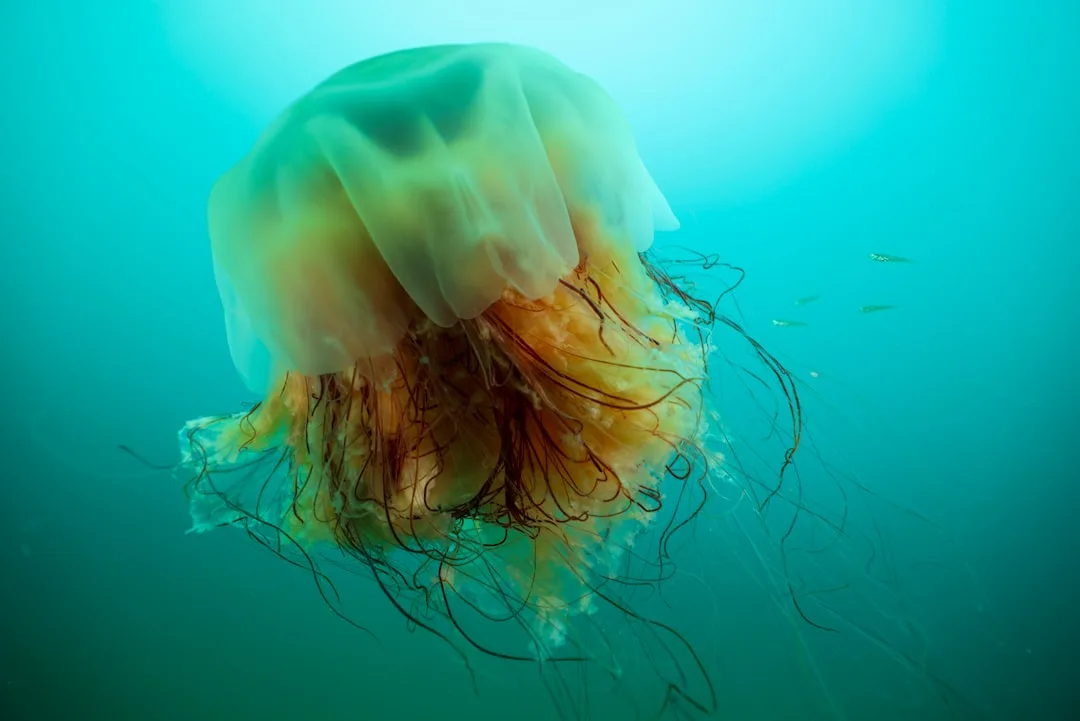
How big is a lion's mane jellyfish?
The lion's mane jellyfish (Cyanea capillata) is the longest animal on Earth by tentacle length. The largest verified specimen had tentacles measuring 37 meters (121 feet) from bell to tip - longer than a blue whale. Their bell diameter reaches 2. 5 meters (8 feet) in large specimens, making them the largest jellyfish species globally.
Tentacles Longer Than a Blue Whale
Blue whales grow to 30 meters, the longest mammals that have ever existed. Most people imagine them as the longest animals on Earth.
They are wrong. The longest animal on Earth is a jellyfish.
A single lion's mane jellyfish washed ashore in Massachusetts Bay in 1870 had tentacles measuring 37.5 meters from bell to tip. The bell itself measured 2.3 meters across. Total length including tentacles: approximately 40 meters, longer than any whale that has ever lived.
These are lion's mane jellyfish (Cyanea capillata), the largest jellyfish species and holders of one of nature's strangest size records.
The Size Records
Lion's mane jellyfish reach extraordinary sizes.
The largest verified specimen (1870):
- Bell diameter: 2.3 meters (7.5 feet)
- Tentacle length: 37.5 meters (123 feet)
- Total length: approximately 40 meters
- Weight: estimated 200 kg
- Location: Massachusetts Bay, USA
Modern large specimens:
Typical adult lion's mane:
- Bell diameter: 30-50 cm
- Tentacle length: 5-10 meters
Large Arctic specimens:
- Bell diameter: 1-2 meters
- Tentacle length: 20-30 meters
Why so long:
The tentacles spread widely to catch prey and for defense. Length provides surface area for capturing zooplankton and small fish drifting through the water column.
The water composition:
Despite their size, lion's mane jellyfish weigh relatively little:
- Body composition: 95% water
- Dry mass: only 5%
- Largest weighed: ~200 kg
- Comparable blue whale: 150,000 kg
A blue whale weighs 750 times more than a comparable-length lion's mane jellyfish.
Tentacles and Stinging
Lion's mane jellyfish are serious predators with impressive weaponry.
Tentacle structure:
- 8 clusters of tentacles
- 70-150 tentacles per cluster
- Up to 1,200 tentacles per animal
- Each tentacle lined with millions of nematocysts (stinging cells)
Nematocysts:
Each stinging cell contains:
- Coiled barbed harpoon
- Venom chamber
- Triggering mechanism
When activated, nematocysts fire in microseconds, injecting venom into prey or threat.
Venom effects:
On small prey:
- Immediate paralysis
- Tissue damage
- Facilitates capture
On humans:
- Painful stings
- Welts and redness
- Sometimes systemic effects
- Rarely life-threatening
Detached tentacles:
Nematocysts remain active long after separation from the jellyfish:
- Beached tentacles still sting
- Fragments in water dangerous
- Can remain active for weeks
- Dead jellyfish washed ashore still dangerous
Human Encounters
Lion's mane jellyfish occasionally interact with humans.
Famous incidents:
The Rye Beach incident (2010):
- A large lion's mane broke apart in waters near New Hampshire
- 150 swimmers were stung by floating tentacle fragments
- Incident made international news
- No fatalities but many required medical attention
Scottish coastal stings:
- Regular summer stings along UK east coast
- Annual press coverage
- Swimmers advised to avoid infested waters
Sting treatment:
- Leave the water (avoid more stings)
- Carefully remove visible tentacles (wear gloves)
- Rinse with vinegar (deactivates nematocysts)
- Apply heat (40-45°C water for 20+ minutes)
- Medical attention for severe reactions
Don't do:
- Fresh water rinse (activates more nematocysts)
- Alcohol rinse (same problem)
- Urine (myth; doesn't help)
- Rubbing (spreads nematocysts)
- Pressure bandage (increases venom spread)
Severe reactions:
Risk factors:
- Allergic sensitivity
- Existing heart conditions
- Children (smaller body, larger dose)
- Elderly
- Large exposure area
Where They Live
Lion's mane jellyfish thrive in cold northern waters.
Primary range:
North Atlantic:
- Atlantic Canada (Newfoundland, Nova Scotia)
- Cape Cod
- Scandinavian coasts
- Scottish waters
- Northern European coasts
Pacific:
- Alaska
- Northern Japan
- Northern Russian coasts
Arctic Ocean:
- Central Arctic
- Around Arctic Circle
- Throughout Arctic seas
Temperature preferences:
- Optimal: 10-20°C
- Tolerates colder: -1°C to 5°C
- Avoids: above 20°C
- Reason: warm water reduces oxygen and changes metabolism
Why northern:
Cold water:
- Supports larger body size
- Provides abundant zooplankton
- Allows slower metabolism
- Enables longer lifespan
Climate change effects:
- Warming waters pushing range north
- Some populations extending further south seasonally
- Mediterranean populations increasing
- Arctic populations shifting
Diet and Hunting
Lion's mane jellyfish are active predators.
Prey:
- Zooplankton (primary)
- Copepods
- Krill
- Small fish
- Larval fish
- Shrimp
- Other jellyfish
- Sometimes larger prey that gets entangled
Hunting strategy:
They drift with currents, tentacles spread widely like a net. When prey contacts a tentacle:
- Nematocysts fire (paralyzing prey)
- Tentacle contracts
- Prey moved toward central mouth
- Digestion occurs in gastric cavity
Feeding pattern:
- Continuous throughout life
- Can eat nearly constantly
- Large jellies may capture thousands of small prey daily
- Efficient energy extraction from planktonic prey
Their predators:
- Leatherback sea turtles (major jellyfish predators)
- Sunfish (largest bony fish, eat jellyfish)
- Some large fish
- Seabirds (usually opportunistic)
- Other jellyfish
Symbiotic relationships:
Some species benefit from lion's mane tentacles:
- Small crustaceans live among tentacles (immune to stings)
- Juvenile fish shelter in the tentacle cloud
- Commensal relationship protects them from predators
Life Cycle
Lion's mane jellyfish have complex multi-stage lives.
Stages:
Polyp:
- Sessile, attached to underwater surfaces
- Small (millimeters)
- Asexual reproduction through budding
- Year-round presence
Strobila:
- Polyp elongates and segments
- Each segment develops into a medusa bud
- Ready to release
Ephyra:
- Free-swimming juvenile jelly
- Small (few centimeters)
- Begins drifting and feeding
Medusa (adult jellyfish):
- The famous form we recognize
- Growth occurs rapidly
- Sexual reproduction
- Lives 1 year typically
Reproduction:
- Adult medusas release eggs and sperm into water
- External fertilization
- Fertilized eggs develop into larvae (planulae)
- Planulae settle on surface and become polyps
- Cycle repeats
Lifespan:
Typical individuals live approximately 1 year:
- Polyps can live longer
- Medusa phase: months
- Die after reproduction
- No life extension like immortal jellyfish relatives
Scientific and Cultural Interest
Lion's mane jellyfish have drawn attention for centuries.
Arthur Conan Doyle:
The jellyfish featured prominently in Sherlock Holmes story "The Adventure of the Lion's Mane" (1926). Holmes identifies a mysterious death as caused by a lion's mane jellyfish sting, one of the first detective stories to feature marine biology.
Educational importance:
Used in biology education to teach:
- Marine invertebrate biology
- Jellyfish life cycles
- Evolution of nematocysts
- Cold-water marine ecology
Research subjects:
Active research on:
- Population dynamics and climate change impacts
- Stinging cell mechanics
- Neurological effects of venom
- Potential medical applications
- Symbiotic relationships
Tourism and media:
- Beach warnings during peak seasons
- Tourist photography of beached specimens
- Documentary film subjects
- News coverage of unusual events
Population Dynamics
Lion's mane populations fluctuate dramatically.
Boom years:
Occasional years see massive population explosions:
- Weather patterns favorable
- Abundant prey
- Reduced predation
- Ideal reproduction conditions
During boom years:
- Beaches receive huge numbers
- Swimming often discouraged
- Impacts fisheries (jellyfish in nets)
- Tourism disruption
Crash years:
Other years see dramatic population drops:
- Unfavorable conditions
- Predator population increases
- Disease outbreaks
- Climate fluctuations
Climate change:
Warmer waters generally:
- Favor jellyfish populations overall
- Allow range expansion
- Support higher growth rates
- Reduce predator populations
Many scientists predict jellyfish populations will continue increasing globally as climate changes.
Conservation and Management
Lion's mane jellyfish are abundant but face some concerns.
Population status:
- Abundant in native range
- Not conservation concern globally
- Regional populations may fluctuate significantly
- Population dynamics complex
Human interactions:
- Occasional swimmer stings
- Not targeted by fisheries (some commercial use for food in Asia)
- Bycatch in some fisheries
- Impact on other fisheries through competition
Ecological role:
Lion's mane jellyfish are important:
- Control zooplankton populations
- Prey for sea turtles and sunfish
- Part of North Atlantic food web
- Nutrient cycling contributions
Management approaches:
- Monitoring populations
- Beach warnings during high-density events
- Research on population drivers
- Climate adaptation planning
The Record-Holder
Lion's mane jellyfish demonstrate that biology can produce extreme lengths through unusual body plans.
Most "longest animal" candidates are:
- Long but rigid (ribbon worms up to 55m, also contenders)
- Colonial rather than individual (siphonophores, up to 40m, but colonies)
- Elongated-shaped snakes, fish, or whales
Lion's mane jellyfish are:
- Single individual organisms
- Non-rigid (flexible tentacles)
- Flexible length (varies continuously)
- Combine large bell with extraordinary tentacles
The 37.5-meter record was measured as a single animal's extension from bell to tentacle tip. This specific combination of size and form makes lion's mane jellyfish genuinely the longest individual animals.
A single lion's mane is longer than:
- A blue whale (30 m)
- Most ocean liners' length (typical cruise ships)
- Three semi-trucks parked end-to-end
- A typical city block
All in a single animal made of 95% water.
When you see a lion's mane jellyfish washed ashore or drifting in cold northern waters, you're looking at an evolutionary success story, an animal that grew longer than any whale by exploiting the buoyancy of water and the efficient architecture of gelatinous body plans.
They will not disappear. As oceans warm and change, jellyfish species (including lion's mane) are expected to thrive. The 37.5-meter record may not stand forever; larger specimens may be out there or yet to appear.
Blue whales are larger in mass. Colossal squid have longer tentacles in proportion. But for single-animal total length, lion's mane jellyfish hold the record, and probably will for a long time.
Ranking the World's Longest Animals
The lion's mane jellyfish's claim to the title of longest animal depends on how "length" is defined and whether colonial organisms are included. Our research team has compiled the leading candidates based on maximum documented lengths from primary scientific sources.
| Species | Maximum Length | Body Type | Notes |
|---|---|---|---|
| Lion's mane jellyfish (Cyanea capillata) | 36.6 m (1870 specimen) | Single flexible individual | Massachusetts Bay record |
| Bootlace worm (Lineus longissimus) | 55 m (Scottish beach 1864) | Rigid nemertean worm | Disputed single specimen |
| Giant siphonophore (Praya dubia) | 50 m | Colonial cnidarian | Not a single individual |
| Apolemia siphonophore | 47 m | Colonial cnidarian | Discovered 2020, off W. Australia |
| Blue whale (Balaenoptera musculus) | 33.6 m | Single rigid vertebrate | Largest mammal ever |
| Giant squid (Architeuthis dux) | 13 m (including tentacles) | Single individual | Stretched-out measurement |
| Reticulated python (Malayopython reticulatus) | 7.67 m | Single individual | Longest snake |
The 1870 Massachusetts Bay specimen of lion's mane jellyfish remains the longest documented single individual animal, though the measurement combined the bell and fully extended tentacles. The Scottish bootlace worm specimen from 1864 is sometimes cited as longer, but the 55-meter figure is based on stretched-out measurement of a highly elastic animal and is widely considered overstated.
Ecological Role in the Subarctic Food Web
Lion's mane jellyfish occupy a critical trophic position in subarctic and boreal marine ecosystems, transferring enormous quantities of zooplankton biomass to larger predators. A single adult lion's mane may filter hundreds of cubic meters of seawater daily, capturing copepods, small fish, and other cnidarians.
"Large jellyfish such as Cyanea capillata function as mobile filter-feeding islands. They extract zooplankton from the water column at rates comparable to an entire fish school, and their gelatinous bodies eventually become food for leatherback turtles, ocean sunfish, and many seabirds. Removing them would have substantial consequences for the northern hemisphere pelagic food web." - Dr. Lucas Brotz, Sea Around Us program, University of British Columbia [1]
Leatherback sea turtles, the largest turtle species alive, rely on Cyanea capillata as a dietary staple during North Atlantic foraging migrations. Ocean sunfish and several species of large-bodied jellyfish also consume lion's mane as a major prey component.
Jellyfish Populations Under Climate Change
A 2013 study by Lucas Brotz and colleagues, published in Hydrobiologia, reviewed population data from 45 Large Marine Ecosystems globally and concluded that jellyfish populations have increased in 62 percent of the regions examined since 1950. Lion's mane jellyfish have shown especially rapid increases in the Gulf of Maine, the Irish Sea, and Norwegian coastal waters [2].
"The rise of jellyfish in many of the world's seas is not a single-cause phenomenon. Warming waters, overfishing of jellyfish predators, eutrophication, and coastal construction all contribute. But the net result is that ecosystems are shifting toward jellyfish-dominated states, and lion's mane is one of the species most clearly profiting from that transition." - Dr. Cathy Lucas, University of Southampton [3]
This shift has economic consequences. In 2007, a single lion's mane jellyfish bloom in Northern Ireland's Glenarm salmon farm killed over 100,000 farmed salmon in a single event. Similar bloom-associated fish-kill events have occurred in Norwegian, Scottish, and Canadian aquaculture operations since.
Sting Biology and Medical Response
Lion's mane jellyfish tentacles carry cnidocytes, specialized stinging cells that fire nematocyst capsules into the skin of anything making contact. Each tentacle contains millions of these cells, and the total nematocyst count across a large specimen's tentacle array may exceed one billion. Nematocyst discharge is triggered by a combination of mechanical contact and chemical cues, meaning even dead or detached tentacles can sting for hours after separation from the body.
Human exposure typically produces intense but non-lethal stings, characterized by burning pain, red welts in the pattern of tentacle contact, and occasional systemic reactions including muscle cramps, nausea, and breathing difficulty. A 2010 incident off Rye Beach, New Hampshire, saw a partially decomposed lion's mane jellyfish sting over 150 swimmers simultaneously as tentacle fragments dispersed in the surf.
"Lion's mane tentacle fragments remain biologically active for up to 12 hours after separation from the body, which is why we see mass-sting events on beaches where a single large specimen has been torn apart by surf action. Every fragment is a loaded weapon." - Dr. Dan Huber, marine biologist, University of Tampa [5]
Treatment differs from that for tropical box jellyfish - vinegar, the standard box jellyfish first aid, actually triggers additional nematocyst discharge in Cyanea capillata and should be avoided. The correct protocol is rinsing with seawater, removing tentacle fragments with tweezers, and applying hot water or heat packs at 45 degrees Celsius, which denatures the protein venom components.
Are Whales the Biggest Animals Ever?
By mass, yes - the blue whale (Balaenoptera musculus) at approximately 150,000 kg and up to 33.6 meters is the largest animal that has ever lived, exceeding any known dinosaur.
But by length, the title belongs to a jellyfish: a lion's mane jellyfish (Cyanea capillata) washed ashore in Massachusetts Bay in 1870 measured 37.5 meters from bell to tentacle tip, with a 2.3-meter bell diameter, making it longer than any blue whale.
The bootlace worm (Lineus longissimus) has a disputed 55-meter record, and siphonophore colonies like Praya dubia reach 50 meters, but those are colonial organisms. A blue whale weighs 750 times more than a comparable-length lion's mane jellyfish, which is 95 percent water.
References
- Pauly, D., Graham, W., Libralato, S., et al. (2009). Jellyfish in ecosystems, online databases, and ecosystem models. Hydrobiologia, 616(1), 67-85. DOI: 10.1007/s10750-008-9583-x
- Brotz, L., Cheung, W. W. L., Kleisner, K., et al. (2012). Increasing jellyfish populations: trends in Large Marine Ecosystems. Hydrobiologia, 690(1), 3-20. DOI: 10.1007/s10750-012-1039-7
- Lucas, C. H., Gelcich, S., & Uye, S. I. (2014). Living with jellyfish: management and adaptation strategies. Jellyfish Blooms, 129-150. DOI: 10.1007/978-94-007-7015-7_6
- Doyle, T. K., Houghton, J. D. R., Buckley, S. M., et al. (2007). The broad-scale distribution of five jellyfish species across a temperate coastal environment. Hydrobiologia, 579(1), 29-39. DOI: 10.1007/s10750-006-0362-2
- Tibballs, J. (2006). Australian venomous jellyfish, envenomation syndromes, toxins and therapy. Toxicon, 48(7), 830-859. DOI: 10.1016/j.toxicon.2006.07.020
Related Articles
- Box Jellyfish: The Most Venomous Sea Creature
- Immortal Jellyfish: How Turritopsis Dohrnii Cheats Death
- Jellyfish: Brainless Drifters That Rule the Ocean
Frequently Asked Questions
How big is a lion's mane jellyfish?
The lion’s mane jellyfish (Cyanea capillata) is the longest animal on Earth by tentacle length. The largest verified specimen had tentacles measuring 37 meters (121 feet) from bell to tip - longer than a blue whale. Their bell diameter reaches 2.5 meters (8 feet) in large specimens, making them the largest jellyfish species globally. Total body length (including tentacles) can exceed 40 meters.
The largest ever recorded washed ashore in Massachusetts Bay in 1870 with tentacles of 37.5 meters and bell diameter of 2.3 meters. Despite their enormous size, lion’s mane jellyfish weigh relatively little - approximately 200 kg for the largest specimens - because their bodies are 95% water. They contain eight clusters of 70-150 tentacles each, totaling up to 1,200 tentacles per animal.
Each tentacle is lined with nematocysts (stinging cells) that deliver painful venom to prey and defensive targets.
How dangerous is a lion's mane jellyfish?
Lion’s mane jellyfish stings are painful but rarely life-threatening to healthy adults. The venom causes burning pain, welts, and cramps at the sting site, often lasting hours or days. Systemic effects including nausea, sweating, headaches, and muscle pain can occur with major exposures.
The venom is less potent than box jellyfish or Portuguese man-of-war venom, but the enormous tentacle length means a single encounter can deliver dozens or hundreds of stings across the body. A famous incident occurred on New Hampshire’s Rye Beach in 2010 when 150 swimmers were stung by fragments of a broken lion’s mane jellyfish. Children and elderly people face higher risk of serious reactions. Allergic individuals may experience anaphylaxis.
Most people should avoid swimming in areas with sighted lion’s mane jellyfish. Even detached tentacles in the water or on beaches can sting for days after separation. Sting treatment involves careful removal of tentacle pieces (wear gloves), vinegar rinse, and warm water soaks - do NOT use fresh water or alcohol, which activate remaining stinging cells.
Where do lion's mane jellyfish live?
Lion’s mane jellyfish inhabit cold northern waters of the Atlantic, Pacific, and Arctic oceans. They are most abundant in the North Atlantic (from Canada and Scandinavia south to Cape Cod), Arctic Ocean, and North Pacific (especially Alaskan waters). They rarely venture south of the 42nd parallel except in exceptionally cold years. They prefer water temperatures between 10-20°C and don’t survive long in warmer waters.
Largest specimens live in Arctic waters where cold temperatures support their growth. They spend most of their lives in surface waters to 20-meter depth, though some descend to 80+ meters. They drift with ocean currents, sometimes washing into coastal areas or being carried into less typical habitats.
Climate change is altering their range - warming waters are pushing them northward while also creating conditions for population explosions in certain regions. They are not found in tropical or subtropical waters under normal conditions. Most specimens seen by humans are younger, smaller individuals; truly enormous specimens are rare outside their optimal Arctic habitat.
What do lion's mane jellyfish eat?
Lion’s mane jellyfish are opportunistic predators that eat zooplankton, small fish, crustaceans, and other jellyfish. Primary prey includes copepods, krill, small fish, shrimp, larval fish, and other gelatinous zooplankton. They capture prey using their extensive tentacles - the length allows them to cast a wide net through the water. Stinging nematocysts paralyze prey, which is then slowly moved toward the central mouth opening under the bell.
A large lion’s mane jellyfish may eat continuously, capturing hundreds or thousands of small prey items daily. They are themselves eaten by larger predators including sea turtles (leatherback turtles specifically eat jellyfish), large fish (sunfish), seabirds, and even other jellyfish.
Surprisingly, small shrimp and other crustaceans often live among lion’s mane tentacles - immune to the stings through mucus coatings - effectively using the jellyfish as mobile shelter. These symbiotic relationships demonstrate that lion’s mane jellyfish, despite their predatory danger to small prey, coexist with specialized organisms that benefit from their protective tentacle clouds.
How long do lion's mane jellyfish live?
Lion’s mane jellyfish typically live only 1 year, with most individuals dying after reproducing. Their life cycle is complex: they begin as polyps (attached to hard surfaces underwater), which then bud off free-swimming medusa jellies that grow rapidly to adult size. Reproduction occurs when adult jellies release eggs and sperm into the water for external fertilization. The resulting larvae settle on substrate and become new polyps, completing the cycle.
Unlike the famous immortal jellyfish (Turritopsis dohrnii), lion’s mane jellyfish cannot reverse their life cycle. Once an adult jelly reproduces and dies, its body decomposes within days, even if the animal hasn’t been injured. This relatively short lifespan makes population turnover rapid - many of the jellyfish visible in any given year are just months old.
The larger specimens often represent individuals that avoided predation and continued growing throughout their year. Some specimens may live slightly longer in Arctic conditions where cold temperatures slow their metabolism. The largest individuals are therefore typically late-season Arctic populations that have grown throughout their maximum lifespan.