
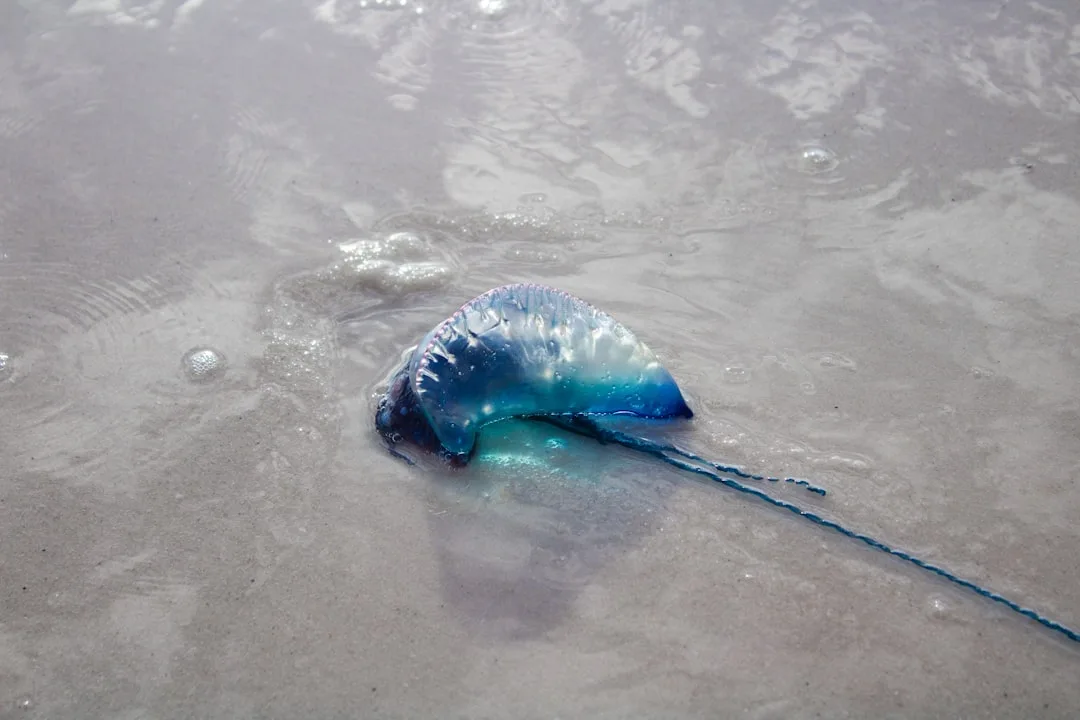
Is a Portuguese man o' war a jellyfish?
No, Portuguese men o' war (Physalia physalis) are not jellyfish - they're siphonophores, which are actually colonies of individual organisms living together as a single functional unit. While they look like jellyfish, they belong to the order Siphonophorae, entirely separate from true jellyfish (Scyphozoa).
Not a Jellyfish, but a Colony of Organisms
A beautiful blue-purple gas-filled bladder floats on the ocean surface. Long tentacles trail beneath, some reaching 30 meters. It looks like a jellyfish. It stings like a jellyfish. But it's not a jellyfish.
The Portuguese man o' war (Physalia physalis) is a colony of individual organisms called polyps, each with a specialized role, functioning together as a single creature. It's actually more closely related to corals than to jellyfish. And its sting ranks among the most painful in the ocean.
Not a Jellyfish
Portuguese men o' war are siphonophores.
What they actually are:
A colony of four types of polyps:
Pneumatophore:
- Gas-filled bladder
- Makes creature float
- Provides direction (via shape)
- Looks like a ship's sail
Dactylozooids:
- Form the tentacles
- Provide defense
- Capture prey
- Contain stinging cells
Gonozooids:
- Reproductive polyps
- Produce gametes
- Replenish colony
- Enable reproduction
Gastrozooids:
- Feeding polyps
- Digest captured prey
- Nourish entire colony
- Specialized digestion
None survive alone:
Each polyp cannot live independently:
- Complete specialization
- Require colony cooperation
- Evolved for specific functions
- Interdependent survival
The Dangerous Tentacles
Portuguese man o' war tentacles are extremely long.
Length:
- Typical: 10-20 meters
- Maximum: up to 30 meters
- Thousands: per colony
- Combined: enormous sting zone
Nematocysts:
Stinging cells on tentacles:
- Millions per colony
- Each a spring-loaded venom injector
- Triggered by touch
- Fire rapidly
Venom components:
Complex mixture including:
- Cardiotoxins (affect heart)
- Neurotoxins (affect nerves)
- Various peptides
- Each with specific effects
Sting severity:
For humans:
- Immediate intense burning pain
- Welts and rashes develop
- Nausea and vomiting
- Muscle cramps possible
- Respiratory difficulty in severe cases
Fatalities:
Rare but documented:
- 9 known deaths globally
- Usually from cardiac events
- Pre-existing conditions often factor
- Most victims recover fully
Detached Tentacles Still Dangerous
Tentacles remain dangerous after detachment.
Persistent threat:
Even after the colony dies:
- Tentacles continue stinging
- Beach-washed material dangerous
- Can sting for weeks after
- Particularly dangerous to bare feet
Beach warnings:
Common in tropical areas:
- Warning signs
- Beach patrols
- Safety education
- Public awareness
Protection:
Safety measures:
- Watch for distinctive blue bladders
- Avoid contact in water
- Check beaches before walking
- Wear foot protection
Where They Live
Portuguese men o' war drift across warm oceans.
Global distribution:
Tropical and subtropical:
- Atlantic Ocean
- Gulf of Mexico
- Caribbean Sea
- Mediterranean Sea
- Indian Ocean
- Tropical Pacific
- Coastal waters globally
Movement:
- Cannot actively swim
- Entirely wind-driven
- Follow currents
- Unpredictable arrival at beaches
Seasonal patterns:
- Tropical coasts: year-round
- Temperate areas: seasonal
- Storm seasons: concentration events
- Trade winds: regular movement
Beach concentration:
During specific conditions:
- Strong onshore winds
- Storm surges
- Current patterns
- Can see thousands on single beach
The Blue Color
Portuguese men o' war have distinctive coloration.
Colors:
- Bladder: blue, purple, or pink
- Tentacles: blue-ish
- Overall: distinctive appearance
Why blue:
- Color reduces UV damage
- Blue pigments protective
- Natural selection maintains
- Advertising warning
Identification:
Easy to spot:
- Distinctive blue bladder
- Surface floating
- Dragging tentacles
- Unmistakable silhouette
Wind-Powered Movement
Their locomotion is unique.
How they move:
- Cannot swim actively
- Wind pushes bladder
- Entire colony drifts
- Direction determined by bladder shape
Two types:
Actually two types of Portuguese man o' war:
- Left-handed pneumatophore shape
- Right-handed pneumatophore shape
- Drift in different wind conditions
- Same species, different orientations
Wind dependency:
- Complete wind dependence
- Cannot fight currents
- Storm surges transport them
- Can end up far from normal range
Oceanic travel:
Long-distance drifting:
- Across entire oceans
- Years of drifting
- Genetic mixing
- Global species connections
Hunting Behavior
They prey on small ocean life.
Diet:
- Small fish
- Larval fish
- Zooplankton
- Crustaceans
- Whatever gets caught
Hunting:
Automated capture:
- Tentacles hang down
- Small prey drift into them
- Nematocysts fire
- Tentacles contract
- Prey pulled to gastrozooids
Feeding:
- Specialized gastrozooids digest
- Nutrients shared across colony
- Continuous feeding
- Efficient digestion
Opportunistic:
- Wait for prey
- Don't actively chase
- Tentacles as passive nets
- Always catching something
Reproduction
Colony-level reproduction is complex.
Reproductive structure:
- Gonozooids produce gametes
- Same colony has both male and female
- External fertilization in water
- Larvae develop independently
Larvae:
Planula larvae:
- Free-swimming initially
- Settle on substrate
- Begin as small polyp
- Develop into colony
Colony development:
- Young colony small
- Grows by adding polyps
- Takes months to reach full size
- Eventually ready to float surface
Reproduction success:
- Huge gamete production
- Low survival rate
- Oceanic dispersion
- Population connectivity global
Similar Species
Related siphonophores exist.
Blue bottle (Physalia utriculus):
- Pacific and Indian Ocean
- Similar appearance
- Also called "bluebottle"
- Different species but similar
Atlantic differences:
- Often larger
- More colorful bladder
- Longer tentacles
- Slightly different structure
Other siphonophores:
Several other species:
- Hula skirt siphonophore
- Giant siphonophore (longest animal)
- Various smaller species
- All colonial organisms
Dangers to Humans
Understanding minimizes risk.
Sting risks:
- Direct contact: immediate pain
- Skin exposure to tentacles
- Swimming through them
- Walking on beach material
High-risk behaviors:
- Ignoring beach warnings
- Swimming in visible specimens
- Contact with washed-up tentacles
- Bare feet on beach debris
First aid:
Do:
- Remove tentacles carefully
- Rinse with seawater (not freshwater)
- Apply heat (40°C water, 20+ minutes)
- Seek medical attention if severe
Don't:
- Use freshwater (activates more stings)
- Rub affected area
- Use ice (worsens)
- Ignore symptoms
Predators
Some animals eat Portuguese men o' war.
Natural predators:
- Loggerhead sea turtles (specialized)
- Some marine mammals occasionally
- Certain fish species
- Some birds
Specialized feeders:
Blue glaucus (sea slug):
- Actively hunts Portuguese men o' war
- Stores their nematocysts
- Uses stolen venom for defense
- One of few predators
Violet snail:
- Drifts with floating surface
- Eats Portuguese men o' war
- Specialized lifestyle
- Extinction risk from pollution
Sea turtles:
- Loggerheads can eat them
- Protected by scales
- Immune to stings
- Important natural predator
Ecological Role
Portuguese men o' war fill specific niches.
Food source:
- Provide prey for specialized predators
- Support specialized feeders
- Part of surface food web
- Connected to turtle populations
Population control:
- Regulate small fish populations
- Capture larval fish
- Affect oceanic food webs
- Influence population dynamics
Nutrient transport:
- Transport nutrients long distances
- Connect ocean regions
- Wind-driven biological transport
- Ecological connection
Oceanic cycles:
- Part of surface ecosystems
- Influenced by global patterns
- Indicator species for conditions
- Climate change sensitivity
Climate Change Impact
Portuguese men o' war may be affected.
Potential changes:
Range expansion:
- Warmer temperatures extending range
- New coastal appearances
- Increased beach events
- Shifting patterns
Population changes:
- Uncertain effects
- Some populations growing
- Others stable
- Variable patterns
Marine ecosystem shifts:
- Changing ocean conditions
- Acidification concerns
- Prey availability shifts
- Multiple interacting factors
Cultural Significance
Portuguese men o' war have cultural presence.
Name origin:
From 18th-century Portuguese warships:
- Recognized globally
- Ships had distinctive sails
- Bladder resembled ship's sail
- Name stuck
Global variants:
- Bluebottle: Australia (though Physalia utriculus)
- Caravela portuguesa: Portuguese
- Galera portuguesa: Spanish
- Various: other languages
Cultural impact:
- Beach safety awareness
- Tourist education
- Medical literature
- Marine biology
Conservation
Portuguese men o' war are not threatened.
Status:
- Abundant globally
- Not conservation concern
- Wind-distributed massively
- Robust populations
Human interactions:
- Minor aquarium curiosity
- Scientific interest
- Public safety concerns
- Generally neutral relationship
Threats (minimal):
- Ocean pollution minor
- Climate change uncertain
- Generally stable
- Adaptive species
Research
Portuguese men o' war are research subjects.
Scientific interest:
Colonial organism biology:
- Understanding polyp cooperation
- Evolution of coloniality
- Superorganism concept
- Unique biology
Venom research:
- Medical applications
- Pain management studies
- Toxin characterization
- Therapeutic potential
Ecology:
- Ocean dynamics
- Wind-driven biology
- Food web participation
- Climate change response
Education:
- Example of unusual biology
- Teaching colonial organisms
- Public understanding
- Scientific communication
Why They Matter
Portuguese men o' war represent unique biology.
Biological uniqueness:
- Perfect example of colonial organisms
- Challenges individual/colony definitions
- Evolutionary complexity
- Fascinating biology
Ecological role:
- Predator in surface waters
- Prey for specialized feeders
- Nutrient transport
- Global distribution
Educational value:
- Teach colonial life
- Show biological diversity
- Challenge concepts
- Inspire curiosity
Medical research:
- Venom studies
- Pain research
- Toxin characterization
- Therapeutic potential
The Sailing Colony
Every Portuguese man o' war drifting across tropical oceans represents a remarkable biological concept: individual organisms functioning so completely together that they seem to be a single animal.
They're not. They're a society of specialized cells and polyps, each unable to survive alone, working in perfect coordination. The pneumatophore floats while the dactylozooids catch prey while the gonozooids reproduce while the gastrozooids digest. Everything runs smoothly without central control.
Wind carries them across thousands of kilometers. They've spread across all tropical oceans. They catch millions of small prey. They reproduce continuously. They drift with weather systems and currents.
Their name comes from 18th-century warships, their beautiful blue coloration protects from UV damage, their deadly tentacles work automatically, and their colonial structure teaches us about biological cooperation at its most complete.
Every beach walker in tropical regions should learn to recognize them. Every swimmer should respect them. Every curious person should marvel at how individual organisms can function as one creature, something no true jellyfish achieves, but something these ocean drifters do daily across the world's warmest seas.
They are not jellyfish. They are colonies. And they are remarkable.
Siphonophore Diversity and the Colonial Plan
Siphonophores belong to the order Siphonophorae within the class Hydrozoa, and they include some of the most extraordinary colonial organisms on Earth. The Portuguese man o' war is the most famous, but the group contains roughly 175 species, several of which rival the largest individual animals in length and biomass.
| Species | Common Name | Maximum Length | Habitat | Notable Feature |
|---|---|---|---|---|
| Physalia physalis | Portuguese man o' war | 30 m tentacles | Surface, Atlantic | Air-filled float |
| Physalia utriculus | Bluebottle | 10 m tentacles | Surface, Indo-Pacific | Smaller Pacific cousin |
| Praya dubia | Giant siphonophore | 50 m | Deep sea | Colonial longest animal |
| Apolemia sp. | Stringy siphonophore | 47 m | Mid-water | 2020 record, NW Australia |
| Velella velella | By-the-wind sailor | 10 cm | Surface, global | Flat sail colony |
| Porpita porpita | Blue button | 3 cm | Surface, tropical | Disc-shaped colony |
| Erenna sp. | Glowing siphonophore | 1 m | Deep sea | Bioluminescent lures |
| Nanomia bijuga | Trailing siphonophore | 30 cm | Pelagic | Jet-powered coordinated swimming |
The colonial body plan, in which genetically identical but morphologically distinct individuals function as an integrated whole, represents one of the most successful innovations in cnidarian evolution. Siphonophores extend this strategy further than any other lineage, with some species containing more than 10 distinct zooid types specialized for flotation, feeding, reproduction, defense, and locomotion.
Envenomation Biology and Medical Perspectives
Portuguese man o' war stings are among the most frequently reported envenomations on Atlantic coastal beaches. A 2017 study by Haddad and colleagues at the State University of Sao Paulo documented over 10,000 Portuguese man o' war stings annually on Brazilian beaches, making Physalia physalis the most medically significant cnidarian in the region [1].
"Contrary to popular belief, Portuguese man o' war venom is not chemically identical to that of true jellyfish. The dominant protein components include porin-forming cytolysins and neurotoxins that act on sodium and calcium channels. Sting severity varies widely, and treatment protocols must be tailored to the specific species rather than applied as a generic cnidarian response." - Dr. Vidal Haddad Jr., School of Medicine of Botucatu, Brazil [1]
The correct first aid for Physalia stings diverges from the standard box jellyfish protocol - research published in Toxins in 2017 demonstrated that hot water immersion at 45 degrees Celsius for 20 minutes consistently outperforms vinegar treatment for Physalia envenomations, while vinegar may actually worsen the sting by triggering additional nematocyst discharge.
The Blue Dragon and the Ocean Food Web
One of the most astonishing predator-prey relationships in the ocean involves the nudibranch Glaucus atlanticus, commonly called the blue dragon or blue sea slug. Despite being only 3 to 4 centimeters long, this tiny mollusk actively hunts Portuguese men o' war, consumes their tentacles, and incorporates their undischarged nematocysts into its own body as stolen defensive weapons.
"Glaucus atlanticus is a kleptocnide specialist, meaning it steals and re-uses the chemical weapons of its cnidarian prey. The blue dragon's own sting is more potent than that of the Portuguese man o' war it fed upon, because the slug selectively stores only the most powerful nematocysts and concentrates them in its finger-like cerata." - Dr. Karen Osborn, Smithsonian National Museum of Natural History [2]
This stolen-weapon strategy, termed kleptocnidae, represents one of the most economically efficient defensive adaptations in the animal kingdom - the predator literally outsources weapon manufacturing to its own prey.
References
- Haddad, V. Jr., Virga, R., Bechara, A., et al. (2017). An outbreak of Portuguese man-of-war (Physalia physalis-Linnaeus, 1758) envenoming in southeastern Brazil. Revista da Sociedade Brasileira de Medicina Tropical, 46(5), 641-644. DOI: 10.1590/0037-8682-0245-2013
- Valdes, A., Breslau, E., & Padula, V. (2018). Molecular and morphological systematics of Glaucus (Mollusca: Nudibranchia). Invertebrate Systematics, 32(6), 1307-1322. DOI: 10.1071/IS17055
- Yanagihara, A. A., Wilcox, C., King, R., et al. (2016). Experimental assays to assess the efficacy of vinegar and other topical first-aid approaches on cubozoan (Alatina alata) tentacle firing and venom toxicity. Toxins, 8(1), 19. DOI: 10.3390/toxins8010019
- Mackie, G. O., Pugh, P. R., & Purcell, J. E. (1987). Siphonophore biology. Advances in Marine Biology, 24, 97-262. DOI: 10.1016/S0065-2881(08)60074-7
- Munro, C., Siebert, S., Zapata, F., et al. (2018). Improved phylogenetic resolution within Siphonophora (Cnidaria) with implications for trait evolution. Molecular Phylogenetics and Evolution, 127, 823-833. DOI: 10.1016/j.ympev.2018.06.030
Wind-Driven Distribution and Mass Strandings
The pneumatophore that gives the Portuguese man o' war its characteristic float also makes the colony entirely dependent on prevailing winds for transport. Unlike most marine animals, Physalia cannot actively direct its course - the angle of the crest on the float determines whether a given individual is a "left-sailing" or "right-sailing" colony.
Populations in the North Atlantic contain roughly equal proportions of both forms, ensuring that shifting wind patterns do not drive the species to regional extinction.
Mass stranding events occur when sustained onshore winds drive thousands or millions of Portuguese men o' war onto beaches. Notable events include the summer 2020 strandings along the French Atlantic coast, which deposited an estimated 800,000 individuals on beaches between La Rochelle and Biarritz, and the 2022 Florida east coast event that closed beaches in Volusia and Brevard Counties for several days.
Even after stranding, Physalia tentacles remain biologically active and capable of stinging for up to one week under humid conditions. Beachgoers unaware of this fact often suffer delayed envenomations from stepping on apparently dead specimens or handling washed-up fragments.
Related Articles
- Box Jellyfish: The Most Venomous Sea Creature
- Lion's Mane Jellyfish: The Longest Animal on Earth
- Immortal Jellyfish: Cheats Death
Frequently Asked Questions
Is a Portuguese man o' war a jellyfish?
No, Portuguese men o’ war (Physalia physalis) are not jellyfish - they’re siphonophores, which are actually colonies of individual organisms living together as a single functional unit. While they look like jellyfish, they belong to the order Siphonophorae, entirely separate from true jellyfish (Scyphozoa).
The ‘individual’ you see is actually 4 types of specialized polyps working together: pneumatophore (the gas-filled bladder, acting like a body), dactylozooids (tentacles, providing defense and hunting), gonozooids (reproductive specialists), and gastrozooids (feeding specialists). Each polyp cannot survive alone. Together they function as one organism - a superorganism.
This colonial structure is fundamentally different from jellyfish, which are single animals. Their appearance is deceiving: the purple-blue gas bladder and long tentacles look jellyfish-like, but their biological organization is profoundly different. They are more closely related to corals and sea anemones than to true jellyfish. This makes them one of nature’s most remarkable examples of colonial organisms functioning as individuals.
How dangerous is a Portuguese man o' war sting?
Portuguese man o’ war stings are extremely painful but rarely fatal to healthy adults. Their venom causes: intense burning pain (often described as worst marine sting pain), welts and rashes at sting site, nausea and vomiting, shortness of breath, muscle cramps, difficulty breathing, and potentially cardiac or respiratory issues. They have 9 documented fatalities globally in recent history. Most sting victims recover within 24-48 hours.
Their stinging cells (nematocysts) are on tentacles that can extend 30+ meters underwater - you can be stung without seeing the creature. Their venom contains: cardiotoxins (affecting heart), neurotoxins (affecting nerves), and various peptides.
Most dangerous aspects: tentacles can break off and remain dangerous for weeks after the colony dies, separated tentacles continue stinging effectively, beach-washed specimens still cause injury, and children and elderly face higher risk. Treatment involves: remove tentacle pieces (carefully), rinse with saltwater (not freshwater, which activates more nematocysts), apply heat (40°C+ water for 20+ minutes). Most stings heal completely with proper care.
Why are Portuguese men o' war called that?
The name comes from the 18th-century Portuguese warship called ‘man-of-war’ (man o’ war), which the creature resembled. The gas-filled float looks like a ship’s sail, and the trailing tentacles resemble the lines of a ship. Portuguese ships of this era were recognized globally - trading vessels with distinctive sails. The resemblance was noted by sailors and naturalists, and the name stuck.
Different regional names exist: ‘bluebottle’ (Australia - for a different but related species), ‘Portuguese man-of-war’ (English), ‘galera portuguesa’ (Spanish - Portuguese galley), ‘caravela portuguesa’ (Portuguese - Portuguese caravel), and various regional terms.
The creature’s appearance truly matches its nautical name: the gas-filled pneumatophore forms a sail-like structure that catches wind, the creature drifts with wind and currents like a sailing ship, and tentacles trail behind like ship’s anchor lines. This passive wind-driven movement is part of what makes them unpredictable on beaches - they can arrive from wherever winds push them. Their name reflects how deeply they impressed centuries of sailors.
Where do Portuguese men o' war live?
Portuguese men o’ war inhabit warm ocean waters worldwide, carried by winds and currents. They drift across tropical and subtropical oceans. Common regions include: tropical Atlantic, Gulf of Mexico and Caribbean, Mediterranean Sea, Indian Ocean, tropical Pacific, South China Sea, Gulf of Aden, and various coastal regions. They cannot control their movement - they’re purely wind-driven, so their distribution depends on ocean winds.
Seasonal patterns affect distribution: North Atlantic hurricane season pushes them toward coasts, El Niño and La Niña events change distribution, and trade winds determine typical movement. They sometimes appear in unusual locations when wind patterns change. Beach warnings for Portuguese men o’ war are common in tropical tourist destinations.
They’ve occasionally been recorded in colder waters - Portuguese populations have appeared in British waters during unusual wind conditions. Their wind-driven lifestyle means: beach arrivals are unpredictable, coastal concentrations can be massive during storms, they can be completely absent in normal conditions, and their movements depend entirely on weather patterns.
How do Portuguese men o' war reproduce?
Portuguese men o’ war reproduce through their colonial structure involving specialized reproductive polyps (gonozooids). Each colony produces both male and female reproductive polyps (gonophores) - they are hermaphroditic.
Reproduction involves: polyps release eggs and sperm into surrounding water, external fertilization occurs, larvae develop through several stages, young polyps eventually form new colonies, and colonies grow by adding more specialized polyps over time. The reproductive process is unusual among marine animals - each ‘individual’ Portuguese man o’ war is actually a growing collection of reproducing organisms.
Large colonies produce millions of gametes (eggs and sperm). Fertilization success rates are likely high in concentrated populations. Larval development takes place in surface waters, carrying young to new locations by currents. Young colonies start small and grow by budding new specialized polyps. Full-sized colonies with floating pneumatophores take several months to develop.
Reproduction is continuous in warm waters, synchronized somewhat with seasonal patterns. Their reproductive success contributes to their global distribution.