
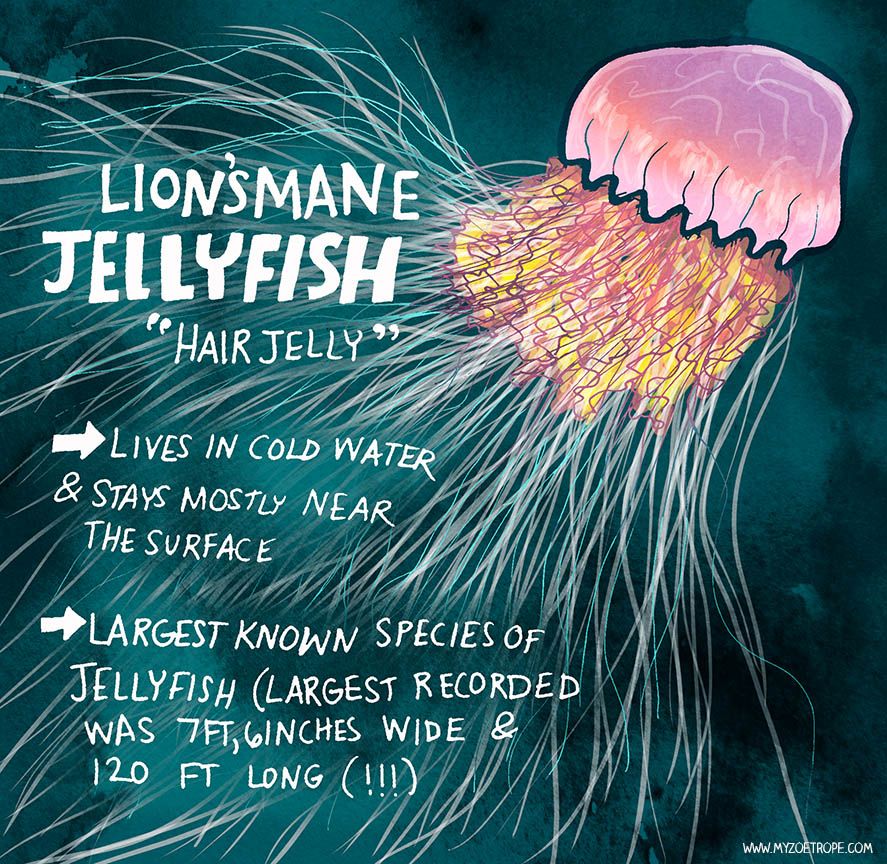
The lion's mane jellyfish is the largest jellyfish species on Earth and, measured from the top of its bell to the tip of its longest tentacle, the longest animal ever reliably recorded.
Cyanea capillata is a cold-water drifter that rides the surface currents of the Arctic, the northern Atlantic, and the northern Pacific, trailing a dense curtain of stinging tentacles that can stretch thirty metres or more behind its translucent bell.
It eats fish, shrimp, and even other jellyfish, shelters juvenile cod among its tentacles, kills its victims in a Sherlock Holmes mystery, and finishes its entire spectacular life cycle in a single year.
This guide covers every major aspect of lion's mane jellyfish biology and ecology: size and physical structure, habitat and range, diet and hunting, sting chemistry and human safety, reproduction, life cycle, population trends, and the cultural afterlife of a jelly that managed to become a murder suspect in Victorian-era London fiction. It is a reference entry, not a summary - expect specifics in metres, kilograms, and cited observations.
Etymology and Classification
The scientific name Cyanea capillata was coined by Carl Linnaeus in 1758 in the tenth edition of Systema Naturae. The genus name derives from the Greek kyanos, meaning dark blue, while capillata means 'hair-bearing' in Latin - a direct reference to the long, hair-like tentacles that trail behind the bell.
In English the species is most commonly called the lion's mane jellyfish because the dense mass of reddish-brown tentacles hanging beneath the oral disc resembles the mane of a male lion. Regional names include giant jellyfish, hair jelly, winter jelly, and sea blubber. Scandinavian fishers sometimes refer to it as brennmanet or burnan jellyfish because of its sting.
Taxonomically, Cyanea capillata is a true jellyfish in the class Scyphozoa. Its wider classification reads as follows.
- Kingdom: Animalia
- Phylum: Cnidaria
- Class: Scyphozoa
- Order: Semaeostomeae
- Family: Cyaneidae
- Genus: Cyanea
- Species: C. capillata
The genus Cyanea contains several similar species including the blue jellyfish Cyanea lamarckii and the Pacific lion's mane Cyanea ferruginea, which were long confused with C. capillata in regional records. Molecular studies continue to refine the boundaries between these populations, and some researchers now treat Pacific giant lion's manes as potentially distinct.
Size and Physical Description
Lion's mane jellyfish are the largest jellyfish in the world and rank among the very largest invertebrates of any kind. Size grows rapidly through the medusa's single summer of life, so individuals caught early in the season look nothing like the monsters recorded at the end of it.
Adult medusa dimensions:
- Typical bell diameter: 0.5-1.5 metres
- Record bell diameter: 2.3 metres (Massachusetts Bay, 1870)
- Typical tentacle length: 10-20 metres
- Record tentacle length: 36.5 metres
- Typical weight: tens of kilograms
- Record weight: approximately 200 kilograms
The bell is shaped like a shallow, eight-lobed dome. From above it looks like a giant translucent flower. The colour of mature specimens grades from deep red at the centre of the bell to purple, orange, and yellow at the margin, while very young medusae can appear almost colourless. The colour itself comes from pigments in the tissue rather than from ingested prey.
Beneath the bell hang the two most distinctive structures of the species: the oral arms and the marginal tentacles. The four large, frilled oral arms extend down from the central mouth like curtain folds and guide captured prey into the gastric cavity. Surrounding them, eight thick clusters of marginal tentacles fan out from the bell margin.
Each cluster can contain between seventy and one hundred and fifty tentacles, giving a single large adult a total of roughly 800 to 1,200 individual tentacles. Fully extended these tentacles can trail many body-lengths behind the drifting animal.
Because the body is approximately 95 per cent water, even a record-sized lion's mane weighs dramatically less than an animal of equivalent length. A 200-kilogram specimen with 36-metre tentacles is massive in reach but modest in mass.
Built for the Cold
Lion's mane jellyfish are obligate cold-water animals. They occur almost exclusively where surface temperatures remain below about 20 degrees Celsius and prefer water between roughly 0 and 10 degrees. Several features of their biology match this thermal specialisation.
Cold water holds more dissolved oxygen than warm water, which supports the metabolic activity required to grow many metres of new tissue within a single year. Cold water is also denser and more viscous, which reduces the effort required to suspend a huge, thin-bodied drifter in the upper water column. Finally, cold Arctic and sub-Arctic seas carry enormous seasonal pulses of plankton - the krill, copepods, and larval fish that sustain the species - which makes fast growth possible.
Lion's mane jellyfish have no centralised organs. Instead, their bodies are built around a simple radial plan. A thin outer epidermis and an inner gastrodermis sandwich a thick jelly-like mesoglea layer, the hydrostatic skeleton that gives the bell its shape. Around the bell margin sits a ring-shaped nerve net linked to eight sensory structures called rhopalia, each bearing simple light and gravity detectors.
There is no brain. Coordinated swimming pulses, orientation to gravity, and basic responses to light emerge from the nerve net alone.
Habitat and Range
The lion's mane jellyfish inhabits the cold surface waters of the circumpolar north. Populations are recorded around the following regions.
- Arctic Ocean and its marginal seas, including the Barents, Kara, Laptev, Chukchi, and Beaufort seas
- North Pacific: Gulf of Alaska, Bering Sea, and cold currents off northern Japan and eastern Russia
- North Atlantic: coasts of Scandinavia, Iceland, the United Kingdom and Ireland, the North Sea, the Baltic, and the Atlantic seaboard of North America from Labrador south to Cape Cod
- Scandinavian fjords, where sheltered cold water produces dense seasonal blooms
The species does not naturally inhabit tropical or subtropical waters. Occasional strays may be recorded slightly south of the normal range when cold-water currents push them in, but these individuals rarely survive long. Lion's mane jellyfish are typically found in the upper 20 metres of the water column, though individuals have been documented down to around 80 metres.
Distribution is almost entirely passive: individuals drift with currents, and blooms often reach coastal areas only because the wind has been pushing the right way for a few days.
Diet and Hunting
Lion's mane jellyfish are opportunistic carnivores. They feed on almost any small animal that blunders into their tentacles. Stomach analyses and field observations list the following as regular prey.
- Copepods and other small zooplankton
- Krill and mysid shrimps
- Larval fish and small adult fish
- Shrimp and small crustaceans
- Moon jellyfish (Aurelia aurita) and other smaller scyphozoans
- Ctenophores (comb jellies) and gelatinous zooplankton
Hunting is entirely passive. The enormous tentacle curtain acts as a drifting vertical net. Any small animal that contacts a tentacle is paralysed within seconds by stinging cells called nematocysts, then transferred up the tentacle and onto the oral arms, which conduct the prey into the central mouth cavity. Digestion proceeds in a simple gastrovascular system, and undigested material is expelled through the same opening.
The fact that lion's manes eat other jellyfish, including moon jellyfish, is ecologically important. In some regions where moon jellyfish blooms clog fishing grounds and cooling-water intakes, lion's manes function as a partial natural brake on their populations.
Lion's mane jellyfish also host tenants. Small fish, particularly juvenile cod and whiting in the North Atlantic, and various small shrimps shelter among the tentacles. These commensals have mucus coatings or behaviours that let them move among the stinging cells without triggering them. For the juvenile fish, the jellyfish functions as a mobile nursery: a drifting stinging cage that deters larger predators while the fish grow big enough to fend for themselves.
Sting, Venom, and Human Safety
The lion's mane jellyfish sting is painful but rarely life-threatening to healthy adults. The venom is delivered by nematocysts, capsular stinging cells concentrated in bands along each tentacle. When the capsule is triggered by contact, internal osmotic pressure fires a tiny coiled harpoon out of the cell in under a millisecond. Each harpoon is hollow and injects a cocktail of proteins into the victim.
The venom contains several active components including pore-forming toxins, proteases, and low-molecular-weight peptides. Compared with the venom of a box jellyfish (Chironex fleckeri) or a Portuguese man-of-war (Physalia physalis), lion's mane venom is mild per molecule. What makes the species notable is the delivery system - a contact area that can include dozens of metres of trailing tentacles - rather than the chemistry of the injected fluid.
Typical sting symptoms:
- Immediate burning pain that intensifies over minutes
- Red welts and linear marks following the tentacle imprint
- Muscle cramping and joint pain
- Occasional nausea, sweating, or headache in heavy exposures
- Rare allergic or anaphylactic reactions
Recommended first aid:
- Leave the water and avoid further contact
- Carefully remove visible tentacle fragments with tweezers, gloves, or the edge of a card - never with bare fingers
- Rinse the affected area with sea water or household vinegar, not fresh water and not alcohol, because fresh water and alcohol can trigger unfired nematocysts to discharge additional venom
- Immerse the affected skin in hot water (around 40-45 degrees Celsius) for 20-45 minutes, which denatures the pain-causing toxin components
- Seek medical attention for children, older adults, anyone with heart disease or severe allergies, or anyone whose sting covers a large surface area
A notorious incident illustrating the scale of the species' sting capacity occurred at Rye Beach, New Hampshire, on 21 July 2010. A single large lion's mane jellyfish broke apart in the surf zone and its fragments stung roughly 150 swimmers simultaneously. No deaths occurred, but many victims required medical treatment. Dead tentacle fragments can remain capable of stinging for days after being separated from the bell.
Reproduction and Life Cycle
The lion's mane jellyfish follows the classic two-stage scyphozoan life cycle that alternates between a free-swimming medusa and a sessile polyp. This alternation lets the species exploit abundant summer plankton while surviving poor years as hidden polyps on the seabed.
Stage 1: spawning medusa. Adult lion's mane jellyfish reach sexual maturity during their single summer of growth. Males release clouds of sperm directly into the water column. Females may spawn eggs into the water, where external fertilisation occurs, or in some populations retain eggs on the oral arms until they are fertilised and early development begins.
Stage 2: planula larva. Fertilised eggs develop into tiny ciliated larvae called planulae. These swim weakly for several days, selecting a hard underwater surface - a rock, a shell, a pier piling, or a pebble on the seabed.
Stage 3: scyphistoma polyp. The settled planula transforms into a polyp called a scyphistoma. It looks like a tiny upturned jellyfish attached to the substrate by a stalk, with a ring of tentacles surrounding a central mouth. The polyp feeds on passing plankton and can clone itself asexually, budding off additional polyps and building small clonal colonies that can persist for many months or years.
Stage 4: strobilation. When temperature, day length, and chemical cues signal favourable conditions, the polyp enters a phase called strobilation. It segments along its length into a stack of small plate-like discs, resembling a pile of tiny saucers.
Stage 5: ephyra. Each disc detaches in sequence as a juvenile medusa called an ephyra. Ephyrae are only a few millimetres across at first but grow rapidly through the summer, taking on the structure of an adult bell with oral arms and marginal tentacles within weeks.
Stage 6: adult medusa. Fast growth produces a mature, reproductive adult by late summer. After spawning, adult medusae typically die. The total medusa lifespan is approximately one year. Polyps on the substrate, meanwhile, continue their longer existence, waiting for the next suitable season.
This split life cycle explains how lion's mane jellyfish can apparently disappear from a region and then return in strength: a small cryptic polyp population can seed vast surface blooms when conditions favour strobilation.
Population and Conservation
The IUCN Red List has not formally assessed Cyanea capillata. The species has no global conservation classification and is not considered threatened. Regional observations suggest that populations are large and, in some cases, growing.
| Region | Observed trend |
|---|---|
| North Sea and Baltic | Intermittent increases in bloom size |
| Gulf of Alaska | Stable with seasonal variability |
| Atlantic Canada / New England | Increasing coastal sightings |
| Scandinavian fjords | Large seasonal blooms in some years |
| Western Arctic | Limited monitoring |
Proposed drivers of apparent regional increases include rising sea surface temperatures extending the growth season, nutrient enrichment from agricultural and urban runoff that fuels plankton blooms, and removal of small pelagic fish through overfishing, which reduces competition for the zooplankton that feed jellyfish. Where these factors coincide, jellyfish can dominate a food web in ways they previously did not.
Large blooms create concrete problems for humans. Dense swarms foul fishing gear, clog cooling-water intakes at coastal power stations and desalination plants, close public beaches, and - as the 2010 Rye Beach incident demonstrated - sting large numbers of swimmers.
Cultural Afterlife: Sherlock Holmes and the Lion's Mane
The lion's mane jellyfish occupies an unusual cultural niche as the first and arguably only invertebrate murder suspect in classic detective fiction. Sir Arthur Conan Doyle's 1926 short story 'The Adventure of the Lion's Mane' is one of only two Holmes tales narrated by the detective himself rather than by Dr Watson. In the story, Holmes has retired to the Sussex Downs and takes up beekeeping.
A schoolmaster named Fitzroy McPherson staggers out of the sea after a morning swim, his back and shoulders covered in red welts, gasps the words 'the lion's mane', and dies.
Holmes investigates the social circle around the victim before discovering, from a natural history book in his own library, a description of Cyanea capillata: a giant jellyfish whose sting can deliver a catastrophic shock to a swimmer. Holmes returns to the cove, locates the jellyfish in a rock pool, and closes the case. The story is atypical in Holmes canon because the solution depends on biology rather than on deduction from human testimony.
'The Adventure of the Lion's Mane' helped fix Cyanea capillata in popular imagination as a dangerous sea creature. In reality, human fatalities directly attributable to lion's mane stings are extremely rare and may be unverified. The story likely exaggerates the toxicity of a real animal for dramatic effect, though it is medically plausible for a susceptible swimmer to experience severe cardiovascular stress from extensive stings.
Ecological Role
Despite its horror-movie dimensions, the lion's mane jellyfish plays a normal and important role in cold-water marine ecosystems. It is a middle-trophic-level predator that converts small zooplankton and larval fish into a food source accessible to larger consumers.
Leatherback sea turtles, which migrate thousands of kilometres into the North Atlantic specifically to feed on gelatinous prey, rely on Cyanea and related jellyfish for a large fraction of their summer diet. Ocean sunfish (Mola mola), certain seabirds, and some large fish also eat adult lion's manes.
The species also supports a small but ecologically real community of commensal animals - juvenile cod, whiting, and several species of pelagic shrimp - that shelter among its tentacles. These fish benefit from the jellyfish's stinging protection during vulnerable larval and juvenile phases, a relationship that probably contributes to recruitment in some North Atlantic fisheries.
Finally, lion's mane jellyfish provide organic matter that fuels the deep-sea food web when they die. Jelly falls - the sinking of dead gelatinous animals to the seabed - have emerged in recent research as a meaningful energy subsidy to benthic scavengers in areas where jellyfish biomass is high.
Related Reading
- Box Jellyfish: The Most Venomous Sea Creature
- Moon Jellyfish: The Most Common Jellyfish
- Immortal Jellyfish (Turritopsis dohrnii)
- Jellyfish: Brainless Drifters That Rule the Ocean
- Lion's Mane Jellyfish: The Longest Animal on Earth
References
Relevant peer-reviewed and reference sources consulted for this entry include the WoRMS (World Register of Marine Species) record for Cyanea capillata, Kramp's 'Synopsis of the Medusae of the World', published population studies in Marine Biology and the Journal of Plankton Research, and NOAA Fisheries habitat summaries for the North Atlantic.
Historical size records trace to the 1865-1870 observations of Alexander Agassiz in Massachusetts Bay. The literary reference is Arthur Conan Doyle, 'The Adventure of the Lion's Mane', The Case-Book of Sherlock Holmes (1927).
Frequently Asked Questions
How big is the lion's mane jellyfish?
The lion’s mane jellyfish (Cyanea capillata) is the largest jellyfish in the world and the longest animal on Earth by total length. The bell of a mature specimen typically measures 0.5 to 1.5 metres across, and the largest reliably measured individual - which washed ashore in Massachusetts Bay in 1870 - had a bell 2.3 metres wide and tentacles 36.5 metres long. That total length exceeds the largest blue whales ever recorded.
Despite these dimensions, the animal weighs only around 200 kilograms because its body is roughly 95 per cent water. A single adult can carry up to 1,200 tentacles arranged in eight thick clusters beneath the bell, which is where the species gets its popular name. Most lion’s mane jellyfish encountered by divers and beachgoers are much smaller juveniles or sub-adults.
Where do lion's mane jellyfish live?
Lion’s mane jellyfish live in cold surface waters of the Arctic, northern Atlantic, and northern Pacific oceans. They thrive where sea-surface temperatures sit between roughly 0 and 20 degrees Celsius and do not occur naturally in tropical waters.
Common sightings happen in the Gulf of Alaska, the Bering Sea, the coasts of Scandinavia and Iceland, the North Sea, the Baltic, and the Atlantic coast of North America from Cape Cod northward into the Canadian Arctic. They drift in the upper 20 metres of the water column but have been recorded down to around 80 metres.
Truly enormous specimens are almost always found in the coldest waters, where the species grows fastest and largest before its single-season life cycle ends.
What do lion's mane jellyfish eat?
Lion’s mane jellyfish are carnivorous drift predators. Their main foods are zooplankton, small fish, shrimp, and other gelatinous animals, including moon jellyfish (Aurelia aurita) and smaller scyphozoans. They hunt passively. The enormous tentacle curtain extends many metres behind the drifting bell and acts as a vertical net.
Prey that brushes a tentacle is paralysed by stinging cells called nematocysts, then hauled slowly up toward oral arms that conduct it into the central mouth beneath the bell. A large adult can capture hundreds to thousands of small prey animals per day. In turn, leatherback sea turtles, ocean sunfish, seabirds, and some large fish eat adult lion’s mane jellyfish, apparently unaffected by the sting.
How painful is a lion's mane jellyfish sting?
The sting of a lion’s mane jellyfish is painful but very rarely fatal to humans. The venom is less potent per milligram than that of a box jellyfish or Portuguese man-of-war, but the sheer length of the tentacles means a single encounter can deliver contact across a very large area of skin.
Typical symptoms are an immediate burning sensation, red welts tracing the tentacle, cramping muscle pain, and occasional systemic effects such as nausea, sweating, or headache in heavy exposures. Children, older people, and individuals with heart conditions or severe allergies face higher risk and should receive medical attention.
First aid involves leaving the water, carefully removing visible tentacle fragments (with gloves or tweezers), rinsing with sea water or vinegar rather than fresh water, and treating pain with hot water immersion. Even fragments washed up on beaches remain capable of stinging for days.
How long does a lion's mane jellyfish live?
The swimming medusa stage of a lion’s mane jellyfish lives only about one year. Most adults die shortly after spawning in late summer or autumn. The full life cycle alternates between the free-swimming medusa and a sessile polyp. Adult medusae release sperm and eggs into the water, where fertilisation produces a tiny swimming larva called a planula.
The planula settles onto a hard underwater surface - a rock, shell, or pier piling - and transforms into a polyp called a scyphistoma. The polyp can persist for much longer than a year, cloning itself asexually and waiting for favourable conditions. When temperature and daylight conditions are right, the polyp strobilates, budding off a stack of tiny juvenile medusae called ephyrae that grow rapidly into the next generation of adult jellyfish.
Are lion's mane jellyfish endangered?
The lion’s mane jellyfish has not been formally evaluated by the IUCN Red List and holds no global conservation classification. Populations appear large and in some regions may be expanding. Anecdotal and regional survey evidence suggests that lion’s mane blooms have become more frequent or more intense in parts of the North Atlantic and North Sea in recent decades.
Proposed drivers include warming surface temperatures, nutrient enrichment from agricultural runoff, and the removal of small fish that compete with jellyfish for plankton through overfishing. While the species is not threatened, regional population spikes can close beaches, foul fishing gear, clog power-plant cooling intakes, and - as at Rye Beach, New Hampshire, in 2010 - sting large numbers of swimmers simultaneously.
How does the lion's mane jellyfish reproduce?
Lion’s mane jellyfish follow the classic scyphozoan two-stage life cycle. Sexually mature adult medusae are either male or female. During the summer spawning season they release clouds of sperm and eggs into the open water, where fertilisation happens externally. Fertilised eggs develop into ciliated swimming larvae called planulae, which drift for days before settling onto a hard substrate on the seabed.
Once settled, a planula metamorphoses into a small polyp called a scyphistoma. The polyp feeds on microscopic prey and can clone itself asexually for months or years, building small colonies. When cold-season cues arrive, the polyp undergoes strobilation - segmenting like a stack of tiny plates - and buds off ephyrae, the juvenile medusae that grow into the adult stage.
This split life cycle lets the species survive poor years as hidden polyps and explode into huge surface populations when conditions are good.
Why is the lion's mane jellyfish in a Sherlock Holmes story?
The lion’s mane jellyfish is famous in literature as the murderer - or rather, the non-murderer - in Sir Arthur Conan Doyle’s 1926 short story ‘The Adventure of the Lion’s Mane’. In the story, a retired Holmes investigates the apparently inexplicable death of a man who staggers back from a swim in a Sussex cove, whispers the phrase ‘the lion’s mane’, and dies covered in red welts.
After reading up on natural history, Holmes identifies the true cause as Cyanea capillata, the giant jellyfish whose sting can deliver a sudden catastrophic welt-covered shock. The case is one of only two narrated by Holmes himself rather than Dr Watson. It helped fix the lion’s mane jellyfish in popular imagination as a dangerous sea creature, even though human fatalities from the species are extremely rare in reality.