
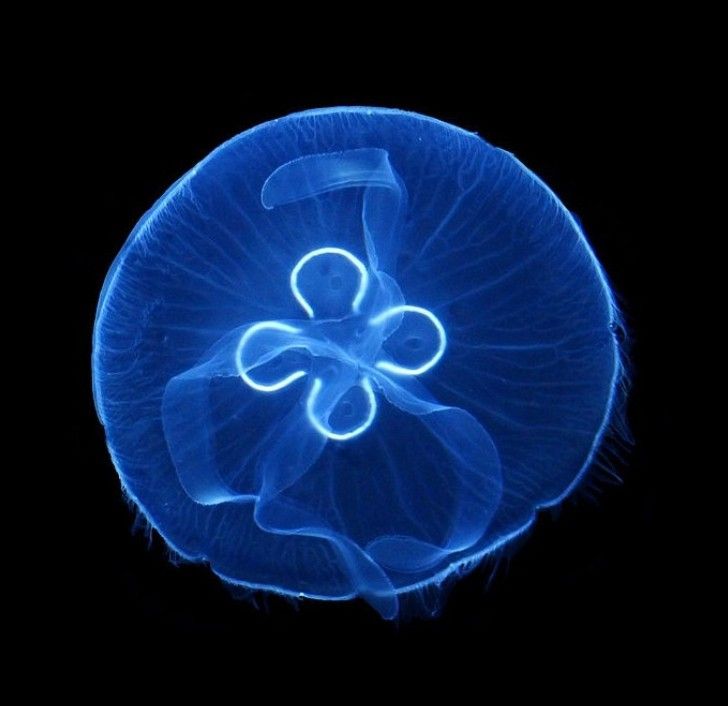
The moon jellyfish is probably the jellyfish you have already seen. It drifts against piers in summer harbours, pulses gently through aquarium tanks in every major city, and washes up in translucent discs on beaches from Scotland to California. Its pale, four-lobed bell gives it its common name - a small full moon sliding through the water - and its near-global distribution, mild sting, and easy captive husbandry have made Aurelia aurita the most studied jellyfish on Earth.
This guide covers every aspect of moon jellyfish biology and ecology: anatomy, reproduction, filter feeding, life cycle, blooms, distribution, predators, the strange 2003 space experiment aboard the International Space Station, and the relationship between moon jellies and human infrastructure. It is a reference entry, not a summary - expect specifics: centimetres, months, temperatures, and documented events.
Etymology and Classification
The scientific name Aurelia aurita comes from two Latin words. Aurelia derives from aureolus, meaning 'golden' or 'gilded', a nod to the soft golden-pink tint of the gonads visible through the transparent bell. Aurita means 'eared', a reference to the four horseshoe-shaped structures that vaguely resemble ears arranged around the mouth. Carl Linnaeus described the species in 1758 in the tenth edition of Systema Naturae, and it has remained one of the most stable names in invertebrate zoology.
Common names across languages tend to reference either the moon - moon jelly, moon jellyfish, mond-qualle, luna jellyfish - or the disc-like shape, as in saucer jelly and common jelly. In many fishing communities the species is simply called the jellyfish, because for most temperate coastal people it is the only jellyfish they have ever seen up close.
Taxonomically Aurelia aurita sits inside the class Scyphozoa, the so-called true jellyfish, within the phylum Cnidaria that also includes corals, sea anemones, and the far more dangerous box jellyfish. Within Scyphozoa it belongs to the order Semaeostomeae and the family Ulmaridae.
Molecular work since the 1990s has revealed that what was long treated as one cosmopolitan species is actually a complex of at least a dozen genetically distinct Aurelia species distributed across the world's oceans. For practical purposes A. aurita remains the label for moon jellies found in the North Atlantic and associated seas.
Size and Physical Description
The moon jellyfish is a flattened, saucer-shaped animal far wider than it is tall.
Typical adult dimensions:
- Bell diameter: 25-40 cm, with 25-30 cm most common
- Bell height: a few centimetres only; the body is disc-like
- Marginal tentacles: hundreds, usually 1-5 cm long
- Oral arms: four, dangling from the mouth beneath the bell
Body composition:
- Water: approximately 95%
- Collagen-rich mesoglea: the gelatinous middle layer providing structure
- Thin outer and inner cell layers: surround the mesoglea like bread on a sandwich
Their most famous feature sits in the centre of the bell. Viewed from above, four pink, orange, or violet horseshoes arranged in a perfect clover pattern glow softly through the transparent tissue. These are not eyes or stomachs - they are the four gonads, where eggs or sperm are produced. The colour varies with diet, water chemistry, and sex. Well-fed females often show the deepest pink; starving or young individuals can appear almost colourless.
The rest of the animal is nearly transparent. In still water the bell can be hard to see at all; only the ring of marginal tentacles and the four gonads give the outline away. This transparency is passive camouflage against both predators and prey. The mesoglea acts like an optical gel, bending and transmitting light with minimal scattering, which is why a live moon jellyfish almost vanishes against a pale sand or open-water background.
Around the rim of the bell, at equal intervals, sit eight small sensory organs called rhopalia. Each rhopalium contains a statocyst (a crystal-in-a-pit that senses gravity), light-sensitive cells, and chemoreceptors. There is no brain. Instead, a diffuse nerve net connects the rhopalia to the bell's swimming muscles, producing the rhythmic pulsing that propels the animal through the water.
Anatomy and Body Plan
Moon jellyfish are built around a simple radial body plan that has changed very little since the Cambrian.
Outer layers:
- Epidermis: thin outer skin with scattered sensory cells
- Mesoglea: thick, jelly-like connective layer that gives the animal shape and buoyancy
- Gastrodermis: inner lining of the gut and canal system
Gut and canal system:
- A single central mouth opens beneath the bell
- Four gastric pouches house the gonads and the initial digestion chambers
- A branching network of radial canals carries partially digested food and oxygen through the mesoglea to all parts of the bell
Appendages:
- Four oral arms frill down from the mouth and transfer food into the gut
- Hundreds of fine marginal tentacles line the bell edge and trap prey
- Eight rhopalia distributed around the rim process sensory information
Moon jellyfish have no heart, no blood, no skeleton, no respiratory system, and no brain. Oxygen diffuses directly across the thin body walls, aided by the canal system that keeps tissues close to seawater. Circulation relies on ciliary currents and the pulsing of the bell. Despite this extreme simplicity, Aurelia aurita can coordinate swimming, feeding, avoidance of obstacles, and response to light through its decentralised nerve net.
Filter Feeding
Moon jellyfish are often described as predators, but their feeding is much closer to passive filter feeding than to hunting. They drift, pulse, and let food come to them.
How the feeding system works:
- The bell contracts, pushing water outward and downward.
- Plankton and suspended particles settle onto the mucus-coated lower surface of the bell and the marginal tentacles.
- Cilia beat the trapped material toward the bell margin.
- The four oral arms scoop the mucus strings from the edge and carry them to the single central mouth.
- Digestion occurs in the gastric pouches; soluble products are distributed through the radial canal system.
Typical prey:
- Copepods and other small crustaceans
- Rotifers and ciliates
- Fish eggs and larvae
- Mollusc veligers
- Detritus and marine snow
A single adult moon jelly can process many litres of seawater an hour through this system. In dense plankton swarms they can take in enough food to visibly change the colour of the gonads within days. Because the tentacles and bell surface are covered in weak nematocysts, even small active prey are typically immobilised on contact before they can escape from the mucus.
Below their tolerable food concentration, moon jellies shrink. The mesoglea is structurally active: when food is scarce an adult can reduce in diameter by 30-40% over a few weeks, reabsorbing its own tissue. When food returns, the animal regrows. This reversible shrinkage is one of the reasons moon jellies can persist through variable conditions that would starve a fish.
Movement and Sensory Life
The pulsing bell of a moon jellyfish looks decorative, but it is one of the most efficient forms of locomotion known. A 2013 study found that Aurelia aurita achieves a higher cost of transport efficiency than almost any other swimmer its size, in part because it uses vortex rings in the water to recover energy between pulses.
In practical terms, the bell contracts strongly, expels a jet of water, and then relaxes slowly, riding the returning vortex. Between one and two pulses per second is typical in an active adult.
Most of a moon jellyfish's horizontal movement, however, is not self-powered. Jellies drift with currents and tides, pulsing only to maintain depth or avoid drying out near the surface. They adjust vertical position in response to light (generally descending in bright sun), temperature, salinity, and oxygen.
Sensory input is modest but meaningful:
- Gravity: statocysts in the rhopalia orient the animal relative to 'up' and 'down'.
- Light: light-sensitive cells in the rhopalia trigger diving behaviour near the surface and may help synchronise spawning.
- Chemical cues: dissolved amino acids and prey-related compounds trigger feeding responses.
- Touch: tentacle and bell contact fires nematocysts and stimulates the oral arms.
There is no central processing. Instead, each rhopalium acts as a small pacemaker. The net effect, when the eight pacemakers are coordinated by the diffuse nerve net, is a surprisingly well-adjusted animal.
Reproduction and Life Cycle
The moon jellyfish life cycle is the textbook illustration of cnidarian reproduction, used in school biology classes around the world.
Stages in order:
- Medusa (adult jellyfish): sexes are separate. Males release sperm into the water; females draw it in through the oral arms and fertilise eggs internally.
- Planula larva: a tiny, ciliated larva swims for a few days, then settles on a hard surface - a rock, shell, dock, pier, or aquaculture cage.
- Polyp (scyphistoma): a small, anemone-like stage, typically under 1 cm, attached by a basal disc. Polyps feed actively on tiny zooplankton and can survive for years.
- Strobilation: when triggered by temperature, light, or chemical cues, a polyp divides transversely, stacking up like a pile of dinner plates.
- Ephyra: each plate is released as a tiny, star-shaped juvenile medusa.
- Young medusa: the ephyra grows over weeks to months into a full-sized adult, closing the cycle.
Key life-history numbers:
- Medusa lifespan: 12-18 months in most populations
- Polyp lifespan: effectively indefinite, with documented cultures surviving decades
- Strobilation rate: one polyp can release dozens of ephyrae per season
- Sexual maturity in medusa: roughly 3-5 months after release
The polyp bank is the demographic backbone of any moon jellyfish population. Medusae come and go seasonally; polyps persist on the seabed year-round. Under adverse conditions polyps can encyst as dormant podocysts that wait out bad years and re-activate when conditions improve. This two-stage life cycle explains why moon jelly populations can collapse in one year and still return in force the next.
Blooms
Moon jellyfish are capable of producing spectacular blooms, concentrations of hundreds of millions of individuals over tens of square kilometres.
Typical bloom triggers:
| Factor | Effect |
|---|---|
| Warm water | Accelerates polyp strobilation and medusa growth |
| Plankton-rich water | Supplies filter-feeding food for rapid growth |
| Overfishing of rivals | Removes fish competing for the same plankton |
| Artificial hard surface | Gives polyps more places to settle and bud |
| Low oxygen | Stresses fish far more than jellies, shifting the balance |
Blooms are often amplified by human activity. Harbours, oil platforms, fish farms, and aquaculture cages all provide ideal polyp habitat. Fertiliser runoff fuels plankton that feed the medusae. Overfishing of small pelagic fish removes competitors. The result, documented in multiple regions since the 1990s, is a long-term increase in jellyfish biomass in many coastal seas.
The most dramatic consequence of moon jellyfish blooms is their habit of clogging power plant cooling water intakes. The species has forced emergency shutdowns at coastal plants in Sweden (Oskarshamn nuclear station), Japan, Israel, the Philippines, and the United States. Desalination plants, fish farms, and ship cooling systems have all been disrupted in similar ways. A major bloom can deposit hundreds of tonnes of jelly on a single intake screen in a matter of hours.
Moon Jellyfish in Space
In 2003 NASA flew moon jellyfish polyps aboard space shuttle missions in an experiment designed to test how microgravity affects development of gravity-sensing organs. Moon jellies rely on statocysts - tiny calcium carbonate crystals sitting in sensory pits around the bell rim - to tell which way is up. Researchers reared successive generations of polyps and medusae in weightlessness on board the International Space Station.
Results showed measurable developmental problems in the space-reared jellies. Many had fewer functional statocysts than Earth-reared controls. When returned to Earth gravity, those individuals struggled to orient and swim normally, showing what researchers described as vestibular dysfunction.
Because the underlying developmental logic is similar to that of the vertebrate inner ear, the findings are still cited in discussions of how long-term spaceflight might affect human balance and spatial orientation.
Aurelia aurita's simple anatomy - few cell types, easy rearing, rapid generations - is exactly what made the experiment feasible. This is also why the species is among the most widely used model organisms for cnidarian development, regeneration, neural coordination without a brain, and the evolution of animal nervous systems.
Predators and Ecological Role
Despite their mild sting, moon jellyfish are not defenceless, and they are not without enemies. They sit firmly in the middle of coastal food webs.
Main predators:
- Leatherback sea turtles (a single leatherback may eat hundreds per day)
- Other sea turtles (loggerhead, green, hawksbill)
- Ocean sunfish (Mola mola)
- Spiny dogfish and a handful of other fish
- Various seabirds, especially during strandings
- Some larger jellyfish and ctenophores that eat ephyrae and juveniles
Ecological functions:
- Top-down control of zooplankton, including competitors of fish larvae
- Nutrient recycling - dead jellies that sink to the seabed deliver a pulse of carbon and nitrogen that supports scavengers and benthic invertebrates
- Substrate and shelter - juvenile fish shelter under the bells of large jellies to evade predators
Plastic pollution intersects with moon jellyfish ecology in a particularly grim way. Drifting plastic bags closely resemble the transparent disc of a moon jelly, and sea turtles routinely mistake them for food. A 2019 review found plastic ingestion in more than half of all examined leatherback carcasses globally. Reducing plastic waste in coastal waters is therefore as much a turtle conservation measure as a jellyfish-predator relationship.
Conservation Status
The moon jellyfish has not been formally assessed on the IUCN Red List. There is no evidence of decline. Moon jellies are widespread, abundant, and demonstrably capable of expanding their populations under current environmental trends. They are also among the easiest cnidarians to culture, and are kept routinely in public aquaria from Osaka to Boston.
Conservation-relevant concerns around Aurelia aurita are less about their survival than about their influence:
- Their blooms can stress fisheries, aquaculture, power generation, and tourism.
- Their polyps colonise man-made structures and can be difficult to remove.
- Their shifting distribution is one of the most visible indicators of nutrient pollution, overfishing, and warming in coastal seas.
- Their predators - especially leatherback turtles - are endangered, in part because of plastic pollution that mimics this species.
In practical terms the moon jellyfish functions as both bioindicator and opportunist, a species whose spread reflects the health of the coastal ocean rather than its decline.
Moon Jellies and Humans
Moon jellyfish are among the few large marine animals that most coastal humans have encountered directly. Swimmers collide with them. Aquarists keep them in display tanks. Fishers haul them up in nets. Children poke them on beaches.
Everyday encounters:
- Swimming and snorkelling: contact usually produces no noticeable sting, and the species is considered safe for recreational swimming areas. Sensitive skin and mucous membranes can feel a mild prickle.
- Aquariums: moon jellies are the backbone of jellyfish displays worldwide. Their round cylindrical tanks (kreisel tanks) are specifically engineered to keep soft-bodied animals suspended without pressing them against sharp corners.
- Beach strandings: after storms, hundreds to thousands of moon jellies can wash up on a single stretch of coast. They shrink to glassy discs as they dehydrate. Stinging capacity fades within a day or two of stranding.
- Cuisine: moon jellyfish are not a preferred food species in the large jellyfish fisheries of East Asia, which favour rhizostome jellies with firmer mesoglea. Small quantities are processed for consumption in some regions.
Human infrastructure interacts with moon jellies in both directions. We build the harbours, docks, and cages that give their polyps more habitat. Their blooms then shut down our power plants and cooling systems. This feedback loop is one of the clearest examples in marine ecology of a generalist species profiting from human alteration of coastal environments.
Related Reading
- Moon Jellyfish: Most Common Jellyfish
- Jellyfish: Brainless Drifters That Rule the Ocean
- Box Jellyfish: Most Venomous Sea Creature
- Immortal Jellyfish (Turritopsis dohrnii)
- Lion's Mane Jellyfish: Largest Jellyfish
References
Relevant peer-reviewed and institutional sources consulted for this entry include the MarLIN species profile for Aurelia aurita, published research in Marine Biology, Journal of Plankton Research, Hydrobiologia, and PLOS ONE, NASA technical reports on the 2003-2005 ISS jellyfish experiments, and bloom case studies documented by Oskarshamn Nuclear Power Plant (Sweden) and the Japan Sea Research Institute.
Taxonomic placement follows the World Register of Marine Species (WoRMS), and molecular species-complex evidence draws on studies by Dawson and collaborators (2005-2015). Life-cycle and strobilation figures reflect consolidated values from long-term captive-culture studies at several major public aquaria.
Frequently Asked Questions
How big are moon jellyfish?
Adult moon jellyfish (Aurelia aurita) have bells ranging from 25 to 40 centimetres across, with most specimens falling in the 25-30 cm range. Exceptionally large individuals in nutrient-rich waters can reach 45 cm. The body is flattened and saucer-like, far wider than it is tall. Hundreds of short marginal tentacles hang from the rim, typically only a few centimetres long, and four oral arms dangle beneath the mouth at the centre.
Despite the generous bell size, a moon jellyfish weighs very little because roughly 95% of its body mass is water - a stranded adult quickly shrinks to a thin film of tissue on the sand.
Where do moon jellyfish live?
Moon jellyfish inhabit shallow coastal seas throughout the world’s temperate and tropical oceans. The genus Aurelia is absent only from the true polar regions. Populations occur along the Atlantic coasts of North America and Europe, across the North Sea, the Baltic, the Mediterranean, the Black Sea, the Indo-Pacific, and the coasts of Japan, Australia, and the west coast of the Americas.
What was traditionally called a single cosmopolitan species is now recognised as a complex of at least a dozen genetically distinct Aurelia species, each adapted to regional conditions. They tolerate a wide range of salinities, including estuaries and brackish lagoons, and thrive in bays, harbours, and sheltered inshore waters.
Do moon jellyfish sting humans?
Technically yes, but in practice most people do not feel a moon jellyfish sting at all. The species possesses stinging cells (nematocysts) like all cnidarians, but the barbs are short and relatively weak, and they struggle to penetrate the thicker skin of human palms, soles, and torsos. Contact with thin-skinned areas - the lips, eyelids, inner wrists, or the face of a swimmer - can produce a mild prickling, redness, or a short-lived rash.
Allergic reactions have been documented in rare cases. Compared with dangerous species such as the box jellyfish or Portuguese man o’ war, the moon jellyfish is essentially harmless and is the species most commonly handled in public aquarium touch tanks.
What do moon jellyfish eat?
Moon jellyfish are passive filter feeders that rely on drifting plankton rather than active hunting. Their diet centres on copepods and other small crustaceans, fish eggs, fish larvae, mollusc larvae, rotifers, protozoans, and detrital particles. Prey is captured on the sticky mucus coating the bell and tentacles. Cilia then move the trapped material toward the bell margin, where the four oral arms collect it and carry it to the single central mouth.
The rhythmic contractions of the bell serve a double purpose - propulsion and feeding - by pulling water and suspended food past the feeding surfaces. In productive coastal waters a single adult may process many litres of seawater per hour.
Why do moon jellyfish form massive blooms?
Moon jellyfish blooms occur when a combination of warm water, abundant plankton, low oxygen, reduced predator pressure, and suitable hard substrate for polyps all align. Under good conditions the sessile polyp stage can produce hundreds of tiny medusae through asexual budding (strobilation), and those medusae reach reproductive size within months.
Human pressures amplify this effect: nutrient runoff fertilises plankton, overfishing removes fish that compete with or eat jellyfish, and artificial hard surfaces - harbours, oil platforms, docks, aquaculture cages - provide ideal polyp habitat.
Blooms can contain hundreds of millions of individuals and have repeatedly clogged the cooling water intakes of coastal power stations and desalination plants, forcing emergency shutdowns in Sweden, Japan, Israel, the Philippines, and elsewhere.
How long do moon jellyfish live?
The free-swimming medusa that most people recognise as a moon jellyfish lives only 12 to 18 months under typical conditions, with many individuals dying after a single reproductive season. The full life cycle, however, is effectively immortal. Fertilised eggs develop into tiny planula larvae that settle onto a hard surface and transform into a polyp - a small, anemone-like stage that can survive for decades and bud new polyps indefinitely.
When conditions are right, polyps undergo strobilation, stacking up like dinner plates and releasing dozens of miniature medusae called ephyrae. Those ephyrae grow into the adult moon jellies seen in the water column. If a medusa dies, the polyp bank on the seabed persists and can repopulate the area the following year.
What happened in the 2003 space jellyfish experiment?
NASA and collaborating researchers flew moon jellyfish polyps aboard space shuttle missions and kept them on the International Space Station to study how microgravity affects the development of gravity-sensing organs. Moon jellies rely on small statocysts - calcium carbonate crystals inside specialised pits - to sense orientation and coordinate swimming. The experiment reared successive generations of jellies in weightlessness.
When those space-born individuals were returned to Earth gravity, many showed measurable vestibular problems: they swam abnormally, struggled to orient, and had fewer functional statocysts than Earth-reared controls. The findings are still cited in vertebrate research because the same developmental logic applies to the inner ear of humans and other animals, making Aurelia aurita a useful simple model for how gravity shapes sensory biology.
Are moon jellyfish endangered?
Moon jellyfish have not been formally assessed on the IUCN Red List, and there is no evidence that the species is in decline. If anything, their coastal populations appear to be expanding in many regions because the conditions that favour jellyfish blooms - warming seas, nutrient pollution, overfishing of pelagic fish, and the spread of artificial hard substrate - are all increasing.
They are also among the easiest jellyfish to maintain in captivity, and are kept routinely in public aquaria around the world. Their main natural predators include sea turtles (especially leatherbacks), ocean sunfish, some seabirds, and a handful of fish species.
Drifting plastic bags closely resembling a moon jellyfish are often mistakenly eaten by sea turtles with fatal results, making plastic pollution an indirect but serious concern for the predators that depend on this species.