
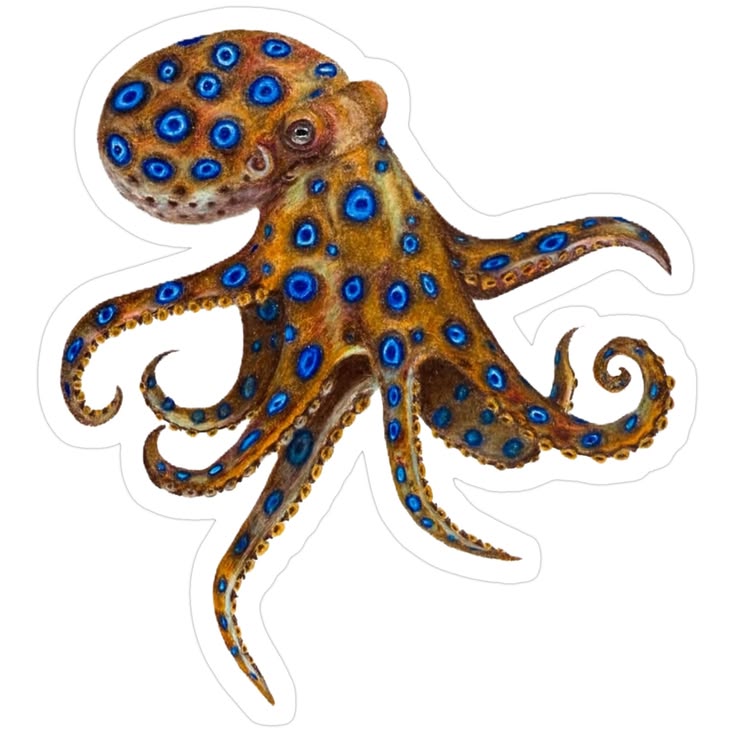
The blue-ringed octopus is a group of four tiny cephalopods from the tropical Indo-Pacific whose adult bodies are no larger than a golf ball, whose bite is frequently painless, and whose saliva carries enough tetrodotoxin to kill roughly twenty-six healthy adult humans.
It is one of the most venomous marine animals known to science, and its defensive colour display - brilliant electric-blue rings pulsing on a dull body in fractions of a second - is one of the fastest and most striking warning signals in the animal kingdom.
The genus Hapalochlaena contains four currently recognised species: the greater blue-ringed octopus (H. lunulata), the southern or lesser blue-ringed octopus (H. maculosa), the blue-lined octopus (H. fasciata), and the less-studied H. nierstraszi. This guide focuses on H. lunulata as the reference species but covers the biology shared across the genus. Expect specifics: millimetres, milligrams, minutes of paralysis, population ranges, and the physics of the blue pulse.
Classification and Names
The scientific name Hapalochlaena comes from Greek roots meaning roughly 'soft cloak', a reference to the thin, delicate mantle typical of the genus. The species name lunulata refers to the little moons - the crescent- or circle-shaped blue rings that give the genus its common name.
The greater blue-ringed octopus was formally described in the nineteenth century, but the genus as a whole was not fully separated from other small octopuses until revisionary work in the twentieth century clarified its distinctive warning display and venom chemistry.
Four species are currently accepted:
- Hapalochlaena lunulata - greater blue-ringed octopus, ranges across much of the tropical Indo-Pacific.
- Hapalochlaena maculosa - southern or lesser blue-ringed octopus, concentrated in southern Australian waters.
- Hapalochlaena fasciata - blue-lined octopus, common on Australia's east coast, distinguished by lines rather than closed rings.
- Hapalochlaena nierstraszi - poorly known species described from the Bay of Bengal.
Genetic work suggests the genus contains additional undescribed species across the Indo-Pacific, particularly in Indonesia and the Philippines, where cryptic diversity is likely. All four recognised species share the same general body plan, the same fast iridophore-driven warning display, and the same tetrodotoxin-based venom system.
Size and Physical Description
Blue-ringed octopuses are among the smallest cephalopods that regularly interact with humans. An adult H. lunulata typically measures:
- Mantle length: 4-6 cm
- Total length including arms: 5-10 cm
- Arm span when fully extended: 10-20 cm
- Weight: roughly 10-100 g
For comparison, a large specimen is approximately the size of a small tennis ball with thin tentacles. Most adults in the wild are closer to the size of a golf ball or walnut. H. maculosa is smaller still, with many adults fitting comfortably in a human palm.
The body is soft and slightly elongated, with eight arms of roughly equal length. Each arm carries two rows of suckers. The head sits just ahead of the mantle, with large, prominent eyes on either side. At rest the skin is a drab yellow-beige, tan, or grey-brown, patterned to match rubble and algae. This camouflage is effective enough that most people never see a blue-ringed octopus in the wild - even in areas where the animal is abundant.
Distributed across the body are roughly fifty to sixty specialised colour-patches that become the iconic blue rings. In H. lunulata these form full circular rings; in H. fasciata they form longer stripes and lines. At rest they are nearly invisible. When activated they flash with an intensity and speed that is rare in any animal.
The Blue Ring Flash
The warning display is the feature that has made this octopus famous. It is an aposematic signal - visual shorthand evolved over generations to tell potential predators that eating the owner of the display will end badly.
Key properties of the display:
- Flash duration: roughly one third of a second per pulse
- Flash rate: up to three pulses per second
- Total activation time from calm to full display: well under one second
- Light source: no bioluminescence; the blue is structural colour
- Contrast: deep blue rings on a darkened background produced by simultaneous body-colour change
The 2011 study by Lydia Mathger and colleagues in the Journal of Experimental Biology resolved the physics behind the pulse. Each blue ring sits over a specialised iridophore - a skin cell packed with stacks of thin reflective protein plates. These plates are spaced at distances tuned to the wavelength of blue light.
When the plates are exposed, incoming light bounces off multiple layers in phase, producing intense structural blue through thin-film interference. Around and over each iridophore sit muscle-driven chromatophores that hold darker pigment. When the octopus is calm, the chromatophores cover and shade the iridophores.
When threatened, the animal contracts chromatophore muscles elsewhere on the body and relaxes them over the rings, unmasking the reflectors and producing the flash.
Because the system is driven by muscles rather than chemistry, the octopus can turn the whole display on and off within a blink and pulse it rhythmically. It is one of the fastest deliberate colour changes in any animal. The display is visible not only to human eyes but to the ultraviolet-sensitive vision of many reef fish and predators, who see an even brighter warning than we do.
Venom: Tetrodotoxin
The chemistry behind the display is even more remarkable than the optics. Blue-ringed octopuses carry tetrodotoxin (TTX), a small neurotoxin that binds to voltage-gated sodium channels in nerve and muscle membranes and blocks the flow of sodium ions. Without sodium influx, nerves cannot fire, muscles cannot contract, and the victim suffers progressive paralysis.
Key facts about the venom:
- Chemical: tetrodotoxin, a small non-protein guanidinium-based molecule
- Source: symbiotic bacteria (including Vibrio and Pseudomonas species) in the octopus's salivary glands
- Mechanism: blocks voltage-gated sodium channels, stopping nerve and muscle signalling
- Lethal dose (human): as little as one to two milligrams can be fatal
- Amount per octopus: enough to kill roughly twenty-six healthy adults in a single bite
- Antivenom: none exists
The octopus does not synthesise TTX itself. Instead, symbiotic bacteria inside the salivary glands produce the molecule. The same toxin is found in pufferfish (fugu), certain newts, some crabs, arrow worms, and a scattering of other marine species - all of which obtain it either through bacterial symbionts or through dietary uptake. This shared source explains why TTX appears in such an odd, unrelated collection of animals.
TTX is functionally ideal for an octopus predator of crustaceans. Crab and shrimp nervous systems are vulnerable to sodium-channel blockade, and the paralysis is almost instantaneous. The fact that TTX is lethal to humans is an evolutionary accident: our sodium channels are similar enough to a crab's that the toxin works on us too.
The Bite
The bite itself is often the most disturbing aspect of envenomation reports. Victims commonly describe either a small pinch or no sensation at all at the moment of biting. The beak is small, and the bite wound may be invisible. Many documented victims did not realise they had been bitten until numbness and tingling announced the arrival of tetrodotoxin.
Symptom timeline in a typical envenomation:
| Time after bite | Symptoms |
|---|---|
| 0-5 minutes | Painless bite or mild pinch; tiny wound often invisible |
| 5-10 minutes | Tingling and numbness around bite; numb lips and tongue |
| 10-30 minutes | Weakness, difficulty swallowing, blurred vision |
| 30-90 minutes | Progressive paralysis, respiratory failure, consciousness |
| Hours | Full-body paralysis; life depends on artificial ventilation |
| 12-48 hours | Gradual recovery as toxin is cleared |
A crucial detail of tetrodotoxin poisoning is that the victim usually remains fully conscious throughout paralysis. The toxin does not cross the blood-brain barrier readily, so cognition is preserved even after the muscles stop working. People who have survived describe being aware and alert but unable to move, speak, or breathe.
First-aid guidance follows the pressure-immobilisation protocol developed in Australia for venomous bites: firm bandaging over the wound and limb to slow lymphatic spread, complete immobilisation of the affected limb, rapid emergency transport, and - most importantly - prompt cardiopulmonary resuscitation if the victim stops breathing.
Hospital care consists of continuous mechanical ventilation until the toxin clears. Several survivors have required more than twenty-four hours on a ventilator before regaining the ability to breathe unaided.
Because there is no antivenom, prevention is the entire strategy. Australian beaches in tropical and temperate zones carry signs specifically warning against handling small octopuses, and first-aid kits in coastal communities include pressure bandages precisely for this scenario.
Habitat and Range
Blue-ringed octopuses live in warm, shallow coastal waters of the tropical and subtropical Pacific and Indian Oceans. Their range broadly includes:
- Southern Japan and the East China Sea
- The Philippines, Taiwan, and Malaysia
- Indonesia and the Coral Triangle
- Papua New Guinea and the Solomon Islands
- Northern, eastern, and southern Australia - including Tasmania
- Vanuatu and parts of the western Pacific
Different species occupy different segments of this range. H. lunulata dominates in tropical reef systems from Japan through Indonesia and the Philippines. H. maculosa is concentrated in cooler southern Australian waters. H. fasciata is most common on Australia's temperate east coast.
Typical habitat is shallow and sheltered. The animals occur in:
- Rocky and coral tide pools at the intertidal edge
- Coral reef rubble and rubble-sand interfaces
- Seagrass flats and algal beds
- Shallow sandy lagoons and coastal bays
- Artificial substrates - jetties, pilings, and human debris
Depth range runs from zero to roughly twenty metres, but most individuals are found in the top ten metres. They are not strong swimmers and rarely venture into open water.
Within the habitat each octopus maintains a small den, typically an empty shell, a crevice in rock or coral, or a piece of human debris such as a discarded bottle, can, or bivalve shell. The den is defensive refuge, dining table, and - for females - nursery. Octopuses discard the shells of consumed crustaceans outside the den, creating a small midden that researchers sometimes use to locate individuals.
Feeding and Hunting
Blue-ringed octopuses are carnivorous ambush predators. Their prey is small and local:
- Small crabs of many species
- Shrimp and prawns
- Hermit crabs (often bitten through or around the shell)
- Tiny bottom-dwelling fish
- Occasional molluscs
Hunting typically begins at dusk, when the octopus leaves its den and explores the surrounding rubble. Detection is combined tactile and chemical - the suckers carry both mechanical and chemoreceptive cells capable of tasting surfaces. When a suitable prey item is located, the octopus pounces, wraps it with the web between the arms, and delivers a venomous bite. Tetrodotoxin paralyses a small crab within seconds.
The octopus then drags the prey back to the den, injects digestive enzymes through the bite wound, and consumes the soft tissues through a small opening in the shell.
Hunting is mostly solitary. Females brooding eggs do not hunt at all during the brooding period. Aggression between individuals occurs but is less elaborate than the territorial combat of larger octopus species.
Reproduction and Life Cycle
Blue-ringed octopuses have short, intense, tightly compressed life cycles. Their entire adult life typically fits inside twelve to twenty-four months.
Life cycle stages:
- Hatchling - tiny planktonic young drift with currents for a brief period after hatching.
- Settlement and growth - young octopuses settle onto the reef or rubble and begin feeding. Growth is rapid.
- Sexual maturity - reached within a few months of settlement.
- Mating - a single mating event per lifetime for most individuals. The male uses a modified third right arm (hectocotylus) to transfer a sperm packet to the female.
- Brooding - the female lays roughly fifty eggs and carries them under her arms in a den for approximately one month, stopping feeding during the brood.
- Hatching and death - soon after the eggs hatch, the female dies. Males typically die shortly after mating.
This life history pattern - one reproductive event followed by death - is called semelparity. It is common across octopus species but is particularly sharp in the small, short-lived Hapalochlaena. The small clutch size (around fifty eggs compared to tens or hundreds of thousands in larger octopuses) is balanced by relatively large, well-developed hatchlings that skip most of the planktonic phase.
The short life cycle also explains why blue-ringed octopuses are almost impossible to keep in public aquariums for long: a fresh adult will die within a year regardless of care, and offspring are difficult to raise through the early stages.
Behaviour and Intelligence
Blue-ringed octopuses belong to the same class of animals that includes the giant Pacific octopus, the common octopus, and the mimic octopus - all of which show remarkable problem-solving ability, tool use, and flexible behaviour. Little research has specifically targeted Hapalochlaena cognition, but laboratory observations suggest they share the basic cephalopod capacities for den selection, spatial memory, and individual recognition.
Notable behavioural traits:
- Strong den attachment. Individuals often return repeatedly to the same den over weeks.
- Nocturnal or crepuscular activity. Most hunting happens at dusk and during the first hours of darkness.
- Defensive escalation. A disturbed octopus first attempts to flee, then darkens its body, then deploys the full ring-flash display, and only bites if cornered or handled.
- Tolerance of artificial dens. In habitats where natural shelters are scarce, individuals readily occupy bottles, cans, shells, and other human debris.
- Minimal social behaviour. Outside of mating, individuals are generally solitary.
The bite itself is almost always a last-resort defence rather than an unprovoked attack. Nearly every documented human envenomation involves handling the animal - picking it up from a tide pool, letting it crawl across a palm, or disturbing it in rubble.
Blue-Ringed Octopuses and Humans
Hapalochlaena is responsible for a small number of human fatalities each decade across its range. Documented deaths are rare relative to other marine hazards, partly because the animal is small and shy, and partly because beachgoers rarely encounter it. Where deaths have occurred, they have usually followed a predictable pattern: a small, beautifully patterned octopus is picked up out of curiosity, bites the handler without obvious pain, and begins the tetrodotoxin cascade.
Australian public-health authorities treat blue-ringed octopus envenomation as a serious but manageable emergency. Warning signs are posted at popular tide-pool beaches from New South Wales through Queensland to Western Australia. First-aid training in coastal Australian schools typically covers pressure-immobilisation bandaging and rescue breathing. Lifeguards in heavily visited tropical areas carry the necessary equipment.
For divers and snorkellers the practical rules are simple:
- Do not pick up small octopuses, especially in rubble, tide pools, or on night dives.
- Do not let an unidentified small octopus crawl on exposed skin.
- If bitten, treat every octopus bite as if it were a blue-ringed octopus bite until proved otherwise. Apply pressure-immobilisation, summon emergency services, and prepare to assist breathing.
Blue-ringed octopuses do appear in the aquarium trade, sold occasionally to advanced private keepers. The combination of lethal venom, short lifespan, and difficulty of captive care makes them an unsuitable pet for almost anyone, and some jurisdictions have restricted the trade.
Conservation Status
None of the four recognised Hapalochlaena species has been formally assessed by the IUCN Red List. They are not currently classified as endangered, threatened, or vulnerable, but this reflects lack of assessment rather than confirmed abundance.
Likely pressures on populations include:
- Loss and degradation of coral reefs and rocky tide-pool habitat
- Coastal pollution, including agricultural runoff and plastics
- Warming and acidification of shallow tropical seas
- Occasional collection for the aquarium trade
- Incidental damage from coastal development and shoreline modification
Short generation time and reasonable reproductive output probably buffer populations against moderate disturbance, but the species' strict dependence on shallow, sheltered, complex coastal habitat means that coral loss, seagrass die-off, and tide-pool degradation would all reduce available habitat rapidly. Better monitoring and formal IUCN assessment across the genus would clarify the situation.
Related Reading
- Octopuses: The Alien Intelligence of the Ocean
- Octopuses Have Three Hearts and Nine Brains
- Giant Pacific Octopus: The Red Giant of the Cold Pacific
- Mimic Octopus: The Ocean's Master of Disguise
References
Relevant peer-reviewed and governmental sources consulted for this entry include Mathger L M et al. (2011) 'How does the blue-ringed octopus flash its blue rings?' Journal of Experimental Biology 215, on the iridophore physics of the warning display; Williams B L et al.
(2011) work on tetrodotoxin distribution and bacterial symbionts in Hapalochlaena; Australian state health department bite-treatment protocols (Queensland Health, NSW Health); toxinological reviews in Toxicon; and systematic treatments of the genus in Molluscan Research and Zootaxa.
Species counts reflect currently accepted taxonomy as of recent revisions; additional cryptic species are likely to be described in the Indo-Pacific.
Frequently Asked Questions
How venomous is the blue-ringed octopus?
The blue-ringed octopus (Hapalochlaena lunulata and its three congeners) is among the most venomous marine animals known. A single adult contains enough tetrodotoxin to paralyse and kill roughly twenty-six healthy adults within minutes. Tetrodotoxin blocks voltage-gated sodium channels in nerves, shutting down motor and respiratory function while leaving the victim fully conscious. There is no antivenom.
Lethal doses for an adult human are measured in milligrams, and a single bite from a golf-ball sized octopus can deliver many times that. Survival depends on rapid recognition, immediate pressure bandaging, and uninterrupted artificial ventilation until the body clears the toxin - which may take many hours.
How big is a blue-ringed octopus?
Blue-ringed octopuses are very small. Adult greater blue-ringed octopuses (H. lunulata) have a mantle length of roughly four to six centimetres and a total length including arms of five to ten centimetres - comparable to a golf ball with tentacles. Arm span reaches ten to twenty centimetres when fully extended. Weight is typically ten to one hundred grams. The smaller southern blue-ringed octopus (H. maculosa) is even more compact.
Their tiny size is a large part of what makes encounters dangerous, because beachgoers often mistake them for harmless tide-pool animals and pick them up without realising what they are holding.
Where do blue-ringed octopuses live?
The four recognised species of Hapalochlaena are distributed across the tropical and subtropical Pacific and Indian Oceans, from southern Japan through the Philippines, Indonesia, Papua New Guinea, and along the northern, eastern, and southern coasts of Australia as far as Tasmania.
They inhabit shallow water almost exclusively - tide pools, coral reef rubble, seagrass flats, and shallow lagoons - typically from the intertidal zone down to about twenty metres. They rest in small dens built into empty shells, crevices, coral, and occasionally human debris such as bottles or cans. They are nocturnal hunters, emerging at dusk to stalk small crabs and shrimp.
Why do blue-ringed octopuses flash their rings?
The blue rings are an aposematic warning signal - a visual shout that says ‘do not eat me’. At rest the octopus is dull yellow, beige, or grey-brown and almost invisible. When threatened it contracts muscles surrounding specialised skin structures called iridophores, exposing a layer of multilayer reflectors underneath. The rings flash on and off roughly every third of a second, sometimes pulsing three times per second.
Mathger and colleagues demonstrated in 2011 that the blue colour is produced by physics, not pigment: stacks of thin reflective plates interfere with incoming light to produce intense structural blue. The speed and contrast of the display make it one of the fastest colour changes in the animal kingdom.
What happens if a blue-ringed octopus bites you?
A blue-ringed octopus bite is typically painless or feels like a tiny pinch. Within five to ten minutes the first symptoms appear: tingling lips and tongue, numbness around the bite, and a feeling of weakness. Over the following ten to ninety minutes tetrodotoxin paralyses the voluntary muscles, including the diaphragm, while the victim remains fully conscious. Without artificial respiration, respiratory failure kills within thirty minutes to a few hours.
With rapid pressure-immobilisation bandaging and continuous assisted breathing, survival is possible because the body eventually clears the toxin. Several documented survivors spent more than twenty-four hours on a ventilator before recovering fully.
Does the blue-ringed octopus produce its own venom?
No. The tetrodotoxin (TTX) in the octopus’s salivary glands is synthesised by symbiotic bacteria, primarily members of the genera Vibrio, Pseudomonas, and related groups. The octopus provides a habitat and nutrients; the bacteria produce the toxin.
The same neurotoxin is found in pufferfish, certain newts, some crabs, and a handful of other marine animals - all of which acquire it through bacterial symbionts or dietary uptake rather than evolving it independently. This is one reason tetrodotoxin appears in such a scattered collection of unrelated species. The octopus uses its venom primarily to subdue crustacean prey; its lethality to humans is an accident of shared ion-channel biology.
How long does a blue-ringed octopus live?
Blue-ringed octopuses have very short lives, typically twelve to twenty-four months total. After hatching as tiny planktonic larvae, they settle to the reef and grow quickly. Sexual maturity arrives within a few months. Mating occurs once, and females then brood a single clutch of roughly fifty eggs under their arms for about a month. During brooding the female does not eat.
Soon after the eggs hatch she dies, a pattern biologists call semelparity or reproductive senescence, which is common across octopus species. Males typically die shortly after mating. This rapid life cycle is one reason populations are hard to study and impossible to keep in captivity for long.
Are blue-ringed octopuses endangered?
None of the four recognised species in the genus Hapalochlaena has been formally evaluated by the IUCN Red List. They are not currently listed as threatened or endangered, but this reflects lack of assessment rather than confirmed abundance. Population sizes are unknown. Like most shallow-water reef species, blue-ringed octopuses face pressure from coral reef loss, coastal pollution, habitat destruction, and warming seas.
Collection for the aquarium trade is a minor additional pressure. Their short lifespan and high reproductive output probably buffer them against moderate disturbance, but their dependence on intact tide-pool and reef habitat makes them vulnerable to large-scale coastal change.