
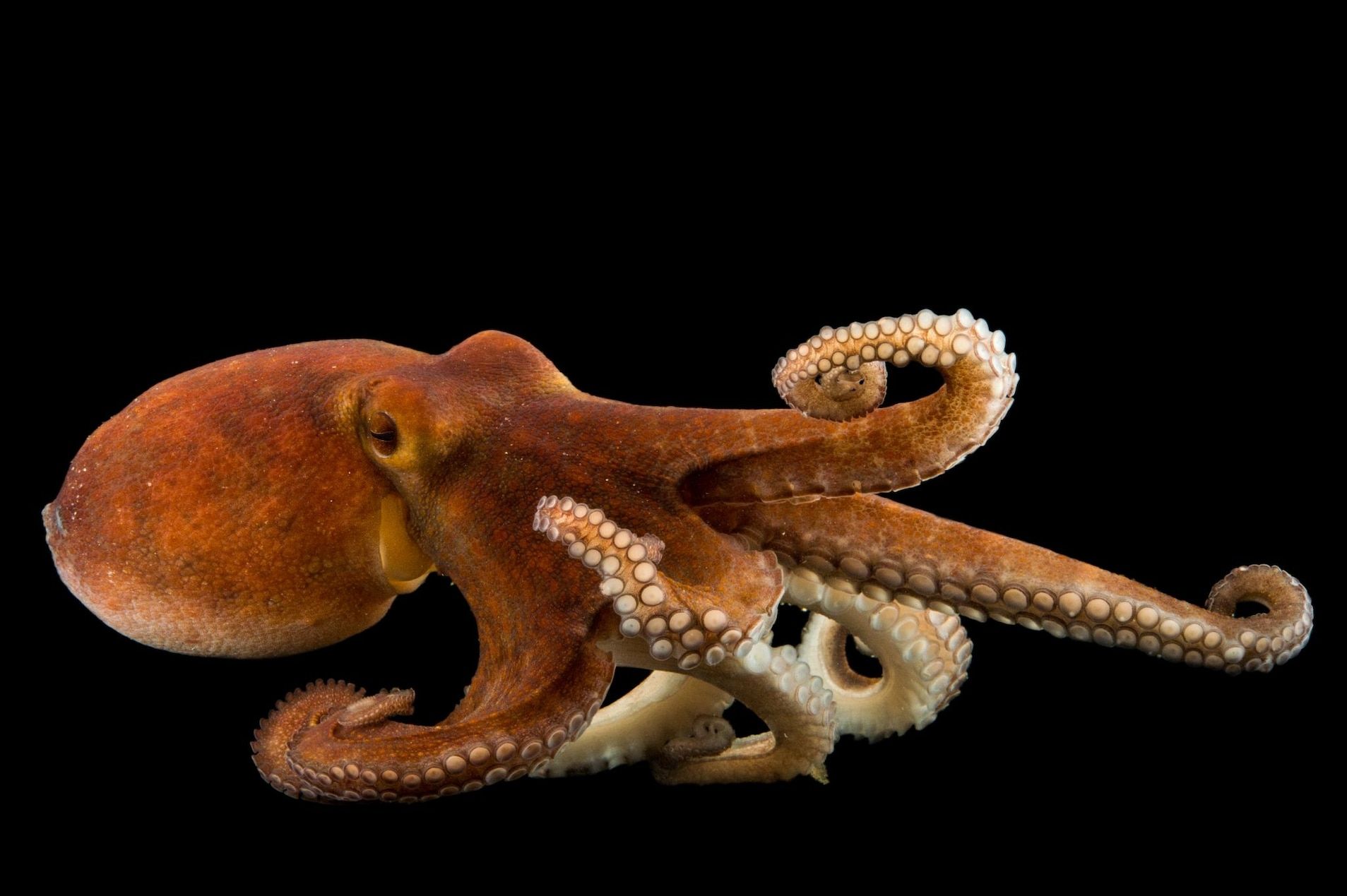
The common octopus is the animal most biologists picture when someone says the word "octopus". It is the species on which nearly every foundational experiment in cephalopod behaviour, learning, and neuroanatomy has been carried out. For more than a century it has served as the model organism for cephalopod research, the way the fruit fly serves for genetics and the mouse serves for mammalian biology.
Octopus vulgaris is also the most heavily fished octopus on Earth, one of the first cephalopods taken in commercial quantity, and - it turns out - not a single species at all, but a complex of several cryptic species hiding under a single name.
This guide covers the biology, ecology, cognition, and cultural history of the common octopus in depth: its anatomy, its Atlantic and Mediterranean range, its hunting techniques, its eight semi-autonomous arms, its disputed but fascinating skin-vision system, its compressed 12-to-18-month life cycle, and the strange corners of its behaviour that modern research keeps uncovering - from coconut-shell shelters to the 2018 "Octlantis" discovery of apparent octopus gatherings.
It is a reference entry, not a summary, so expect specifics: centimetres, kilograms, neurons, eggs, and named experiments.
Etymology and Classification
The Latin name Octopus vulgaris means, roughly, "common eight-foot". The genus name comes from Greek okto (eight) and pous (foot); the species epithet vulgaris is the standard Latin adjective for "common" or "widespread". The name was formalised by the French naturalist Pierre Denys de Montfort in 1798, although the animal had been described in detail by Aristotle in Greek natural philosophy more than two thousand years earlier.
Within the class Cephalopoda, Octopus vulgaris sits in the order Octopoda - the true octopuses - and the family Octopodidae, which is the largest and most diverse octopus family. The genus Octopus is itself a sprawling and taxonomically messy group, currently under active revision, and O. vulgaris has for a long time served as the "type" species against which other octopuses are compared.
Common names in other languages reflect the animal's long history on European tables. In Spanish and Portuguese it is pulpo and polvo respectively. In Italian it is polpo or polipo; in Greek chtapodi; in French poulpe; in Japanese madako. All of these names were in use long before taxonomists agreed on the Latin binomial, and most refer specifically to the familiar coastal form that we now call Octopus vulgaris sensu stricto.
A Species Complex, Not a Species
One of the most important developments in common octopus science over the past twenty years has been the slow realisation that Octopus vulgaris is not a single species. For most of the twentieth century, any medium-sized temperate or subtropical octopus that broadly resembled the Mediterranean form was assigned to O. vulgaris.
As a result, the name came to be applied worldwide: to populations in the eastern Atlantic and Mediterranean, along the coasts of southern Africa, around Japan, through the Caribbean, and along the Brazilian shelf.
Once molecular markers - first mitochondrial DNA, then nuclear sequence data - became routine in the 1990s and 2000s, a different picture emerged. Populations from the Caribbean and Brazil were genetically divergent enough from the European type to be described as separate species, with Octopus insularis now formally recognised. South African, Japanese, and West African lineages are also genetically distinctive, and several are likely to be split off in the coming years.
The remaining Octopus vulgaris sensu stricto - the eastern Atlantic and Mediterranean form - is therefore one member of a wider species complex. Modern papers are careful to specify which population they studied, because life-history parameters, growth rates, and even basic morphology differ measurably between members of the complex.
For most of the purposes of this entry, "common octopus" refers to the eastern Atlantic and Mediterranean animal, but readers should be aware that older literature using the name may be describing a cryptic relative.
Size and Physical Description
The common octopus is a medium-sized octopod. A typical adult reaches an arm span of 60 to 100 centimetres tip to tip and weighs 3 to 10 kilograms, with the mantle itself measuring around 25 centimetres. Exceptionally large individuals from productive Atlantic and Mediterranean waters can reach arm spans of roughly 130 centimetres and weights of 15 kilograms, usually females approaching the end of life.
Typical adults:
- Arm span: 60-100 centimetres tip to tip
- Mantle length: 15-25 centimetres
- Weight: 3-10 kilograms
- Suckers per arm: roughly 200-240, total around 1,600-1,900
Large specimens:
- Arm span: up to about 130 centimetres
- Weight: 12-15 kilograms and occasionally more
Hatchlings and paralarvae:
- Length: roughly 2-3 millimetres
- Weight: a few milligrams
- Behaviour: planktonic drifters for 30-60 days before settling
The body plan is built around a soft, muscular mantle that houses the gills, hearts, digestive system, and reproductive organs. Eight arms radiate from a central crown surrounding the mouth. Each arm is lined with two rows of independently operated suckers capable of suction, fine grip, and chemical sensing. Males have a modified third right arm called the hectocotylus, used to transfer spermatophores during mating.
The only rigid structure in the entire body is the beak, a pair of keratinous jaws that sit at the centre of the arm crown. In a 5-kilogram adult the beak is about the size of a small grape, which sets the minimum gap the whole animal can squeeze through. A full-grown common octopus can force itself through holes narrower than a golf ball, and captive individuals regularly exploit this to escape from aquaria.
Habitat and Range
The common octopus is a coastal, benthic, rocky-reef species. Its classic range covers the eastern Atlantic from the British Isles and Norway down the European coast, through the Iberian Peninsula, along the West African shelf as far south as Angola, and throughout the Mediterranean from Gibraltar to the Levant.
Populations long identified as O. vulgaris also occur off southern Africa, around Japan, through the Caribbean, and along the Brazilian shelf, although as noted above several of these are now treated as separate species in the wider complex.
Preferred habitat features:
- Rocky subtidal reefs with crevices and boulder fields
- Seagrass beds, rubble patches, and shell-gravel substrate
- Depth range: 0-200 metres, most commonly under 100 metres
- Water temperature: 10-25 degrees Celsius, with local adaptation
- Salinity: fully marine, 34-38 parts per thousand in core habitat
- Artificial structures: shipwrecks, harbour walls, and unbaited octopus pots
The common octopus is a den-based predator. Each adult selects a sheltered crevice, overhang, or pot, excavates loose sediment, and piles shell debris at the entrance as a midden. Biologists and fishers both use these middens to find occupied dens - a fresh pile of broken crab carapaces, empty bivalve shells, and fish bones almost always indicates a resident octopus inside. Individual dens may be occupied for days to several weeks before the animal moves on.
The species is generally considered solitary and will usually drive other octopuses, including smaller conspecifics, away from an occupied den.
But this long-held picture was disrupted in 2017 and 2018 when researchers documented "Octopolis" and "Octlantis", two sites off Jervis Bay in eastern Australia where a close relative, Octopus tetricus, was observed gathering in loose groups of up to fifteen animals, sharing dens, displaying at each other, and evicting neighbours.
Similar gathering behaviour has since been noted in common octopuses in the Mediterranean. The picture of the octopus as strictly solitary is quietly being revised.
The Eight Semi-Autonomous Arms
The defining feature of the common octopus, and the source of most of its scientific fame, is the structure of its nervous system. Roughly 500 million neurons are distributed between a doughnut-shaped central brain that surrounds the oesophagus and eight large arm ganglia, one per arm. Each arm ganglion contains on the order of 40 million neurons - more than the entire brain of a frog.
The central brain integrates vision, memory, and strategic decision-making. The arm ganglia handle local sensorimotor control: where each sucker grips, how the arm extends, how the arm reacts to a touched surface.
Experimental work by Binyamin Hochner and colleagues has shown that a severed arm, surgically isolated from the central brain, will still reach toward food, grasp, and withdraw in response to touch. This is why the common octopus is often described as having "nine brains" - one central and one per arm.
This architecture has real consequences for behaviour. The central brain does not appear to track the exact position of each arm in the way a vertebrate motor cortex tracks its limbs. Instead, it seems to issue goal-directed commands - "bring that crab to the beak" - and leave the detailed motor planning to the arm itself. The arms also communicate with each other directly through a nerve ring at their base, bypassing the central brain for some coordinated movements.
Roughly two thirds of all neurons sit outside the central brain. The common octopus is therefore the clearest example on Earth of distributed, embodied cognition in an animal that is still undeniably intelligent by any vertebrate-derived measure.
Sensory Systems and Skin Vision
The common octopus has large, camera-style eyes that superficially resemble vertebrate eyes but evolved independently. They produce high-resolution images and are highly sensitive to polarised light, but they contain only a single visual pigment and are therefore functionally colour-blind in the conventional retinal sense.
This produces a famous paradox: a colour-blind animal that reliably matches the colour of its surroundings. The leading explanation - supported by work from Roger Hanlon, Desmond Ramirez, Todd Oakley and others - is that the skin itself contains opsins, the same class of light-sensing proteins found in retinas, scattered across its chromatophores and pigment-control cells.
In this model, the skin can detect wavelength locally and feed that information directly into the circuits controlling chromatophore contraction, producing colour-matched camouflage without the information ever passing through the brain.
Evidence for skin-vision has been strengthened by experiments showing that isolated patches of octopus skin respond to changes in ambient light even after being separated from the central nervous system, and that chromatophore behaviour tracks wavelength in ways that cannot be accounted for by retinal signals alone. The picture is still debated, but "the skin sees" is now a mainstream working hypothesis rather than a fringe idea.
Each sucker is lined with chemoreceptor cells that function as taste buds. An extended common octopus arm literally tastes every surface it touches, sampling molecules dissolved in the water and bound to the substrate. Mechanoreceptors in the suckers are fine enough that the animal can identify objects by texture alone.
Paired fluid-filled statocysts sit inside the mantle and detect gravity, acceleration, and low-frequency vibrations, giving the animal a sense of balance and a crude form of hearing.
Cognition and Behaviour
The common octopus is the best-studied invertebrate nervous system in history. Nearly every canonical experiment on cephalopod cognition - from the classic work of J.Z. Young and Brian Boycott at the Stazione Zoologica in Naples in the 1950s and 1960s, through the later studies of Martin Wells and Jennifer Mather, to contemporary research at laboratories in Naples, Lisbon, Jerusalem, and Okinawa - has used O. vulgaris as its subject.
Documented cognitive abilities:
- Discrimination learning. Common octopuses learn to distinguish shapes, textures, and brightness cues in classical conditioning tasks, and retain the learned association for weeks.
- Reversal learning. When the reward-cue association is flipped, individuals relearn the new rule within a few trials.
- Problem solving. Individuals unscrew screw-top jars from either side, dismantle puzzle boxes, and extract prey from latched containers.
- Individual recognition. Captive common octopuses behave differently toward familiar and unfamiliar humans, including reliably squirting water at specific disliked caretakers.
- Tool use. Common octopuses and their close relatives carry coconut halves, bivalve shells, and small rocks across open seabed to assemble improvised shelters.
- Observational learning. Laboratory work has shown that naive individuals can acquire behaviours by watching trained demonstrators, a capacity once thought restricted to vertebrates.
- Play. Well-fed common octopuses manipulate novel objects in repeated, non-functional ways consistent with behavioural definitions of play.
- Personality. Individuals show stable traits - bold versus shy, active versus sedentary, aggressive versus curious - across months.
These abilities are especially striking given the evolutionary distance between octopuses and vertebrates. The last common ancestor of a human and a common octopus lived well over 600 million years ago and had, at most, a simple nerve net. Whatever similarities we see between cephalopod and vertebrate cognition are therefore not inherited from a shared ancestor but independently evolved. The common octopus is the clearest natural example of convergent intelligence in the animal kingdom.
Hunting and Diet
Common octopuses are opportunistic carnivores that hunt mainly at dawn, dusk, and night. They leave the den, work the surrounding substrate, and return before exposing themselves too long in open water.
Primary prey:
- Shore crabs, velvet crabs, spider crabs, and hermit crabs
- Mussels, clams, scallops, and other bivalves
- Gastropods such as topshells and whelks
- Small reef fish and flatfish
Opportunistic prey:
- Other octopuses, including smaller conspecifics
- Shrimp and small lobsters
- Sea urchins and brittle stars
- Occasional seabirds caught from below
Capture techniques:
- Ambush. Camouflaged against substrate, the octopus allows prey to come within range, then explodes outward and drops its arms and interbrachial web over the prey in a smothering motion.
- Engulfing. The arms and web trap the prey inside a bell shape and draw it toward the beak.
- Drilling. For shelled prey, the octopus uses its rasping radula to drill a small hole through the shell, then injects cephalotoxin and paralysing saliva through the hole. The bivalve's adductor muscle relaxes and the octopus opens the shell.
- Biting. The beak shears through crab carapace and fish vertebrae with ease.
A healthy adult consumes roughly 2 to 3 per cent of its body mass per day. Over the compressed 12 to 18 months of an individual's adult career, the cumulative biomass consumed is substantial, and common octopus predation has been shown to exert measurable top-down pressure on local crab and shellfish populations in the Mediterranean.
Camouflage and Skin
The common octopus skin combines four cooperating cell types to produce the colour and texture changes for which the group is famous.
Chromatophores are muscular pigment sacs, each operated by a ring of radial muscles controlled by the nervous system. When the muscles contract, the sac flattens and spreads pigment across a wide visible area. When they relax, the sac shrinks to a pinpoint and effectively disappears. Common octopuses carry chromatophores containing red, yellow, brown, and black pigments.
Iridophores are stacks of thin protein platelets that create structural colour through thin-film interference. They produce blues, greens, silvers, and shifting metallic sheens that change with viewing angle. Unlike chromatophores, they are slower and are not under direct muscular control in the same way.
Leucophores scatter all visible wavelengths equally, producing bright matte whites. They supply a neutral backdrop against which the chromatophores paint colour.
Papillae are small muscular bumps in the skin that can be raised into ridges, horns, and spikes to mimic seaweed, rock, and coral texture. Common octopuses can independently control dozens of papillae.
A full colour-and-texture change can complete in under a second, with individual chromatophores cycling in milliseconds. Camouflage is the dominant use, but the system also supports deimatic displays - sudden dark, high-contrast patterns used to startle predators - and may play a role in conspecific signalling.
Circulatory and Respiratory Systems
Like all octopuses, the common octopus has three hearts and blue blood. Two branchial hearts sit at the base of each gill and pump deoxygenated blood through the gill filaments at high pressure. The larger systemic heart then pumps the oxygenated blood through the rest of the body. The systemic heart stops beating during active jet swimming, which is one reason octopuses tire quickly when they jet and prefer crawling over short distances.
The blood carries oxygen using hemocyanin, a copper-based respiratory protein rather than the iron-based hemoglobin used by vertebrates. Hemocyanin binds oxygen efficiently across the warm-to-cool water range the common octopus inhabits. Oxygenated hemocyanin is bright blue; deoxygenated hemocyanin is pale grey.
Water enters the mantle cavity through a slit around the edge of the mantle, passes across the gills, and exits through the funnel, a muscular tube that also serves as the propulsion outlet during jet swimming.
Reproduction and Life Cycle
Reproduction in Octopus vulgaris is short, intense, and terminal. The species is semelparous - each individual reproduces only once, and reproduction initiates programmed senescence ending in death.
Mating. Males and females meet in the open, typically at the edge of rocky habitat. The male inserts his hectocotylised arm into the female's mantle cavity and deposits one or more spermatophores, each containing millions of sperm. Mating may last minutes to hours. Males may mate with multiple females across a short window.
Egg laying. The female retreats to a protected den and lays between 100,000 and 500,000 tiny eggs, each about the size of a grain of rice, attached in braided strings to the den ceiling and walls.
Brood care. The female stops hunting and guards the eggs continuously. She cleans them with her arms, circulates oxygenated water over them using jets from her funnel, and drives off predators. She does not eat during the entire brood period, which lasts 25 to 125 days depending on water temperature. Her body weight falls by more than 50 per cent, her skin thins, and her immune system deteriorates.
Hatching and death. When the eggs hatch, tiny planktonic paralarvae drift out of the den. The female, exhausted and in terminal senescence driven by hormones from the optic glands at the base of the eyes, dies within days. Males that have mated successfully also enter senescence and usually die within a few months.
Larval and juvenile phases. Hatchlings are 2 to 3 millimetres long and spend 30 to 60 days as planktonic drifters. Mortality is enormous. Survivors settle to the seabed at around 10 millimetres mantle length and begin an explosive growth phase that can double body mass every few weeks. Sexual maturity is reached at around 9 to 12 months, and the whole life cycle closes between 12 and 18 months.
| Life stage | Duration | Approximate mass |
|---|---|---|
| Egg | 25-125 days | grain of rice |
| Paralarva | 30-60 days | milligrams |
| Juvenile | 4-8 months | grams to hundreds of grams |
| Sub-adult | 2-4 months | 0.5-3 kilograms |
| Reproductive adult | 1-3 months | 3-10 kilograms |
| Senescence | weeks | declining |
Defence, Escape, and Autophagy
When threatened, the common octopus deploys a layered defence strategy: camouflage first, then ink, then jet propulsion, and - as a last resort - arm autotomy.
Camouflage. The animal blends into its substrate well enough that divers routinely swim past occupied dens without noticing them.
Ink. When startled, the octopus releases a dense dark cloud of melanin from its ink sac, mixed with tyrosinase, an enzyme that disrupts predator olfactory and gustatory receptors. The ink is both a visual screen and a chemical deterrent.
Jet propulsion. The mantle fills with water, then muscular contraction blasts water out through the funnel, pushing the animal backward at short bursts of 25 to 40 kilometres per hour. The systemic heart stops during jetting, so sustained jet swimming is not possible.
Autotomy. The octopus can detach an arm at a predetermined breakpoint. The severed arm continues to move for several minutes, distracting the predator, while the octopus escapes. Lost arms regenerate fully over weeks to months.
Squeezing. With only the beak as a rigid limit, a 5-kilogram common octopus can force itself through gaps narrower than a golf ball, exploiting refuges unavailable to most predators of similar mass.
One unusual and darker behaviour deserves mention. Severely stressed common octopuses occasionally begin to eat their own arms, a self-injurious behaviour called autophagy. It has been linked to bacterial infections, chronic stress in poorly designed captivity, and late-stage senescence. The underlying cause is still debated - some researchers attribute it to a neurological disorder, others to behavioural pathology - but in any case it is a reliable warning sign in captive animals.
Predators and Threats
Despite their camouflage and intelligence, common octopuses are prey for many species.
Marine predators:
- Moray eels, conger eels, and other reef predators
- Groupers, sea bass, and other large bony fish
- Dolphins - several populations specialise in eating octopus
- Seals and sea lions
- Larger octopuses, including conspecifics
Human pressures:
- Artisanal pot fisheries across the Mediterranean, West Africa, and Japan
- Industrial trawl bycatch in European and African waters
- Hook-and-line and spearfishing in recreational settings
- Coastal habitat loss and pollution
- Marine heatwaves and ocean warming
- Ocean acidification affecting shelled prey availability
- Proposed industrial aquaculture operations, which have drawn strong opposition
Common octopus is the most heavily fished octopus on Earth, with global landings routinely exceeding 100,000 tonnes per year. Morocco, Mauritania, Spain, Portugal, Italy, Greece, Tunisia, and Japan dominate the catch. The short lifespan and high fecundity of the species make populations capable of rebounding quickly from exploitation, but equally capable of collapsing rapidly if a year-class fails.
Several regional populations are showing warning signs of overexploitation, and management plans in Europe increasingly rely on seasonal closures, minimum landing sizes, and pot-fishery quotas.
Common Octopuses and Humans
The common octopus has one of the longest human cultural records of any invertebrate. Minoan pottery from 1500 BCE depicts the animal in recognisable form. Aristotle described it accurately in the fourth century BCE. Roman, Arab, Iberian, Japanese, and West African cuisines all developed dedicated common octopus preparations - Galician pulpo a feira, Greek chtapodi sti schara, Japanese tako sashimi and takoyaki, Tunisian octopus couscous.
In public aquaria and research laboratories, Octopus vulgaris has been the cephalopod species of choice since the mid-twentieth century. The Stazione Zoologica Anton Dohrn in Naples maintained common octopuses on an industrial scale for decades and contributed most of the classical neuroanatomy of the species.
More recent work at the Max Planck Institute, the Hebrew University of Jerusalem, the University of the Aegean, and several US and Japanese laboratories has extended the cognitive record and begun to decode the molecular basis of skin colour change.
Encounters with scuba divers are generally peaceful. The common octopus is curious rather than aggressive and will often investigate divers by extending an arm to taste their equipment. Bites are rare, usually a response to handling, and not life-threatening, though beak punctures can inject cephalotoxin and cause local pain and numbness.
The more serious welfare question in recent years has been the proposed development of industrial common octopus aquaculture, which scientists and animal-welfare organisations have argued is ethically indefensible for an animal with this level of cognitive complexity and sensitivity.
Related Reading
- Octopus Intelligence: How Invertebrates Out-Think Most Vertebrates
- Giant Pacific Octopus: The Largest Octopus on Earth
- Blue-Ringed Octopus: The Smallest Lethally Venomous Cephalopod
- Mimic Octopus: The Animal That Impersonates Other Animals
- Three Hearts, Nine Brains: The Octopus Body Plan Explained
References
Relevant peer-reviewed and institutional sources consulted for this entry include IUCN Red List information for Octopus vulgaris, FAO global cephalopod landings statistics, and published research in Journal of Experimental Biology, Current Biology, Nature, Proceedings of the Royal Society B, Marine Biology, and Journal of Molluscan Studies.
Classical neurobiology and behaviour draw on work from the Stazione Zoologica Anton Dohrn in Naples, the laboratories of J.Z. Young, Brian Boycott, Martin Wells, and Jennifer Mather, and later work by Binyamin Hochner, Roger Hanlon, Desmond Ramirez, and the Octolab group at Lisbon.
Species-complex taxonomy follows revisions published by Jaruwat Nabhitabhata, Michael Vecchione, and colleagues, including the formal separation of Octopus insularis. Fisheries and management data are drawn from FAO, ICES, and national stock assessments for Morocco, Mauritania, Spain, Portugal, Italy, and Japan.
Frequently Asked Questions
How big is the common octopus?
The common octopus (Octopus vulgaris) is a medium-sized octopus. A typical adult has an arm span of 60 to 100 centimetres tip to tip and weighs 3 to 10 kilograms, with the mantle alone measuring roughly 25 centimetres.
Large individuals from productive Atlantic and Mediterranean waters can reach arm spans of 130 centimetres and weights of 15 kilograms or more, but these sizes are uncommon and usually represent exceptionally well-fed females near the end of life. Hatchlings are tiny planktonic paralarvae about 2 to 3 millimetres long and weigh only a few milligrams.
Most of the growth happens in the last six to nine months of life, when a juvenile can double its mass every few weeks.
Where do common octopuses live?
The common octopus was classically described from the eastern Atlantic and the Mediterranean Sea, where it remains abundant along rocky subtidal coasts from the British Isles and Norway in the north to the coast of Angola in the south, and throughout the Mediterranean from Gibraltar to the Levant.
Populations long identified as Octopus vulgaris also occur off southern Africa, Japan, the Caribbean, and Brazil, though molecular studies now consider several of these to be separate cryptic species within a wider Octopus vulgaris species complex.
Wherever it lives, the animal prefers rocky subtidal reefs, boulder fields, seagrass beds, and artificial structures such as shipwrecks and pots, usually at depths of less than 100 metres but occasionally as deep as 200 metres.
What do common octopuses eat?
Common octopuses are opportunistic carnivores that eat essentially any animal they can subdue. The staple diet is decapod crustaceans - shore crabs, velvet crabs, spider crabs, and hermit crabs - supplemented by bivalves such as mussels, clams, and scallops, gastropods, and a wide range of small fish. Larger individuals also take other octopuses, including smaller conspecifics.
Capture techniques combine ambush, camouflage, and web-assisted engulfment: the octopus drifts over the prey, drops its arms and interbrachial web in a smothering motion, and pulls the catch to its beak. Shelled prey are drilled through with the radula and injected with paralysing saliva. A healthy adult consumes roughly 2 to 3 per cent of its body mass per day and can leave behind diagnostic piles of broken shells - middens - at the entrance to its den.
Why is the common octopus called a species complex?
For most of the twentieth century the name Octopus vulgaris was applied worldwide to any medium-sized temperate or subtropical octopus that looked broadly like the Mediterranean form. Once molecular markers became available in the 1990s and 2000s, it became clear that populations from South Africa, Japan, Brazil, and the Caribbean were genetically distinct from the European type and from each other, often by more than is typical between separate species.
The Caribbean form has since been separated as Octopus insularis, and several other lineages are under formal description. The remaining Octopus vulgaris sensu stricto is now understood as one member of a wider Octopus vulgaris species complex, which is why modern papers are careful to specify the geographic population being studied.
How intelligent is the common octopus?
The common octopus is the best-studied invertebrate nervous system in history and the species from which almost all claims about octopus intelligence originate. Individuals solve novel mazes, open screw-top jars from either side, learn by observation, remember human faces, use shells and coconut halves as portable shelters, and display stable personality traits across months.
Their nervous system contains roughly 500 million neurons, comparable to a dog, but distributed in a strikingly un-vertebrate way: about a third in a central brain surrounding the oesophagus and the remaining two thirds in eight large arm ganglia of roughly 40 million neurons each. Each arm can taste, grip, and react independently, while the central brain handles strategic decisions. The classical laboratory work of J.Z.
Young, Brian Boycott, Martin Wells, and Jennifer Mather established that this species possesses both short-term and long-term memory, can transfer learning between arms, and exhibits what behavioural researchers consider play.
How does the common octopus change colour if it is colour-blind?
The paradox at the heart of octopus camouflage is that the animal’s eyes contain only one visual pigment and are therefore effectively colour-blind, yet its skin reliably matches the colour of its surroundings.
The leading explanation - supported by work from the Hanlon laboratory and others - is that the skin itself contains opsins, the same light-sensing proteins found in vertebrate retinas, distributed around the chromatophores and other pigment-control cells. The skin can detect wavelength locally and feed that information directly into colour-change circuits without routing through the central brain.
This distributed skin-vision hypothesis explains why the common octopus can produce accurate colour matches in milliseconds, and why denervated patches of skin in experiments still respond to changes in ambient light. Four cooperating cell types - chromatophores, iridophores, leucophores, and muscular papillae - then produce the actual visual output.
How long do common octopuses live?
The common octopus lives only 12 to 18 months, even though adults weigh several kilograms. The species is semelparous, meaning a single reproductive event ends life. After mating, females retreat to a den and lay between 100,000 and 500,000 tiny eggs, which they tend for 25 to 125 days depending on water temperature. During this brood period the female does not eat.
Her body weight falls by more than half, her skin thins, and her immune system deteriorates. When the eggs hatch she dies within days, driven by a hormonal cascade produced in the optic glands at the base of the eyes. Males enter a parallel senescence after mating and usually die within a few months. The entire life cycle - paralarval drift, benthic juvenile, reproductive adult, senescence - is compressed into roughly 18 months.
Are common octopuses endangered?
The IUCN currently classifies the common octopus as Least Concern based on its broad distribution and apparent resilience to fishing pressure, but the species is the most heavily fished octopus on Earth and several regional populations are showing signs of overexploitation. Global landings exceed 100,000 tonnes per year, dominated by artisanal pot fisheries in Morocco, Mauritania, Spain, Portugal, Italy, Greece, Tunisia, and Japan.
Short lifespan and high fecundity make populations capable of rebounding quickly, but also vulnerable to rapid collapse when a year-class fails. Longer-term threats include ocean warming, marine heatwaves, ocean acidification affecting shelled prey, coastal pollution, and the development of industrial octopus aquaculture - which has drawn strong opposition from scientists citing welfare concerns for such a cognitively complex animal.