
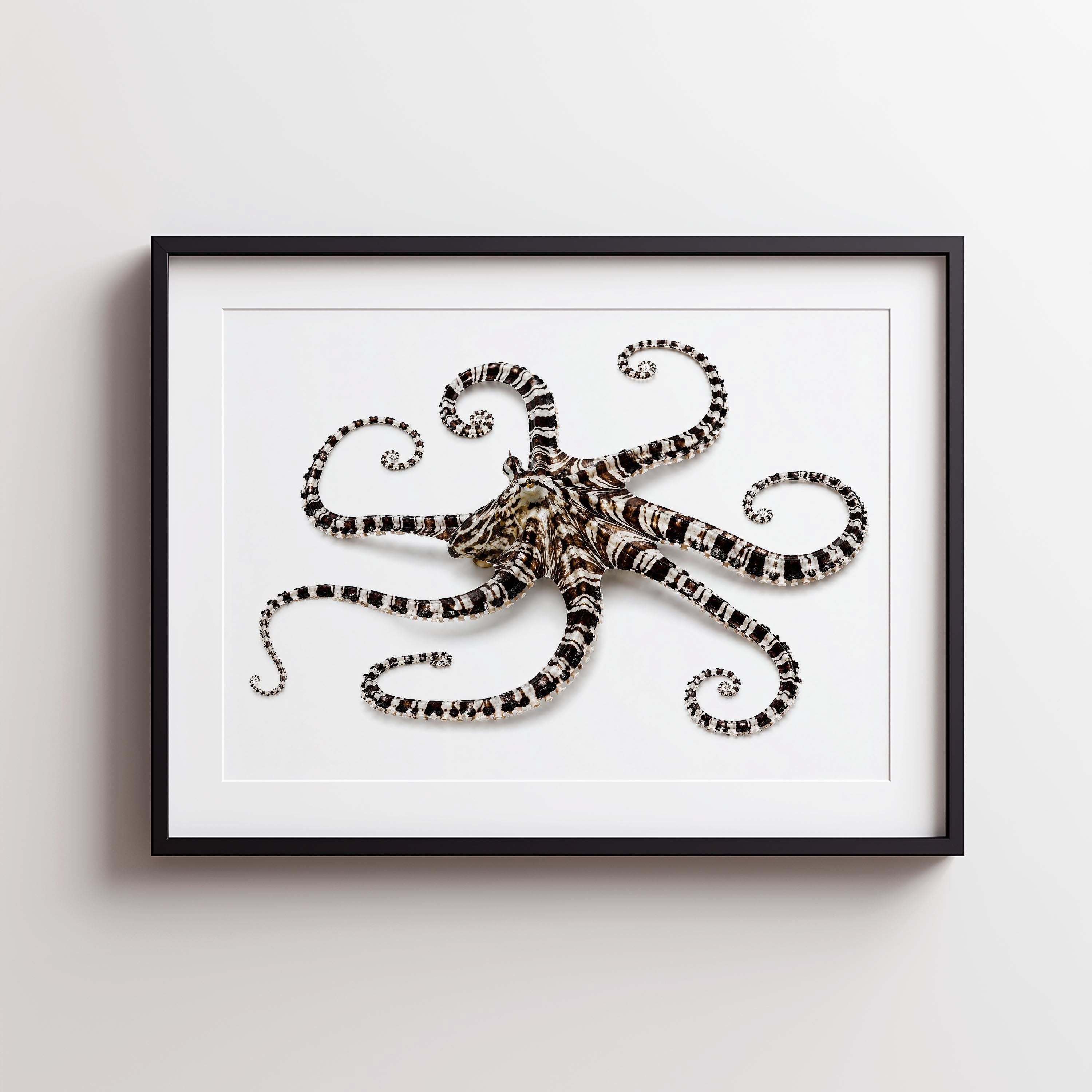
The mimic octopus is the only animal currently known to impersonate more than a dozen different species at will, switching costumes within seconds to match the threat or opportunity in front of it. Where most octopuses vanish into the background, Thaumoctopus mimicus does the opposite - it stages a performance.
It stretches itself into the shape of a venomous lionfish, flattens into a drifting flounder, buries six arms to become a banded sea snake, and rolls into a pulsing blob to pass as a jellyfish. Each of these impressions is aimed at a specific audience, and a mimic octopus appears to choose its role based on who is watching.
This guide covers every major aspect of the species: its recent scientific discovery, its muddy estuarine habitat, its anatomy, its startling behavioural repertoire, its diet, its short and intense life cycle, and its uncertain future. Mimic octopuses are small - less than a metre across with arms fully extended, and under half a kilogram in mass - yet they have rewritten how zoologists think about mimicry in animals.
A Species Hiding in Plain Sight
Western science did not formally describe the mimic octopus until 2005, when Norman and colleagues named Thaumoctopus mimicus in a paper based on observations going back only to 1998. That late discovery is remarkable for such a large, conspicuous, shallow-water macrofauna species. The animal had been overlooked for three main reasons.
First, it lives in muddy estuaries and silted river mouths rather than on photogenic coral reefs, so recreational divers and reef biologists rarely visited its habitat. Second, the estuarine waters where it lives often have visibility of less than a metre, which makes surveys difficult.
Third, its mimicry is so good that earlier sightings were probably logged as observations of the animals it was imitating - a flounder here, a sea snake there, a lionfish over sand.
Divers photographing the muck-diving sites of Sulawesi, Indonesia, in the late 1990s noticed something strange: a flounder gliding across the sand that slowly uncurled into an octopus, or a sea snake that dissolved back into a banded body in a hole. Those photographs triggered the taxonomic work that produced the current description.
The genus name Thaumoctopus comes from the Greek thauma, meaning wonder or marvel, and octopus, meaning eight-footed. The species name mimicus is self-explanatory. Together the name translates roughly as 'the wonderful mimic octopus' - a name chosen deliberately to highlight the species' most unusual trait.
Classification and Relatives
Mimic octopuses belong to the family Octopodidae, the same family that contains most familiar shallow-water octopuses including the common octopus and the day octopus. Within that family, Thaumoctopus appears closely related to the longarm octopus genus Wunderpus, another group of long-armed, banded, soft-bottom specialists. The two are often confused by divers and photographers.
The taxonomic hierarchy runs:
- Kingdom: Animalia
- Phylum: Mollusca
- Class: Cephalopoda
- Order: Octopoda
- Family: Octopodidae
- Genus: Thaumoctopus
- Species: T. mimicus
Only one species is currently recognised in the genus. Some regional populations show subtle differences in banding and arm proportion, and future work may split Thaumoctopus mimicus into several closely related species.
Size and Physical Description
Mimic octopuses are small by octopus standards. The mantle - the bulbous body behind the eyes that contains the gills and internal organs - is typically only five to eight centimetres long. The eight arms extend the total span to around sixty centimetres from tip to tip, though the animal very rarely holds them in that spread-out posture outside of active mimicry. Most of the time the arms are coiled, folded, or tucked, making the whole animal look no larger than a fist on the sea floor.
Body dimensions:
- Mantle length: 5-8 cm
- Arm span (fully extended): up to 60 cm
- Weight: usually under 500 g
- Arm thickness: pencil-thin, narrower than most reef octopuses
The signature feature of the mimic octopus is its colour pattern. Unlike reef octopuses, which typically hold muted browns and greys that blend into background, the mimic octopus wears high-contrast brown-and-white bands or stripes running along its arms and across its mantle. The pattern is aposematic - that is, deliberately visible.
It resembles the warning colouration of venomous lionfish, banded sea kraits, and several venomous flatfish species simultaneously. Because mimic octopuses live on plain, featureless mud, this bold colouration does not give them away against any specific background; instead it invokes an overlap of dangerous animals, and a predator has to decide which of them it is looking at.
The eyes sit high on the mantle, on raised stalks, which allows the octopus to survey the surrounding sand while the rest of the body is buried in a burrow or pressed flat.
Habitat and Range
The mimic octopus is a specialist of soft-bottom, low-energy, shallow tropical environments - the exact places that reef-focused marine biology long ignored. Confirmed populations live in Indonesia (especially northern Sulawesi, Bali, and the Lembeh Strait), the Philippines, Malaysia, and parts of the Andaman Sea. Additional observations from the Great Barrier Reef and the Red Sea indicate that the range may extend further than the original description suggested.
Habitat features:
- Sandy, silty, or muddy substrate
- Shallow water, typically 1-15 m
- Low visibility from suspended sediment
- Adjacent to river mouths, mangrove outflows, or sheltered bays
- Sparse vegetation, scattered rubble, burrows of other animals nearby
- Warm temperatures, typically 25-30 degrees Celsius
The species digs or occupies vertical burrows in the sediment, usually in areas where polychaete worms and crustaceans are dense. A burrow provides shelter between foraging trips and a retreat when the mimicry strategy fails. Some individuals return to the same burrow night after night; others rotate between several burrows across a home range of a few hundred square metres.
Because the habitat is challenging - unstable substrate, poor visibility, river-borne pollutants - few predators and competitors have specialised for it. The mimic octopus has essentially exploited an empty ecological niche that other cephalopods avoid.
The Mimicry: Catalogue of Disguises
Mimic octopuses are not simply shape-shifters. Every octopus can change colour and texture; that is standard cephalopod biology. What separates Thaumoctopus mimicus is the diversity of distinct, named models it imitates and its apparent ability to choose among them situationally.
Documented imitations:
- Flatfish / flounder / sole. The octopus draws six arms behind it, trails them along the midline, and swims in a flat, undulating wave just above the seabed. Seen from above, it looks indistinguishable from a flounder gliding across sand.
- Lionfish. The octopus holds itself above the bottom and spreads all eight arms outward and slightly downward, trailing them like the venomous dorsal spines of a lionfish. The banded colour pattern reinforces the illusion.
- Banded sea snake. Six arms disappear into a burrow, with only two remaining. One arm extends forward like a snake's head, the other backward like a tail, both waving with the characteristic undulating rhythm of a banded sea krait.
- Jellyfish. The body inflates, all eight arms fall loosely below, and the animal drifts at mid-water in a slow pulse - mimicking a harmless but possibly stinging medusa.
- Stingray. The arms flatten around the body to form a diamond outline that glides just above the seabed with one arm trailing as a tail.
- Mantis shrimp. The octopus raises its mantle, folds two arms forward, and waves them as exaggerated claws.
- Crab. Several arms held overhead mimic segmented legs of a swimming crab.
- Anemone. The animal settles on the substrate and extends its arms in a slow, swaying radial pattern.
- Tube worm. Limbs pulled close and the body lifted like an extended feeding crown.
- Brittle star, feather star, and others. Additional imitations reported from photographs but less frequently confirmed.
Researchers have catalogued at least fifteen distinct imitations, and anecdotal reports suggest more. Not all of these have been confirmed in peer-reviewed work, but the core repertoire - flounder, lionfish, and sea snake - is well documented.
Context-Dependent Choice
The truly unusual finding is not just that mimic octopuses imitate many species, but that they appear to choose among those imitations based on the situation.
A classic example comes from field observations of mimic octopuses approached by damselfish. Damselfish are aggressive toward octopuses and will harass them relentlessly on sandy bottoms. When harassed, a mimic octopus commonly rears into the banded sea snake posture. Banded sea snakes are principal predators of damselfish, and the damselfish generally retreat.
Against larger, slower predators from above, the same octopus flattens into a flounder shape and glides along the bottom, which reduces its vertical profile and removes the obvious octopus silhouette.
This capacity to match the disguise to the threat is called context-dependent mimicry. Fixed mimicry - permanently looking like one other species - is common across animals. Dynamic mimicry that switches among multiple models on the basis of context is extraordinarily rare, and the mimic octopus remains the clearest documented example.
How the animal achieves this choice is still under investigation. Octopuses in general have decentralised nervous systems, with roughly two-thirds of their neurons distributed through the arms rather than centralised in the brain. Mimic octopuses may use visual cues, chemical cues, and experience-based learning, but the exact decision-making circuitry is not yet resolved.
Movement and Hunting
Mimic octopuses forage primarily by poking their thin arms into crevices, burrows, and soft sediment. Each arm carries hundreds of suckers lined with chemoreceptors, effectively allowing the octopus to taste the inside of a burrow it cannot see. Prey detected this way is seized, pulled out, and delivered to the central beak.
Typical prey:
- Small benthic fish
- Shrimp and mysid crustaceans
- Small crabs
- Polychaete worms
- Occasional molluscs
Saliva injected by the beak paralyses prey and begins the process of external digestion. The octopus then sucks softened tissue out of its shell or exoskeleton.
Movement around the seabed uses two distinct gaits. For short repositioning, mimic octopuses jet-swim by contracting their mantle and expelling water through the siphon. For quiet foraging they walk on two or three arms, sometimes adopting the two-arm gait that produces the flounder impression. The two-arm gait is unusual among octopuses and appears to be used both for locomotion and for mimicry in the same movement.
Life Cycle and Reproduction
Mimic octopus life cycles are compressed into roughly nine months. Hatchlings emerge as tiny planktonic paralarvae no larger than a rice grain, drift in the upper water column for a few weeks, and settle to the seafloor once they reach a critical size. Settlement appears to depend on encountering suitable silty habitat, which is one reason the species is so tightly tied to specific estuarine areas.
Approximate life cycle timeline:
| Stage | Age | Key events |
|---|---|---|
| Paralarva | 0-3 weeks | Planktonic drift, feeds on tiny crustaceans |
| Settlement | 3-6 weeks | Settles on soft bottom, begins adult behaviour |
| Juvenile | 2-5 months | Rapid growth, develops mimicry repertoire |
| Sexual maturity | 5-7 months | Reproductive activity begins |
| Brooding / death | 7-9 months | Female broods eggs, ceases feeding, dies after hatch |
As with most octopuses, reproduction is terminal. Females brood their clutches of eggs inside a burrow, fanning them with fresh water and defending them against parasites and fungal attack. During brooding the female stops feeding, loses mass, and typically dies around the time the eggs hatch. Males survive slightly longer on average but also senesce and die soon after mating.
This short life cycle is a double-edged sword. It allows populations to respond quickly to improving conditions but also means that environmental disturbances during any single generation can cause large, fast swings in local abundance.
Predators and Defence
Mimic octopuses share their muddy habitat with a range of predators: groupers, snappers, lizardfish, sea snakes, and large wrasses, plus opportunistic hunters such as cormorants and herons in very shallow water. None of these are specialised on mimic octopus prey, but all will take one if they can catch it unaware.
The species' defence is a layered stack:
- Burrow retreat. The first line of defence is simply disappearing into a sediment burrow. Mimic octopuses excavate and maintain burrows that fit their bodies closely.
- Aposematic colouration. The bold brown-and-white banding announces the animal from a distance. Many visual predators have evolved caution around that colour pattern because of overlap with dangerous banded species.
- Specific mimicry. Once a predator has committed to approaching, the octopus switches to whichever model most directly deters that predator.
- Ink. As a last resort, mimic octopuses release a cloud of ink that both obscures vision and contains compounds that disrupt predator olfaction.
- Jet escape. A full mantle contraction can launch the animal several metres in a fraction of a second, usually into a nearby burrow.
The layered system is energetically expensive, especially because repeated displays consume oxygen and colour-control resources. A mimic octopus forced to perform many times in sequence has less energy left for hunting and growth.
Conservation Status
The IUCN Red List classifies Thaumoctopus mimicus as Least Concern. The species is relatively widespread across the shallow Indo-Pacific and does not appear to face any single, dominant threat comparable to sea ice loss for polar bears. That assessment, however, is based on limited data, and several pressures deserve attention.
Identified pressures:
- Coastal pollution. Mimic octopus habitat sits directly downstream of many of the densest human populations on Earth. Fertiliser runoff, sewage discharge, and industrial effluent all accumulate in estuaries. Estuary chemistry directly affects benthic invertebrate prey.
- Sediment changes. Dams, river diversions, and coastal construction alter sediment flow, which in turn changes the grain size and organic content of estuary floors. Mimic octopuses are habitat specialists and may not persist if sediment character shifts.
- Coastal development. Mangrove removal, reclamation, and port expansion directly eliminate suitable estuarine habitat.
- Aquarium trade collection. The species is highly prized by marine aquarium hobbyists. Because mimic octopuses do not breed in captivity and live less than a year, every specimen sold represents a wild removal. Small local populations can be rapidly depleted by collection.
- Climate change. Warming water temperatures may shift the species' range, and rising sea levels may drown some estuary habitats while exposing others.
- Fishing bycatch. Trawling and shrimp fisheries operating over soft bottoms occasionally take mimic octopuses as bycatch.
Because the species is only recently described, long-term population data do not exist. The Least Concern listing should be treated as provisional and revisited as better regional monitoring becomes available.
Mimic Octopus and People
Mimic octopuses have become a poster species for muck diving - the practice of exploring sandy, silted, seemingly empty bottoms for the cryptic animals that live there. Sites like Lembeh Strait and Anilao have developed substantial ecotourism economies around mimic octopus encounters, and revenue from these operations provides a concrete incentive for local communities to protect estuary habitat.
For photographers and videographers the species is almost an obsession, thanks to the spectacle of watching a single animal impersonate a flounder, then a sea snake, then a lionfish inside a few minutes. Responsible operators insist on minimum approach distances, low light output, and strict limits on the number of divers per animal.
For science, the mimic octopus has re-opened questions that were considered settled. Mimicry was long treated as a static trait - fixed colour patterns, fixed body shapes - inherited from parent to offspring. The mimic octopus is neither fixed nor stereotyped. It chooses, switches, and combines models on the fly. Understanding how a short-lived invertebrate can pull this off is actively reshaping the theory of animal communication.
Related Reading
- Giant Pacific Octopus: Enteroctopus dofleini and the Largest Octopus on Earth
- Octopuses: The Alien Intelligence of the Ocean
- Three Hearts, Nine Brains, Blue Blood: Inside Octopus Biology
References
Relevant peer-reviewed sources consulted for this entry include Norman, Finn and Tregenza (2001) on dynamic mimicry in Indo-Malayan octopuses in Proceedings of the Royal Society B, the formal description of Thaumoctopus mimicus by Norman and Hochberg (2005) in Molluscan Research, field reports on mimic octopus behaviour from Marine Biology and Journal of the Marine Biological Association of the United Kingdom, and IUCN Red List cephalopod assessments.
Behavioural catalogues draw on long-term documentation from muck-diving research sites in Lembeh Strait and the Philippines.
Frequently Asked Questions
What is a mimic octopus?
The mimic octopus (Thaumoctopus mimicus) is a small cephalopod from the shallow estuaries of the tropical Indo-Pacific, first described by science in 1998. Adults reach an arm span of roughly 60 centimetres with a mantle only 5-8 centimetres long.
The species is unique among known animals for its context-dependent mimicry: it imitates at least fifteen other species - including flatfish, lionfish, sea snakes, jellyfish, stingrays, and mantis shrimp - and chooses each disguise to fit the specific threat or opportunity in front of it. That flexibility, rather than its size or strength, is what sets it apart.
What does the mimic octopus eat?
The mimic octopus is a specialised carnivore of soft-bottom habitats. Its diet centres on small benthic fish, shrimp, crabs, and polychaete worms found in muddy estuaries and sandy flats. It hunts by poking its arms into burrows, flushing prey into the open, and seizing them with suckers tipped in chemosensory cells. Like other octopuses it injects saliva containing paralysing and digestive compounds, then sucks out softened tissue.
Because visibility in its silty habitat is often poor, the mimic octopus relies heavily on touch and chemical cues rather than eyesight when hunting.
Where does the mimic octopus live?
The mimic octopus inhabits the shallow tropical waters of the western Indo-Pacific, with confirmed populations in Indonesia (especially Sulawesi, Bali, and Lembeh Strait), the Philippines, and Malaysia. Additional sightings have been reported as far as the Great Barrier Reef and the Red Sea, suggesting a wider range than originally assumed.
It prefers sandy and silty estuarine bottoms near river mouths - habitats that most reef animals avoid because of low visibility and unstable substrate. Typical depths run from about one metre down to fifteen metres. The species is rarely, if ever, seen over healthy coral reef.
How does the mimic octopus choose which animal to imitate?
The mimic octopus appears to select each disguise based on the identity of the threat or the context of the encounter. When confronted by territorial damselfish, for instance, it raises its arms in a banded sea snake pattern - and sea snakes are a principal predator of those damselfish. Approached by larger fish, it may flatten itself into a flounder shape and skim across the sand, a hard target to attack from above.
This threat-appropriate switching separates the mimic octopus from most other mimics, which generally imitate only one model species. Researchers describe the behaviour as functionally context-dependent mimicry.
How long does the mimic octopus live?
Mimic octopuses live only about nine months from hatching to death. They grow rapidly, reach sexual maturity in a few months, mate once, and die shortly after the female finishes brooding her eggs. This is a typical pattern for smaller tropical octopuses, which rely on fast reproduction rather than longevity.
Because individuals live less than a year, every generation is effectively independent, and the species cannot accumulate the long-term learning seen in longer-lived cephalopods. Short lifespan also makes population monitoring difficult, since animals counted one season will be entirely replaced by the next.
Is the mimic octopus venomous or dangerous to humans?
The mimic octopus is not considered dangerous to humans. Like other octopuses it has a beak and saliva containing active compounds used to subdue prey, but bites are extremely rare and no serious envenomation has been documented. Most of its famous imitations are of venomous or stinging animals - lionfish, sea snakes, stingrays - but those models do the deterrent work. The octopus itself is small, delicate, and retreating by nature.
Divers are advised to observe from a respectful distance because repeated disturbance forces the octopus to spend energy on defensive displays that it would otherwise use for hunting.
When was the mimic octopus discovered?
The mimic octopus was first photographed by divers on a muddy estuary bottom off Sulawesi, Indonesia, in 1998. It was formally described as Thaumoctopus mimicus in a 2005 paper by Norman and colleagues. Before those records the animal had been overlooked, partly because it lives in habitats rarely surveyed by reef biologists and partly because its mimicry made it easy to mistake for the animals it was imitating.
Its late scientific discovery - extremely recent for a conspicuous macrofauna species - is often cited as evidence that the ocean’s shallow tropics still hold poorly known animals in plain sight.
Is the mimic octopus endangered?
The IUCN Red List currently classifies the mimic octopus as Least Concern. The species appears to be relatively widespread across suitable estuarine habitat in the Indo-Pacific, and no quantified global decline has been documented. That said, the animal faces real pressures: estuary pollution, river sediment changes from upstream development, coastal construction, and targeted collection for the marine aquarium trade.
Because the species is a habitat specialist with a nine-month life cycle, local populations can crash and recover quickly in response to environmental change. Long-term monitoring is limited and conservation status should be treated as provisional.