
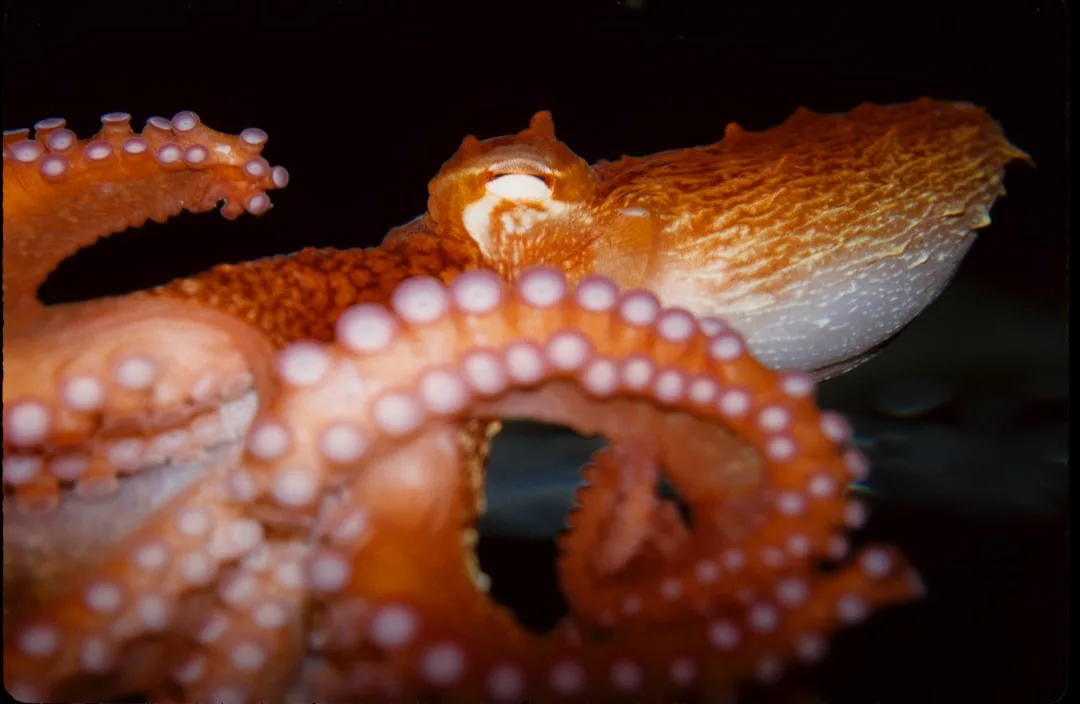
The giant Pacific octopus is the largest octopus species on Earth and one of the strangest large animals in the ocean. Unlike most predators of its size, it has no bones, no shell, and only one rigid body part - a parrot-like beak the size of a small coin.
It has three hearts, blue blood, nine brains if you count the peripheral ganglia that control each arm, and a life that ends in a programmed collapse shortly after a single reproductive event. Enteroctopus dofleini is the species most aquarium visitors picture when they imagine an octopus, and the species most marine biologists cite when they discuss invertebrate intelligence.
This guide covers every aspect of giant Pacific octopus biology and ecology: size and anatomy, habitat, hunting, diet, cognition, reproduction, sensory systems, defences, and the short, compressed life cycle that makes the species so biologically unusual. It is a reference entry, not a summary - so expect specifics: metres, kilograms, neurons, eggs, and verified records.
Etymology and Classification
The scientific name Enteroctopus dofleini honours the German zoologist Franz Theodor Doflein, who studied Pacific cephalopods in the early twentieth century. The genus Enteroctopus was erected to group a small cluster of cold-water giant octopuses distinct from the more familiar warm-water Octopus vulgaris and its relatives. Older literature still refers to the species as Octopus dofleini or Octopus apollyon, a synonym used in the nineteenth century.
Japanese fishers call the species mizudako, meaning water octopus, a name that reflects both its scale and its preference for cold Japanese waters. In the Pacific Northwest it is often called simply the Pacific octopus or North Pacific giant octopus. In Russian it appears as giganstkiy osminog.
Within the class Cephalopoda the species sits in the order Octopoda, the true octopuses, and the family Enteroctopodidae, which contains roughly half a dozen other cold-water giants. Genetic analysis confirms that E. dofleini diverged from its nearest relatives several million years ago and has since adapted specifically to the North Pacific cold temperate zone.
Despite its apparent uniformity, population genetics suggest several regional lineages that may eventually be described as subspecies or separate species.
Size and Physical Description
The giant Pacific octopus holds the record for the largest octopus ever measured, though which measurement counts as the record is a matter of ongoing debate. Reliable modern specimens reach an arm span of about 5 metres and a live mass of roughly 50 kilograms.
Historical accounts, most famously a 1957 specimen from British Columbia, report animals of 9.1 metres and 272 kilograms, but those figures were estimated rather than weighed on certified scales and have never been repeated under controlled conditions.
Typical adults:
- Arm span: 3-5 metres tip to tip
- Mantle length: 30-60 centimetres
- Weight: 10-50 kilograms
- Suckers per arm: roughly 280, total 2,240 across the body
Large verified specimens:
- Arm span: up to about 5 metres
- Weight: 50-70 kilograms
Disputed historical records:
- Arm span: up to 9.1 metres
- Weight: up to 272 kilograms
Hatchlings:
- Length: roughly 3 millimetres
- Weight: a few milligrams
- Behaviour: planktonic drifters for 30-90 days before settling
The body plan is built around a soft, muscular mantle that houses the gills, hearts, digestive system, and reproductive organs. Eight arms radiate from a central ring surrounding the mouth. Each arm is lined with two rows of suckers capable of independent suction, grip, and chemical sensing. Males have a modified third right arm called the hectocotylus, which is used to transfer sperm packets during mating.
The only rigid structure in the entire body is the beak, a pair of keratinous jaws that sit at the centre of the arm crown. In a 50-kilogram adult the beak is about the size of a five-pence coin. Because every other tissue is flexible, the beak determines the smallest gap an octopus can squeeze through, and giant Pacific octopuses have been documented forcing a 30-kilogram body through holes no wider than a tennis ball.
Their skin is thin, pigmented, and interleaved with multiple layers of specialised cells that produce colour and texture changes discussed in detail below.
Habitat and Range
Giant Pacific octopuses live exclusively in the cold temperate North Pacific. Their continuous range stretches from the southern Japanese islands and the Korean Peninsula northward along the Russian Far East, across the Sea of Okhotsk and the Bering Sea, along the Aleutian chain, and down the North American west coast through Alaska and British Columbia to roughly Monterey Bay in central California. Outliers occur further south in deeper, cooler water.
Preferred habitat features:
- Rocky reefs with crevices and boulder fields suitable for dens
- Depth range: 0-100 metres most commonly, down to 1,500 metres on record
- Water temperature: 4-12 degrees Celsius
- Salinity: fully marine, typically 30-34 parts per thousand
- Dissolved oxygen: high, limiting the species to well-oxygenated coastal water
Giant Pacific octopuses are den-based predators. An adult selects a sheltered crevice or overhang, excavates loose sediment, and piles shell debris at the entrance to form a midden. Biologists use middens to locate occupied dens: a fresh pile of broken crab shells, clam fragments, and fish bones almost always signals a resident octopus inside. Individual dens are used for weeks to months at a time, with the octopus making short foraging excursions at dawn and dusk.
The species is generally solitary and will actively drive other octopuses, including smaller members of its own species, away from an occupied den. Population density varies with habitat quality but rarely exceeds one adult per hundred square metres of prime rocky substrate.
Sensory Systems
The octopus nervous system is organised unlike that of any vertebrate, and the giant Pacific octopus is the species where this architecture has been studied most intensively.
Central and peripheral brains: A central brain shaped like a doughnut surrounds the oesophagus and coordinates overall behaviour. Eight additional large ganglia sit in the arms, one per arm, each containing tens of millions of neurons. Roughly two thirds of the animal's approximately 500 million neurons sit outside the central brain.
Each arm is effectively a semi-autonomous limb capable of exploring, grasping, and reacting to stimuli without the central brain telling it what to do. This is the origin of the popular phrase "nine brains".
Eyes: The eyes are large, camera-style organs superficially similar to vertebrate eyes but evolved independently. They produce high-resolution images but contain only one visual pigment, making the animal functionally colour-blind in the conventional retinal sense.
Paradoxically, the species is famous for colour-matching camouflage, which has led researchers to the hypothesis that the skin itself contains opsin-based photoreceptors that detect wavelength locally and feed that information into colour-change circuits.
Chemoreception: Each sucker is lined with chemoreceptor cells that function as taste buds. An extended arm can literally taste every surface it touches, sampling molecules dissolved in the water and absorbed by contact. This is why octopuses appear to "feel around" in crevices - they are tasting as much as touching.
Mechanoreception and proprioception: Suckers also contain touch-pressure receptors so sensitive that an octopus can identify objects by texture alone. Proprioception - the sense of limb position - is thought to be handled largely at the arm ganglion level, which is why the central brain does not appear to track arm position in the way a vertebrate brain tracks its limbs.
Hearing: Cephalopods have statocysts, paired fluid-filled balance organs with calcareous concretions that detect gravity and low-frequency vibrations. They do not have ears in the vertebrate sense but respond to low-frequency sound and water pressure changes.
Cognition and Behaviour
Giant Pacific octopuses have been studied in public aquaria and research institutions for decades, and the accumulated record of intelligent behaviour is extensive.
Documented cognitive abilities:
- Individual recognition. Octopuses housed in aquariums behave differently toward familiar and unfamiliar humans, reliably extending arms toward caretakers they associate with food and ignoring or squirting water at strangers.
- Tool use. Giant Pacific octopuses have been observed manipulating coconut halves, rocks, and clam shells as portable shelters, carrying them across open seabed and assembling them into improvised dens.
- Problem solving. Individuals learn to unscrew jar lids from both the outside and the inside within a few minutes of exposure. They navigate mazes, disassemble experimental puzzle boxes, and manipulate latches designed for primates.
- Learning by observation. Laboratory studies have shown that naive octopuses can acquire behaviours by watching trained demonstrators, an ability previously thought to be restricted to vertebrates.
- Personality. Across multiple studies, individual giant Pacific octopuses show consistent traits - bold vs. shy, active vs. sedentary, aggressive vs. curious - that persist for months.
- Play. When provided with novel objects, well-fed octopuses will manipulate them in repeated, non-functional ways consistent with behavioural definitions of play.
These abilities are particularly striking given the evolutionary distance between octopuses and vertebrates. The last common ancestor of a human and an octopus lived over 600 million years ago and had, at best, a simple nerve net. Octopus intelligence is therefore considered the best example of independently evolved, convergent cognition on Earth.
Hunting and Diet
Giant Pacific octopuses are nocturnal and crepuscular hunters that leave their dens at dusk, forage across the surrounding substrate, and return before dawn carrying prey. They are opportunistic carnivores and will attempt to capture almost any moving animal within reach.
Primary prey:
- Dungeness crab, red rock crab, and spider crab
- Clams, scallops, abalone, and other bivalves
- Shrimp and small lobsters
- Flatfish, sculpins, rockfish, and other demersal fishes
Opportunistic and documented prey:
- Other octopuses, including conspecifics
- Small sharks such as spiny dogfish
- Seabirds caught at the surface
- Lingcod, cabezon, and other reef predators
Capture techniques:
- Ambush. The octopus changes colour and texture to blend with the substrate, allows prey to pass within striking distance, and explodes outward by launching its web and arms simultaneously.
- Engulfing. The arms and interbrachial web wrap around prey, trapping it inside the funnel formed by the web. This is the dominant capture method for crabs and fish.
- Drilling. For shelled prey, the octopus uses its radula - a tongue-like rasping organ - to drill a small hole through the shell, then injects cephalotoxin and other paralysing compounds through the hole. The bivalve's adductor muscle relaxes and the octopus pulls the shell open.
- Biting. The beak can shear through crab carapace and fish vertebrae with ease. Larger prey are dismantled outside the den and the edible parts carried home.
A healthy adult consumes roughly 2 to 4 per cent of its body mass per day. Over a typical three-to-four-year foraging career, an individual may eat hundreds of kilograms of marine prey, with measurable effects on local crab and shellfish populations.
Camouflage and Skin
The skin of the giant Pacific octopus is one of the most sophisticated display systems in the animal kingdom. Four separate cell types cooperate to produce the full range of colour and texture changes observed in the species.
Chromatophores are muscular pigment sacs, each operated by a ring of radial muscles controlled by the nervous system. When the muscles contract, the sac flattens and expands the pigment across a wide visible area. When the muscles relax, the sac shrinks to a pinpoint and effectively disappears. Giant Pacific octopuses carry chromatophores containing red, brown, yellow, and black pigments.
Iridophores are stacks of thin protein platelets that create structural colour through thin-film interference, much like a soap bubble or a butterfly wing. They produce blues, greens, silvers, and shifting metallic tones that change with viewing angle. Iridophores are not under direct muscular control in the same way chromatophores are; they are slower to respond and contribute primarily to longer-term background-matching.
Leucophores scatter all visible wavelengths equally, producing bright matte whites. They function as a neutral backdrop against which the chromatophores paint colour.
Papillae are small muscular bumps in the skin that can be raised into ridges, horns, and spikes to mimic seaweed, rock, or coral texture. Giant Pacific octopuses carry dozens of papillae of varying sizes and can independently control many of them.
A full colour-and-texture change can complete in milliseconds. The species uses these displays for camouflage (matching substrate), communication (deimatic displays during threat, pale-on-pale mating signals), and possibly thermoregulation by darkening or paling the skin.
Circulatory and Respiratory Systems
The giant Pacific octopus circulatory system is unusual in two respects: three hearts and copper-based blue blood.
Three hearts:
- Two branchial hearts sit at the base of each gill and pump deoxygenated blood through the gill filaments. Pushing blood through dense gill tissue is energetically expensive and requires a dedicated pump per gill.
- One systemic heart sits in the centre and pumps the newly oxygenated blood through the rest of the body.
- The systemic heart stops beating during active swimming. This is one of the reasons octopuses tire quickly when jetting and prefer to crawl over short distances.
Blue blood: Giant Pacific octopus blood uses hemocyanin, a copper-based respiratory protein, rather than the iron-based hemoglobin used by vertebrates. Hemocyanin binds oxygen efficiently in cold, low-oxygen seawater where hemoglobin would struggle. Oxygenated hemocyanin is bright blue; deoxygenated hemocyanin is pale grey. The cost of hemocyanin is lower oxygen-carrying capacity per unit volume, which further limits sustained aerobic activity.
The gills sit inside the mantle cavity. Water enters through a slit around the edge of the mantle, passes across the gills, and exits through the funnel, a muscular tube that also serves as the propulsion outlet during jet swimming.
Reproduction and Life Cycle
Reproduction in Enteroctopus dofleini is the strangest and most compressed part of its biology. The species is semelparous - each individual reproduces only once, and reproduction initiates a programmed physiological decline ending in death.
Mating: Males and females meet in the open, usually at the edge of suitable rocky habitat. The male inserts his hectocotylised arm into the female's mantle cavity and deposits one or more spermatophores, each a cartridge containing millions of sperm. Mating can last from a few minutes to several hours. Males may mate with multiple females across their short reproductive window, but each mating event drains them further.
Egg laying: The female retreats to a den, typically within a few weeks of successful mating, and begins laying eggs. A single clutch numbers between 20,000 and 100,000 eggs, each about the size of a grain of rice, attached in braided strings to the ceiling and walls of the den.
Brood care: The female stops hunting and guards the eggs continuously for 6 to 8 months. She cleans them with her arms, circulates oxygenated water over them using jets from her funnel, and drives off predators. She does not eat during the entire brood period. Her body weight drops by over 50 per cent, her skin thins, and her immune system deteriorates.
Hatching and death: When the eggs hatch, tiny paralarvae drift out of the den as plankton. The female, exhausted and in terminal senescence, dies shortly afterwards. In most observed cases death occurs within a few weeks of the last hatch.
Male senescence: Males that mate successfully also enter senescence, triggered by hormones produced in the optic glands that sit at the base of the eyes. They stop feeding, lose coordination, and usually die within months of mating.
Larval phase: Hatchlings are 3 millimetres long and spend 30 to 90 days as planktonic drifters. Mortality is enormous - more than 99 per cent of hatchlings die before settling.
Growth: Survivors settle to the seabed and begin a phase of explosive growth. A juvenile may double its mass every month for the first year. Sexual maturity is reached at around 2 to 3 years, and the whole life cycle typically closes between years 3 and 5.
| Life stage | Duration | Approximate mass |
|---|---|---|
| Egg | 6-8 months | grain of rice |
| Paralarva | 30-90 days | milligrams |
| Juvenile | 1-2 years | grams to kilograms |
| Sub-adult | 6-12 months | 5-20 kilograms |
| Reproductive adult | 2-6 months | 10-50 kilograms |
| Senescence | weeks to months | declining |
Defence and Escape
Giant Pacific octopuses deploy a layered defence strategy.
Camouflage is the first line and usually sufficient. The animal blends into substrate well enough that divers routinely swim past occupied dens without noticing them.
Ink is the second line. When startled, the octopus releases a dense dark cloud of melanin from its ink sac, mixed with tyrosinase - an enzyme that interferes with predator olfactory and gustatory receptors. The ink cloud is both a visual screen and a chemical deterrent. Many predators, including moray eels and small sharks, react to ink with confusion and reduced attack rates.
Jet propulsion is the escape mechanism. The mantle fills with water, then muscular contraction blasts water out through the funnel, pushing the animal backward at speeds up to 40 kilometres per hour for short bursts. The systemic heart stops during jetting, so sustained jet swimming is not possible; the octopus uses it to clear danger, then resumes crawling.
Autotomy is the last resort. The octopus can detach an arm at a predetermined breakpoint. The severed arm continues to move for several minutes, distracting the predator, while the octopus escapes. Lost arms regenerate fully over weeks to months.
Squeezing lets octopuses exploit refuges unavailable to most large predators. With only the beak as a rigid limit, a 30-kilogram individual can force itself through gaps of a few centimetres, passing through aquarium drains, boat hatches, and crevices that would stop any vertebrate of similar mass.
Predators and Threats
Despite their size, giant Pacific octopuses are prey for several species.
Marine predators:
- Harbour seals, sea lions, and northern elephant seals
- Transient orcas in certain regions
- Large rockfish, lingcod, and cabezon for smaller individuals
- Spiny dogfish and other small sharks
- Other octopuses, including larger conspecifics
Human pressures:
- Commercial pot, trawl, and hook-and-line fisheries in Japan, Korea, Russia, and parts of North America
- Recreational harvest where permitted
- Bycatch in Dungeness crab and bottom trawl fisheries
- Coastal pollution, including sewage outfalls and plastic debris
- Ocean warming pushing cold-water populations northward
- Ocean acidification affecting shelled prey availability
- Hypoxic dead zones in semi-enclosed basins
The IUCN currently classifies the species as Least Concern based on its broad range and apparent resilience, but several regional assessments caution that local populations could decline rapidly under fishing pressure or warming. Puget Sound in Washington State has implemented recreational harvest restrictions, and Alaska adjusts commercial quotas annually based on local abundance.
Giant Pacific Octopuses and Humans
Giant Pacific octopuses have a long cultural history in the North Pacific. Japanese cuisine features mizudako in sashimi, takoyaki, and stewed dishes; Korean cuisine prepares sannakji, the famous live-sliced dish, using smaller relatives but occasionally larger specimens. Indigenous coastal peoples of the Pacific Northwest have harvested and eaten the species for thousands of years.
In Western public aquariums, E. dofleini is the flagship invertebrate. The Seattle Aquarium, Vancouver Aquarium, and Monterey Bay Aquarium have all housed giant Pacific octopuses for decades and contributed most of the behavioural and cognitive data used in research. Public interest is enormous, driven partly by the species' size and partly by the steady stream of documented intelligent behaviour.
Encounters with scuba divers are generally peaceful. The species is curious rather than aggressive and will often investigate divers by extending an arm to taste their equipment. Bites are rare and usually a response to handling. Beak punctures can inject cephalotoxin and cause local pain and numbness but are not life-threatening.
Related Reading
- Octopus Intelligence: How Invertebrates Out-Think Most Vertebrates
- Cephalopods of the World: Masters of Disguise
- Camouflage in the Ocean: Colour Without Colour Vision
- Deep Sea Giants: Why Cold Water Produces Huge Invertebrates
References
Relevant peer-reviewed and institutional sources consulted for this entry include IUCN Red List assessments for Enteroctopus dofleini, Alaska Department of Fish and Game stock assessments, Washington Department of Fish and Wildlife survey reports, and published research in Journal of Experimental Biology, Current Biology, Marine Biology, and Journal of Molluscan Studies.
Behavioural and cognitive data draw on work from the Seattle Aquarium, Vancouver Aquarium, Monterey Bay Aquarium, and academic laboratories at the University of Washington and University of Alaska Fairbanks. Size records are reported as published, with disputed historical figures flagged as such.
Frequently Asked Questions
How big is the giant Pacific octopus?
The giant Pacific octopus (Enteroctopus dofleini) is the largest octopus species on Earth. A typical adult measures 3 to 5 metres in arm span and weighs 10 to 50 kilograms, with mature males usually slightly larger than females.
The largest verified specimens approach 5 metres across and about 50 kilograms, though a historical record from 1957 in British Columbia is frequently cited at 9.1 metres and 272 kilograms; that figure is widely disputed and has never been replicated under scientific observation. Hatchlings are the size of a grain of rice, roughly 3 millimetres long, and spend the first month drifting as plankton before settling to the seabed.
Where do giant Pacific octopuses live?
Giant Pacific octopuses inhabit cold temperate coastal waters around the northern rim of the Pacific Ocean. Their range runs from southern Japan and the Korean Peninsula, north through the Russian Far East, across the Aleutian chain, along the coasts of Alaska and British Columbia, and south to about central California.
They favour rocky reefs, boulder fields, and artificial structures where they can excavate dens, typically between the low-tide line and depths of about 100 metres, though specimens have been trawled from below 1,500 metres. Water temperatures in core habitat range from roughly 4 to 12 degrees Celsius.
What do giant Pacific octopuses eat?
Giant Pacific octopuses are opportunistic carnivores that eat essentially any animal they can capture and subdue. The staple diet is crustaceans - primarily crabs such as Dungeness, red rock, and spider crabs - supplemented by clams, scallops, abalone, shrimp, and a wide variety of bony fish.
Larger specimens regularly kill and eat other octopuses, including smaller members of their own species, and there are documented cases of giant Pacific octopuses catching and consuming small sharks, seabirds, and even spiny dogfish. They hunt using camouflage and ambush, wrap prey in their arms, inject paralysing saliva through the beak, and then either drill into shells or dismantle prey piece by piece.
A healthy adult consumes roughly 2 to 4 per cent of its body mass per day.
How long do giant Pacific octopuses live?
Giant Pacific octopuses live only 3 to 5 years, which is remarkable given their size - almost every other animal in the 50-kilogram range lives for decades. The species is semelparous, meaning a single reproductive event marks the end of life. After mating, males drift into a months-long decline driven by changes in a hormone produced by the optic glands, and typically die within a few months.
Females survive only long enough to tend their egg clutch - six to eight months without eating - and die shortly after the eggs hatch. The entire life cycle compresses rapid growth, a short reproductive window, and programmed senescence into roughly 60 months.
How intelligent are giant Pacific octopuses?
Giant Pacific octopuses are among the most cognitively capable invertebrates ever studied. They solve novel mazes, open screw-top jars from either side, learn by observation, remember the identities of individual humans, and exhibit distinctive personalities that persist across years.
Their nervous system contains about 500 million neurons, comparable to a dog, but distributed unusually: roughly a third sits in a central brain around the oesophagus and the remaining two thirds is split across 8 peripheral ganglia, one per arm. Each arm can explore, taste, and grip on its own, with the central brain acting more like a coordinator than a command centre.
Laboratory tests confirm long-term memory, short-term memory, and the ability to transfer learning between arms.
How do giant Pacific octopuses camouflage?
The giant Pacific octopus changes colour and texture using four cooperating systems in the skin. Chromatophores are muscular pigment sacs that expand or contract to produce reds, browns, yellows, and blacks. Iridophores are stacked crystal plates that reflect structural colour - blues, greens, and silvers - without pigment. Leucophores scatter all wavelengths to produce bright white.
Papillae are bundles of small muscles that raise the skin into bumps, ridges, and spikes to mimic surrounding rock and seaweed. A giant Pacific octopus can cycle through a complete colour and texture change in under a second. Curiously, their eyes have only one visual pigment and are functionally colour-blind, so camouflage matching is thought to rely on photoreceptors in the skin itself.
Why do giant Pacific octopuses have three hearts and blue blood?
The three hearts evolved to handle the demands of a high-activity invertebrate breathing cold seawater. Two smaller branchial hearts sit at the base of each gill and push deoxygenated blood through the gill filaments at high pressure, which is energetically expensive because gills are dense tissue. The larger systemic heart then takes the newly oxygenated blood and pumps it through the rest of the body.
The systemic heart stops beating during active swimming, which is thought to be one reason octopuses tire so quickly and prefer crawling. Their blood carries oxygen using hemocyanin, a copper-based protein that binds oxygen efficiently in cold, low-oxygen seawater but turns the blood bright blue when oxygenated and pale grey when deoxygenated.
Are giant Pacific octopuses endangered?
The IUCN currently classifies the giant Pacific octopus as Least Concern based on its broad North Pacific distribution and apparent population stability across much of that range, though several regional assessments caution that population data are limited. Commercial and recreational fisheries target the species in Japan, Korea, and parts of the United States, and bycatch in pot and trawl fisheries is substantial.
The main long-term pressures are ocean warming (which is squeezing cold-water populations northward), ocean acidification (which reduces the availability of shelled prey and may affect larval survival), hypoxic dead zones, and coastal habitat loss. Giant Pacific octopus populations in Puget Sound and parts of Alaska are monitored with dive surveys, and regional catch limits are adjusted based on local abundance.