
How do sea turtles navigate thousands of miles to return to the exact beach where they were born?
Sea turtles use a sophisticated biological compass based on Earth's magnetic field. When hatchlings first crawl from their nest to the ocean, they imprint on the unique magnetic signature of their natal beach - a combination of magnetic field intensity and inclination angle that acts like a geomagnetic address.
On a warm night along the coast of Costa Rica, the sand begins to move. Not in one place, but across an entire stretch of beach - hundreds of dark shapes hauling themselves from the surf, each one following an ancient biological imperative older than most mountain ranges.
These are olive ridley sea turtles, arriving in a synchronized mass nesting event called an arribada, and they have been performing this ritual for longer than the Andes have existed. To watch it is to witness a living connection to the Cretaceous period, when sea turtles shared the oceans with mosasaurs and plesiosaurs.
Sea turtles are among the most extraordinary animals on Earth. They navigate across entire ocean basins using the planet's magnetic field, dive to crushing depths that would destroy a submarine's hull, and return - after decades of wandering - to the precise stretch of sand where they hatched. They have survived asteroid impacts, ice ages, and the rise and fall of countless species. What they may not survive is us.
Evolutionary Origins: 110 Million Years of Ocean Mastery
The evolutionary lineage of sea turtles stretches back approximately 110 million years to the Cretaceous period, when they diverged from their terrestrial ancestors and committed fully to a marine existence. The earliest known sea turtle, Desmatochelys padillai, was discovered in Colombia and dated to approximately 120 million years ago, making sea turtles contemporary with many of the most iconic dinosaurs.
By the Late Cretaceous, sea turtles had diversified into multiple lineages, including the enormous Archelon ischyros, which reached lengths of 4.6 meters (15 feet) and weighed over 2,200 kilograms - roughly the size of a small car.
The most remarkable chapter in sea turtle evolutionary history is their survival of the Cretaceous-Paleogene (K-Pg) extinction event approximately 66 million years ago - the asteroid impact that annihilated the non-avian dinosaurs, pterosaurs, mosasaurs, plesiosaurs, and roughly 75% of all species on Earth.
While the oceans experienced catastrophic disruption, including the collapse of marine food webs and acidification from atmospheric sulfur, ancestral sea turtles endured.
Researchers believe several factors contributed to their survival: their ability to enter torpor (a state of reduced metabolic activity) during periods of food scarcity, their omnivorous dietary flexibility, and the protective thermal buffering of the ocean itself.
Since the K-Pg extinction, sea turtles have continued to evolve and diversify, but the basic body plan - streamlined carapace, powerful front flippers for underwater flight, salt-excreting glands near the eyes, and the capacity for extraordinary long-distance migration - has remained remarkably stable.
The seven species alive today represent the survivors of a much larger radiation, and they occupy ecological niches ranging from shallow seagrass meadows to the open pelagic ocean and the frigid waters of the subarctic.
"Sea turtles are the ocean's great connectors. A single loggerhead may link a Japanese nesting beach to Baja California feeding grounds, crossing the entire Pacific in the process. They bind ecosystems together across thousands of miles." - Dr. Wallace J. Nichols, marine biologist and author of Blue Mind
The Seven Species: A Comprehensive Profile
All seven living species of sea turtles belong to two families: Cheloniidae (the hard-shelled sea turtles, comprising six species) and Dermochelyidae (containing only the leatherback). Each species occupies a distinct ecological role, and together they span every tropical and temperate ocean on the planet.
| Species | Scientific Name | Max Length (cm) | Max Weight (kg) | Diet | IUCN Status | Key Range |
|---|---|---|---|---|---|---|
| Green | Chelonia mydas | 150 | 315 | Herbivore (seagrass, algae) | Endangered | Tropical/subtropical worldwide |
| Loggerhead | Caretta caretta | 120 | 200 | Carnivore (crustaceans, mollusks) | Vulnerable | Temperate/subtropical worldwide |
| Hawksbill | Eretmochelys imbricata | 100 | 80 | Sponges (specialist) | Critically Endangered | Tropical reefs worldwide |
| Leatherback | Dermochelys coriacea | 180 | 700 | Jellyfish (specialist) | Vulnerable | All oceans, subarctic to tropics |
| Kemp's Ridley | Lepidochelys kempii | 70 | 50 | Crabs (specialist) | Critically Endangered | Gulf of Mexico, Atlantic |
| Olive Ridley | Lepidochelys olivacea | 75 | 50 | Omnivore (jellyfish, crabs, algae) | Vulnerable | Tropical waters worldwide |
| Flatback | Natator depressus | 100 | 90 | Omnivore (soft corals, jellyfish) | Data Deficient | Northern Australia only |
Green Sea Turtle (Chelonia mydas)
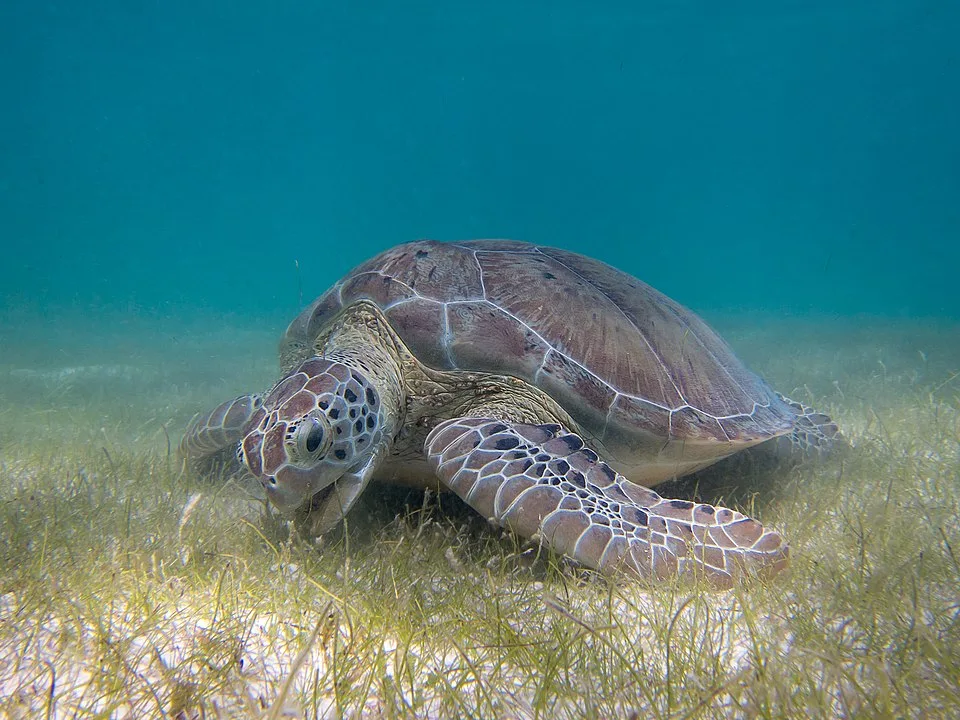
The green sea turtle is the largest of the hard-shelled species and the only sea turtle that is primarily herbivorous as an adult. The name refers not to its external coloration - which is typically olive to dark brown - but to the green-colored fat beneath its carapace, a consequence of its seagrass and algae diet.
Green turtles play a critical ecological role as marine grazers: by cropping seagrass beds, they stimulate new growth, increase nutrient cycling, and maintain the health of habitats that serve as nurseries for hundreds of fish species.
Green turtles undergo one of the most dramatic dietary shifts in the animal kingdom. Juveniles are omnivorous, feeding on jellyfish, crustaceans, and sponges in the open ocean. As they mature and move to coastal habitats, they transition to an almost exclusively herbivorous diet - one of very few reptiles to do so. Their serrated jaw edges are perfectly adapted for tearing seagrass and scraping algae from rocks.
Populations nest at sites throughout the tropics, with major rookeries at Tortuguero, Costa Rica (the largest Atlantic green turtle nesting beach), Raine Island in Australia's Great Barrier Reef (where up to 60,000 females nest annually), and Ascension Island in the central South Atlantic. Green turtles nesting at Ascension Island undertake one of the longest known sea turtle migrations, traveling approximately 2,300 kilometers from feeding grounds off the coast of Brazil.
Loggerhead Sea Turtle (Caretta caretta)
Named for their proportionally massive heads and powerful jaws, loggerhead turtles are specialized crushers. Their jaw muscles generate sufficient force to demolish the shells of horseshoe crabs, whelks, queen conchs, and other heavily armored invertebrates that few other predators can exploit. This dietary niche makes loggerheads keystone predators in benthic (seafloor) communities, regulating invertebrate populations and influencing the structure of bottom habitats.
Loggerheads undertake some of the longest migrations of any sea turtle species. Japanese loggerheads nesting on the beaches of southern Japan cross the entire North Pacific Ocean - a journey of approximately 12,000 kilometers - to reach foraging grounds off Baja California, Mexico. After years of feeding in the eastern Pacific, they make the return crossing to nest.
Satellite tracking data published by the National Oceanic and Atmospheric Administration (NOAA) has documented individual loggerheads traveling over 14,500 kilometers in a single year.
Hawksbill Sea Turtle (Eretmochelys imbricata)
The hawksbill is the jewel of the coral reef. Its narrow, pointed beak - from which it takes its name - is perfectly shaped for reaching into crevices and extracting sponges, its primary food source.
This dietary specialization makes hawksbills essential to reef health: many of the sponge species they consume are aggressive competitors that would otherwise overgrow and smother reef-building corals. A single hawksbill can consume over 500 kilograms of sponge per year, directly contributing to coral reef resilience.
Tragically, the hawksbill's exquisite shell - composed of overlapping, translucent scutes with rich amber, brown, and gold patterning - has made it the target of centuries of exploitation for the tortoiseshell trade. Despite international bans under CITES (the Convention on International Trade in Endangered Species), illegal harvesting continues. The hawksbill is classified as Critically Endangered, with global populations estimated to have declined by more than 80% over the past century.
Leatherback Sea Turtle (Dermochelys coriacea)
The leatherback defies nearly every expectation of what a turtle should be. It is the largest living reptile by mass (excluding saltwater crocodiles by some metrics), reaching lengths of 180 centimeters and weights of up to 700 kilograms (1,540 pounds).
Its carapace is not a rigid shell but a flexible, hydrodynamic structure composed of a layer of tough, oil-saturated skin reinforced by thousands of tiny bone fragments called osteoderms. Seven prominent longitudinal ridges run the length of the carapace, reducing drag and channeling water flow.
Leatherbacks are the deepest-diving and widest-ranging of all sea turtles. The deepest recorded dive reached 1,280 meters (4,200 feet) - deeper than most military submarines operate - documented by researchers in the U.S. Virgin Islands. At such depths, the pressure exceeds 130 atmospheres, more than enough to crush a rigid shell. The leatherback's flexible carapace compresses gradually, and its collapsible lungs push residual air into reinforced upper airways to prevent nitrogen narcosis.
Their ability to maintain elevated body temperatures through gigantothermy - a combination of enormous body mass, low surface-area-to-volume ratio, countercurrent heat exchangers in the flippers, and a thick insulating fat layer - allows leatherbacks to forage in waters as cold as 0.4 degrees Celsius, ranging as far north as Norway and as far south as New Zealand. No other reptile operates at these temperatures.
Kemp's Ridley Sea Turtle (Lepidochelys kempii)
The Kemp's ridley holds the distinction of being both the smallest and the most endangered sea turtle species. Adults rarely exceed 70 centimeters in carapace length and 50 kilograms in weight. Unlike all other sea turtles, which nest across multiple beaches throughout their range, Kemp's ridleys concentrate their nesting almost exclusively on a single stretch of beach at Rancho Nuevo in Tamaulipas, Mexico - a geographic bottleneck that makes the species extraordinarily vulnerable.
The species was driven to the brink of extinction by a combination of egg poaching, incidental capture in shrimp trawls, and habitat loss. In 1947, an amateur film captured an estimated 40,000 Kemp's ridley females nesting simultaneously at Rancho Nuevo in a single arribada. By 1985, fewer than 200 nesting females remained - a decline of over 99.5% in less than four decades. This catastrophic collapse triggered one of the most intensive conservation programs in sea turtle history.
Olive Ridley Sea Turtle (Lepidochelys olivacea)
The olive ridley is the most abundant sea turtle species globally, with an estimated adult population in the hundreds of thousands. It is also the species most famous for arribada nesting - the synchronized mass nesting events in which thousands to hundreds of thousands of females come ashore simultaneously over the course of several nights.
The largest recorded arribadas occur at Ostional, Costa Rica, and Gahirmatha Beach, India, where peak events can involve 300,000 to 500,000 females arriving within a single week.
Olive ridleys are generalist feeders, consuming jellyfish, salps, crabs, shrimp, fish, and algae. Their relatively small size and broad dietary flexibility have likely contributed to their greater resilience compared to more specialized species. However, olive ridleys face severe threats from fishing bycatch, particularly in trawl fisheries, and from entanglement in ghost nets - abandoned fishing gear that drifts through the ocean for years.
Flatback Sea Turtle (Natator depressus)
The flatback is the most geographically restricted and least studied of the seven species. It occurs only in the continental shelf waters of northern Australia and the southern coast of Papua New Guinea - it does not cross deep ocean basins and is the only sea turtle species that does not have an oceanic juvenile phase. Hatchlings remain in nearshore waters rather than dispersing into the open ocean, making them unique among sea turtles.
The flatback's carapace is distinctively smooth and low-domed, with thin, waxy scutes that are easily damaged. Adults feed on soft-bodied invertebrates including sea cucumbers, soft corals, jellyfish, and prawns.
Because the species nests exclusively in remote areas of the Australian coastline - including the beaches of Crab Island and Mon Repos in Queensland - it has been somewhat buffered from the worst human impacts. However, increasing threats from feral predators (foxes, pigs, and goannas raiding nests), industrial development, and climate change have raised concerns about its long-term viability.
Magnetic Navigation: The Earth as a Map
Perhaps the most extraordinary ability possessed by sea turtles is their capacity for geomagnetic navigation - the use of Earth's magnetic field as a positioning system for transoceanic travel. This navigational feat allows an adult female green turtle to cross 2,000 kilometers of featureless open ocean and arrive at the same small island where she hatched two or three decades earlier.
The foundational research on sea turtle magnetic navigation was conducted by Dr. Kenneth Lohmann and his colleagues at the University of North Carolina at Chapel Hill.
Through a series of elegant experiments beginning in the 1990s, Lohmann demonstrated that loggerhead sea turtle hatchlings can detect two distinct properties of Earth's magnetic field: the intensity (total field strength, which varies with latitude) and the inclination angle (the angle at which magnetic field lines intersect the Earth's surface, which also varies with latitude).
Together, these two parameters provide a coordinate system - a bicoordinate magnetic map - that allows turtles to determine their approximate position on the globe.
The mechanism of magnetic detection in sea turtles remains an area of active research. The leading hypothesis involves magnetite crystals - tiny particles of the iron oxide mineral magnetite (Fe3O4) - located in the turtle's brain or sensory tissues. These crystals would respond to the external magnetic field and transduce the geomagnetic signal into nerve impulses.
Evidence for magnetite-based magnetoreception has been found in several other migratory animals, including salmon, honeybees, and homing pigeons.
The precision of natal beach homing is staggering. Genetic studies using mitochondrial DNA analysis have confirmed that female sea turtles return to nest within a few kilometers of their natal beach - and in some populations, within a few hundred meters. This site fidelity persists over nesting careers spanning 20 to 30 years, with females returning every two to four years to lay multiple clutches.
The implication is that the magnetic imprint acquired during the brief crawl from nest to ocean as a hatchling is retained and accessible for the turtle's entire life.
"The ability of a sea turtle hatchling to imprint on the magnetic field of its natal beach, carry that information across an ocean for 20 years, and then use it to find its way home is one of the most remarkable navigational feats in the animal kingdom." - Dr. Kenneth Lohmann, University of North Carolina at Chapel Hill
Arribada: The Great Gathering
The word arribada comes from the Spanish for "arrival," and it describes one of the most spectacular wildlife events on the planet. During an arribada, tens of thousands to hundreds of thousands of female olive ridley sea turtles emerge from the ocean over a period of three to seven nights to nest on a single beach simultaneously.
The phenomenon is driven by a combination of lunar cycles, offshore winds, and hormonal synchronization, though the precise triggering mechanism remains incompletely understood.
The most studied arribada site is Ostional National Wildlife Refuge in Costa Rica, where olive ridleys have been documented arriving in numbers exceeding 500,000 individuals during peak events.
The beach becomes so densely packed with nesting females that later arrivals inadvertently dig up and destroy the eggs of earlier nesters - a phenomenon that has led to the controversial but biologically justified practice of legal egg harvesting during the first 36 hours of an arribada, when most eggs would be destroyed by subsequent nesters anyway. This managed harvest provides economic benefits to the local community while reducing nest destruction.
At Gahirmatha Beach in Odisha, India, arribadas of comparable magnitude occur annually, making it the single most important nesting site for olive ridleys in the Indian Ocean basin. Conservation efforts at Gahirmatha have included seasonal fishing bans in offshore waters, deployment of turtle excluder devices in trawl nets, and military patrols to prevent egg poaching.
The evolutionary advantage of the arribada strategy is one of predator satiation. By nesting synchronously in overwhelming numbers, olive ridleys ensure that predators - including raccoons, coatis, vultures, dogs, and crabs - cannot consume more than a fraction of the eggs before they become satiated. The sheer volume of nesting activity guarantees that a significant percentage of clutches will survive to hatching, despite heavy predation pressure.
Threats: A Crisis on Every Front
Sea turtles face a convergence of anthropogenic threats that, taken together, represent the most severe survival challenge in their 110-million-year history.
Plastic Pollution: The Jellyfish Illusion
A translucent plastic bag drifting through the water column is, to a sea turtle, virtually indistinguishable from a jellyfish. This resemblance is lethal. Research published in Global Change Biology in 2018 by Qamar Schuyler and colleagues found that approximately 52% of all sea turtles worldwide have ingested plastic debris.
Leatherbacks, which feed almost exclusively on jellyfish, are particularly vulnerable - studies have found plastic in the digestive tracts of over 60% of stranded leatherbacks examined.
Ingested plastic causes intestinal blockages, internal lacerations, reduced nutrient absorption, chemical contamination from absorbed pollutants (including PCBs, DDT, and heavy metals), and a false sense of satiety that leads turtles to stop feeding and slowly starve. A study in Scientific Reports determined that ingesting just 14 pieces of plastic raises a sea turtle's mortality risk to 50%.
Fishing Bycatch: The Number One Killer
Incidental capture in fishing gear - known as bycatch - is the single greatest source of direct mortality for sea turtles globally. The World Wildlife Fund estimates that over 250,000 sea turtles are accidentally caught in fishing gear each year, with longline fisheries, trawl nets, and gillnets being the most destructive.
Loggerhead and leatherback turtles are particularly affected by pelagic longline fisheries targeting tuna and swordfish, in which turtles become hooked while attempting to take bait or become entangled in the mainline.
The introduction of Turtle Excluder Devices (TEDs) - metal grid trapdoors installed in trawl nets that allow captured turtles to escape while retaining shrimp - has been one of the most successful bycatch mitigation measures. Studies by NOAA have documented that properly installed TEDs reduce sea turtle bycatch in shrimp trawls by 97%. However, TED use remains inconsistent globally, and enforcement is weak in many of the most important sea turtle habitats.
Light Pollution: Hatchlings Led Astray
Sea turtle hatchlings, upon emerging from the nest at night, instinctively orient toward the brightest horizon - which, under natural conditions, is the open ocean reflecting moonlight and starlight. Artificial lighting from coastal development, hotels, streetlights, and beachfront properties creates an ecological trap: hatchlings crawl toward the artificial light source rather than the ocean, leading them inland where they are exposed to predation, dehydration, vehicle strikes, and exhaustion.
Studies at heavily developed nesting beaches in Florida have documented hatchling disorientation rates exceeding 50% at some locations. The problem is particularly acute for loggerheads nesting along Florida's Atlantic coast, where dense residential and commercial development abuts some of the most important nesting habitat in the western Atlantic.
Egg Poaching
Despite legal protections in most countries, illegal egg collection remains a significant threat, particularly in Central America, Southeast Asia, and parts of Africa. Sea turtle eggs are consumed as a food source and, in some regions, are falsely believed to have aphrodisiac or medicinal properties.
In Malaysia, egg poaching has reduced leatherback nesting at the formerly major rookery of Rantau Abang, Terengganu, from over 10,000 nests per year in the 1950s to functional extinction - fewer than five nests per year in recent decades.
Temperature-Dependent Sex Determination: A Climate Crisis
Unlike mammals, in which sex is determined by chromosomes at conception, sea turtles possess temperature-dependent sex determination (TSD). The sex of a developing embryo is determined by the temperature of the surrounding sand during the middle third of incubation - a critical window known as the thermosensitive period.
In all sea turtle species, warmer temperatures produce females and cooler temperatures produce males. The temperature at which an equal ratio of males and females is produced - called the pivotal temperature - is approximately 29 degrees Celsius (84.2 degrees Fahrenheit) for most species.
As global temperatures rise due to climate change, nesting beaches are warming, and the sex ratios of sea turtle populations are becoming increasingly female-skewed.
A landmark study published in Current Biology in 2018 by Michael Jensen and colleagues examined green turtle populations at Raine Island in Australia's northern Great Barrier Reef and found that 99.1% of juvenile and subadult turtles at the site were female. At the cooler southern Great Barrier Reef nesting sites, the female ratio was approximately 65 to 69% - still skewed but far less extreme.
The implications are severe. If warming trends continue, some populations could become functionally all-female within decades, eliminating the ability to reproduce. Researchers are exploring interventions including artificial shading of nesting beaches, irrigation of nests with cool water, and the strategic relocation of nests to cooler microclimates, but these measures are difficult to scale to the thousands of nesting beaches worldwide.
Conservation Success Stories
Despite the magnitude of the threats facing sea turtles, several conservation programs have achieved remarkable results, demonstrating that sustained, science-based intervention can reverse population declines.
The Kemp's Ridley Recovery
The recovery of the Kemp's ridley sea turtle is one of the most celebrated conservation achievements in marine biology. After the species crashed from an estimated 40,000 nesting females in 1947 to fewer than 200 by 1985, a binational conservation partnership between the United States and Mexico implemented a comprehensive recovery program.
Measures included round-the-clock protection of the Rancho Nuevo nesting beach by Mexican marines, mandatory use of TEDs in Gulf of Mexico shrimp trawl fisheries, a headstarting program (in which hatchlings are raised in captivity past their most vulnerable stage before release), and establishment of secondary nesting populations at Padre Island National Seashore in Texas.
The results have been dramatic. Kemp's ridley nesting numbers increased from fewer than 200 nests in 1985 to over 12,000 nests in 2017. While the population remains critically endangered and was set back by the Deepwater Horizon oil spill in 2010 - which contaminated critical juvenile foraging habitat in the Gulf of Mexico - the overall trajectory remains positive and the species is no longer on the immediate brink of extinction.
Headstarting Programs
Headstarting - the practice of collecting eggs or hatchlings, raising them in protected conditions until they reach a size less vulnerable to predation, and then releasing them - has been applied to several sea turtle species with varying success. The most rigorous programs maintain hatchlings for 9 to 12 months in tanks with natural seawater, live food, and minimal human contact before release.
Critics argue that captive-raised turtles may not imprint properly on natal beach conditions or develop normal foraging behaviors, but genetic studies have confirmed that headstarted Kemp's ridleys have successfully returned to nest at both their natal beaches and their headstarting sites.
Sea Turtle Rehabilitation Centers
Across the world, specialized sea turtle hospitals and rehabilitation centers treat injured and sick turtles before releasing them back into the wild.
The Sea Turtle Hospital at the Karen Beasley Sea Turtle Rescue and Rehabilitation Center in Surf City, North Carolina, treats turtles suffering from cold-stunning, boat strikes, fishing hook ingestion, and fibropapillomatosis - a debilitating viral disease that causes tumor growth.
The Turtle Hospital in Marathon, Florida, has treated over 2,500 sea turtles since its founding in 1986 and has become a model for rehabilitation protocols worldwide.
In the Pacific, the Sea Turtle Conservancy of Costa Rica (originally the Caribbean Conservation Corporation, founded in 1959 with the direct involvement of Archie Carr) operates long-term monitoring programs at Tortuguero that have provided critical nesting data spanning over six decades.
Archie Carr: The Father of Sea Turtle Biology
No discussion of sea turtle science and conservation is complete without acknowledging the contributions of Dr. Archie Fairly Carr Jr. (1909-1987), the University of Florida zoologist whose pioneering research essentially created the field of sea turtle biology. Before Carr's work, virtually nothing was known about the migratory behavior, nesting biology, or population dynamics of sea turtles.
His 1956 book, The Windward Road, combined rigorous natural history observation with elegant prose and awakened public awareness of sea turtles as complex, vulnerable creatures requiring protection.
Carr's most consequential scientific contribution was his documentation of the long-distance migrations of green turtles between feeding grounds off the coast of Brazil and nesting beaches at Ascension Island - a journey of over 2,300 kilometers across open Atlantic waters. His work raised the fundamental question that has driven sea turtle navigation research ever since: how does a turtle find a tiny island in the middle of an ocean?
Carr also founded the Caribbean Conservation Corporation (now the Sea Turtle Conservancy) in 1959 and was instrumental in establishing legal protections for nesting beaches at Tortuguero, Costa Rica, which remains one of the most important green turtle rookeries in the Atlantic. His legacy is honored through the Archie Carr National Wildlife Refuge on Florida's Atlantic coast, which protects 20 miles of critical loggerhead and green turtle nesting habitat.
The Future of Sea Turtles
Sea turtles have survived for 110 million years, enduring catastrophes that eliminated far more formidable animals. They watched the dinosaurs disappear, adapted to ice ages that reshaped the continents, and navigated oceans that bore no resemblance to those of today. Their continued existence is a testament to the power of evolutionary refinement - the slow accumulation of advantages over deep time that produces an organism superbly adapted to its environment.
But the threats they face today are unlike anything in their evolutionary history. Climate change is altering the sex ratios of their offspring. Plastic pollution is filling their habitat with lethal mimics of their food. Industrial fishing is killing hundreds of thousands annually. Coastal development is erasing their nesting beaches and disorienting their hatchlings.
These pressures are not spread across geological time - they are compressed into decades, a pace of change that no evolutionary process can match.
The conservation tools exist. TEDs work. Beach protection works. Lighting ordinances work. International cooperation, as demonstrated by the Kemp's ridley recovery, works. The question is not whether we know how to save sea turtles, but whether we will choose to do so at the scale required.
What Are Animals That Glow in the Dark Called?
Animals that produce their own light are called bioluminescent, while those that fluoresce under external UV light are described as fluorescent.
Sea turtles themselves do not produce light, but they interact with glowing organisms: the leatherback (Dermochelys coriacea), a 180 cm, 700 kg jellyfish specialist, feeds on species like the bioluminescent comb jellies and crystal jelly (Aequorea victoria), whose green fluorescent protein won the 2008 Nobel Prize in Chemistry.
True bioluminescent animals include fireflies, anglerfish, vampire squid, and dinoflagellates that create glowing waves. Fluorescent animals include scorpions, certain sharks, and some flying squirrels. Sea turtle hatchlings orient toward the brightest horizon - historically the moon reflecting off waves - which is why artificial beachfront lighting disorients them.
References
Lohmann, K. J., Lohmann, C. M. F., & Putman, N. F. (2007). Magnetic maps in animals: nature's GPS. Journal of Experimental Biology, 210(21), 3697-3705.
Jensen, M. P., Allen, C. D., Eguchi, T., Bell, I. P., LaCasella, E. L., Hilton, W. A., Hof, C. A. M., & Dutton, P. H. (2018). Environmental warming and feminization of one of the largest sea turtle populations in the world. Current Biology, 28(1), 154-159.
Schuyler, Q. A., Wilcox, C., Townsend, K. A., Wedemeyer-Strombel, K. R., Balazs, G., van Sebille, E., & Hardesty, B. D. (2016). Risk analysis reveals global hotspots for marine debris ingestion by sea turtles. Global Change Biology, 22(2), 567-576.
Carr, A. (1956). The Windward Road: Adventures of a Naturalist on Remote Caribbean Shores. Alfred A. Knopf.
Spotila, J. R. (2004). Sea Turtles: A Complete Guide to Their Biology, Behavior, and Conservation. Johns Hopkins University Press.
National Oceanic and Atmospheric Administration (NOAA). (2023). Sea Turtle Bycatch in U.S. Fisheries. NOAA Fisheries Office of Protected Resources.
Lutcavage, M. E., Plotkin, P., Witherington, B., & Lutz, P. L. (1997). Human impacts on sea turtle survival. In The Biology of Sea Turtles (Vol. 1, pp. 387-409). CRC Press.
Frequently Asked Questions
How do sea turtles navigate thousands of miles to return to the exact beach where they were born?
Sea turtles use a sophisticated biological compass based on Earth’s magnetic field. When hatchlings first crawl from their nest to the ocean, they imprint on the unique magnetic signature of their natal beach - a combination of magnetic field intensity and inclination angle that acts like a geomagnetic address.
Decades later, adult females use this imprinted magnetic map to navigate across entire ocean basins and return to within a few kilometers of their birth beach to lay their own eggs. Research by Kenneth Lohmann at the University of North Carolina demonstrated that loggerhead hatchlings can detect both the intensity and inclination angle of Earth’s magnetic field, giving them a two-coordinate positioning system.
This magnetic sense is supplemented by additional cues including ocean currents, water chemistry, and possibly even the ability to detect subtle differences in the chemical composition of coastal waters near their home beach.
How deep can a leatherback sea turtle dive, and how does it survive the pressure?
The leatherback sea turtle (Dermochelys coriacea) holds the deepest recorded dive for any reptile at 1,280 meters (4,200 feet), documented in the U.S. Virgin Islands. Several adaptations allow leatherbacks to survive pressures that would crush a hard-shelled turtle.
Their carapace is not made of rigid bony plates but rather a flexible, oil-saturated dermis reinforced by thousands of tiny bone fragments called osteoderms, which can compress and flex under extreme pressure without fracturing. Their lungs are collapsible, pushing residual air into reinforced upper airways to prevent nitrogen narcosis.
Leatherbacks also possess exceptionally high concentrations of myoglobin in their muscles, allowing them to store large amounts of oxygen for prolonged dives lasting up to 85 minutes. Their enormous body mass - up to 700 kilograms - helps them maintain core body temperature through gigantothermy even in the near-freezing waters found at those depths.
Why are plastic bags so dangerous to sea turtles, and how many turtles are affected?
Plastic bags pose a severe threat to sea turtles because they closely resemble jellyfish when drifting through the water column - and jellyfish are a primary food source for several sea turtle species, particularly leatherbacks and greens. A study published in Scientific Reports in 2018 found that approximately 52% of all sea turtles worldwide have ingested plastic debris.
Even a single piece of ingested plastic increases a turtle’s risk of death by 22%, and turtles that consume 14 or more pieces face a 50% mortality rate. Ingested plastic can cause intestinal blockages, internal lacerations, reduced nutrient absorption, and a false sense of satiety that leads to starvation. Beyond ingestion, sea turtles become entangled in plastic debris, abandoned fishing nets (ghost nets), and six-pack rings.
The problem is compounded by the fact that an estimated 8 to 12 million metric tons of plastic enter the oceans annually, with plastic bags comprising a significant fraction of marine debris found in turtle foraging habitats.