
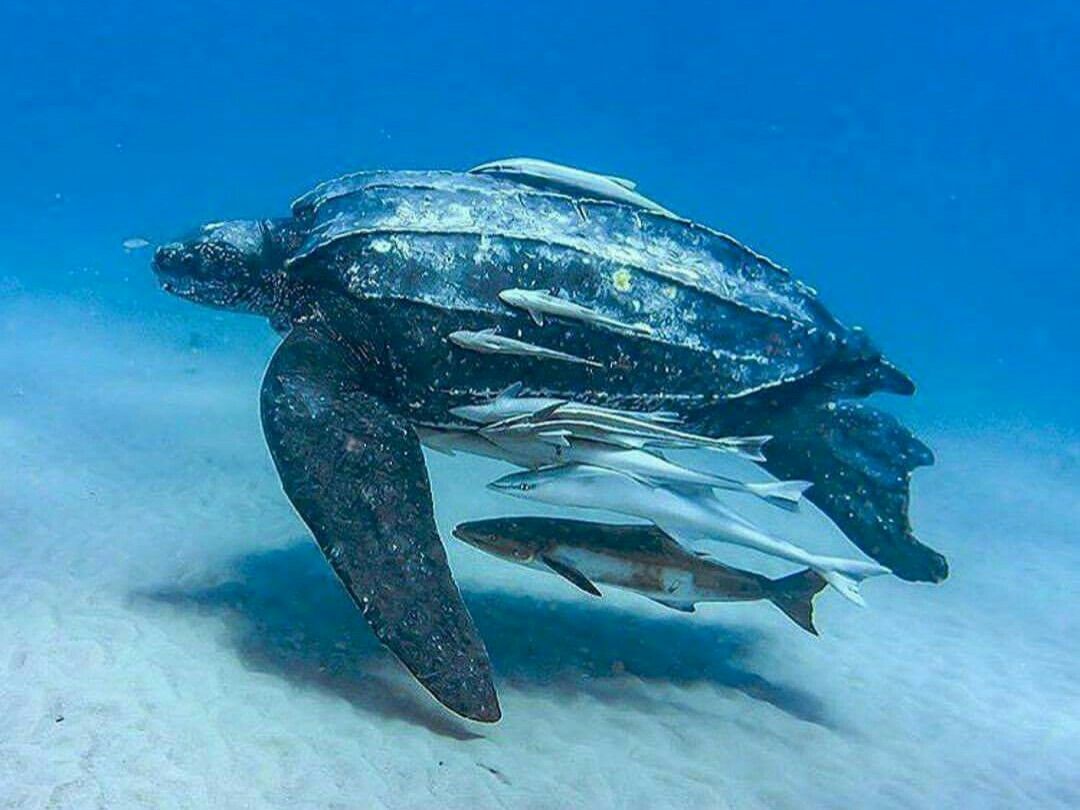
The leatherback sea turtle is a living paradox. It is a reptile that hunts in near-freezing water, a turtle without a true turtle shell, and an open-ocean diver capable of reaching depths that would crush most marine mammals.
Dermochelys coriacea is the largest sea turtle alive today, the largest living reptile outside the crocodile order, and the sole surviving member of a family that diverged from every other sea turtle lineage more than 100 million years ago. It is a Triassic-era design still operating in the present ocean, which is what makes its current decline so disturbing.
This guide covers every aspect of leatherback biology and ecology: size, shell construction, temperature regulation, diet, diving performance, migration, reproduction, conservation status, and the complicated relationship between leatherbacks and the humans who share the seas. It is a reference entry, not a summary - so expect specifics: kilograms, metres, minutes, temperatures, and verified records.
Etymology and Classification
The scientific name Dermochelys coriacea literally means "leathery skin-turtle", combining Greek roots that describe the defining feature of the species. The genus Dermochelys contains only this one living species, and its family Dermochelydidae also contains only one living species.
Every other sea turtle alive today - greens, loggerheads, hawksbills, olive ridleys, Kemp's ridleys, and flatbacks - belongs to a separate family, Cheloniidae. The leatherback's lineage split from this other family at least 100 million years ago, during the Cretaceous, and ancestral relatives of the modern leatherback are recognisable in fossil beds dating back to the late Triassic.
That ancient ancestry is why biologists describe leatherbacks as a relict lineage. The species has outlived the non-avian dinosaurs, outlived mass extinctions, and still swims in the same ocean basins its ancestors occupied before mammals diversified. A modern leatherback is not a dinosaur, but it is genuinely a remnant of a reptile radiation older than any dinosaur ever recovered in full.
Taxonomically the species sits in the reptile class Reptilia, the turtle order Testudines, the suborder Cryptodira (hidden-necked turtles), and the monotypic family Dermochelyidae. Its position inside the turtle family tree has been confirmed repeatedly by molecular phylogenetics, despite its many anatomical departures from every other living turtle.
Size and Physical Description
Leatherbacks are the largest sea turtles and among the largest reptiles alive today. Only the saltwater crocodile rivals a big leatherback in total mass.
Adults:
- Carapace length: 1.5-2.5 m (straight line measurement)
- Total length including head and tail: up to 2.9 m
- Front flipper span: up to 2.7 m
- Weight: typically 250-700 kg, with the largest confirmed specimen weighing 961 kg
Hatchlings:
- Carapace length: ~6 cm
- Weight: ~45 g
The dimensional gap between hatchling and adult is extreme. A newborn leatherback weighs roughly one twenty-thousandth of a large adult. Few other vertebrates stretch so far between their starting and adult sizes, and the fact that a wild leatherback must survive every predator level between 45 grams and 900 kilograms is one of the central biological challenges of the species.
The head is proportionally large, with powerful scissor-like cusps on the upper jaw that lock into matching notches on the lower jaw, producing a bite specialised for puncturing and gripping soft, slippery prey. The body is teardrop-shaped and hydrodynamically sleek. Front flippers are elongated and powerful, doing almost all the work of forward propulsion through long strokes, while hind flippers act mostly as rudders and as digging tools on nesting beaches.
The skin is dark, usually black or deep grey-blue, often spotted with irregular white or pinkish blotches. Individual adults can be identified from their unique blotch patterns. A pinkish spot on the top of the head - called the pineal spot - sits directly above the parietal eye, a light-sensing organ that appears to help with seasonal rhythms and perhaps navigation.
The Unique Leatherback Shell
Every other living sea turtle has a rigid bony carapace covered in keratin scutes, a design shared with tortoises and terrapins. The leatherback is the only exception. Its shell is a flexible, leathery covering supported by a mosaic of roughly a thousand small, loose bones called osteoderms, embedded in thick oily connective tissue. Seven prominent longitudinal ridges run from neck to tail along the carapace, and five similar ridges run along the underside.
This unusual construction delivers several advantages. At depth, the shell compresses rather than resisting pressure, which is a major reason leatherbacks can safely dive far deeper than any hard-shelled sea turtle. The oil-saturated tissue layer beneath the skin also provides insulation, contributing to the turtle's remarkable ability to keep warm in cold water.
The ridges reduce drag and channel water efficiently during long-distance swimming, lowering the energy cost of crossing entire ocean basins.
The skin itself is extraordinarily tough. It resists damage from jellyfish stinging cells, from sharp squid beaks, and from hard-bodied siphonophores that can injure other marine predators. The leatherback essentially wears an armoured wetsuit that doubles as a pressure-resistant diving suit.
Gigantothermy: A Warm-Bodied Reptile
Reptiles are conventionally described as cold-blooded, meaning their body temperature matches the surrounding environment. The leatherback breaks this rule. Core body temperatures have been measured up to 18 degrees Celsius above the surrounding water, which is close to true endothermy even though the turtle lacks the high metabolic rate of mammals and birds.
The mechanism is called gigantothermy, and it stacks multiple adaptations:
- Large body size. A favourable volume-to-surface ratio lets metabolic heat accumulate in the core faster than it is lost at the skin.
- Subcutaneous fat. Thick insulation beneath the skin slows radiative heat loss.
- Oil-saturated shell tissue. The leathery shell acts as a second insulating layer.
- Countercurrent heat exchangers. In the flippers, outgoing arterial blood transfers heat to incoming venous blood, so cold returning blood is warmed before reaching the core and warm outgoing blood is cooled before reaching cold water.
- Continuous powerful swimming. Constant muscular activity generates steady metabolic heat.
Together these adaptations let leatherbacks feed in waters as cold as six degrees Celsius, tracking jellyfish blooms from Nova Scotia to Norway to southern Chile. No other sea turtle can do this. Green turtles and loggerheads become torpid in water below about 15 degrees Celsius and risk cold-stun mortality if they cannot move south in time. Leatherbacks simply keep swimming.
Diet: The Jellyfish Specialist
Leatherbacks are obligate predators of soft-bodied gelatinous prey. The diet is dominated by scyphozoan jellyfish - lion's mane, moon jelly, sea nettle, barrel jelly, purple-striped jelly - and supplemented by siphonophores, salps, pyrosomes, and other gelatinous zooplankton. Squid and tunicates round out the diet, but jellyfish dominate.
The ecological scale of leatherback feeding is difficult to overstate. A single adult can consume up to its own body weight in jellyfish every day, with feeding-rate studies indicating that large individuals process 500-800 kg of jellyfish in a 24-hour period during peak foraging. Multiply that by thousands of adults across the Atlantic and it becomes clear that leatherbacks historically represented one of the largest predatory pressures on the gelatinous component of the open ocean.
Hunting adaptations:
- Pointed upper jaw cusps pierce and grip slippery bell tissue.
- Dozens of backward-pointing keratin spines line the throat and oesophagus, preventing prey from sliding back out between swallows.
- A highly extensible stomach can hold enormous prey volumes.
- Dense salt glands behind each eye excrete excess salt ingested with prey, which is why a beached leatherback appears to be crying.
The throat spines, called papillae, are particularly striking. They form a continuous field of inward-curving keratin hooks down much of the upper digestive tract. Once a jellyfish passes the jaws, the spines ratchet it toward the stomach one swallow at a time. This mechanism works perfectly on jellyfish. It works disastrously on plastic bags, which the turtle cannot cough back out once they are lodged in the throat.
Deep Diving Performance
Leatherbacks are the deepest-diving reptiles known to science. A satellite-tagged adult recorded a dive to 1,280 m, deeper than sperm whales typically reach during routine foraging. Breath-hold durations of up to 86 minutes have been documented, exceeding the dive times of many marine mammals.
Typical foraging dives are far shallower, usually 50-300 m, because that is where vertically migrating gelatinous prey concentrate. Deep exploratory or prey-tracking dives appear to happen during transit between foraging areas and in response to prey descending during the day.
Physiological adaptations for deep diving:
- Flexible, compressible shell that does not crack under pressure.
- Collapsible lungs that avoid nitrogen narcosis.
- Exceptionally oxygen-rich blood and myoglobin-packed muscle.
- Circulatory shunting that diverts blood away from non-essential tissues under stress.
- Slow metabolism during deep dives, conserving oxygen.
The combination puts leatherbacks into the same diving class as elephant seals and beaked whales, which is remarkable for a reptile whose ancestors evolved in shallow coastal waters hundreds of millions of years ago.
Migration and Range
No other reptile travels as far as a leatherback. Satellite tagging has documented adults covering more than 10,000 km in a single year, swimming between tropical nesting beaches and cold-water foraging grounds. Their range spans polar to tropical seas across all three major oceans, giving the species the widest geographical distribution of any reptile on Earth.
Known travel data:
| Metric | Value |
|---|---|
| Cruising speed | 1.8-4.5 km/h |
| Peak swimming speed | ~35 km/h (short bursts) |
| Daily travel distance | 20-70 km |
| Annual migration distance | 10,000+ km |
| Longest single tracked migration | ~20,000 km (Indonesia to North America) |
| Maximum latitude recorded | ~71 degrees north, ~47 degrees south |
The transpacific migrations of west Pacific leatherbacks are the largest documented reptile movements in history. Females nesting in Papua Barat, Indonesia have been tracked crossing the Pacific to feed off the California coast, a round trip of nearly 20,000 km that takes more than a year. Atlantic leatherbacks show comparable long-distance behaviour between Caribbean nesting beaches and feeding grounds off Nova Scotia, the Bay of Biscay, and West Africa.
Navigation cues are not fully understood. Leatherbacks likely combine geomagnetic sensing, celestial cues, ocean current signatures, and learned maps of prey distributions. Females returning to nesting beaches often arrive within a few kilometres of where they themselves hatched decades earlier, suggesting powerful site-specific imprinting during the first hours of life.
Life Cycle and Reproduction
Leatherback reproduction is a high-output, low-survival strategy tuned over tens of millions of years.
Nesting cycle:
- Females reach breeding maturity at roughly 15-30 years old.
- Nesting occurs every 2-4 years, not annually.
- A nesting female hauls out 5-7 times per season at 9-10 day intervals.
- Each nest contains 80-100 yolked eggs plus a smaller number of yolkless decoy eggs laid on top.
- Eggs incubate for 60-70 days beneath approximately 60-80 cm of sand.
- Sex is temperature-dependent, with the pivotal temperature near 29.5 degrees Celsius: warmer nests produce females, cooler nests produce males.
- Hatchlings emerge in synchrony, usually at night, and scramble toward the brightest horizon.
A nesting female selects her beach by a combination of imprinted memory, sand texture, slope, and tidal pattern. She digs a body pit, then a deeper flask-shaped egg chamber using her hind flippers with surprising delicacy. She lays the full clutch, covers the nest, disguises the surface by thrashing sand with her front flippers, and returns to the sea. The entire process takes 1.5-2.5 hours, and large females may crawl more than a hundred metres up a beach to reach suitable nesting sand.
Once the hatchlings break out of the nest, they face brutal mortality. Ghost crabs snatch them from the sand. Frigatebirds, gulls, and vultures pick them off during the run to the surf. In the water, nearshore predators including jacks, sharks, and large fish continue the cull. Estimates from marked cohorts indicate that fewer than one in a thousand hatchlings survive to breeding age, a survival rate among the worst for any vertebrate that produces large eggs.
Those that do survive enter the open ocean and disappear for years. The juvenile leatherback phase is still poorly understood - they are rarely encountered until they return to coastal waters as sub-adults approaching breeding age.
Populations and Subpopulations
The IUCN recognises seven distinct regional management units of leatherback turtles, grouped by ocean basin and rookery genetics. Two of these are in catastrophic decline.
Status by subpopulation:
| Subpopulation | IUCN status | Trend |
|---|---|---|
| Northwest Atlantic | Least Concern (regional) | Stable to slowly increasing |
| Southwest Atlantic | Critically Endangered | Declining |
| Southeast Atlantic | Data Deficient | Unclear |
| Southwest Indian Ocean | Vulnerable | Declining |
| Northeast Indian Ocean | Critically Endangered | Declining |
| West Pacific | Critically Endangered | Declining sharply |
| East Pacific | Critically Endangered | Declining more than 90% |
The East Pacific population has collapsed almost completely compared with its historic abundance. Nesting numbers on key Mexican and Costa Rican beaches have declined by more than 90 per cent since the 1980s, driven by a combination of egg poaching, longline bycatch, and climate-linked shifts in prey availability. West Pacific leatherbacks nesting in Indonesia have likewise plummeted.
The comparatively healthy Atlantic populations benefit from stronger beach protection in Trinidad, Suriname, French Guiana, and Gabon, but even these stocks face significant ongoing bycatch pressure.
Conservation Status and Threats
The global IUCN classification for the leatherback sea turtle is Vulnerable, but this single label obscures significant regional variation. The species is also listed on CITES Appendix I, which bans commercial international trade in individuals, eggs, or derived products.
Primary threats:
- Fisheries bycatch. Longline, gillnet, and trawl fisheries accidentally hook or entangle tens of thousands of leatherbacks per year. Even when the turtle is released alive, injury rates are high and post-release mortality is substantial.
- Plastic ingestion. Floating plastic bags, balloons, and thin film closely resemble jellyfish from below. Leatherbacks swallow them, plastic jams the throat or digestive tract, and the turtle starves or dies of perforation. Necropsy studies now find plastic inside roughly a third of dead leatherbacks examined.
- Egg poaching. Unguarded nests are still harvested for subsistence or black-market sale in parts of the range. Beach patrols and community hatchery programmes have reduced but not eliminated poaching pressure.
- Coastal development and light pollution. Beach erosion, sea walls, and beachfront lighting all interfere with nesting. Artificial lights draw hatchlings inland instead of toward the sea, where they die of dehydration or predation.
- Climate change. Warmer nests produce a growing female bias, with some beaches now generating more than 95 per cent female hatchlings. Rising seas drown low-lying nests, and changing currents disrupt jellyfish prey distributions.
- Vessel strikes. Leatherbacks spend much of their time near the surface digesting prey, which puts them directly in the path of commercial shipping and recreational boats.
Conservation interventions include nest relocation, in-situ nest protection, circle-hook requirements in longline fisheries, time-area closures around nesting beaches, turtle excluder devices in trawl fisheries, and international tracking programmes. The Atlantic recovery - modest but real - shows that sustained intervention can work. The East Pacific collapse shows what happens when it fails.
Leatherback Turtles and Humans
Human communities across the tropics have interacted with leatherback turtles for thousands of years. Some coastal cultures revered them, others harvested their eggs as a seasonal protein pulse. Industrial-scale exploitation did not begin until the 20th century, when egg collection, incidental fishing mortality, and coastal development combined to push populations toward collapse.
Modern human impacts now include research and tourism alongside exploitation. Night-time turtle-watching tours at protected nesting beaches - Matura in Trinidad, Mayumba in Gabon, Grande Riviere in the Caribbean - provide economic incentives for local communities to protect rather than harvest nesting females. Done well, this tourism funds ranger patrols and hatchery programmes. Done badly, it floodlights beaches, disturbs nesting females, and misdirects hatchlings.
Scientific interest in the species remains high because of its unique physiology. Leatherbacks are of direct interest to researchers studying thermoregulation, deep-dive oxygen economy, long-distance navigation, and the ecological role of large gelatinous predators. Satellite tagging programmes have transformed understanding of leatherback movement patterns, revealing migration corridors that can now be protected through shipping lane adjustments and fishery closures.
The long-term outlook depends on reducing bycatch in pelagic fisheries, eliminating plastic debris from the open ocean, protecting nesting beaches, and limiting climate change enough to preserve viable nest temperatures and prey distributions. No single measure is sufficient. The species survived the end-Cretaceous extinction, but whether it survives the current century remains an open question.
Related Reading
- Sea Turtles of the World: Ancient Mariners in a Changing Ocean
- Green Sea Turtle: The Ocean's Vegetarian Reptile
- How Sea Turtles Navigate Across Oceans
- Plastic Pollution and Marine Wildlife
References
Relevant peer-reviewed and governmental sources consulted for this entry include IUCN Marine Turtle Specialist Group regional assessments, NOAA Fisheries Leatherback Sea Turtle Recovery Plan documentation, the Wider Caribbean Sea Turtle Conservation Network technical reports, and published research in Ecological Monographs, Proceedings of the Royal Society B, Marine Ecology Progress Series, and Nature.
Migration distances, dive records, and body size figures reflect the peer-reviewed literature current as of the most recent regional status assessments.
Frequently Asked Questions
How big is a leatherback sea turtle?
Adult leatherback sea turtles (Dermochelys coriacea) have carapace lengths of 1.5-2.5 m and typically weigh between 250 and 900 kg. The largest verified specimen, a male that washed ashore in Wales in 1988, measured 2.91 m in total length and weighed 961 kg, making the leatherback the largest living reptile outside the crocodile order.
Adults routinely exceed the size of every other sea turtle species by a wide margin - green turtles and loggerheads rarely pass 200 kg, while a mature leatherback can be four to five times that mass. Hatchlings are tiny in comparison, emerging from the egg at only about 6 cm long and 45 grams, a ratio of adult to newborn mass that is among the most extreme in the animal kingdom.
What do leatherback turtles eat?
Leatherbacks are specialist predators of soft-bodied gelatinous prey, above all jellyfish. Lion’s mane jellyfish, moon jellies, sea nettles, salps, and siphonophores together make up the overwhelming majority of the diet. A single adult can process enormous quantities: feeding studies indicate that a large leatherback may consume up to 800 kg of jellyfish in a day, roughly equal to its own body weight.
This matters ecologically because jellyfish blooms can collapse fisheries, and leatherbacks are one of the few large predators that can eat jellyfish fast enough to regulate populations. The turtle’s scissor-like jaw points and the dense field of keratin spines lining the throat and oesophagus work together to grip and swallow prey that would slip away from any hard-beaked animal.
How deep can leatherback turtles dive?
Leatherback sea turtles hold the verified depth record for any living reptile. Satellite tags have recorded dives to 1,280 m - deeper than sperm whales reach on most foraging dives - and breath-holds of up to 86 minutes. Typical foraging dives are far shallower, usually 50-300 m, where vertically migrating gelatinous prey concentrate.
Leatherbacks manage these depths thanks to several adaptations: a flexible shell that compresses rather than cracks under pressure, collapsible lungs, oxygen-rich myoglobin-packed muscle, and a cardiovascular system that can shunt blood away from non-essential tissues. Their deep-diving ability lets them exploit a rich mid-ocean food layer that is simply unreachable for every other sea turtle species.
Where do leatherback turtles live?
Leatherbacks have the widest geographic distribution of any reptile on Earth. Their range stretches from the edge of Arctic waters off Norway and Alaska down to sub-Antarctic seas near New Zealand and Chile, covering the Atlantic, Pacific, and Indian Oceans. Adults are true pelagic wanderers, crossing entire ocean basins between feeding and nesting grounds and covering more than 10,000 km in a single year.
Major nesting beaches include Trinidad, Suriname, French Guiana, Gabon, Indonesia, and Papua New Guinea in the tropics, but feeding grounds extend to cold waters such as Nova Scotia, the Bay of Biscay, and the California Current. This extraordinary latitudinal range is only possible because leatherbacks can regulate their body temperature far above ambient water, a trick no other sea turtle has mastered.
Are leatherback turtles endangered?
The IUCN lists the leatherback sea turtle as Vulnerable globally, but this headline figure disguises severe regional decline. The East Pacific subpopulation is classified as Critically Endangered, with nesting numbers down more than 90 per cent from historic levels, and the West Pacific population is also Critically Endangered and trending further downward.
The Atlantic subpopulation is more stable and in some locations appears to be slowly recovering after decades of protection.
Primary threats include fisheries bycatch in longline and gillnet operations, ingestion of plastic debris mistaken for jellyfish, egg poaching at unguarded nesting beaches, coastal development destroying nesting habitat, and climate change that both warms nests toward all-female hatchling production and shifts jellyfish prey distributions.
How do leatherback turtles reproduce?
Leatherback reproduction is a high-output, low-survival strategy. Females reach breeding maturity at roughly 15-30 years old and migrate thousands of kilometres back to nesting beaches, often the same beach where they themselves hatched. During a single nesting season - which occurs every two to four years - a female hauls out five to seven times, laying 80 to 100 yolked eggs each visit along with a smaller number of yolkless decoy eggs on top.
Eggs incubate for around 60-70 days under sand, with temperature-dependent sex determination: warmer nests produce females, cooler nests produce males, and the pivotal temperature sits near 29.5 degrees Celsius. Hatchlings emerge in synchrony, scramble toward the brightest horizon (normally moonlit surf), and face enormous predation pressure from crabs, gulls, frigatebirds, and nearshore fish.
Less than one per cent of hatchlings will live to breed themselves.
Why is the leatherback's shell so different?
Every other sea turtle alive today has a rigid carapace built from fused bony plates covered in keratin scutes. The leatherback has neither. Its shell is a mosaic of small bones embedded in a thick, oil-soaked layer of connective tissue covered by dark, rubbery skin. The outer surface is ridged along seven prominent longitudinal keels. This flexible construction offers two big advantages.
First, it compresses safely at depth, which is a major reason leatherbacks can survive dives that would implode a hard-shelled turtle. Second, the shell surface itself acts as an insulating layer, working with the turtle’s subcutaneous fat, muscular swimming style, and countercurrent heat exchangers to maintain body temperatures far warmer than the surrounding water.
How does a leatherback turtle stay warm in cold water?
Leatherbacks achieve something that biology textbooks once deemed impossible for a reptile: they maintain a core body temperature up to 18 degrees Celsius above the surrounding water. The strategy is called gigantothermy, and it rests on several stacked adaptations. Their sheer size gives them a favourable volume-to-surface ratio, so metabolic heat is retained more easily than in a smaller animal. Thick peripheral fat deposits insulate the body core.
Countercurrent heat exchangers in the flippers cool outgoing blood before it reaches cold water and warm incoming blood before it returns to the heart. Continuous powerful swimming generates steady metabolic heat, and the oil-saturated leathery shell acts as a final insulating layer. Together these features let the leatherback feed on jellyfish in waters as cold as six degrees Celsius, territory entirely closed to any other sea turtle.