
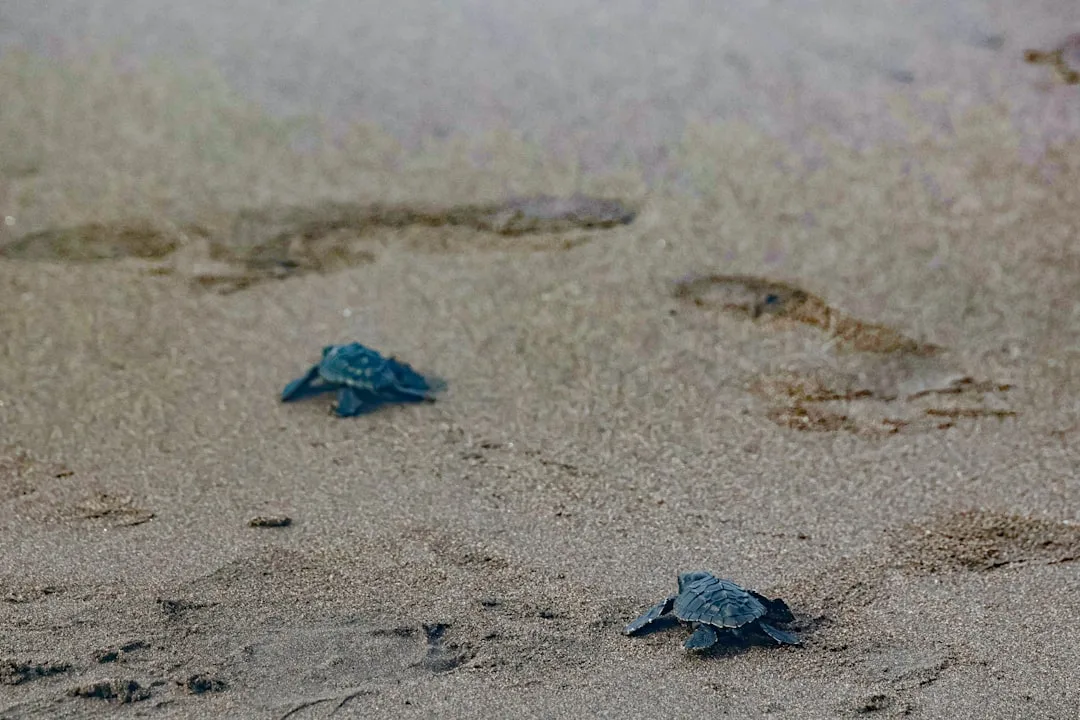
The olive ridley is the most abundant sea turtle species on Earth and the star of one of the most astonishing reproductive spectacles in the animal kingdom. On a handful of beaches in Costa Rica, Mexico, Nicaragua, and India, hundreds of thousands of female olive ridleys come ashore within a window of two or three days to lay eggs together.
This behaviour - called the arribada, Spanish for 'arrival' - has no close parallel anywhere else in the sea turtle family. Outside of the arribada, the olive ridley lives a quiet, solitary, oceanic life, drifting across tropical seas and diving for jellyfish.
This guide covers every aspect of olive ridley biology: size, anatomy, distribution, diet, migration, arribada synchronisation, the Ostional community egg harvest, conservation status, and the strange facts that set Lepidochelys olivacea apart from its larger and more famous cousins. It is a reference entry, not a summary - so expect specific numbers: kilograms, kilometres, temperatures, clutch sizes, and population estimates.
Etymology and Classification
The scientific name Lepidochelys olivacea was established by Heinrich Eschscholtz in 1829. Lepidochelys comes from the Greek lepis (scale) and chelys (turtle), reflecting the scale-rich carapace. Olivacea is Latin for 'olive-coloured', a reference to the dull olive-green hue of the adult shell. In Spanish-speaking range states the turtle is known as tortuga golfina. In Odisha, India, it is simply olive kachhapa or included under the general term samudri kachhua.
The olive ridley and the Kemp's ridley (Lepidochelys kempii) are the only two species in the genus Lepidochelys. They are sister species and share the defining arribada behaviour, though Kemp's ridley is restricted to the Gulf of Mexico and the western Atlantic. The two diverged roughly two to three million years ago, most likely when the Isthmus of Panama closed and separated ancestral populations into Pacific and Atlantic basins.
Within the family Cheloniidae, the ridleys are considered evolutionarily distinct from the larger green, loggerhead, and hawksbill turtles. They are generally treated as a basal offshoot in the cheloniid tree, which is part of why they retain features - small body size, high clutch synchrony, coastal dispersal - that the larger sea turtles have moved away from.
Size and Physical Description
The olive ridley is the smallest of the so-called hard-shelled sea turtles - only the Kemp's ridley matches it. Leatherbacks are larger but sit outside this comparison because they belong to a different family entirely. Olive ridleys are compact, rounded, and noticeably heart-shaped when viewed from above.
Adults:
- Carapace length: 60-70 cm
- Weight: 35-50 kg, occasionally up to 55 kg
- Shell colour: olive green to grey-green, darkening with age
- Plastron (belly shield): cream to pale yellow
Hatchlings:
- Length: roughly 4 cm
- Weight: 15-20 g
- Carapace colour: dark grey to black, with pale margins
Males and females are similar in body mass but differ in tail length. Males develop a longer, thicker, more muscular tail that extends well beyond the carapace rear margin and serves as a grasping organ during mating. Females retain a short tail. Males also have a single large, curved claw on each front flipper used to hook onto the female's shell during copulation.
The olive ridley's carapace is notable for its variable scute count. Most sea turtles have five pairs of costal (lateral) scutes on the shell. Olive ridleys have six to nine pairs, often with asymmetry between the left and right sides of the same animal. This anatomical quirk has no known functional consequence but makes individual identification easier for researchers working from photographs.
Range and Habitat
Olive ridleys occupy the tropical and subtropical belts of the Atlantic, Pacific, and Indian Oceans. Their distribution is genuinely global across warm waters, unlike species such as Kemp's ridley or flatback that are confined to a single ocean basin.
Major nesting regions:
| Region | Key sites |
|---|---|
| Indian Ocean - eastern India | Gahirmatha, Rushikulya, Devi (Odisha) |
| Eastern Pacific - Costa Rica | Ostional, Nancite, Playa Hermosa |
| Eastern Pacific - Mexico | La Escobilla, Morro Ayuta, Ixtapilla |
| Eastern Pacific - Nicaragua | Chacocente, La Flor |
| Atlantic - South America | Suriname, French Guiana, Brazil (scattered) |
| Atlantic - West Africa | Gabon, Republic of the Congo |
Between nesting seasons the turtles disperse into the open ocean, sometimes ranging thousands of kilometres from the nearest coastline. Satellite tracking of post-nesting females has recorded individuals crossing the Pacific from Mexico toward the central Pacific gyre, and Indian Ocean females wandering from Odisha into the Bay of Bengal and beyond.
Unlike green turtles, which spend long periods in predictable coastal foraging grounds, olive ridleys are largely pelagic outside of breeding periods. This makes them harder to monitor and harder to protect from industrial fisheries.
Diet and Feeding
The olive ridley is the most carnivorous of the sea turtles on average, though the species is more accurately described as an opportunistic omnivore. Adults feed on a wide range of invertebrates and occasional vertebrates depending on what is locally abundant.
Primary prey:
- Jellyfish and salps
- Tunicates
- Crabs, shrimps, and lobsters
- Sea urchins
- Snails and other molluscs
- Fish eggs and small fish
- Algae and plant material (minor)
Olive ridleys are strong divers. Foraging dives routinely reach 100-150 metres, and individual turtles have been recorded below 200 metres. Dive durations of 30 to 45 minutes are common during foraging, with longer rest dives during calm sea conditions. The species is more willing than most cheloniids to feed in the open water column rather than along the seafloor, and gelatinous prey (jellyfish, salps) makes up a substantial and frequently underestimated fraction of the diet.
The jellyfish preference is a chronic hazard in the modern ocean. Floating plastic bags mimic jellyfish visually and are eaten at high rates. Post-mortem studies of stranded olive ridleys routinely report plastic in the gut, sometimes in quantities large enough to have contributed directly to the death.
Reproduction and the Arribada
The arribada is the defining behaviour of the olive ridley and one of the great unsolved puzzles of marine biology. Most sea turtles nest solitarily, with scattered females spread along many kilometres of beach across many months. Olive ridleys do the opposite: at arribada sites, tens of thousands to hundreds of thousands of females come ashore together, lay eggs within a few days, and then vanish back into the sea.
Scale of documented arribadas:
| Site | Country | Peak nesting count (single season) |
|---|---|---|
| Gahirmatha | India | 600,000+ females |
| Rushikulya | India | 450,000 females |
| La Escobilla | Mexico | 1 million+ nests |
| Ostional | Costa Rica | 500,000+ females |
| Nancite | Costa Rica | 100,000+ females (historic) |
Nesting sequence during an arribada:
- Females aggregate offshore, often visibly milling in the shallow water for hours or days before the event.
- The first wave comes ashore, usually on a rising or falling tide, often over two to four nights.
- Each female digs a pit with her rear flippers, lays 100-110 eggs, covers the nest, and returns to sea within roughly an hour.
- Successive waves of females arrive over the next 24-72 hours, frequently digging up earlier clutches in the search for nest space.
- After three to seven days the peak passes and nesting returns to scattered individuals.
The trigger that synchronises so many females on the same beach at the same time is still unknown. Proposed cues include lunar phase, tidal amplitude, offshore swell direction, pheromonal signals, and stored reproductive hormones reaching a threshold simultaneously after a shared migration. No single factor matches every documented arribada, and synchronisation appears to vary between sites and seasons. It is one of the most conspicuous unsolved questions in sea turtle biology.
Eggs incubate in the sand for 45-65 days. Sex is determined by sand temperature during the middle third of incubation, with warmer nests producing more females and cooler nests producing more males. Hatchlings emerge en masse, usually at night, and make the short but hazardous run to the sea.
Temperature-Dependent Sex Determination
Like all sea turtles, olive ridleys do not have sex chromosomes. Sex is decided in the nest by temperature during the 'thermosensitive period' - roughly the middle third of incubation. The pivotal temperature, at which clutches produce roughly equal numbers of males and females, sits around 29-30 degrees Celsius. Above that, clutches skew female. Below that, clutches skew male.
Temperature outcomes:
- Below 28 degrees: nearly all males
- 28-29 degrees: mostly males, some females
- 29-30 degrees: roughly balanced
- 30-31 degrees: mostly females
- Above 31 degrees: nearly all females
- Above 33 degrees: embryonic mortality rises sharply
This mechanism evolved in a climate that produced a workable male-to-female ratio on most nesting beaches. Modern warming is pushing beaches toward the female-dominated end of that range. Long-running monitoring at several Costa Rican and Mexican beaches already reports hatchling sex ratios of 70-90 per cent female. Conservationists at some sites now use shading, irrigation, and relocated hatcheries to cool the sand and protect a functional male supply.
The Ostional Managed Harvest
Ostional, on the Pacific coast of Costa Rica, is the only place in the world where harvesting sea turtle eggs is legal. The arrangement is unusual, controversial, and instructive.
At Ostional the arribada is so intense that the beach itself becomes the main threat to the eggs. Later-arriving females dig nests into the same spots used by the first wave, shattering earlier clutches. Broken eggs rot, spread bacteria, and raise ambient sand temperature, which in turn kills embryos in nearby nests. Long-term studies found that under unmanaged conditions only a small fraction of the eggs laid at Ostional would ever hatch.
In 1987 the Costa Rican government granted the local community, through the Ostional Integral Development Association (ADIO), the right to harvest eggs during the first 36 hours of each arribada - the period when eggs are most likely to be destroyed by subsequent waves of nesting females. Later nests are protected.
Community members patrol the beach, protect hatchlings from dogs and poachers, and run environmental education programmes. Revenue from legal egg sales funds beach monitoring, infrastructure, and social services.
Arguments in favour:
- Removes eggs that would almost certainly be destroyed anyway
- Gives the community an economic stake in beach protection
- Funds intensive patrols that deter poaching elsewhere
- Nesting numbers at Ostional have remained stable or increased since harvesting began
Arguments against:
- Sets a precedent that could be exploited elsewhere without Ostional's specific density conditions
- Creates a legal market that may mask illegal eggs from other beaches
- Makes wildlife crime enforcement harder in Costa Rica as a whole
- Raises difficult animal welfare questions regardless of ecological outcome
Ostional is cited by pro-use conservation biologists as a rare example of a genuinely sustainable wild harvest of a threatened species. It is cited by preservationist conservationists as a dangerous compromise. Both sides agree that the model should not be copied casually to other arribada beaches.
Migration and Movement
Olive ridleys are long-distance migrants. Satellite telemetry shows individual post-nesting females travelling 1,500 to 5,000 kilometres between arribada beaches and offshore foraging grounds. Some cross entire ocean basins. Unlike loggerheads, which follow relatively predictable oceanographic highways, olive ridleys disperse in many directions from a single nesting beach, which is one reason population-level monitoring is difficult.
Migration data:
| Metric | Value |
|---|---|
| Typical migration distance | 1,500-5,000 km |
| Typical swimming speed | 1-2 km/h sustained |
| Maximum documented dive depth | Approximately 200 m |
| Typical dive duration | 20-45 minutes |
| Re-nesting interval | 1-3 years |
| Clutches per season | 1-3 (arribada sites), 1-2 (solitary) |
Despite this range, olive ridleys return to nest within a few kilometres of where they hatched. The navigational mechanism is assumed to involve a combination of magnetic imprinting at the natal beach and chemical cues picked up as the turtle approaches the coast. This is similar to the mechanism used by other sea turtles and by salmon.
The result is that the arribada beaches are genetically semi-isolated: olive ridleys from Odisha are measurably distinct from olive ridleys in Costa Rica, even though both belong to the same species.
Conservation Status and Threats
The IUCN Red List classifies olive ridleys as Vulnerable. The species is also listed on CITES Appendix I, which prohibits international commercial trade, and protected under national laws across most of its range.
The species is simultaneously the most abundant sea turtle and one of the most vulnerable, because its population is concentrated at a small number of arribada beaches. A disaster at any one of those beaches - an oil spill, a disease outbreak, a cyclone at peak nesting, or industrial development - could cut the global breeding population dramatically in a single season.
Primary threats:
- Bycatch. Shrimp trawls, longlines, and gillnets kill tens of thousands of olive ridleys each year worldwide. The eastern Pacific longline fishery and the Bay of Bengal trawl fishery are among the most damaging. Turtle Excluder Devices (TEDs) have reduced mortality where enforced but remain unevenly adopted.
- Coastal development. Beachfront hotels, seawalls, and ports destroy nesting beaches or change their geometry in ways that ruin nest success. Artificial light disorients hatchlings and draws them inland rather than to the surf.
- Egg poaching. Outside managed sites like Ostional, eggs are widely poached for local consumption and sale. The harvest is often presented as traditional but is intensified far beyond subsistence levels by modern market demand.
- Climate change. Rising sand temperatures skew sex ratios toward females, and the pivotal temperature is exceeded at more and more nests each year. Sea level rise threatens low-lying nesting beaches. Stronger storms can wipe out nests directly.
- Plastic pollution. Jellyfish-mimicking plastic bags and ghost nets entangle turtles and fill guts. The November 2023 mass stranding on Mexico's Pacific coast, which killed hundreds of olive ridleys, was largely attributed to entanglement in abandoned fishing gear.
- Oil and chemical pollution. Regional spills and chronic coastal pollution affect foraging grounds. Persistent organic pollutants concentrate in turtle fat and eggs, with unclear but worrying reproductive consequences.
Conservation measures:
- Turtle Excluder Device mandates in many national fisheries
- Protected nesting beaches and refuges (Gahirmatha Marine Sanctuary, Ostional National Wildlife Refuge, La Escobilla protected beach)
- Hatcheries and egg relocation programmes at threatened beaches
- Community-based monitoring (ADIO at Ostional, the Rushikulya Sea Turtle Protection Committee in Odisha)
- International cooperation through the Inter-American Convention for the Protection and Conservation of Sea Turtles
- CITES Appendix I trade prohibition
Olive ridley numbers at some major beaches are stable or slowly recovering under active protection. Others, including several historic Mexican and Central American sites, remain below their mid-20th century levels. Regional declines are often masked by the raw abundance at a few standout beaches.
Olive Ridleys and Humans
Olive ridleys have been harvested by coastal communities across their range for centuries. In Odisha, local families have long included turtle eggs in traditional diets, though religious restrictions against eating the turtles themselves are common.
In parts of Mexico and Central America, the species was commercially exploited on an industrial scale in the mid-20th century, with hundreds of thousands of animals killed each year for leather, oil, and meat before protections were introduced in the 1990s.
Today the dominant relationship is conservation-driven. The Ostional egg harvest is the most visible example of community-based use. Elsewhere, ecotourism around arribadas generates meaningful local income without harvesting the turtles themselves. Volunteer-led beach patrols in Odisha, Costa Rica, and Mexico mobilise thousands of people to protect nests and guide hatchlings to the sea each year.
Industrial fisheries remain the single largest human pressure on the species. The long-term future of the olive ridley depends less on how well nesting beaches are protected - that work is generally going well - and more on how effectively bycatch is reduced in the open ocean, where the adult turtles spend most of their lives and are hardest to monitor.
Related Reading
- Sea Turtles: Ancient Navigators of the Ocean
- Leatherback Sea Turtle
- Loggerhead Sea Turtle
- Hawksbill Sea Turtle
References
Sources consulted for this entry include IUCN Red List assessments for Lepidochelys olivacea, the NOAA Fisheries Office of Protected Resources species profile, Wildlife Institute of India monitoring reports from Gahirmatha and Rushikulya, the Ostional Integral Development Association (ADIO) annual reports, and peer-reviewed research published in Biological Conservation, Marine Ecology Progress Series, Chelonian Conservation and Biology, and PLOS ONE.
Population figures and arribada counts reflect the most recent consolidated estimates available through the Indian Ocean - South-East Asian Marine Turtle Memorandum of Understanding and the Inter-American Convention for the Protection and Conservation of Sea Turtles.
Frequently Asked Questions
How big are olive ridley sea turtles?
Adult olive ridleys (Lepidochelys olivacea) have a carapace length of 60-70 cm and weigh 35-50 kg. That makes them the smallest of the hard-shelled sea turtles, tied with their close relative the Kemp’s ridley. Only the leatherback, which is a soft-shelled outlier at up to 900 kg, exceeds other sea turtles by more. Males and females are similar in body size, but males have a longer, thicker tail used to grip the female during mating.
Hatchlings emerge at around 4 cm long and weigh roughly 15-20 grams.
What is an arribada?
Arribada is Spanish for ‘arrival’ and refers to the mass synchronised nesting events that are the defining behaviour of olive ridley and Kemp’s ridley turtles. During an arribada, tens of thousands - sometimes hundreds of thousands - of female olive ridleys come ashore over three to seven days to dig nests and lay eggs on the same beach at the same time.
The largest documented arribadas have occurred at Rushikulya, Gahirmatha, and Devi in the Indian state of Odisha, and at Ostional and Nancite in Costa Rica. More than 600,000 nesting females have been counted in a single season at one beach.
The trigger that synchronises this behaviour remains one of the unsolved mysteries of marine biology: proposed cues include lunar phase, tide, wind direction, offshore pheromones, and hormonal signalling among nearby females, but no single factor explains every arribada.
Where do olive ridley turtles live?
Olive ridleys inhabit tropical and subtropical waters across the Atlantic, Pacific, and Indian Oceans. Major nesting sites are concentrated in a handful of regions. In the Indian Ocean, the beaches of Odisha (India) host the largest known nesting aggregations on Earth. In the eastern Pacific, Ostional and Nancite in Costa Rica, La Escobilla in Mexico, and several sites in Nicaragua and Panama host regular arribadas.
In the Atlantic, olive ridleys nest along the coasts of Suriname, French Guiana, and parts of west Africa. Between nesting seasons the turtles disperse into the open ocean, sometimes thousands of kilometres from any coast, where they spend most of their adult lives.
Is the Ostional egg harvest legal?
Yes. Ostional on the Pacific coast of Costa Rica is the only place in the world where harvesting sea turtle eggs is legally permitted. The harvest is run by the Ostional Integral Development Association under a quota set by Costa Rican wildlife authorities.
Biologists observed that at Ostional the arribada is so dense that later-arriving females routinely dig up and destroy eggs laid by earlier females, and that the sheer volume of eggs leads to bacterial contamination and nest failure. The managed harvest allows the community to collect eggs laid during the first 36 hours of an arribada - eggs that are statistically very likely to be destroyed anyway - while protecting all subsequent nests.
Proceeds fund beach patrols, hatchling protection, and community services. The harvest is controversial among conservationists, but decades of monitoring at Ostional have shown stable or increasing nesting numbers, suggesting that the model works under its specific conditions.
Are olive ridley turtles endangered?
The IUCN lists the olive ridley as Vulnerable. It is the most abundant sea turtle species on Earth, with an estimated 800,000 annual nesting females globally, yet it is still considered at risk because its population is concentrated at a handful of arribada beaches. A disaster at any one of those beaches could wipe out a large fraction of the global breeding population in a single season.
Primary threats include bycatch in shrimp trawls, longlines, and gillnets - responsible for the majority of adult mortality - along with coastal development at nesting beaches, egg poaching outside managed sites, artificial lighting that disorients hatchlings, plastic pollution, and climate-driven changes to sand temperature that skew sex ratios toward females.
How long do olive ridley turtles live?
Reliable lifespan data for olive ridleys is limited because long-term tagging studies are still running. Best current estimates put wild lifespan at 50 years or more, with sexual maturity reached at 12-15 years of age. Females that reach the breeding population can return to nest for decades. Mortality is extreme in the first year - fewer than one in a thousand hatchlings is believed to survive to breeding age.
Ghost crabs, birds, raccoons, coyotes, and fish take a steady toll during the run from nest to surf and in the hatchling’s first weeks at sea.
What do olive ridley turtles eat?
Olive ridleys are omnivores with a varied diet. They feed on jellyfish, salps, crabs, shrimps, lobsters, snails, sea urchins, bryozoans, tunicates, fish, fish eggs, and algae. Prey depends on region and season. Olive ridleys often forage in the open ocean rather than over reefs or seagrass beds, and they can dive to depths of around 150 metres in pursuit of crustaceans and molluscs.
Because jellyfish feature in the diet, floating plastic bags are a chronic hazard - olive ridleys are among the species most commonly found with plastic in their gut on post-mortem.
How is olive ridley sex determined?
Like all sea turtles, olive ridleys practise temperature-dependent sex determination. The sex of each hatchling is set during the middle third of incubation by the temperature of the sand around the egg. Below roughly 29 degrees Celsius, clutches produce mostly males. Above roughly 31 degrees Celsius, clutches produce mostly females. The transitional ‘pivotal’ temperature sits around 29-30 degrees Celsius.
Rising sand temperatures driven by climate warming are already skewing hatchling sex ratios toward females at several major nesting beaches, and long-term projections warn of possible feminisation of the breeding population if current trends continue without intervention.