
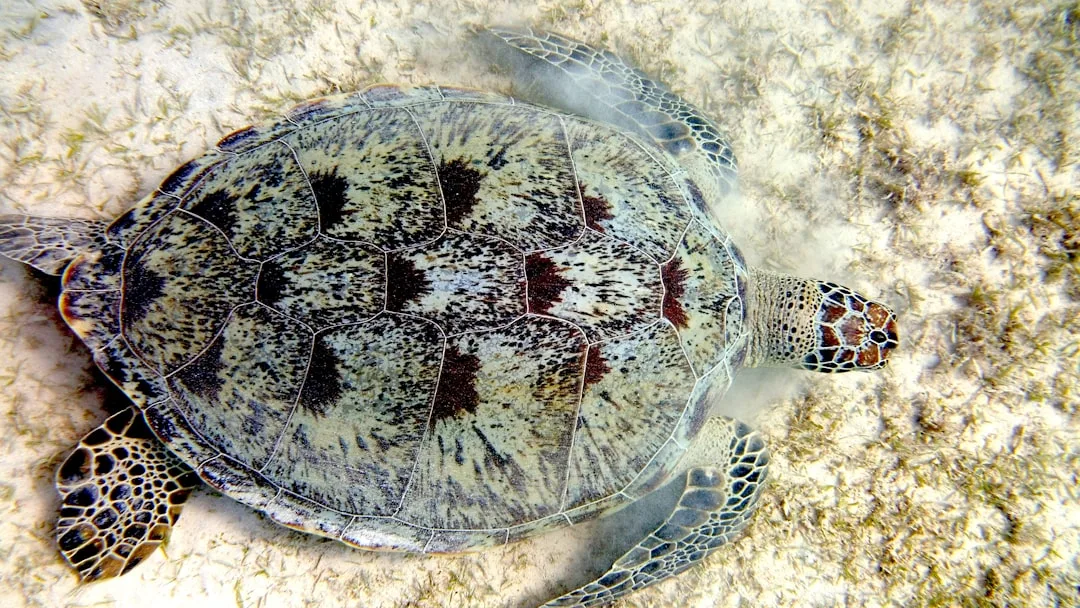
The hawksbill sea turtle is the coral reef's specialist sponge-hunter and one of the most visually distinctive reptiles alive. Unlike its generalist cousins, Eretmochelys imbricata ties its entire life history to tropical reef systems, where a narrow hawk-like beak and slender body let it extract chemically defended sponges from crevices no other predator can reach.
That specialisation makes hawksbills a keystone species for reef health - and also makes them one of the most imperilled vertebrates on Earth. The same marbled amber-and-brown shell that lets them vanish against a coral backdrop drove centuries of exploitation as 'tortoiseshell', reducing the global population by more than eighty per cent.
This guide covers every major aspect of hawksbill biology: taxonomy, size and shell anatomy, the strange world of sponge-eating, reef ecology, reproduction and natal homing, the history of the tortoiseshell trade, modern conservation, and the cultural record that links humans to this species across continents. It is written as a reference entry - so expect specifics: depths, weights, clutch sizes, sponge taxa, poisoning case counts, and verified records.
Etymology and Classification
The scientific name Eretmochelys imbricata was established by Linnaeus in 1766 from specimens in the Caribbean. The genus name combines the Greek eretmo (oar) and chelys (turtle), referring to the species' powerful paddle-like flippers. The species epithet imbricata means 'overlapping' in Latin and refers to the diagnostic roof-tile arrangement of its carapace scutes - a pattern unique among modern sea turtles.
In common usage the species is named for its most conspicuous feature: the hooked, hawk-like beak. Spanish speakers call it carey; Portuguese, tartaruga-de-pente (comb turtle); Japanese, tai-mai, which became the global term in the tortoiseshell trade. Indigenous names across the Caribbean, Pacific, and Indian Ocean typically reference either the beak or the marbled shell.
Within the order Testudines, hawksbills belong to the family Cheloniidae, the hard-shelled sea turtles, alongside green turtles, loggerheads, olive ridleys, Kemp's ridleys, and flatbacks. Only the leatherback (Dermochelys coriacea) sits outside this family. Molecular analyses place hawksbills on a relatively old branch of cheloniid evolution, with the lineage likely diverging from its closest relatives more than fifty million years ago.
Two regional subspecies have been proposed - E. imbricata imbricata in the Atlantic and E. imbricata bissa in the Indo-Pacific - although the taxonomic validity of this split is debated. Modern genetic work shows enough regional structure to justify managing Atlantic, East Pacific, West Pacific, and Indian Ocean populations separately for conservation purposes.
Size and Physical Description
Hawksbills are among the smallest of the hard-shelled sea turtles, sitting between the tiny Kemp's ridley and the mid-sized loggerhead. Adult carapace lengths run between 70 and 95 centimetres measured along the curve, with typical body weights of 45 to 80 kilograms. The largest reliably documented individual weighed about 127 kilograms, but such giants are very rare.
Adults:
- Carapace length: 70-95 cm (record ~1 m)
- Weight: 45-80 kg (record ~127 kg)
- Flipper span: 90-120 cm
- Carapace coloration: marbled amber, orange, brown, and black
Hatchlings:
- Length: ~4 cm
- Weight: ~15 grams
- Colour: uniform dark brown above, lighter below for countershading
The shell is the most diagnostic part of the animal. Hawksbills have thirteen carapace scutes - five central and four lateral on each side - and these scutes physically overlap like tiles on a roof in juveniles and young adults. The overlap gradually smooths out as the animal ages, but the seams remain visible as characteristic stepped ridges. No other modern sea turtle carries this arrangement.
The carapace also carries a sharply serrated posterior margin, giving the rear of the shell a distinctly toothed outline.
The head is small and narrow, tapering to the eponymous hooked beak. That beak is built like a pair of tweezers rather than a crushing tool: thin, laterally compressed, sharply pointed, and reinforced with hard keratin. It is the single anatomical feature that unlocks the species' entire ecological niche, because no other sea turtle can reach the sponges that grow deep inside reef crevices.
Two pairs of prefrontal scales sit between the eyes, and each front flipper carries two visible claws - two more features used to separate hawksbills from other cheloniids in the field.
Range and Habitat
Hawksbills are tropical reef specialists. Their range stretches across the Atlantic, Pacific, and Indian Oceans between roughly 30 degrees north and 30 degrees south of the equator, concentrating wherever warm water, clear visibility, and structurally complex reef habitat overlap.
Major population centres:
| Ocean region | Key areas |
|---|---|
| Western Atlantic | Cuba, Mexican Caribbean, Bahamas, Puerto Rico, Panama |
| Eastern Atlantic | Gulf of Guinea, Cape Verde, Sao Tome and Principe |
| Indo-West Pacific | Indonesia, Philippines, Solomon Islands, Papua New Guinea |
| Australasia | Great Barrier Reef, Torres Strait |
| Indian Ocean | Seychelles, Chagos, Maldives, East African coast |
| Middle East | Red Sea, Persian Gulf, Gulf of Oman |
Unlike leatherbacks, which roam the open ocean, or green turtles, which patrol seagrass pastures, adult hawksbills stay close to structurally complex reefs. Typical adult home ranges are only a few square kilometres, and individual turtles may use the same small set of reef patches for decades. Juveniles drift in open-ocean currents for several years before 'recruiting' to shallow reef habitat, usually at carapace lengths of 20-30 cm.
Hawksbills tolerate a wider range of habitats than any other cheloniid sea turtle. They use shallow lagoons, coral reef walls down to at least 20 metres, rocky shores, mangrove estuaries, and even cliffed volcanic coastlines. What the animal really needs is access to sponges and nooks it can reach with that narrow beak.
Diet and Sponge Specialisation
The hawksbill is the most specialised predator in its entire family. Across most of its range, adult hawksbills are spongivores: sponges, largely chemically defended ones, make up the majority of the diet.
Documented dietary categories:
- Sponges - dominant; often 70-95% of adult diet by mass
- Anemones and zoanthids - secondary reef prey
- Jellyfish and salps - seasonal, when blooms pass a reef
- Corallimorphs - small, anemone-like cnidarians
- Algae - mostly as incidental intake or juvenile forage
- Small crustaceans and molluscs - opportunistic
In the Caribbean, hawksbills concentrate on specific sponges such as Chondrilla nucula, Geodia neptuni, Ancorina alata, and Myriastra, many of which produce secondary chemistry - terpenoids, alkaloids, sulphates - toxic to almost every other reef fish and invertebrate. Sponges are also reinforced with a skeleton of silica spicules, sharp glass-like needles that most predators cannot digest.
Hawksbills apparently process both the toxins and the spicules without difficulty, suggesting unusual biochemical and gastrointestinal adaptations that are still only partly understood.
This diet has a consequence unique among sea turtles: hawksbill flesh itself can become toxic to humans. The phenomenon, known as chelonitoxism, has caused recurring poisoning events across the Indo-Pacific.
Serious outbreaks have been documented in Madagascar, the Federated States of Micronesia, the Philippines, and parts of the Indian Ocean, with symptoms ranging from severe vomiting and liver damage to coma and death. Because toxicity varies with each turtle's recent sponge consumption, risk is effectively impossible to predict by sight.
Juvenile hawksbills are less specialised. Early-life individuals in the open ocean feed on plankton, jellyfish, salps, and floating debris. As they recruit to reef habitat they gradually shift toward sponges, a process that takes several years and tracks growth of the jaw musculature and beak.
Role on Coral Reefs
Hawksbills are widely described as a keystone species on coral reefs. The logic is straightforward. Sponges and reef-building corals compete for the same scarce hard substrate. Several sponge species grow faster than corals and can overtop or chemically smother them. In a healthy reef system, hawksbills crop those aggressive sponges continuously, preventing any one species from dominating and freeing space for new coral recruitment.
Estimates of individual feeding rates vary, but adult hawksbills have been reported to consume upwards of 500 kilograms of sponge per year. Multiplied across a historical Caribbean population of hundreds of thousands of adults, the scale of past sponge-cropping was enormous.
Contemporary reef studies find measurable differences between reefs with intact hawksbill populations and those where hawksbills were depleted: the latter tend to carry heavier sponge cover, less structural coral, and reduced coral recruitment.
The ecological argument for hawksbill recovery is therefore not purely aesthetic. In an era when tropical reefs are already under severe pressure from bleaching, nutrient pollution, and ocean acidification, losing the main sponge-cropping predator weakens the reef's own competitive balance.
Reproduction and Life Cycle
Hawksbill reproduction follows the classic long-lived, high-investment sea turtle pattern. Females reach sexual maturity at roughly 20-30 years of age - slow even by sea turtle standards - and thereafter reproduce every two to three years rather than annually.
Adults migrate from reef feeding grounds to natal nesting beaches, often covering hundreds to several thousand kilometres between the two. Like other sea turtles, hawksbills practise natal homing, returning to nest on or very near the beach where they themselves hatched decades earlier. The navigational mechanism is thought to combine geomagnetic imprinting at the natal beach with chemical and visual cues as the female approaches shore.
Nesting cycle:
- Clutches per season: 3-5
- Eggs per clutch: 130-160
- Nesting interval within a season: ~14 days
- Incubation: ~60 days
- Hatchling mass: ~15 g
- Pivot temperature for sex determination: ~29.9 degrees Celsius
Hawksbills tend to nest in smaller, more dispersed aggregations than green turtles or olive ridleys, often using narrow pocket beaches tucked behind reefs or headlands. Females emerge at night, haul up beyond the high tide line, dig an egg chamber with their rear flippers, and deposit a clutch of leathery-shelled eggs before carefully camouflaging the nest and returning to sea.
Sex is determined entirely by nest temperature, a pattern called temperature-dependent sex determination. Eggs incubated above roughly 29.9 degrees Celsius produce females; below it, males; right at the pivot, mixed clutches. Rising sand temperatures driven by climate change are already skewing hatchling sex ratios heavily female in several populations, which may increase short-term reproductive output but threatens long-term viability.
After about sixty days under the sand, hatchlings emerge in a coordinated nocturnal scramble, orient toward the brightest natural horizon (normally moonlit surf), and rush to the water. Mortality is brutal. Ghost crabs, monitor lizards, gulls, frigatebirds, and nearshore fish take the great majority within hours. Fewer than one hatchling in a thousand is estimated to survive long enough to breed.
Tortoiseshell Trade and Cultural History
No other sea turtle has been so thoroughly defined - and nearly destroyed - by a single cultural product. The hawksbill's marbled carapace scutes, polished and carved, are the source of the material historically traded as 'tortoiseshell' (Japanese bekko). Unlike most other turtle shells, hawksbill scutes can be heated, pressed into sheets, and carved into ornate objects: combs, eyeglass frames, jewellery boxes, hair ornaments, inlays for furniture, and ceremonial items.
The trade ran for centuries. Archaeological evidence places hawksbill shell in elite grave goods across ancient Egypt, Rome, and China. By the early modern period, European colonial powers were shipping Caribbean hawksbill shell to workshops in Naples, Amsterdam, and London. The largest single market, however, was twentieth-century Japan, where bekko craftsmen turned imported hawksbill scutes into luxury goods.
Conservative estimates put Japanese imports of hawksbill shell during the twentieth century alone at the equivalent of approximately two million animals.
The hawksbill's role in Japanese culture is particularly complex. In addition to bekko craft, the species featured in a religious and cultural context often summarised under the name Chelonia ritual, with turtle motifs appearing in shrines, ceremonies, and festival iconography that long predate the commercial shell industry. Reconciling that cultural heritage with the modern conservation imperative has been one of the more delicate tasks of international turtle diplomacy.
International commercial trade in hawksbill shell was banned in most countries with the listing of the species on CITES Appendix I, a status reinforced when Japan withdrew its remaining reservation in 1994. Illegal and domestic trade persists in several hotspots, but legal markets have collapsed. Synthetic imitation tortoiseshell - celluloid, cellulose acetate, and modern polymers - has replaced the real material in almost every application.
Conservation Status and Threats
The IUCN lists the hawksbill sea turtle as Critically Endangered, the highest category of threat before extinction in the wild. The global population is estimated to have declined by more than 80 per cent across the last three generations, driven primarily by tortoiseshell harvest but compounded by modern pressures.
Principal threats today:
- Illegal tortoiseshell trade. Domestic markets remain active in parts of Southeast Asia, Latin America, and West Africa.
- Coral reef degradation. Bleaching, acidification, pollution, and destructive fishing remove the habitat hawksbills depend on. Without reefs there is no niche.
- Climate-driven sex ratio skew. Rising sand temperatures are pushing hatchling ratios toward near-exclusive females in several populations.
- Sea level rise. Low-lying tropical nesting beaches are being eroded or inundated.
- Egg poaching. Unprotected clutches remain a staple food source in many coastal communities.
- Bycatch. Artisanal gillnets, longlines, and trawlers kill adult and juvenile hawksbills across their range.
- Coastal development. Beachfront lighting disorients emerging hatchlings; seawalls and resorts erase nesting habitat.
- Plastic and chemical pollution. Ingestion of plastic and accumulation of persistent organic pollutants reduce health and reproductive output.
Despite this list, there are real recovery stories. Protected populations in parts of the Caribbean, the Seychelles, and northwestern Australia are showing measurable increases in nesting numbers after decades of protection. The species' biology - late maturity, long lifespan, natal homing - means that recovery is slow, but it is possible.
Conservation tools in active use:
- CITES Appendix I listing since 1977; reinforced 1994
- National marine protected areas covering major nesting beaches
- Community-based nest protection and hatchling release programmes
- Bycatch mitigation (turtle excluder devices, gillnet modifications)
- Reef protection programmes in biodiversity hotspots
- Consumer campaigns against tortoiseshell souvenirs
Hawksbills and Humans
Beyond the tortoiseshell trade, hawksbills occupy a layered role in human culture. Coastal communities across the Caribbean, West Africa, the Indian Ocean, and the Pacific have long histories of consuming eggs and occasionally meat, with specific rituals and taboos that vary by region. In some places the turtle is sacred; in others it is food; in many, both at once.
The species also occupies a difficult niche in ecotourism. Dive operators across the Red Sea, the Caribbean, and the Great Barrier Reef market hawksbill encounters as a core attraction, and responsible tourism can provide economic incentives for reef protection that outcompete poaching. Poorly managed tourism, by contrast, stresses nesting females, disturbs eggs, and habituates turtles to human presence in ways that can be dangerous on both sides.
Scientific interest in the species has accelerated. In 2015 researchers documented hawksbills as the first reptile confirmed to exhibit biofluorescence in the wild, with carapaces glowing bright green and red under blue light. The ecological function of this trait is still being investigated - camouflage, signalling, and incidental by-product remain live hypotheses.
Related Reading
- Sea Turtles: Ancient Navigators of the Ocean
- Leatherback Sea Turtle
- Coral Reefs: The Rainforests of the Sea
- Marine Life: Ocean Wildlife and Ecosystems
References
Peer-reviewed and institutional sources consulted for this entry include the IUCN Marine Turtle Specialist Group assessment of Eretmochelys imbricata (2008 and subsequent updates), CITES Appendix I documentation and trade records, NOAA Fisheries species profiles, published research in Chelonian Conservation and Biology, Biological Conservation, Endangered Species Research, and Marine Biology, and regional recovery plans from the Caribbean, Indo-Pacific, and Indian Ocean.
Historical tortoiseshell trade figures draw on synthesised estimates from TRAFFIC and the WWF global sea turtle programme.
Frequently Asked Questions
How big is a hawksbill sea turtle?
Adult hawksbill sea turtles (Eretmochelys imbricata) reach carapace lengths of 70-95 cm and weigh between 45 and 80 kg. The largest reliably recorded specimen weighed about 127 kg, but such giants are exceptional. That makes hawksbills one of the smallest of the seven living sea turtle species, noticeably smaller than green turtles and dwarfed by leatherbacks, which can exceed 900 kg.
Hatchlings emerge from the nest measuring just 4 cm and weighing around 15 grams - light enough to sit comfortably on a human fingertip. Hawksbills grow slowly and do not reach breeding size until 20-30 years old, which is part of why population recovery from historical hunting is so slow.
What do hawksbill turtles eat?
Hawksbills are among the most specialised predators on coral reefs: they are spongivores, meaning sponges dominate their diet. Adult hawksbills regularly feed on more than a dozen sponge species, including many that are chemically defended with compounds toxic to most other animals. In the Caribbean, the sponges Chondrilla, Geodia, and Ancorina can make up 70-90 per cent of an adult hawksbill’s diet by weight.
To cope, hawksbills have evolved an unusually tough oesophagus and digestive tract that can process both the glassy silica spicules sponges contain and the secondary chemistry that protects them. The diet is supplemented with anemones, jellyfish, comb jellies, small crustaceans, and macroalgae. The narrow hooked beak is the tool that makes this lifestyle possible, slipping into reef crevices and tearing sponge tissue away from the substrate.
Where do hawksbill turtles live?
Hawksbills are tropical specialists. Their range spans the Atlantic, Pacific, and Indian Oceans between roughly 30 degrees north and 30 degrees south of the equator, but they are most closely tied to coral reef ecosystems rather than the open ocean.
Important populations occur on the Great Barrier Reef, around Indonesia and the Philippines, across the Caribbean from Cuba and the Bahamas down to Panama, along the East African coast, and in the Red Sea and Persian Gulf. Juveniles drift in ocean currents for several years before recruiting to shallow reef habitat, where they then spend the rest of their lives within fairly small home ranges of just a few square kilometres.
Adults make longer journeys only for breeding, often travelling hundreds to thousands of kilometres between feeding reefs and natal nesting beaches.
Why is the hawksbill critically endangered?
The IUCN classifies the hawksbill sea turtle as Critically Endangered, the highest category of threat before extinction in the wild. The global population has declined by more than 80 per cent across the last three generations, a plunge driven largely by centuries of exploitation for the ‘tortoiseshell’ trade.
The beautiful amber-and-brown scutes were carved into combs, jewellery, eyewear, and inlays across Europe, the Americas, and especially Japan, where a single nation is estimated to have imported the shells of approximately two million hawksbills during the twentieth century. Although the international tortoiseshell trade was banned under CITES Appendix I in 1977 and 1993, illegal harvest continues in several regions.
Additional modern threats include coral reef degradation, climate change, egg poaching, bycatch in coastal fisheries, and coastal development destroying nesting beaches. Some populations - particularly in parts of the Caribbean and the western Indian Ocean - are showing measurable recovery, but the overall trajectory remains precarious.
Are hawksbill turtles poisonous to eat?
Yes, in some regions and some seasons, hawksbill turtle meat is genuinely toxic to humans. The phenomenon is known as chelonitoxism. Because hawksbills eat large quantities of chemically defended sponges and other invertebrates, lipophilic toxins can accumulate in their muscle, liver, and fatty tissues.
When people consume contaminated hawksbill meat - typically at subsistence or celebratory feasts - poisoning outbreaks can cause severe vomiting, liver damage, coma, and in historical records entire village-level mortality events. Fatal incidents have been recorded across the Indo-Pacific, including Madagascar, the Federated States of Micronesia, and the Philippines.
Toxicity appears to vary with the local sponge community each turtle has been eating, which means risk is genuinely unpredictable. The combination of critical endangerment and food-poisoning risk is one of the strongest arguments against hawksbill harvest.
Why are hawksbill turtles important for coral reefs?
Hawksbills are often described as a keystone species for coral reef health. On a thriving tropical reef, sponges and corals compete for the same hard substrate. Sponges are fast-growing, chemically defended, and capable of overtopping and smothering slower-growing reef-building corals.
By continuously cropping the sponge community - an adult hawksbill can consume more than 500 kg of sponge in a single year - hawksbills prevent aggressive sponge species from dominating and free space for new coral recruitment.
Studies from the Caribbean and the Indo-Pacific have shown that reefs where hawksbill numbers have been reduced by historical hunting now carry heavier sponge cover and less structural coral growth than comparable reefs where hawksbill populations remained intact. In an era when coral reefs are under severe pressure from bleaching, pollution, and acidification, the loss of hawksbills removes a key mechanism that helps corals compete.
How do hawksbill turtles reproduce?
Hawksbill reproduction follows the classic long-lived, high-investment sea turtle pattern. Females mature at 20-30 years old and return through a process called natal homing to nest on or very near the beach of their own birth, navigating across thousands of kilometres of open ocean. Nesting occurs every two to three years.
In a single breeding season a female typically lays three to five clutches at roughly two-week intervals, with each clutch containing 130-160 eggs. Incubation lasts around 60 days and sex is determined entirely by nest temperature: above roughly 29.9 degrees Celsius nests produce females, below it they produce males.
Hatchlings emerge in a coordinated nocturnal scramble, orient to the brightest natural horizon (the moonlit surf), and face extreme predation from ghost crabs, gulls, frigatebirds, and nearshore fish. Fewer than one in a thousand hatchlings will survive long enough to breed.
How do you tell a hawksbill turtle apart from other sea turtles?
Three field marks make the hawksbill unmistakable at close range. The first is the beak - narrow, sharply hooked, and hawk-like, noticeably pointier than the rounded beak of a green turtle and very different from the broad crushing beak of a loggerhead. The second is the shell: hawksbill scutes overlap like tiles on a roof, which is the basis for the species name imbricata (‘overlapping’).
All other hard-shelled sea turtles have scutes that meet edge to edge without overlap. The third is the colour pattern: the carapace is an ornate marbled mix of amber, orange, brown, and black that catches the light, historically prized as tortoiseshell. Additional clues include the pair of claws visible on each front flipper, the two pairs of prefrontal scales between the eyes, and the relatively small body size compared with green turtles or loggerheads.