
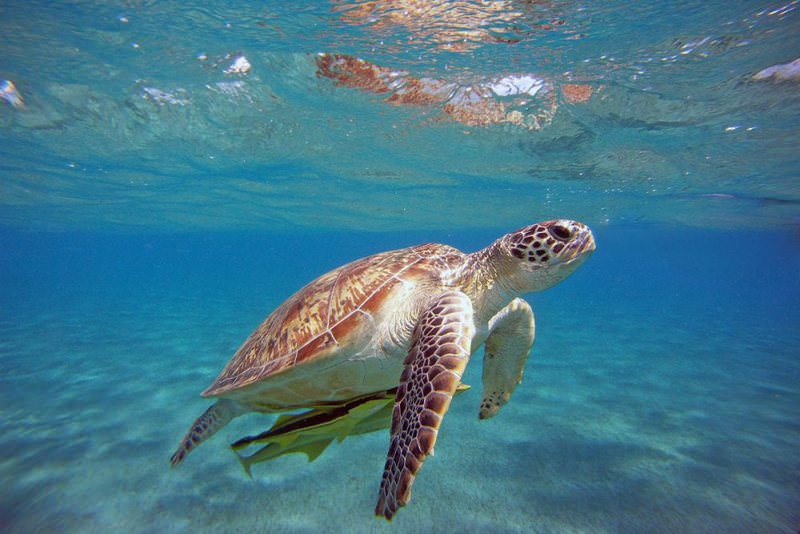
The loggerhead sea turtle is the heavyweight of the hard-shelled turtle family. Among the seven living species of sea turtle, Caretta caretta is the largest with a bony carapace, the most widely distributed across temperate latitudes, and the one whose biology couples the longest-studied magnetic navigation system in the animal kingdom with one of the most powerful set of jaws in the order Testudines.
Loggerheads cross entire ocean basins, crush conch shells that defeat every other sea turtle, return after three decades to the exact beach where they hatched, and live on a timescale measured in human generations rather than years.
This guide is a reference entry on the loggerhead sea turtle, covering size, anatomy, diet, habitat, navigation, reproduction, life history, conservation, and the specific research findings - from Kenneth Lohmann's magnetic-map experiments to satellite tracks from the Gulf of Mexico to Cuba - that make this species one of the most intensively monitored marine reptiles on Earth. Expect specifics: kilograms, kilometres, incubation temperatures, and verified records rather than generalities.
Etymology and Classification
The scientific name Caretta caretta has a long lineage, traceable through eighteenth- and nineteenth-century European natural history. The genus name is derived from an Italian or Portuguese fishermen's term for the species, later Latinised.
The common English name "loggerhead" refers to the turtle's oversized, blocky head - literally a head the size of a log's end - which houses the massive jaw musculature that defines the species. In Mediterranean countries the loggerhead carries local names such as caretta (Italian), karetta (Greek), and caretta de mar (Spanish), all tracing back to the same root.
The loggerhead sits in the family Cheloniidae - the hard-shelled sea turtles - alongside green, hawksbill, olive ridley, Kemp's ridley, and flatback turtles. It is the only living member of its genus.
The family Cheloniidae diverged from the ancestors of the shell-less leatherback more than 100 million years ago, and cheloniid fossils closely resembling modern loggerheads appear in marine sediments more than 40 million years old. In evolutionary terms, the loggerhead belongs to one of the oldest continuously marine reptile lineages still alive.
Full taxonomic placement:
- Kingdom: Animalia
- Phylum: Chordata
- Class: Reptilia
- Order: Testudines
- Family: Cheloniidae
- Genus: Caretta
- Species: C. caretta
Size and Physical Description
The loggerhead is the largest hard-shelled sea turtle alive today. Only the leatherback, which belongs to a separate family, grows larger.
Adults:
- Curved carapace length: 85-110 cm, occasionally exceeding 120 cm
- Weight: typically 70-180 kg
- Record weight: approximately 545 kg
- Head width: up to 28 cm in large females
Hatchlings:
- Straight carapace length: 4-5 cm
- Weight: 15-20 grams
- Dark brown to nearly black, with a pale belly
The carapace is heart-shaped, reddish-brown to olive, with five pairs of costal scutes and a distinct pattern that often darkens with age. The plastron (underside) is typically creamy yellow. Two pairs of prefrontal scales on the face distinguish loggerheads from similar-sized green turtles. Males are recognisable in adulthood by longer tails that extend well beyond the carapace margin, while females retain stubby tails.
The defining feature is the head. It is disproportionately large compared with every other cheloniid, housing the jaw musculature that lets the species feed on armoured prey no other sea turtle can process. The upper jaw forms a short, pointed beak; the lower jaw is broad and deep. The jaw sheaths are keratinised and self-sharpening against hard prey.
Skull, Jaws, and Bite Force
The loggerhead jaw is a crushing instrument. While most sea turtles take soft or moderately hard prey - jellyfish, seagrass, sponges, small fish - the loggerhead regularly processes items that would shatter the beaks of lighter species.
Documented jaw capabilities include:
- Cracking queen conch (Lobatus gigas) shells up to 25 cm long
- Breaking the carapaces of spiny sea urchins and horseshoe crabs
- Splitting whelks, moon snails, and large bivalves
- Processing thick-shelled pen shells and mussels on rocky reefs
The jaw muscles attach to broad processes on the skull and generate bite forces that allow loggerheads to exploit a food niche largely closed to other turtles. When processing very large conchs, turtles have been observed wedging shells against rocks and levering with the beak, producing a fracturing effect that requires both strength and leverage.
Habitat and Global Range
The loggerhead has one of the widest distributions of any sea turtle on Earth. Its range spans temperate and tropical waters of the Atlantic, Pacific, Indian, and Mediterranean seas.
Major nesting and feeding regions include:
| Region | Role | Key locations |
|---|---|---|
| North Atlantic | Major nesting and foraging | Florida, Georgia, South Carolina, North Carolina |
| East Atlantic | Major nesting | Cape Verde archipelago |
| Mediterranean | Nesting and year-round foraging | Greece, Turkey, Cyprus, Libya |
| Indian Ocean | Major nesting and foraging | Oman (Masirah Island), South Africa, Madagascar |
| North Pacific | Nesting in Japan, foraging off Baja | Southern Japan, Mexico's Baja California |
| South Pacific | Nesting in Australia | Queensland, Western Australia |
Adults divide their time between continental-shelf feeding grounds and open-ocean pelagic habitat. In coastal zones they favour seagrass beds, rocky reefs, oyster bars, and the mouths of estuaries. In the open ocean they follow oceanic fronts, gyres, and floating sargassum mats, where soft-bodied prey concentrates.
Juveniles spend roughly the first decade of life in the open ocean, drifting in gyres such as the North Atlantic Gyre, the Kuroshio Current, and the Mediterranean gyre systems. Only after this "lost years" phase do they recruit to coastal feeding grounds, where they spend the remainder of their lives.
Diet and Foraging
Loggerheads are opportunistic hard-prey specialists. Their diet shifts with life stage and region, but the unifying theme is the ability to exploit armoured invertebrates.
Primary adult prey:
- Crabs - blue crabs, spider crabs, swimming crabs, horseshoe crabs
- Whelks, conchs, and other marine gastropods
- Sea urchins, particularly spiny species
- Bivalves - pen shells, clams, mussels
Secondary prey:
- Jellyfish, salps, and other gelatinous organisms (especially during pelagic phases)
- Small fish, often taken opportunistically
- Squid, sponges, and tunicates
- Floating crustaceans and fish eggs in sargassum mats
Juveniles in the open ocean feed largely on small drifting invertebrates and jellyfish within sargassum communities. Once they recruit to coastal waters, the diet pivots sharply toward benthic hard-shelled prey. Seasonal shifts are common - Mediterranean loggerheads feed on jellyfish during pelagic phases and switch to benthic invertebrates when returning to coastal grounds.
Because they crack shells, loggerheads are considered engineers of invertebrate community structure on continental shelves. Their foraging reshapes populations of whelks and crabs, which in turn influences seagrass beds, oyster bars, and reef ecosystems.
Magnetic Navigation
The loggerhead is the most thoroughly studied magnetic navigator in the animal kingdom. Decades of work led by Kenneth Lohmann and colleagues at the University of North Carolina at Chapel Hill have revealed that hatchlings and adults possess a genuine magnetic map, not just a compass.
The navigation system rests on two magnetic cues:
- Inclination angle. The angle at which Earth's magnetic field lines meet the surface varies predictably by latitude, steep near the poles and shallow near the equator. Loggerheads can detect this angle.
- Field intensity. The strength of Earth's magnetic field varies by both latitude and longitude. Combined with inclination, intensity gives a two-coordinate positional fix.
Laboratory experiments place hatchlings in tanks surrounded by magnetic coils. When the coils simulate the magnetic signature of a specific ocean region - for example, the north-eastern edge of the North Atlantic Gyre - hatchlings orient their swimming in the direction that would keep them inside the gyre. Switch the simulated signature to the south-western edge, and the turtles reverse course accordingly.
They respond to locations they have never personally visited, indicating an inherited magnetic map tuned to the geography their ancestors needed.
Adult females appear to use the same system for natal homing. Satellite tracks and genetic analysis show that individual females reliably return, every 2-4 years, to nest within a narrow stretch of coastline - often the same beach where they hatched decades earlier. Small-scale experiments with translocated loggerheads suggest that when carried to unfamiliar locations, they still orient home using magnetic cues.
Migration and Movement
Loggerhead migrations are among the longest documented in marine reptiles.
Notable tracked movements include:
- Trans-Pacific migration from Japanese nesting beaches to foraging grounds off Baja California, Mexico, covering more than 10,000 km
- Gulf of Mexico to Cuban reef loops, with individuals repeatedly cycling between US Gulf foraging grounds and Cuban reef systems
- Mediterranean circulation between nesting in Greece and wintering in Tunisian and Libyan waters
- Atlantic transits between Cape Verde nesting beaches and West African shelf foraging zones
Typical annual migration distances range from a few thousand to more than 13,000 km for trans-ocean individuals. Adults may make repeated migrations across a multi-decade lifespan, producing cumulative travel histories of tens of thousands of kilometres.
Satellite tagging reveals clear individual fidelity: turtles tend to reuse the same foraging grounds year after year, and females reuse the same nesting beaches across decades.
Reproduction and Nesting
Loggerhead reproduction is slow-building and beach-specific. Females do not mature until they are roughly 25-35 years old, longer than almost any other sea turtle, and they nest only every 2-4 years thereafter.
Nesting season:
- Courtship and mating occur offshore, often weeks before first nesting
- Females haul out at night onto sandy beaches
- Each season a female nests 4-5 times, laying 100-120 eggs per clutch
- Total seasonal output: typically 400-600 eggs per female
- Eggs incubate for 55-65 days under the sand
Temperature-dependent sex determination:
- Pivotal temperature: approximately 29 degrees Celsius
- Cooler nests (<28.5 C): predominantly male hatchlings
- Warmer nests (>30 C): predominantly female hatchlings
- Narrow thermosensitive window in the middle third of incubation
Hatchlings emerge synchronously at night, scramble toward the brightest horizon - normally moonlight on the surf - and enter the sea. Predation is severe on both beach and nearshore: ghost crabs, gulls, frigatebirds, raccoons, and coastal fish take most hatchlings within hours or days. Estimated survival from egg to breeding adult is on the order of 1 in 1,000.
Major nesting aggregations include:
- South-eastern United States (Florida hosts more than 50,000 nests annually)
- Cape Verde archipelago (one of the world's largest populations, with tens of thousands of nests on small beaches)
- Oman (Masirah Island and nearby mainland support a globally significant population)
- Mediterranean beaches of Greece, Turkey, Cyprus, and Libya
- Eastern Australia (Queensland, where decades-long monitoring has documented slow recovery)
- Southern Japan (origin of the trans-Pacific migrant cohort)
Life History and Lifespan
Loggerheads are among the longest-lived reptiles that reach adulthood. Estimated maximum lifespan is 50-80 years, with some evidence for individuals exceeding 80.
Life stages typically run as follows:
- Hatchling (0-1 year): emergence from nest, open-ocean dispersal into gyres
- Oceanic juvenile (1-10 years): pelagic phase in sargassum communities and gyre systems
- Neritic juvenile (10-25 years): recruitment to coastal feeding grounds, benthic foraging
- Adult (25-30+ years and onward): reproduction, long migrations, repeated nesting for females every 2-4 years
Growth rates are fastest in the oceanic and early neritic phases and slow sharply once sexual maturity is reached. Skeletochronology - the analysis of growth rings in the humerus bone - has confirmed that individuals found stranded at 80+ cm carapace length are already several decades old.
Populations and Subpopulations
The IUCN recognises several distinct loggerhead subpopulations based on genetic structure, geography, and nesting aggregations. Their conservation status varies widely:
| Subpopulation | IUCN Status | Trend |
|---|---|---|
| North-west Atlantic | Least Concern | Stable to increasing |
| Mediterranean | Least Concern | Stable |
| South-west Atlantic | Near Threatened | Uncertain |
| South-east Atlantic (Cape Verde) | Endangered | Recovering under protection |
| North Indian Ocean | Endangered | Declining |
| South-west Indian Ocean | Near Threatened | Uncertain |
| North Pacific | Endangered | Declining |
| South Pacific | Endangered | Declining |
The species as a whole is listed as Vulnerable globally by the IUCN. Regional variation reflects both the effectiveness of local conservation and exposure to different threat profiles.
Conservation Status and Threats
Loggerheads face a combination of ancient and modern pressures. Some populations have recovered impressively under sustained protection; others continue to decline.
Primary threats:
- Fisheries bycatch. Longline, trawl, and gillnet fisheries incidentally capture tens of thousands of loggerheads each year. Turtle excluder devices (TEDs) in shrimp trawls have reduced mortality significantly in some regions but are unevenly applied globally.
- Plastic and marine debris. Loggerheads ingest floating plastic bags, fragments, and discarded fishing gear, often fatally. Entanglement in lost nets (ghost gear) is a major cause of adult mortality.
- Nesting beach loss. Coastal development, seawalls, erosion, and beach armouring reduce available nesting habitat. Artificial lighting disorients emerging hatchlings, drawing them away from the sea.
- Egg poaching. In some regions, eggs are taken illegally for consumption despite national protections.
- Vessel strikes. Busy shipping lanes and recreational boating traffic kill or injure adults in coastal waters.
- Climate change. Warming sands produce female-biased hatch ratios, in some places exceeding 95 per cent female. Sea-level rise inundates low nesting beaches. Shifting ocean temperatures alter prey distributions and migratory corridors.
- Disease. Fibropapillomatosis and other emerging diseases affect some regional populations.
Conservation measures:
- Protected nesting beaches, including patrol programmes and nest relocation where threatened
- Turtle excluder devices in shrimp and trawl fisheries
- Lighting ordinances for coastal communities during nesting season
- Satellite and genetic monitoring of individual turtles and populations
- International trade restrictions under CITES Appendix I
Recovery stories show that protection works. Florida's loggerhead population has risen substantially from its 1980s low. Cape Verde, once subject to heavy poaching, is trending upward under beach protection. The Mediterranean subpopulation, once considered at high risk, now holds Least Concern status. At the same time, Pacific populations continue to shrink, and climate-driven threats are likely to intensify regardless of local action.
Loggerheads and Humans
Loggerheads have shared coastlines with humans for millennia. Archaeological sites around the Mediterranean preserve evidence of turtle consumption reaching back to Neolithic times. In the twentieth century, widespread consumption of eggs and meat, combined with fisheries mortality and coastal development, pushed several populations close to collapse.
The modern picture is more hopeful but uneven. Dedicated conservation organisations - among them ARCHELON in Greece, the Caretta Caretta Project in Turkey, and the Sea Turtle Conservancy in Florida - have demonstrated that sustained, locally grounded beach protection measurably increases hatchling survival and adult recruitment.
Ecotourism built around nesting beaches provides an economic incentive to conserve rather than exploit turtles, though it must be carefully managed to avoid disturbing nesting females or disorienting hatchlings.
For coastal communities, loggerheads are a visible marker of ocean health. Their long lifespan, wide migrations, and sensitivity to both fisheries and climate change mean that changes in loggerhead populations integrate pressures across entire ocean basins.
Related Reading
References
Relevant peer-reviewed and governmental sources consulted for this entry include IUCN Marine Turtle Specialist Group regional assessments, the U.S.
National Marine Fisheries Service loggerhead recovery plan, long-term monitoring data from ARCHELON and the Sea Turtle Conservancy, and published research in Current Biology, Proceedings of the Royal Society B, Journal of Experimental Biology, and Endangered Species Research. Specific navigational findings reflect the magnetic-map experiments published by Kenneth Lohmann and colleagues.
Satellite tracking data reflect cooperative studies across Gulf of Mexico, Cuban, Japanese, Mexican, and Mediterranean research groups. Nesting figures reflect the most recent consolidated estimates as of the 2024 State of the World's Sea Turtles (SWOT) report.
Frequently Asked Questions
How big is a loggerhead sea turtle?
Adult loggerhead sea turtles (Caretta caretta) have curved carapace lengths of 85-110 cm and typically weigh between 70 and 180 kg. Exceptional individuals - particularly older females on Atlantic nesting beaches - can exceed 200 kg, and the largest verified specimen weighed roughly 545 kg. That size places the loggerhead at the top of the hard-shelled sea turtle family, larger than green turtles, hawksbills, olive ridleys, Kemp’s ridleys, and flatbacks.
Only the shell-less leatherback grows bigger. Shell width is roughly proportional to length, producing a carapace that often reaches 1 metre across. Hatchlings emerge at a tiny 4-5 cm and 20 grams, meaning an adult can be four thousand times heavier than the newborn version of itself.
What do loggerhead turtles eat?
Loggerheads are hard-prey specialists. Their enormous head and powerful crushing jaws - the trait that gave the species its common name - allow them to process prey that other sea turtles cannot handle. The core diet centres on crabs, whelks, conchs, sea urchins, and a wide variety of other armoured invertebrates. On continental shelves and in estuaries they also take horseshoe crabs, bivalves, and benthic fish.
During oceanic phases, juveniles and adults drift in open water and feed opportunistically on jellyfish, salps, floating crabs, and sargassum-associated prey. A feeding adult can exert bite forces measured in the hundreds of newtons, and the edges of the jaw sheaths self-sharpen against hard shells. Stomach contents studies routinely find fragments of shells that would be inedible to any other sea turtle.
Where do loggerhead turtles live?
The loggerhead has one of the widest ranges of any sea turtle, inhabiting temperate and tropical waters of the Atlantic, Pacific, and Indian Oceans, plus the Mediterranean Sea. Major nesting grounds include the south-eastern United States (especially Florida), Oman on the Arabian Peninsula, the Cape Verde archipelago off West Africa, eastern Australia, southern Japan, and the beaches of Greece, Turkey, Cyprus, and Libya in the Mediterranean.
Adults divide their time between continental-shelf feeding grounds - seagrass beds, rocky reefs, and estuaries - and pelagic habitat over deep water, where they follow fronts and gyres. Juveniles spend approximately a decade in the open ocean before recruiting into coastal zones.
Satellite tagging has tracked individuals across entire ocean basins, including repeated Gulf-of-Mexico-to-Cuba loop migrations and trans-Pacific journeys from Japan to Baja California.
Are loggerhead turtles endangered?
The IUCN lists the loggerhead sea turtle as Vulnerable globally, but regional assessments vary sharply. The Mediterranean subpopulation is currently classified as Least Concern thanks to decades of beach protection in Greece, Turkey, Cyprus, and Libya, while other subpopulations - most notably the North Indian and North Pacific - are listed as Endangered.
Primary threats include fisheries bycatch in longline, trawl, and gillnet operations; ingestion of plastic and other marine debris; loss of nesting beaches to coastal development and artificial lighting; egg poaching in unguarded regions; vessel strikes in busy shipping lanes; and climate change that warms nests toward nearly all-female output and shifts prey distributions.
Recovery efforts - including turtle excluder devices on shrimp trawls, protected nesting beaches, and controlled lighting ordinances - have stabilised or increased numbers in some regions while others continue to decline.
How do loggerhead turtles navigate across oceans?
Loggerheads are among the most thoroughly studied navigators in the animal kingdom, thanks in large part to decades of research by Kenneth Lohmann and colleagues at the University of North Carolina. The turtles possess a two-part magnetic sense. They can read the angle at which Earth’s magnetic field lines meet the surface - the inclination angle - which varies predictably by latitude.
They can also read magnetic intensity, which varies by both latitude and longitude. Combined, these two cues produce a magnetic map. Laboratory experiments have shown that hatchlings exposed to the magnetic signature of different ocean regions will orient their swimming in the direction that would keep them inside their natal gyre.
Adult females use the same sense to return, decades later, to nest within a few kilometres of the beach where they hatched - behaviour known as natal homing.
How do loggerhead turtles reproduce?
Loggerhead reproduction is slow, high-output, and tightly tied to specific beaches. Females do not mature until they are roughly 25 to 35 years old. Once mature, they migrate - sometimes thousands of kilometres - back to their natal region and mate offshore. During a single nesting season, which a female undertakes every 2-4 years rather than annually, she hauls out 4 to 5 times over a period of weeks and deposits a clutch of 100 to 120 eggs on each visit.
Eggs incubate in the sand for 55-65 days. Sex is set by nest temperature: cooler nests produce males, warmer nests produce females, and the pivotal temperature sits near 29 degrees Celsius. Hatchlings emerge at night, scramble for the brightest horizon (normally the reflection of moon and stars on the sea), and enter the open ocean to begin a decade-long pelagic phase. Estimated survival from egg to breeding adult is on the order of one in a thousand.
Why is climate change feminising loggerhead populations?
Loggerheads, like all sea turtles, have temperature-dependent sex determination. The sex of each hatchling is decided by the average temperature inside the nest during a critical middle period of incubation. Below the pivotal temperature of roughly 29 degrees Celsius, nests produce mostly male hatchlings. Above it, they produce mostly females.
The relationship is steep: a change of only 2 degrees Celsius can flip a clutch from mixed to almost entirely female. As beaches warm under climate change, nest temperatures are rising. Long-term monitoring at major nesting sites - including beaches in Florida, Cape Verde, and the Mediterranean - now routinely reports hatch sex ratios of 80-99 per cent female.
In the short term this boosts the number of reproductive females, but in the long term it raises serious concerns about mate availability, genetic diversity, and the viability of populations once the male cohort ages out.
How long do loggerhead turtles live?
Wild loggerhead sea turtles are believed to live 50 to 80 years, placing them among the longest-lived reptiles that reach adulthood. Exact maximum lifespan is difficult to measure because individuals cannot be tracked across full adult lives, but growth-ring analysis in humerus bones and long-term tagging programmes consistently suggest several decades of post-maturity breeding.
Mortality is extreme in early life - only a small fraction of hatchlings reach the juvenile stage, and only around 1 in 1,000 hatchlings is thought to reach breeding age. Once a turtle reaches adulthood, annual survival is high, often exceeding 90 per cent, which allows mature females to deposit tens of thousands of eggs over a breeding career.
Because females do not start breeding until 25-35 years old, any pressure that raises adult mortality has a disproportionately severe effect on population recovery.