
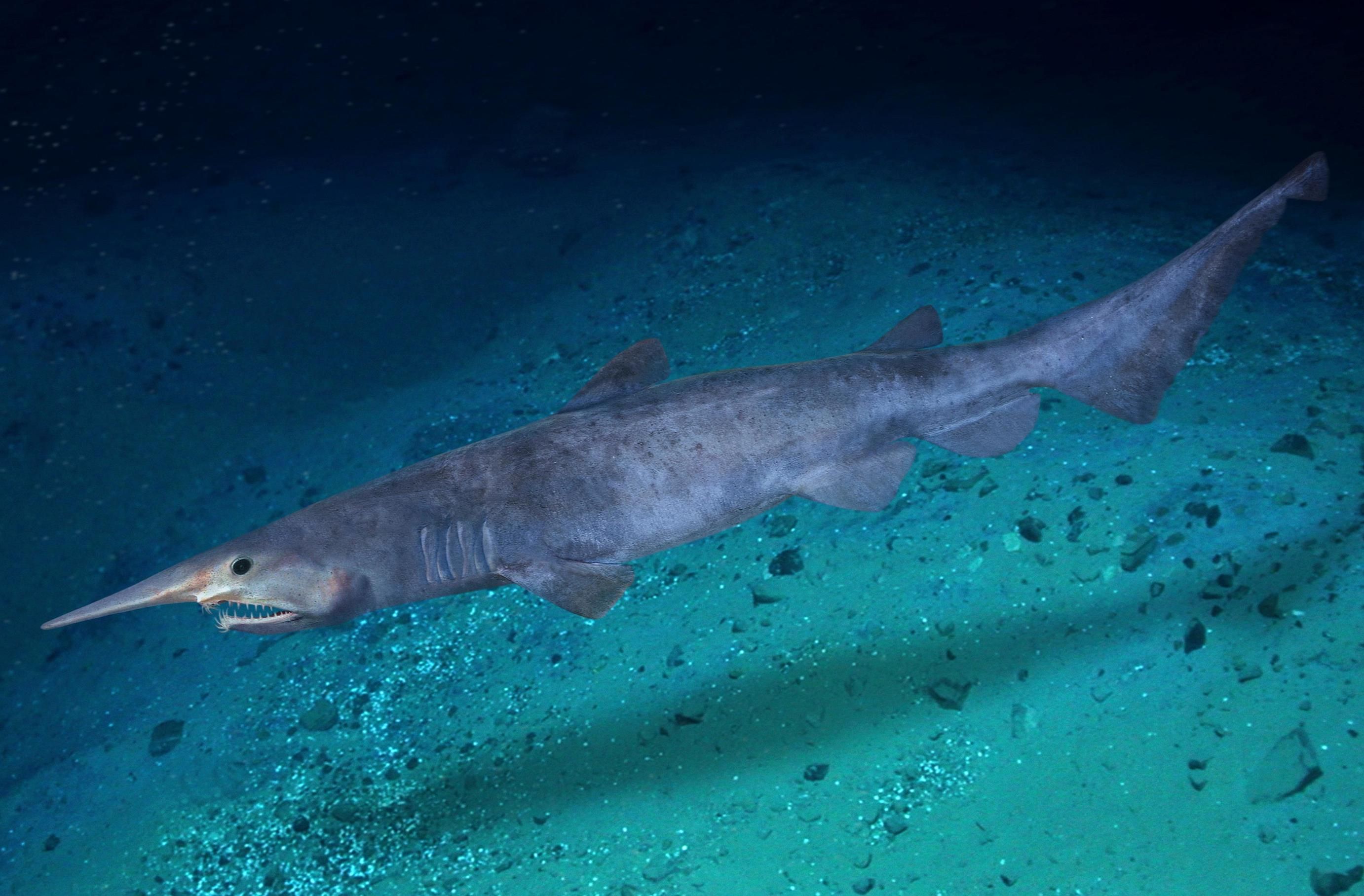
What is a goblin shark?
The goblin shark (Mitsukurina owstoni) is a deep-sea shark species that has remained essentially unchanged for 125 million years, making it a 'living fossil. ' They reach 3-4 meters in length and weigh up to 210 kg. Their most distinctive feature is a long, flat snout with a protrusible jaw that can shoot forward to catch prey at speeds of.
The Shark From 125 Million Years Ago
A submarine in deep Pacific waters encounters a pale, alien-looking shark. Its long flat snout extends forward like a sword. Its skin is translucent pink. As the shark approaches a fish, something extraordinary happens, its jaws suddenly launch forward from under the snout, shoot through the water at 7 mph, grab the prey, and retract in less than a fifth of a second.
The animal just observed is the goblin shark, a species whose family has existed in essentially unchanged form for 125 million years. When dinosaurs roamed the continents, goblin sharks were already in the oceans. They survived the extinction that killed the dinosaurs. They continue to survive in deep ocean waters today, unchanged, while nearly every other shark family has evolved into substantially different forms.
The Appearance
The goblin shark (Mitsukurina owstoni) looks unlike any other living fish.
Physical features:
- Length: 3-4 meters typical, up to 4.3 m maximum
- Weight: 100-210 kg
- Skin: translucent pink/white
- Snout: extremely long and flat
- Eyes: small, adapted to deep darkness
- Jaws: recessed under snout, extend dramatically during hunting
- Teeth: narrow, needle-like, optimized for grabbing
The alien appearance:
The goblin shark's unique features combine into an otherworldly look:
- Long flat snout like a sword extending from the head
- Translucent skin showing blood vessels and organs
- Recessed jaws that create a sunken face
- When jaws protrude, appearance changes dramatically
Popular media often describes goblin sharks as looking "alien" or "mythical." Japanese fishermen historically considered them supernatural because of their strange appearance.
The Jaw Mechanism
The goblin shark's feeding apparatus is one of the most unusual in any vertebrate.
Protrusible jaws:
When hunting, the goblin shark's jaws shoot forward from their recessed position. The mechanism:
- Launch speed: 3.1 m/s (6.9 mph)
- Extension distance: approximately 8.6 cm from body
- Time from start to grab: ~40 milliseconds
- Time from start to full retraction: ~150 milliseconds
How it works:
Specialized double-jointed ligaments connect the jaw to the skull. When muscles contract, the jaw rotates forward and downward, extending outward. The muscles then reverse direction, and the jaw retracts.
This allows the shark to:
- Remain still (saving energy)
- Detect prey with sensory organs in the snout
- Strike at extraordinary speed for its size
- Retract rapidly without moving the body
Why this design:
Goblin sharks are slow swimmers. They cannot pursue prey like faster sharks do. The explosive jaw protrusion compensates, prey passing within striking range is caught before it can react.
The mechanism is among the fastest shark feeding strikes ever measured and arguably the fastest relative to body size.
Living Fossil Status
Goblin sharks are living examples of ancient shark lineages.
Age of the family:
The family Mitsukurinidae has existed since the early Cretaceous period, approximately 125 million years ago. Fossils from this period show goblin shark relatives with essentially identical body plans and jaw mechanisms.
Comparison:
- Dinosaurs: went extinct 66 million years ago
- Modern humans (Homo sapiens): 300,000 years old
- Goblin shark family: 125 million years old
The goblin shark lineage predates the extinction that killed the dinosaurs. While dinosaurs and countless other species went extinct during the K-Pg boundary 66 million years ago, goblin sharks continued essentially unchanged.
Only surviving species:
Many ancient goblin shark species existed, 10+ species in the fossil record. All but one went extinct. Mitsukurina owstoni is the single surviving representative of the entire family.
Why stable:
Several factors likely contributed to goblin shark lineage stability:
- Deep sea habitat: more stable than surface environments
- Specialized niche: no competitors adopted similar hunting strategy
- Low metabolism: survived through periods of food scarcity
- Wide distribution: populations in multiple oceans provide extinction resistance
Deep Sea Life
Goblin sharks live in deep ocean darkness.
Depth range:
- Typical: 270-1,300 meters
- Record deep: 1,370 meters
- Vertical migration: limited, unlike some other deep-sea species
Habitat preferences:
- Continental slopes: gradients where deep water meets shelf
- Submarine canyons: natural gathering points for deep-sea life
- Seamounts: underwater mountain features
- Temperature: 5-13°C
Sensory adaptations:
In deep-sea darkness, goblin sharks rely on:
- Ampullae of Lorenzini: electroreceptors in the long snout that detect prey electrical fields
- Small eyes: useful at these depths though not primary sense
- Lateral line: detects water movement from prey
- Olfaction: detects chemical traces in water
Life rhythm:
Goblin sharks appear to be inactive predators; they conserve energy by moving slowly and striking only when prey comes close. This matches their lean metabolism and deep-sea energy economy.
Discovery
Goblin sharks were unknown to Western science until 1898.
First description:
In 1898, a goblin shark caught off Yokohama, Japan was sent to zoologist Kakichi Mitsukuri, who named the species after himself (Mitsukurina). The common name "goblin shark" translates the Japanese name (tenguzame) meaning "long-nosed goblin."
Japanese folklore:
The Japanese name references tengu, mythological long-nosed creatures from Japanese folklore. The shark's distinctive snout reminded Japanese fishermen of tengu appearance.
Rarity of specimens:
Despite being discovered 125+ years ago, goblin sharks remain rare in scientific collections. Most museum specimens come from accidental bycatch in deep-sea fishing. Only a few hundred specimens have been studied across all global museums.
Live observations:
The first video of a live goblin shark was captured in 2003. Submersible encounters remain rare. Most understanding of live goblin shark behavior comes from a handful of deep-sea research dives.
Where They Live
Goblin sharks are documented in all major oceans.
Pacific Ocean:
- Japan (most common observations)
- Australia
- New Zealand
- California
- Mexico
- Hawaii
Atlantic Ocean:
- Brazil
- Senegal
- Portugal
- Gulf of Mexico
- Canary Islands
Indian Ocean:
- Mozambique
- Madagascar
- South Africa
Why rarely seen elsewhere:
Goblin sharks likely exist in more locations than documented, but deep-sea surveys and fisheries don't cover the entire ocean. Their deep habitat makes them extremely difficult to detect without specific deep-water research.
Diet
Goblin sharks eat primarily small deep-sea fish and squid.
Documented prey:
- Various small deep-sea fish
- Squid
- Crustaceans (crabs, shrimp)
- Occasional larger fish
Hunting strategy:
Unlike active-predator sharks, goblin sharks appear to use ambush hunting:
- Wait motionless in water column
- Detect approaching prey via electroreception
- Launch jaws forward at extreme speed
- Grab and retract
- Resume waiting
This strategy suits their slow swimming and deep-sea habitat.
Feeding frequency:
Deep-sea metabolism runs slowly. Goblin sharks likely eat once every few days or weeks, with meals providing long-lasting energy reserves.
Reproduction
Goblin shark reproduction is poorly understood.
What is known:
- Reproductive mode: likely ovoviviparity (eggs develop internally, live birth)
- Sexual maturity: estimated at 2-3 meters length
- Young: size at birth unknown
- Gestation: unknown
Why limited information:
- Few pregnant specimens have been studied
- Deep-sea habitat prevents direct observation
- Slow reproduction means few pregnant females encountered
Implications for conservation:
Slow-reproducing species are particularly vulnerable to fishing pressure. Without clear reproductive data, predicting population resilience to human impacts is difficult.
Conservation Status
Goblin shark populations are uncertain.
IUCN status:
Least Concern, but this classification is based on limited data.
Threats:
- Bycatch: deep-sea fisheries accidentally catch goblin sharks
- Climate change: ocean warming may affect their habitat
- Deep-sea mining: proposed operations would damage their environment
- Pollution: plastic and chemical contamination accumulates in deep water
Why hard to protect:
- Deep-sea habitat difficult to monitor
- Populations uncertain
- Commercial fishing not specifically targeting them
- Limited political attention to deep-sea species
Research priorities:
- Deep-sea population surveys
- Age and growth studies from preserved specimens
- Reproductive biology
- Population genetics
- Habitat requirements
Why They Matter
The goblin shark represents something important about life's history.
Most animals alive today evolved relatively recently. Modern humans are a few hundred thousand years old. Modern elephants are a few million. Modern mammals diversified after dinosaur extinction 66 million years ago.
The goblin shark lineage is 125 million years old. They existed alongside dinosaurs, not as distant relatives of dinosaur-era sharks, but as essentially the same animals we can still observe today. Their continued existence represents one of the longest unbroken evolutionary lineages in any vertebrate.
This stability has scientific value:
- Understanding how lineages survive mass extinctions
- Observing deep-time evolutionary change (or lack thereof)
- Seeing what predators hunted 100 million years ago
- Accessing ancient evolutionary strategies still functioning
And cultural value:
- Connecting modern oceans to the age of dinosaurs
- Reminding us that the deep sea preserves ancient life
- Showing that strange forms can persist across geological time
For conservation, goblin sharks matter because they cannot be replaced. If they go extinct, the entire Mitsukurinidae family, an ancient, specialized lineage, ends. Whatever evolutionary experiments were conducted over 125 million years will conclude.
They are currently surviving. But our knowledge of them is limited, our observation rare, and our ability to protect them incomplete. The goblin shark swimming in deep dark waters tonight is both a living animal and a living fossil, evidence that life persists through geological time in ways humans are only beginning to appreciate.
Other Living Fossils in the Ocean
Goblin sharks are among a small number of marine species considered "living fossils" - lineages that have retained ancient body plans with minimal morphological change across tens of millions of years. Our research team compiled a comparison of the most notable marine living fossils along with their estimated lineage age.
| Species | Lineage Age | Habitat | Key Ancestral Trait |
|---|---|---|---|
| Goblin shark (Mitsukurina owstoni) | 125 million years | Deep-sea, 270-960 m | Protrusible jaws, paddle snout |
| Coelacanth (Latimeria chalumnae) | 400 million years | Deep reef, 100-500 m | Lobed fins, rostral organ |
| Frilled shark (Chlamydoselachus anguineus) | 80 million years | Deep-sea, 500-1,500 m | Eel-like body, 300 trident teeth |
| Horseshoe crab (Limulus polyphemus) | 445 million years | Shallow coastal | Unchanged chelicerate body plan |
| Nautilus (Nautilus pompilius) | 500 million years | Reef slopes, 100-600 m | External chambered shell |
| Sixgill shark (Hexanchus griseus) | 180 million years | Deep-sea, 200-2,500 m | Six gill slits |
| Lamprey (Petromyzontiformes) | 360 million years | Rivers and oceans | Jawless, cartilaginous skeleton |
| Ginkgo-toothed shark (Isurus paucus) | 55 million years | Open ocean | Ancient mako lineage |
The persistence of these species across major extinction events - including the end-Permian (252 million years ago), end-Triassic (201 million years ago), and end-Cretaceous (66 million years ago) events - demonstrates that deep-sea habitats have served as evolutionary refugia that shielded certain lineages from the environmental disruption that devastated shallower ecosystems.
The Protrusible Jaw Mechanism
The goblin shark's most distinctive anatomical feature is its ability to protrude its upper jaw dramatically forward when striking prey, extending the mouth as much as 8 to 9 percent of the total body length in a fraction of a second. High-speed video of a single captive specimen recorded off the coast of Japan and published in 2008 revealed that this jaw protrusion is the fastest among all known shark species, reaching velocities of 3.1 meters per second [1].
"The goblin shark jaw-protrusion strike is the most extreme example of prey capture kinematics documented in any shark. The entire jaw apparatus is slung forward on a pair of ligaments, ejecting the mouth out of the face like a catapult. Nothing else in the shark world comes close to this level of kinematic extension." - Dr. Kazuhiro Nakaya, Hokkaido University [1]
The mechanism evolved in response to the species's low-light deep-sea habitat, where prey detection occurs at very short range through electroreception rather than vision. The protrusible jaw extends the effective strike distance without requiring the predator to swim closer, reducing the chance of spooking prey in the final instant before capture.
Deep-Sea Encounters and Rare Sightings
Goblin sharks are almost never seen alive. Most specimens known to science have been accidentally caught in deep-water longlines, gillnets, or trawl fisheries. A rare 2014 incident in Tokyo Bay, where Japanese fishermen accidentally netted a living juvenile female goblin shark, resulted in several hours of footage documenting jaw extension behavior before the specimen died.
"Every goblin shark specimen we obtain expands our understanding of this species by several percent, because our total cumulative sample size is still measured in the low hundreds. These are arguably the least-known large shark species in the world. We have vastly more information on species of deep-sea squid than we do on goblin sharks." - Dr. David Ebert, Pacific Shark Research Center [2]
A 2003 incident in Taiwan, following a submarine earthquake that disrupted deep-sea sediments, produced a mass stranding of over 100 goblin sharks in surface waters - the single largest observation event ever recorded. The earthquake-displaced specimens allowed a brief window of enhanced research access that produced much of the modern data on goblin shark diet and reproductive biology.
References
- Nakaya, K., Tomita, T., Suda, K., et al. (2016). Slingshot feeding of the goblin shark Mitsukurina owstoni (Pisces: Lamniformes: Mitsukurinidae). Scientific Reports, 6, 27786. DOI: 10.1038/srep27786
- Ebert, D. A., Fowler, S., & Compagno, L. J. V. (2013). Sharks of the World: A Fully Illustrated Guide. Wild Nature Press. ISBN: 978-0956871749
- Parsons, G. R., Ingram, G. W., & Havard, R. (2002). First record of the goblin shark Mitsukurina owstoni, Jordan (Family Mitsukurnidae) in the Gulf of Mexico. Southeastern Naturalist, 1(2), 189-192. DOI: 10.1656/1528-7092(2002)001[0189:FROTGS]2.0.CO;2
- Yano, K., Miya, M., Aizawa, M., & Noichi, T. (2007). Some aspects of the biology of the goblin shark, Mitsukurina owstoni, collected from the Tokyo Submarine Canyon and adjacent waters, Japan. Ichthyological Research, 54(4), 388-398. DOI: 10.1007/s10228-007-0414-4
Electroreception and the Role of the Rostrum
The goblin shark's elongated flat rostrum is densely packed with ampullae of Lorenzini, electroreceptor organs that detect the weak electric fields generated by the muscular activity of living prey. Most sharks have ampullae concentrated on the snout; goblin sharks have carried this arrangement to an extreme, with rostral ampullae counts estimated to exceed 10,000 - the highest density of any shark species measured.
The resulting sensory system allows the goblin shark to detect prey in total darkness at ranges up to 50 centimeters with spatial resolution better than any shark measured. The combined action of the sweeping rostrum and protrusible jaws permits the shark to detect prey hidden in sediment, lock onto it, and strike with exceptional accuracy despite functioning in environments where visible light has not penetrated for millions of years.
Related Articles
- Great White Shark: The Ocean's Apex Predator
- Megalodon vs Great White Shark
- Deep Sea Creatures: Life in the Eternal Darkness
Frequently Asked Questions
What is a goblin shark?
The goblin shark (Mitsukurina owstoni) is a deep-sea shark species that has remained essentially unchanged for 125 million years, making it a ‘living fossil.’ They reach 3-4 meters in length and weigh up to 210 kg. Their most distinctive feature is a long, flat snout with a protrusible jaw that can shoot forward to catch prey at speeds of 3.1 m/s.
When the jaw isn’t extended, it folds back into a recessed position under the snout, giving the shark its alien appearance. They have pinkish-white translucent skin, small eyes adapted to deep darkness, and sharp needle-like teeth. They live in deep ocean waters between 270 and 1,300 meters, with some records up to 1,370 meters. They were first described scientifically in 1898 after being caught off Japan.
Their family (Mitsukurinidae) was thought extinct for millions of years until live specimens were encountered. Goblin sharks have been documented in all three major oceans but are rarely seen due to their deep-sea habitat.
How does a goblin shark jaw work?
The goblin shark has one of the most unusual feeding mechanisms of any vertebrate. Its jaws can extend forward dramatically from a recessed position under its long snout. When hunting, specialized ligaments launch the jaws forward at 3.1 meters per second (6.9 mph), faster than other sharks can bite. The jaws shoot out approximately 8.6 cm from the body, reach the prey, and retract in under 150 milliseconds.
This ‘slingshot’ feeding mechanism is essentially the fastest bite ever recorded in any shark. The goblin shark is slow-moving, so this explosive strike compensates for its inability to pursue fast prey. The protrusion uses double-jointed mandibular ligaments combined with specialized muscles. In its retracted position, the jaws fit neatly under the long flat snout, which acts as a sensor for detecting prey electrically (through ampullae of Lorenzini).
This unique adaptation allows the goblin shark to sense prey, then strike from an ambush position at extraordinary speed for its size.
Why are goblin sharks called living fossils?
Goblin sharks are called living fossils because their family (Mitsukurinidae) has existed in essentially unchanged form for 125 million years - since the Cretaceous period when dinosaurs still roamed. Fossil evidence shows ancient goblin shark relatives with nearly identical body plans, snout structure, and jaw arrangements. This represents extraordinary evolutionary stability - most shark families have evolved significantly over this time period.
The goblin shark lineage survived multiple mass extinctions including the one that killed the dinosaurs. Most fossil goblin shark species went extinct, but Mitsukurina owstoni remains as the single surviving species of its entire family. Similar living fossil status applies to coelacanths (fish unchanged for 400 million years) and horseshoe crabs (450 million years).
The goblin shark represents one of the few surviving members of an ancient lineage in the ocean. Its survival likely depends on its deep-sea habitat, which has remained relatively stable through geologic time while surface environments changed dramatically.
Where do goblin sharks live?
Goblin sharks live in deep ocean waters worldwide, typically at depths of 270-1,300 meters. Documented locations include the Pacific Ocean (Japan, Australia, New Zealand, California, Mexico), Atlantic Ocean (Brazil, Senegal, Portugal, Gulf of Mexico), and Indian Ocean (Mozambique, Madagascar, South Africa).
They are most commonly encountered in submarine canyons, continental slopes, and other deep-water structures that create upwelling and concentrate prey. Their preferred temperature range is 5-13 degrees Celsius, restricting them to temperate and cold waters. Japanese waters have produced the most goblin shark observations - the species was first described from specimens caught there, and Japanese deep-sea fisheries periodically catch them as bycatch.
Most goblin shark specimens ever studied have been accidentally caught in deep-sea fishing operations rather than through intentional research. Their deep-sea habitat makes direct observation nearly impossible, so most knowledge comes from preserved specimens rather than studies of living animals in their natural environment.
Are goblin sharks dangerous?
No, goblin sharks pose zero danger to humans. They live in deep ocean waters where humans never dive naturally, and even submersible encounters with live goblin sharks are extremely rare. The species is not aggressive and has no recorded history of attacking humans. Their protrusible jaws are impressive but are designed for catching small fish and squid at close range, not for attacking large mammals.
Goblin sharks weigh up to 210 kg but are slow-moving and lethargic compared to more active shark species. They pose no threat even to scientific divers in submersibles. The species faces more danger from humans than the other way around - accidental catch in deep-sea fisheries kills an unknown number each year.
Their vulnerability to fishing pressure is particularly concerning because goblin shark reproduction is poorly understood and their slow metabolism suggests they reproduce slowly. Climate change is also affecting their deep-sea habitat, with warming ocean waters potentially reducing the extent of their suitable temperature range.