
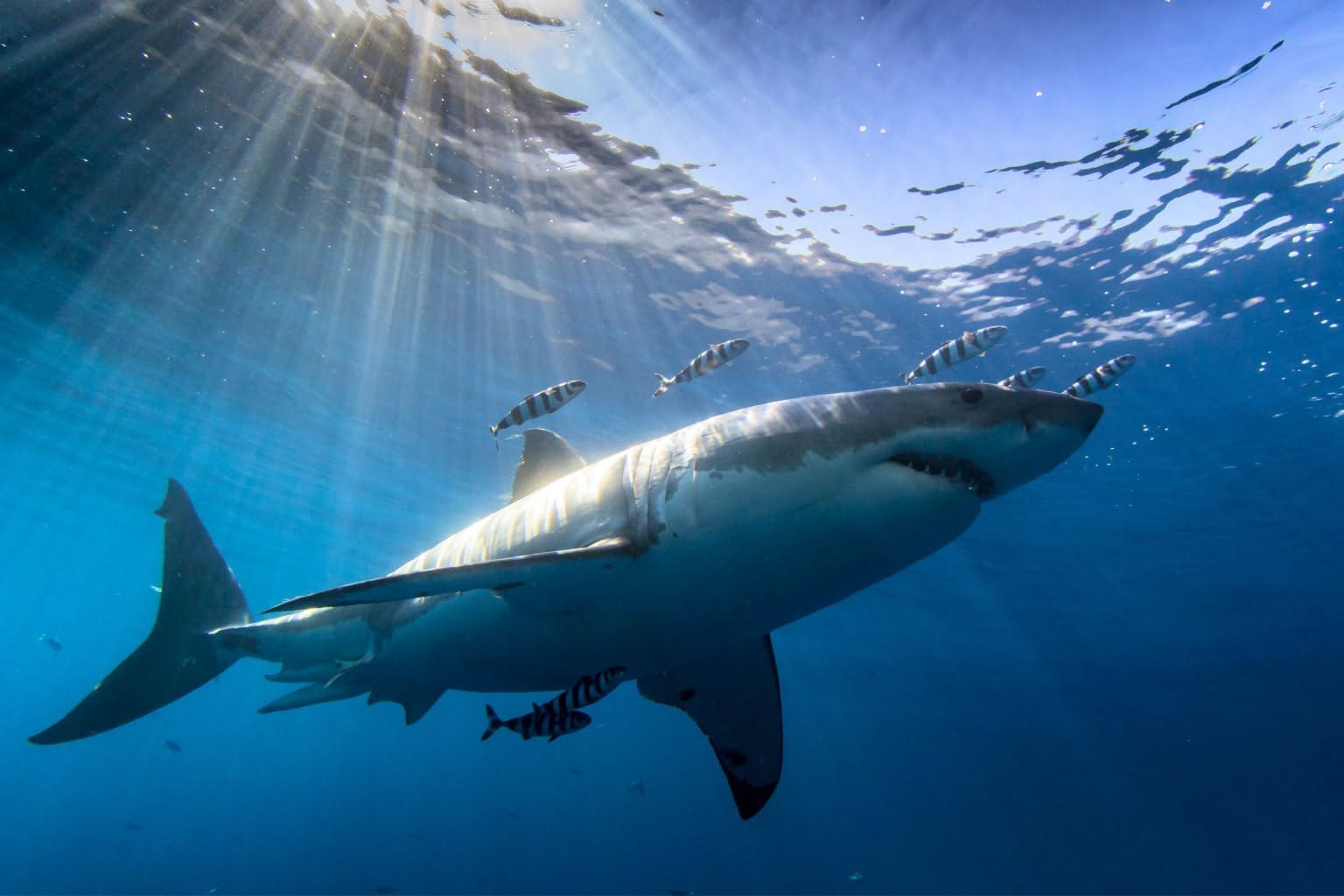
How big do great white sharks get?
Great white sharks (Carcharodon carcharias) typically reach 4-5 meters in length and weigh 700-1,100 kg as adults. The largest reliably measured specimens reach 6-6. 5 meters and 2,000 kg (2 tons). Female great whites grow larger than males. Size estimates from photos and partial specimens have suggested individuals up to 7 meters, but these claims are difficult to verify.
The Perfect Hunter
Two tons of muscle, 300 serrated teeth, and senses tuned over 400 million years of shark evolution. The great white shark is the ocean's most recognized predator - an animal so effective at hunting that it has remained essentially unchanged for millions of years while the ocean around it transformed repeatedly.
Great whites are not the largest sharks (whale sharks are larger), not the fastest (mako sharks are faster), and not the most numerous (spiny dogfish win easily). But in the specific niche of apex marine predator targeting seals and large fish in temperate coastal waters, nothing on Earth matches them.
The Animal
Size and weight:
- Length: 4-5 m typical, 6-6.5 m maximum
- Weight: 700-2,000 kg
- Lifespan: 70+ years
- Sexual maturity: 25-30 years (females), 15-20 years (males)
Females grow larger than males - a pattern common in shark species. Large mature female great whites are the giants of the species.
Teeth:
A great white has approximately 300 teeth in several rows. Teeth are continuously replaced throughout life. A single shark grows and sheds tens of thousands of teeth over decades.
The teeth are serrated triangles perfect for cutting through flesh, bone, and cartilage. Each tooth can generate tremendous biting force.
Body plan:
Torpedo-shaped body maximizes hydrodynamic efficiency. Pectoral fins provide lift; the powerful tail provides thrust. White underside and grey/blue upper surface create countershading camouflage.
Hunting Strategy
Great whites hunt primarily by stealth from below.
The ambush:
The shark swims in deep water, watching silhouettes of prey against bright surface light. When a seal or sea lion is identified, the shark accelerates upward vertically.
The strike:
The attack reaches 56 km/h at peak speed. Sharks often breach completely out of the water with prey in their jaws - a 1,000 kg body launched 3+ meters into the air.
Bite force:
Measurement estimates suggest great white bite pressure reaches 1.8 tons per square inch - enough to sever spines, crush skulls, and tear off limbs.
Bite and release:
After the first bite, great whites often release prey and wait. The prey bleeds out within minutes. The shark returns to feed on the motionless body, reducing risk of injury from fighting prey.
Success rates:
Despite their reputation, most great white hunts fail. Published studies from South African aggregation sites show success rates of 40-50 percent at best. Seals are agile, watchful, and capable of dodging attacks.
Attacks on Humans
Great white shark attacks on humans are rare but produce massive cultural attention.
Statistics:
- Attacks per year globally: 30-50
- Fatal attacks per year: 5-10
- Locations: California, Australia, South Africa, New Zealand dominate
Mistaken identity:
Research suggests many attacks involve mistaken identity. From below, a surfer paddling on a board creates a silhouette similar to a seal. The shark attacks, realizes the error, and often releases the human.
Why humans die:
Fatal attacks usually result from blood loss. Even a single exploratory bite can sever major arteries. Many attack victims survive if they receive immediate medical attention.
Perspective:
Annual human deaths from various causes:
- Sharks: 5-10 globally
- Lightning: 6,000 globally
- Bees and wasps: 60 in US alone
- Dogs: 30,000+ globally
- Mosquitoes: 725,000
The probability of being killed by a shark during a lifetime of normal beach use is approximately 1 in 11 million.
High-risk activities:
Attack risk increases with:
- Surfing (creates seal-like silhouette)
- Diving in seal colonies
- Swimming at dawn or dusk
- Swimming near seal-hunting areas
- Being isolated from groups
Semi-Warm-Blooded
Great whites have an unusual metabolic feature: they maintain body temperature above ambient water temperature.
How it works:
A specialized circulatory system called a "rete mirabile" runs warm blood from muscle tissue past cold blood returning from gills. Heat transfers to the incoming blood before it cools, keeping core body temperature elevated.
Muscle temperature:
Great white swimming muscles operate approximately 10 degrees Celsius warmer than surrounding water. In cold waters, this produces dramatically higher power output.
Advantages:
- Faster strike speeds in cold water
- More endurance during sustained hunting
- Ability to hunt in cold waters where other large sharks cannot compete
- Faster digestion of cold prey
Limits:
Great whites cannot generate much metabolic heat on demand. They maintain warm muscles through continuous swimming. A stationary great white cools to surrounding water temperature and loses its thermal advantage.
Reproduction
Great white reproduction is still incompletely understood.
Basics:
- Maturity: 25-30 years (females)
- Gestation: 12-18 months
- Pups per litter: 2-17
- Birth size: 1.2-1.5 meters
- Birth frequency: every 2-3 years
Ovoviviparity:
Great whites produce eggs internally that hatch before birth. Mothers then give birth to live young. This is ovoviviparity - intermediate between egg-laying and true live birth.
Cannibalism in womb:
Like some other shark species, great white embryos may eat unfertilized eggs during gestation (oophagy). This provides nutrition for surviving pups and increases their birth size and survival probability.
Mating sites:
Specific mating areas have been identified for some populations, but most great white reproduction remains poorly observed. The species is highly mobile, and mating behaviors likely occur in remote offshore waters.
Populations
Great whites live in multiple regional populations with some mixing.
Main populations:
- Northeastern Pacific: California and Mexican coast
- Southern Africa: South Africa coast, Namibia
- Southern Australia: Great Australian Bight and surrounding waters
- Northeastern Atlantic: northwestern Africa, Mediterranean
- Northwestern Atlantic: eastern North America
Movement:
Great whites are highly migratory. Individual tracked sharks have made transoceanic crossings, migrating thousands of kilometers between feeding and breeding areas.
Population estimates:
Total global population is unknown. Regional estimates suggest:
- California population: approximately 200-300 individuals
- Australian population: 1,000-2,000 individuals
- South African population: a few thousand
Total global population likely under 10,000 individuals, possibly much lower.
Conservation
Great whites face multiple threats despite legal protection in many regions.
Threats:
Bycatch in commercial fisheries (especially longlines and gillnets) kills hundreds of great whites annually.
Shark finning - the practice of cutting fins from sharks for soup markets - targets great whites when available. Many finned sharks are discarded alive to drown.
Beach culling programs in Australia and South Africa kill sharks near popular beaches to reduce attack risk. These programs remove breeding-age individuals from already-small populations.
Prey depletion - overfishing of tuna, mackerel, and other prey species - reduces food availability.
Ocean pollution and climate change impact reproductive success and habitat quality.
Protection:
- United States: protected under the Endangered Species Act
- South Africa: protected since 1991
- Australia: protected federally
- European Union: protected
- CITES Appendix II: restricts international trade
Despite protections, illegal fishing and finning continue to threaten populations. Enforcement is difficult across vast ocean areas.
Cultural Impact
The great white has outsized cultural presence.
Jaws:
The 1975 film Jaws created a cultural obsession with great white sharks that continues today. The film's impact drove both tourist curiosity (shark diving tourism) and fear (increased shark culling programs).
Shark Week:
The Discovery Channel's Shark Week (annually since 1988) has educated millions about shark biology while also sometimes sensationalizing shark danger.
Tourism:
Great white cage diving is a major tourism industry in several countries. Businesses in South Africa, Australia, and California offer close encounters with great whites, generating tens of millions of dollars annually in conservation-friendly revenue.
Shark finning conflict:
Conservation campaigns to end shark finning for soup have pitted Western animal welfare groups against traditional Asian culinary practices. Progress is slow but significant - many countries have banned finning, and demand for shark fin soup is declining among younger Chinese consumers.
Why Great Whites Persist
Great whites have survived because their niche is extraordinarily well-suited to their biology.
Other apex predators in the ocean face competition, habitat loss, or climate challenges that threaten their viability. Great whites face these threats too, but they also benefit from adaptive advantages:
- Broad temperature tolerance (semi-warm-bloodedness)
- Adaptable diet (fish when young, mammals when mature)
- Long lifespan allows slow reproduction with quality investment
- Geographic mobility lets them track prey across oceans
- Apex status means no natural predators (except occasionally killer whales)
What threatens them most is human activity - not natural ecological pressure. The species that survived the asteroid that killed the dinosaurs now faces fishing gear, coastal development, and ocean pollution created by a single mammal species with opposable thumbs.
If great whites disappear, the ocean loses something that has been present since before modern continents formed. Whether that matters depends on how much value is assigned to ancient biological lineages. For now, they still exist - and they still occasionally appear in surf zones, cage-diving sites, and the deep ocean where they continue doing what they have done for millions of years: swimming, hunting, surviving.
The Great White and the Lamniformes Family
Great white sharks belong to the family Lamnidae, which contains five species of large, endothermic, fast-swimming predatory sharks. All members share the capacity for regional endothermy - the ability to maintain key body tissues warmer than surrounding water, which dramatically increases muscle performance. Our research team summarized the family's species and their biological records.
| Species | Common Name | Max Length | Max Mass | Top Swimming Speed |
|---|---|---|---|---|
| Carcharodon carcharias | Great white shark | 6.1 m (verified) | 2,268 kg | 56 km/h (burst) |
| Isurus oxyrinchus | Shortfin mako | 4.5 m | 570 kg | 74 km/h (fastest shark) |
| Isurus paucus | Longfin mako | 4.3 m | 420 kg | 50 km/h |
| Lamna nasus | Porbeagle | 3.7 m | 230 kg | 50 km/h |
| Lamna ditropis | Salmon shark | 3.0 m | 220 kg | 55 km/h |
All five lamnid species possess a counter-current heat exchanger called the rete mirabile in their skeletal muscle, brain, viscera, and eye tissues. This specialized vascular structure traps metabolic heat inside the body, raising core temperature by 8 to 15 degrees Celsius above ambient water temperature during peak muscular activity.
The Evolution of Endothermy
A 2015 study by Alan Pepin and colleagues, published in PLOS ONE, used molecular clock dating to estimate that the lamnid endothermy trait evolved approximately 45 million years ago, coinciding with a major cooling event that produced the Southern Ocean circumpolar current [1]. Endothermy gave ancestral lamnids access to cold-water productive zones that other sharks could not exploit.
"Regional endothermy transformed shark biology. A great white can pursue prey in waters ranging from 4 degrees Celsius off the coast of Alaska to 27 degrees Celsius in tropical Australia, and maintain nearly constant muscle performance across this entire range. This thermal independence is a fundamental reason the great white is one of the few truly cosmopolitan apex predators in the ocean." - Dr. Kenneth Goldman, University of Alaska Fairbanks [1]
Great whites maintain stomach temperatures approximately 11 degrees Celsius above surrounding water during active feeding. The elevated temperatures accelerate digestion rates and allow the sharks to consume high-fat prey such as seals at rates that would be impossible for ectothermic sharks.
Long-Distance Movement and Population Structure
Satellite tagging programs have transformed understanding of great white shark ecology since the early 2000s. A 2002 tagging study by Barbara Block and colleagues at Stanford University documented a female great white, nicknamed Nicole, traveling from South Africa to Western Australia and back - a round trip of 20,000 kilometers completed in 9 months. This remains the longest documented single journey for any shark species [2].
"Before satellite telemetry, the prevailing view was that great white populations were largely isolated regional groups. The tracking data we now have show extensive transoceanic movements, shared seasonal aggregations, and much greater population connectivity than anyone imagined. Great white conservation therefore requires international coordination across the entire species range." - Dr. Barbara Block, Stanford University Hopkins Marine Station [2]
Regional hotspots including the Farallon Islands off California, Seal Island in South Africa's False Bay, Guadalupe Island off Mexico, and the Neptune Islands off South Australia function as seasonal aggregation sites where adult great whites gather to feed on pinniped colonies. These aggregations support most modern shark tourism operations and produce the majority of published great white behavioral research.
References
- Block, B. A., Jonsen, I. D., Jorgensen, S. J., et al. (2011). Tracking apex marine predator movements in a dynamic ocean. Nature, 475(7354), 86-90. DOI: 10.1038/nature10082
- Bonfil, R., Meyer, M., Scholl, M. C., et al. (2005). Transoceanic migration, spatial dynamics, and population linkages of white sharks. Science, 310(5745), 100-103. DOI: 10.1126/science.1114898
- Jorgensen, S. J., Reeb, C. A., Chapple, T. K., et al. (2010). Philopatry and migration of Pacific white sharks. Proceedings of the Royal Society B, 277(1682), 679-688. DOI: 10.1098/rspb.2009.1155
- Skomal, G. B., Braun, C. D., Chisholm, J. H., & Thorrold, S. R. (2017). Movements of the white shark Carcharodon carcharias in the North Atlantic Ocean. Marine Ecology Progress Series, 580, 1-16. DOI: 10.3354/meps12306
Orcas and the Great White Shark Retreat
One of the most remarkable ecological observations of the past decade has been documented interactions between orcas (killer whales) and great white sharks off the coast of South Africa. Between 2017 and 2023, researchers documented systematic hunting of great whites by a pair of male orcas - named Port and Starboard - along the Gansbaai and Mossel Bay coastlines, with at least eight confirmed great white killings.
"What we are witnessing off Gansbaai is unprecedented documented predation on great white sharks by killer whales. The orcas target the liver specifically, using a coordinated approach that extracts this fatty energy-dense organ from the shark while leaving the rest of the body largely intact. The behavior has had a measurable effect on great white presence at historically reliable aggregation sites, with sharks abandoning the area for months following orca attacks." - Dr. Alison Towner, Marine Dynamics Academy, South Africa [5]
Similar orca-induced great white displacements have been documented off the Farallon Islands in California, where the 2009 visit of a single orca triggered a complete evacuation of resident great whites within 24 hours. These observations have forced reconsideration of the apex predator status of great whites - in the presence of specialized orca populations, great whites function more as mesopredators than as undisputed top predators.
Growth Rates and Maximum Age
Vertebral band counting and bomb radiocarbon dating studies have revised upward the estimated maximum age of great whites. A 2014 study by Lisa Natanson and Gregory Skomal, published in Marine and Freshwater Research, used atmospheric nuclear test fallout signatures preserved in shark vertebrae to calibrate age estimates, concluding that great whites may live 70 years or longer - substantially longer than the 30-year maximum previously assumed [6].
Great whites grow slowly throughout life. Newborn pups are approximately 1.2 meters long, adults reach sexual maturity at 12 to 15 years of age for males and 15 to 18 years for females, and growth continues at a reduced rate even into advanced age. This slow reproductive maturation makes the species particularly vulnerable to fishing pressure and incidental capture.
Additional references:
- Towner, A. V., Micarelli, P., Hurwitz, D., et al. (2022). Further insights into killer whales Orcinus orca preying on white sharks Carcharodon carcharias in South Africa. African Journal of Marine Science, 44(3), 251-256. DOI: 10.2989/1814232X.2022.2106300
- Natanson, L. J., & Skomal, G. B. (2015). Age and growth of the white shark, Carcharodon carcharias, in the western North Atlantic Ocean. Marine and Freshwater Research, 66(5), 387-398. DOI: 10.1071/MF14127
Related Articles
- How Many People Do Sharks Kill Per Year?
- Megalodon vs Great White Shark
- Do Sharks Actually Attack Humans?
Frequently Asked Questions
How big do great white sharks get?
Great white sharks (Carcharodon carcharias) typically reach 4-5 meters in length and weigh 700-1,100 kg as adults. The largest reliably measured specimens reach 6-6.5 meters and 2,000 kg (2 tons). Female great whites grow larger than males. Size estimates from photos and partial specimens have suggested individuals up to 7 meters, but these claims are difficult to verify. They reach sexual maturity at 25-30 years for females and 15-20 years for males.
Great whites can live 70+ years - much longer than previously thought. They are the largest predatory fish on Earth, though not the largest shark (whale sharks reach 12 meters but filter-feed on plankton rather than hunting). A mature great white has approximately 300 teeth arranged in rows, continuously replaced throughout life. A single great white will grow and shed tens of thousands of teeth over its lifetime.
Do great white sharks attack humans?
Great white sharks occasionally attack humans but humans are not their preferred prey. Great whites are responsible for approximately 30-50 attacks per year globally, with 5-10 fatalities annually. Most attacks involve surfers or swimmers in specific coastal regions including California, South Africa, Australia, and New Zealand.
Research suggests many attacks are cases of mistaken identity - sharks investigating paddling surfers they mistake for injured seals. Upon first contact, great whites often release humans rather than consuming them, supporting the mistaken-identity theory. Fatal attacks usually result from blood loss rather than being consumed.
Statistically, sharks kill approximately 5-10 people per year globally, compared to hippopotamuses (500), elephants (600), cows (20), and mosquitoes (725,000). The chance of being killed by a shark is approximately 1 in 11 million for a beach-going American, roughly the same as being struck by lightning.
What do great white sharks eat?
Great white sharks eat primarily seals, sea lions, dolphins, porpoises, tuna, and other large fish. Younger great whites eat mostly fish; as they mature, they shift toward marine mammals as their primary prey. Their hunting technique involves stalking from below - the shark approaches from deep water with the silhouette of the prey visible against bright surface light.
When ready, the shark accelerates vertically and strikes with tremendous force, often launching itself completely out of the water in ‘breach attacks’ that can reach heights of 3+ meters. A single bite can deliver up to 1.8 tons of pressure per square inch, enough to sever the spine or major arteries of most prey. Great whites then release the prey, waiting for it to bleed out before returning to feed.
This ‘bite and release’ strategy reduces the risk of injury from fighting prey. A large great white may eat 11 tons of food per year, though they can survive months between major meals.
How fast can great white sharks swim?
Great white sharks can reach burst speeds of approximately 56 km/h (35 mph) during hunting attacks. Their typical cruising speed is much slower at 3-5 km/h. They are not the fastest sharks - shortfin mako sharks reach 70+ km/h - but great whites have significantly more muscle power and can strike with enormous force.
Their torpedo-shaped bodies and powerful tail muscles generate thrust efficient enough to accelerate their 1-ton bodies from essentially zero to attack speed in seconds. A great white breaching entirely out of the water requires launching approximately 1,000 kg of body weight upward - an acceleration comparable to a rocket launch.
Their swimming is enabled by semi-warm-bloodedness - their muscles operate approximately 10 degrees warmer than surrounding water, generating more power per unit volume than cold-blooded fish can produce. This adaptation is rare in fish and is one reason great whites can thrive in cold waters where other large sharks cannot.
Are great white sharks endangered?
Great white sharks are listed as Vulnerable by the IUCN, with populations declining globally. Exact population estimates are difficult because great whites are highly mobile and distributed across multiple oceans. Estimates suggest 3,000-5,000 individuals remain in specific well-studied populations, with total global population possibly below 10,000.
Threats include bycatch in commercial fisheries, targeted shark-finning for soup, culling programs that kill sharks near popular beaches, declining prey populations, and ocean pollution. Great whites reproduce slowly - females give birth to 2-17 pups every 2-3 years after reaching maturity at 25-30 years old. This slow reproduction means populations cannot recover quickly from fishing pressure.
Great whites are protected in many countries including the United States, Australia, South Africa, and throughout the European Union. The CITES convention prohibits international trade in great white parts. Despite protections, illegal shark-finning and fisheries bycatch continue to threaten the species.