
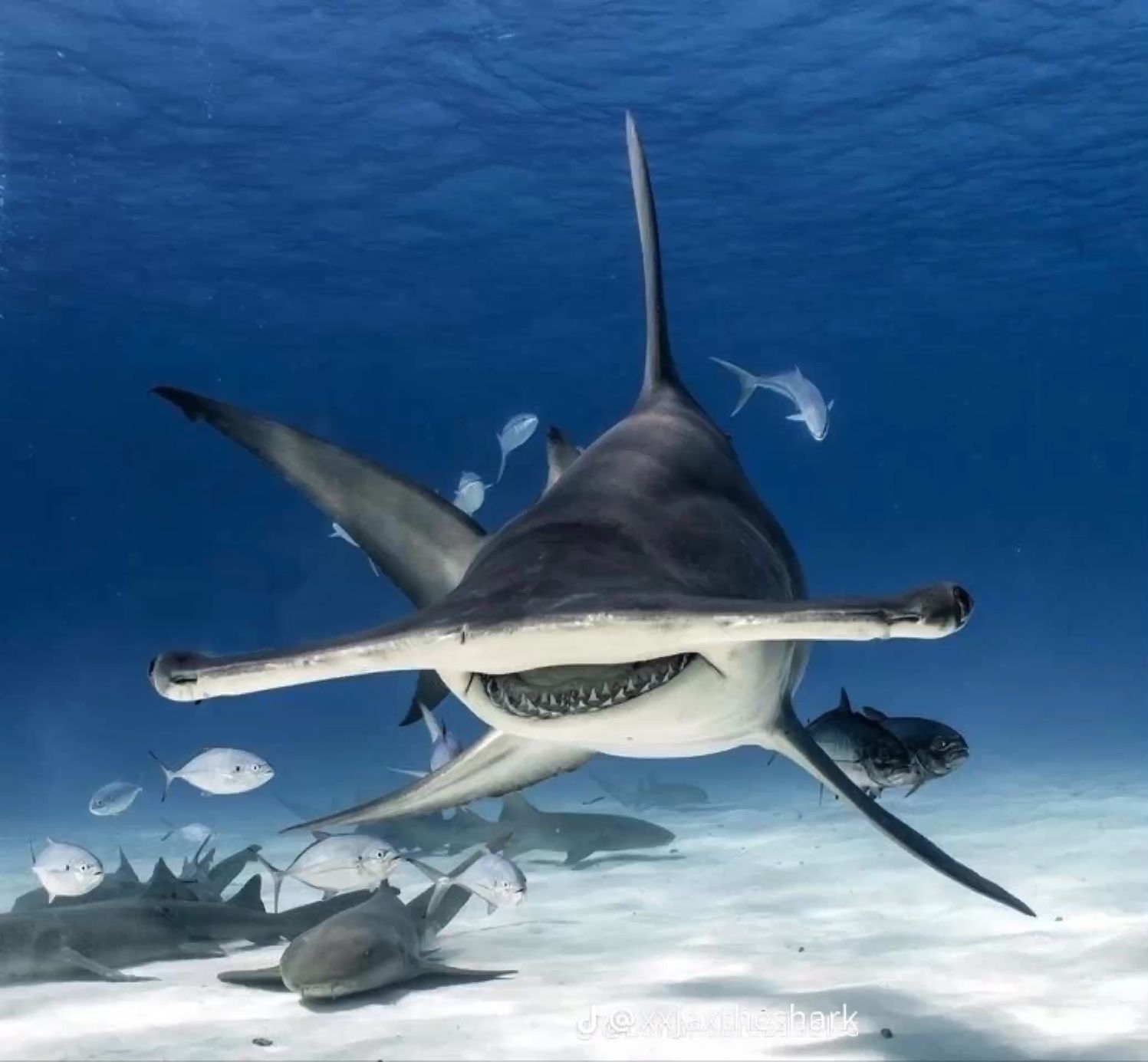
Why do hammerhead sharks have hammer-shaped heads?
The hammerhead shark's distinctive head (called a cephalofoil) evolved primarily to improve prey detection, not for hammering. The flattened head shape spreads electroreceptors called Ampullae of Lorenzini over a wider surface area, giving hammerheads extraordinarily sensitive electrical detection. They can detect the electrical fields produced by prey animals - including rays buried under sand - from much greater distances than.
The Most Unusual Shark Design
Look at a hammerhead shark from above and you see something that looks like a sick joke. The head is flattened into a wide, flat paddle shape, with eyes positioned at the extreme edges - so far apart they seem impossible. The shark appears to be swimming with a hammer strapped to its face.
This is not a random quirk of evolution. The hammer shape - technically called a cephalofoil - is one of the most sophisticated sensory arrays in the ocean. Understanding what it does reveals how specifically evolution has shaped one of the most effective hunting specialists in the sea.
The Cephalofoil
The hammerhead's distinctive head shape is called a cephalofoil (from Greek words for "head" and "wing"). It is not just a flattened head - it is a specialized sensor platform that extends significantly wider than the shark's body.
Cephalofoil dimensions:
- Great hammerhead (largest species): cephalofoil up to 1.5 meters wide on a 6-meter body
- Scalloped hammerhead: cephalofoil approximately 1/3 of body length
- Bonnethead (smallest species): cephalofoil about 20 percent of body length, more rounded
The cephalofoil is highly flattened - much thinner vertically than it is wide. It is covered with specialized sensors, particularly at its leading edge, creating a biological version of a wide-beam radar array.
What the Cephalofoil Actually Does
The hammerhead's head is not primarily a weapon. It is primarily a sensor array that gives the species unique hunting advantages.
1. Enhanced electrical detection.
All sharks have electroreceptor organs called Ampullae of Lorenzini - small jelly-filled pores that detect weak electrical fields produced by living prey. All animal muscles generate electrical signals during movement, and sharks can detect these signals from meters away.
Hammerheads have the same sensor type as other sharks, but distributed across their wide cephalofoil rather than concentrated on their snout. This provides:
- Much wider sensor coverage
- Better triangulation of signal source location
- Greater total sensor density
- Enhanced sensitivity to weak signals
The result: hammerheads can detect prey at much greater distances and with better location precision than conventionally-shaped sharks.
2. Improved vision.
Hammerhead eyes sit at the far edges of the cephalofoil, giving the shark an extremely wide field of view. The eyes can see almost 360 degrees around the shark (with only a small blind spot directly behind the head).
Unlike regular sharks that must turn to look around, hammerheads can scan their entire environment simultaneously. Their stereoscopic vision (both eyes focusing on same target) covers a wider arc than in conventional sharks, providing better depth perception.
3. Hunting advantage against buried prey.
Stingrays and other flat fish bury themselves in sand to escape predators. The hammerhead's cephalofoil, packed with electroreceptors, can detect these buried animals directly through the sand - sensing their electrical activity even when they are completely hidden.
This is the hammerhead's signature hunting capability. They can fly low over sandy seafloors and detect buried prey that other sharks would miss entirely.
4. Maneuverability.
The flat cephalofoil acts as a hydrodynamic surface, providing lift and stability during swimming. Hammerheads can make sharper turns than most shark species, giving them advantages during close-range prey capture.
The Stingray Hunting Technique
Hammerheads use their cephalofoil as a specialized tool for pinning stingrays.
The hunt sequence:
Detection. The hammerhead detects a stingray buried in sand using electroreception.
Approach. The shark swims low over the seafloor, maintaining detection lock on the hidden ray.
Pin. The hammerhead swoops down and uses the flat cephalofoil to press the stingray against the sand. The ray's flat shape and the shark's flat head match almost perfectly, creating an efficient pinning geometry.
Immobilize. Pinned against the seafloor, the ray cannot swim away and has limited ability to use its venomous tail barb.
Feed. The hammerhead bites chunks off the pinned ray while maintaining pressure.
Venom resistance:
Hammerheads appear largely immune to stingray venom. Researchers have found broken stingray barbs embedded in hammerhead bodies with no signs of ill effect. The sharks have essentially evolved tolerance to their primary prey's main weapon - or evolved to not care much about stingray defensive attacks.
This is why hammerheads can specialize in stingray predation where other shark species cannot. A conventional shark pinning a stingray would risk being injected with venom, reducing the success rate of this hunting strategy. Hammerheads can pin stingrays repeatedly without lasting harm.
The Nine Hammerhead Species
Hammerheads belong to the family Sphyrnidae, which includes nine species:
Great hammerhead (Sphyrna mokarran). The largest species, up to 6 meters long. Apex predator of large fish and rays. Cephalofoil extremely wide and prominent. Critically endangered.
Scalloped hammerhead (Sphyrna lewini). 2-3 meters long. Known for forming massive schools at seamounts, especially during the day. Critically endangered.
Smooth hammerhead (Sphyrna zygaena). 2-4 meters long. Prefers cooler waters. Vulnerable.
Bonnethead (Sphyrna tiburo). Smallest species, 1-1.3 meters. More rounded cephalofoil. Only known shark species confirmed to be omnivorous - eats significant amounts of seagrass.
Smalleye hammerhead (Sphyrna tudes). 1.5 meters. Found in coastal waters off South America.
Whitefin hammerhead (Sphyrna couardi). Recently recognized as distinct species. Found in West African waters.
Scoophead (Sphyrna media). Small species in Central and South American coastal waters.
Carolina hammerhead (Sphyrna gilberti). Cryptic species only recognized in 2013. Genetically distinct from scalloped hammerheads it was long confused with.
Shovelhead (Sphyrna vespertina). Eastern Pacific species.
Each species has slightly different head shape, size, hunting behavior, and habitat. The common family pattern is the cephalofoil; the specific variations optimize for different ecological niches.
Why This Shape Evolved
The cephalofoil represents an evolutionary experiment in sensor platform design. Why would evolution produce this specific shape?
The sensor principle:
Electroreceptors detect electric fields by comparing voltage between multiple sensor locations. Just as human vision uses two eyes in different positions to see depth, electroreception uses multiple sensors in different positions to triangulate signal sources.
Greater separation between sensors provides:
- Better triangulation precision
- Detection of weaker signals (because small differences between sensor locations are more meaningful with greater spatial separation)
- Longer detection range
The cephalofoil maximizes sensor separation within the constraints of a shark's skeleton. Evolution favored ever-wider heads in hammerhead ancestors because wider heads gave better electroreception, which gave better hunting success, which gave higher reproductive rates.
The fossil record:
The oldest known hammerhead fossils are approximately 20-25 million years old, already showing the characteristic cephalofoil shape. The evolutionary transition from conventional shark heads to cephalofoils must have occurred over several million years before this, during which head shape gradually widened.
Each intermediate stage would have been viable - slightly wider heads than average provided slightly better sensing, which rewarded those individuals with better hunting success. Over time, the progression toward wider and wider heads produced the extreme cephalofoils we see in modern great hammerheads.
Evolutionary tradeoffs:
The cephalofoil has costs as well as benefits. The flat head creates more drag, requiring more swimming energy. The specialized shape may limit the shark's ability to bite very large prey directly. Breeding requires more complex maneuvering.
Evolution maintained the cephalofoil because the sensing advantages outweighed these costs. For hammerheads' ecological niche (hunting electrogenic prey like rays and small fish), the tradeoff works.
The Schooling Behavior
Scalloped hammerheads display one of the most spectacular group behaviors in the shark world. They form massive schools, sometimes containing 500+ individuals, at specific underwater mountain seamounts.
Where this happens:
The most famous schooling sites include:
- Cocos Island (Costa Rica)
- Galapagos Islands (Ecuador)
- Darwin Island (Galapagos)
- Wolf Island (Galapagos)
- Malpelo Island (Colombia)
The daily pattern:
During daylight hours, scalloped hammerheads gather at seamounts in large schools. They swim slowly together without aggressive behavior toward other school members.
At night, they disperse to hunt individually in open water.
Why they school:
Several hypotheses:
Cleaning stations. Seamounts host fish species (particularly king angelfish) that remove parasites from hammerheads. Schooling provides efficient access to these cleaning services.
Mating. Some evidence suggests schools are associated with mating activities, though the specifics are still being researched.
Thermal regulation. Deep water around seamounts may provide preferred temperature conditions.
Hunting coordination. Schools may collectively hunt more efficiently than individuals in certain conditions.
Protection. Large groups may discourage potential predators (though hammerheads are apex predators in most locations).
The schooling behavior is genuinely spectacular. Videos of hundreds of hammerheads swimming together at seamount sites are among the most iconic marine biology footage.
Conservation impact:
Schooling makes hammerheads vulnerable to commercial fishing. A single well-placed longline or net can catch hundreds of sharks. This concentration at predictable locations has contributed significantly to population declines.
Sexual Dimorphism and Reproduction
Male and female hammerheads differ in size and some anatomical features.
Sexual dimorphism:
- Females generally slightly larger than males
- Female cephalofoils slightly wider than males in some species
- Males have claspers (reproductive organs) on their pelvic fins
Reproduction:
Hammerheads have slow reproductive rates:
- Sexual maturity: 10-13 years for great hammerheads
- Gestation period: 9-11 months
- Litter size: 6-55 pups depending on species
- Reproduction interval: every 1-2 years
This slow reproduction makes hammerhead populations inherently vulnerable to overfishing. A population reduced by commercial fishing cannot recover quickly even if fishing pressure is removed.
The Carolina hammerhead discovery:
For decades, scientists thought they were observing a single species - the scalloped hammerhead - along the eastern U.S. coast. In 2013, genetic analysis revealed that roughly half the supposed scalloped hammerheads were actually a distinct species, the Carolina hammerhead.
The two species are externally nearly identical but genetically distinct, with different vertebra counts and different internal anatomy. They live in the same habitats and had been confused for centuries.
This illustrates how much biological discovery remains possible. Entire shark species can exist, well-studied-seeming populations, and still be misidentified for decades. DNA analysis and careful anatomical study continue revealing surprises.
The Fishing Crisis
Hammerhead populations are in serious decline globally.
Population data:
- Great hammerhead: declined 80-90 percent in many regions since the 1980s
- Scalloped hammerhead: declined 80 percent or more in most populations
- Smooth hammerhead: declined 60+ percent globally
Both great and scalloped hammerheads are now classified as Critically Endangered by the IUCN.
Why they are targeted:
Fin market value. Hammerhead fins are among the most valuable in the Asian shark fin trade. A single great hammerhead fin can sell for $100+ USD.
Predictable locations. Schooling behavior at seamounts makes hammerheads easy to catch in large numbers.
Bycatch. Even when not specifically targeted, hammerheads are caught in tuna longlines and other fishing gear.
Recovery challenge. Slow reproduction means populations cannot rebound quickly. Recovery from even moderate fishing pressure takes decades.
International protection:
Several hammerhead species are listed under CITES Appendix II, requiring permits for international trade. This has reduced but not eliminated fin trade.
National protections vary significantly. Some countries (including Costa Rica, Colombia, Ecuador) protect hammerheads at seamount schooling sites. Others provide little protection or ineffective enforcement.
The conservation outlook:
Without substantial additional protection, some hammerhead species face effective extinction in the next 50-100 years. Current population trajectories cannot be sustained indefinitely.
Recovery is biologically possible but requires:
- Reduced fishing pressure
- Protected schooling sites
- Reduced bycatch in fisheries targeting other species
- International cooperation on protection measures
Danger to Humans
Despite their intimidating appearance, hammerheads rarely attack humans.
Attack statistics (1580-2024):
- Great hammerhead: 17 confirmed unprovoked attacks, 1 fatality
- Scalloped hammerhead: 3 confirmed unprovoked attacks, 0 fatalities
- Smooth hammerhead: 5 confirmed unprovoked attacks, 0 fatalities
- Bonnethead: 0 confirmed unprovoked attacks
Compare to:
- Great white: 355 attacks, 57 fatalities
- Tiger shark: 138 attacks, 39 fatalities
- Bull shark: 121 attacks, 27 fatalities
Why hammerheads are rarely dangerous:
Different prey preference. Hammerheads specialize in rays, small fish, and cephalopods. They are not programmed to attack human-sized prey.
Cautious behavior. Hammerheads often approach divers curiously but rarely become aggressive. Most encounters end with the shark investigating and leaving.
Specialized hunting style. The hammerhead's pinning technique requires specific conditions that do not apply to humans swimming vertically.
The primary time hammerheads become potentially dangerous is during spearfishing activities, where wounded fish attract the sharks. Even then, hammerheads usually focus on the speared fish rather than the human diver.
Popular misconception:
Hammerheads have appeared as antagonists in films and media, but their real reputation in the diving community is mostly positive. Diving with hammerheads at seamounts is a popular ecotourism activity, with virtually no incidents of shark-diver injury.
The Sensory Marvel
Hammerheads represent one of the most specialized sensor systems in the ocean. Their cephalofoil is not just a strange shape - it is an evolved biological technology that would be difficult to engineer artificially.
What modern technology cannot match:
Human-made electroreceptors (for submarines, scientific instruments, etc.) can detect electrical fields, but their performance relative to the volume they occupy is far below the hammerhead's cephalofoil. The evolved sensor array distributes detection across a large surface area while maintaining processing speed and precision that exceeds most artificial systems.
Biomimicry potential:
Engineers studying hammerheads have proposed applications including:
- Advanced underwater navigation systems
- Biological sensor networks
- New approaches to radar and sonar design
- Sensor arrays for security applications
The specific way hammerheads integrate electroreceptor data across their cephalofoil remains incompletely understood. As we learn more, biomimicry applications may multiply.
Research challenges:
Studying hammerhead sensory systems requires specialized equipment and underwater research capabilities that are difficult to deploy. Most of what we know comes from a combination of behavioral observation, anatomical study, and laboratory work with captive specimens.
The field is advancing rapidly as underwater technology improves. New discoveries about hammerhead sensory integration continue to emerge.
The Big Picture
Hammerheads are among the most specialized sharks on Earth. Their cephalofoil represents millions of years of evolution producing a sensor platform optimized for specific hunting challenges.
Every element of hammerhead biology - the shape of the head, the placement of the eyes, the electroreceptors, the pinning hunting style, the schooling behavior, even the resistance to stingray venom - fits together as a coordinated specialization package. Remove any piece and the whole system works less well.
This specialization has made hammerheads extraordinarily successful hunters for tens of millions of years. It has also made them vulnerable. When human fishing pressure exceeded what populations could sustain, their specialized life history left little room to adapt quickly.
The hammerhead shark is a remarkable evolutionary achievement and a potential early casualty of the Anthropocene. Whether the specific design that took millions of years to evolve continues for many more millennia or disappears within a few decades depends entirely on decisions being made now by fisheries managers, policymakers, and consumers.
An ocean without hammerheads would be missing something genuinely unique. Their cephalofoil evolved exactly once in the history of sharks. If the species disappear, nothing quite like them will evolve again for tens of millions of years - if ever.
Related Articles
- Sharks: The Ocean's Most Misunderstood Predators
- Do Sharks Actually Attack Humans?
- Megalodon vs Great White Shark
Frequently Asked Questions
Why do hammerhead sharks have hammer-shaped heads?
The hammerhead shark’s distinctive head (called a cephalofoil) evolved primarily to improve prey detection, not for hammering. The flattened head shape spreads electroreceptors called Ampullae of Lorenzini over a wider surface area, giving hammerheads extraordinarily sensitive electrical detection.
They can detect the electrical fields produced by prey animals - including rays buried under sand - from much greater distances than conventionally-shaped sharks. The wide head also provides improved 360-degree stereoscopic vision, better maneuverability during tight turns, and enhanced sensing capability in three dimensions.
The ‘hammer’ shape is essentially a biological sensor array built into the shark’s skull, optimized for hunting in specific marine environments.
How do hammerhead sharks hunt stingrays?
Hammerhead sharks specialize in hunting stingrays using a distinctive pinning technique. When a hammerhead detects a stingray (usually buried under sand), it swims down and uses its wide head to press the ray against the seafloor. The pinned ray cannot escape or use its venomous tail barb effectively. The hammerhead then bites pieces off the immobilized ray.
This technique works specifically because the hammerhead’s flat head provides the right shape for pinning flat fish like rays. Regular-shaped sharks cannot perform this maneuver effectively. Great hammerheads (the largest species) are apex predators of stingrays, including large species like southern stingrays and eagle rays.
Hammerheads appear largely immune to stingray venom - their bodies often contain broken stingray barbs from past encounters with no apparent ill effects.
How many species of hammerhead sharks are there?
There are nine recognized hammerhead shark species in the family Sphyrnidae. They range from the small bonnethead (Sphyrna tiburo) at 1-1.3 meters, to the great hammerhead (Sphyrna mokarran) at up to 6 meters. Other species include the scalloped hammerhead, smooth hammerhead, smalleye hammerhead, whitefin hammerhead, scoophead, Carolina hammerhead, and the Golden hammerhead. Each species has a slightly different head shape and ecological niche.
Great hammerheads are solitary predators of large fish and rays. Scalloped hammerheads form massive schools of up to 500+ individuals, particularly around seamounts. Smooth hammerheads prefer cooler waters and temperate seas. The distinct cephalofoil shapes represent evolutionary experiments in optimizing sensor array geometry - essentially, different species with different ‘antennae’ designs for their specific hunting styles.
Are hammerhead sharks dangerous to humans?
Hammerhead sharks are rarely dangerous to humans despite their intimidating appearance. Only 17 confirmed attacks by hammerheads have been recorded since 1580, with only one fatality. This is far fewer than attacks by great whites, tigers, or bull sharks. Hammerheads typically show curiosity toward divers but rarely initiate attacks. When hammerheads do bite humans, incidents usually involve spearfishing, where the shark is attracted by wounded fish.
Great hammerheads occasionally act aggressively during feeding frenzies but do not actively hunt humans. The species is ecologically similar to great whites in terms of apex predator status but behaviorally much less inclined to interact with humans. The danger ratio is reversed - humans are vastly more dangerous to hammerheads, which are being killed at rates threatening several species with extinction.
Are hammerhead sharks endangered?
Several hammerhead species are critically endangered. The great hammerhead and scalloped hammerhead are both classified as Critically Endangered by the IUCN, with populations reduced 80-90 percent in some regions. The smooth hammerhead is Vulnerable.
Hammerhead populations have declined because they are particularly vulnerable to commercial fishing - they aggregate in predictable locations (particularly around seamounts) and are targeted for the shark fin soup trade. Hammerhead fins are especially valuable in Asian fin markets, making the species targets for high-value fishing. Additionally, they are slow to reproduce - great hammerheads only mature at 10-13 years old and produce small litters.
Recovery from population crashes is inherently slow. Several international conservation efforts attempt to protect hammerheads, but enforcement remains difficult, particularly in international waters. The global population continues declining despite awareness of the crisis.