
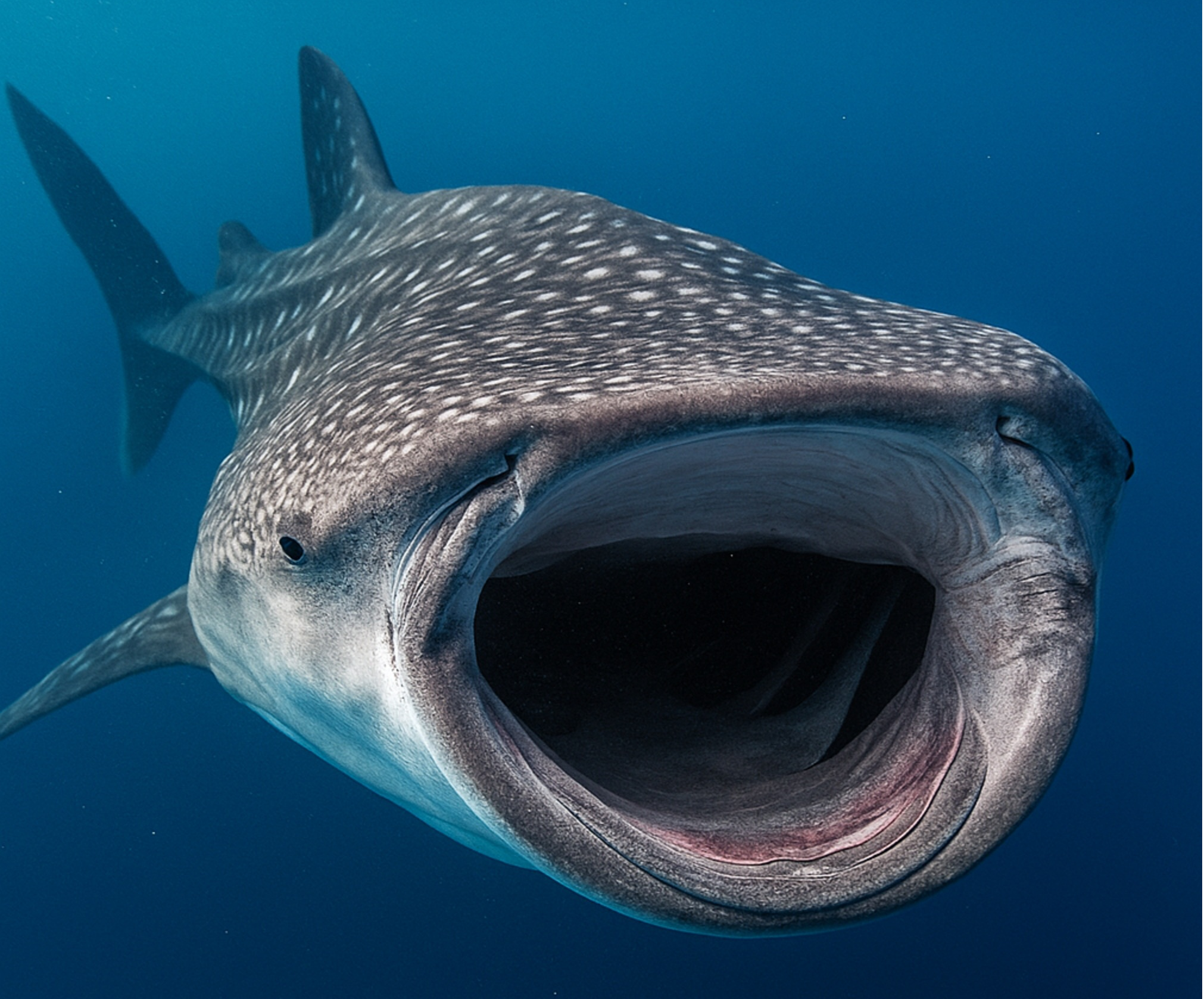
How big is a whale shark?
Whale sharks (Rhincodon typus) reach up to 12 meters (40 feet) in length and weigh up to 20 tons (40,000 pounds), making them the largest fish on Earth. The largest verified specimen measured 12. 65 meters and weighed 21. 5 tons. They are significantly larger than the largest great white sharks (which max at 6-7 meters).
A Shark Bigger Than a Bus That Eats Plankton
A 12-meter-long animal swims slowly through tropical water. It is heavier than 20 cars combined. Its mouth is over a meter wide. Yet as you approach it, nothing aggressive happens, the huge creature continues its slow swim, occasionally turning one large eye toward you, but showing no threat.
This is a whale shark (Rhincodon typus), the largest fish on Earth. It's a shark, but behaves like a whale. It has teeth, but doesn't use them for eating. It's gigantic, but eats only microscopic plankton. It lives among tropical reefs worldwide, and it has never been documented attacking a human.
Size Records
Whale sharks are extraordinary by every size measurement.
Dimensions:
- Length: 12 meters typical for large adults
- Maximum length: 12.65 meters (verified)
- Possibly larger: reports up to 18 meters (unconfirmed)
- Weight: 15-20 tons typical
- Maximum weight: 21.5 tons (record)
- Mouth width: up to 1.5 meters
Compared to other sharks:
- Whale shark: up to 12 meters, 20 tons
- Basking shark: up to 10 meters (second largest shark)
- Great white: up to 6 meters (apex predator by comparison)
- Megalodon (extinct): possibly 15+ meters
Compared to whales:
- Blue whale: 30 meters (larger)
- Fin whale: 25 meters (larger)
- Sperm whale: 20 meters (comparable)
- Minke whale: 8 meters (smaller)
The largest fish title:
Whale sharks hold the title of largest fish because whales are mammals, not fish. No bony fish or other shark species approaches whale shark size.
The Filter-Feeding Giant
Despite massive size, whale sharks eat microscopic prey.
Diet:
- Plankton (primary)
- Copepods and krill
- Fish eggs (especially coral spawn)
- Fish larvae
- Small fish (passive catch)
Feeding mechanism:
Whale sharks are filter feeders:
- Open massive mouth (up to 1.5m wide)
- Swim slowly through water
- Water flows in through mouth, out through gill slits
- Plankton trapped by filter structures
- Collected prey swallowed periodically
Filter system:
Their gills contain specialized structures:
- Gill rakers: tiny projections that catch particles
- Mucous coating: traps small items
- Selective filtering: separates water from prey
Daily consumption:
- Approximately 20 kg of plankton per day
- Can process 6 cubic meters of water per minute
- Requires massive volume to extract sufficient nutrition
Feeding aggregations:
Whale sharks gather at plankton-rich sites:
- Coral spawn events (Ningaloo Reef, Australia)
- Fish spawn (Philippines)
- Upwelling currents (various locations)
- Predictable seasonal gatherings
The Gentle Giant
Despite size, whale sharks are harmless.
Behavior around humans:
- Curious but non-aggressive
- Often approach divers
- Show no territorial behavior
- No defensive attacks
- Can be touched safely (though not recommended)
Why harmless:
- Filter feeders don't hunt large prey
- Tiny teeth (decorative, not functional)
- Slow swimmer (not built for pursuit)
- No predator-like instincts toward mammals
- Don't perceive humans as threats or food
Diving tourism:
Whale shark tourism is significant:
- Mexico: Holbox Island, Isla Mujeres
- Philippines: Donsol (famous aggregation)
- Belize: Gladden Spit
- Western Australia: Ningaloo Reef
- Maldives: South Ari Atoll
- Mozambique: Tofo Beach
Safety record:
No documented human fatalities from whale sharks ever. The only reported injuries are accidental - swimmers hit by a whale shark's tail when the shark moves suddenly. No aggressive attacks in recorded history.
Identification and Individual Recognition
Every whale shark has unique markings.
Spot pattern:
- White spots on blue-gray background
- Pattern different for each individual
- Fingerprint-like identification
- Remains stable throughout life
Scientific use:
Researchers use spot patterns to:
- Identify individual sharks
- Track migration and return
- Study aging and growth
- Monitor populations
Photo-identification projects:
Global databases track thousands of individual whale sharks:
- Allows long-term study
- Reveals migration patterns
- Shows aggregation site fidelity
- Provides conservation data
Some famous individuals:
Certain whale sharks have become famous through long-term observation:
- Particularly photogenic individuals
- Returning year after year to same sites
- Featured in documentaries
- Names given by tourism operators
Where They Live
Whale sharks are tropical and subtropical ocean wanderers.
Range:
- 30° N to 35° S latitudes
- All major oceans
- Warm-water regions
- Avoid colder temperate and polar waters
Seasonal aggregations:
- March-July: Ningaloo Reef, Australia (coral spawn)
- Year-round with peaks: Philippines (Donsol)
- April-September: Mexican Caribbean
- May-October: Belize (Gladden Spit)
Depth behavior:
- Surface feeding (primary)
- Can dive deeper when needed
- Record depth: 1,900 meters
- Most activity in upper 100 meters
Migration:
Whale sharks migrate long distances:
- Individuals tracked 1,000+ km
- Some crossings of entire ocean basins
- Follow seasonal food availability
- Return to same aggregation sites
Reproduction
Whale shark breeding remains largely mysterious.
What is known:
- Internal fertilization
- Eggs hatch internally (ovoviviparity)
- Live birth of fully-formed young
- Litters can be very large
Landmark discovery:
In 1995, a pregnant whale shark captured off Taiwan revealed:
- 300+ embryos in various development stages
- Confirmed ovoviviparous reproduction
- Provided first clear understanding
- Young born 55-60 cm long
Reproductive challenges:
- Sexual maturity at 30 years
- Slow reproduction rate
- Limited breeding events per lifetime
- Population replenishment slow
Unknown aspects:
- Specific breeding locations
- Courtship behaviors
- Mating frequency
- Male-female ratio
- Population dynamics
Lifespan
Whale sharks are long-lived fish.
Typical lifespan:
- 80-130 years estimated
- Some individuals possibly 150+
- Significantly longer than most fish
Aging methods:
- Cannot use typical fish age techniques
- Chemical markers in vertebrae
- Photo-identification over decades
- Growth measurements over time
Growth rates:
- Young: rapid growth
- Mature: very slow growth
- Continuous growth throughout life
- Individual differences based on feeding
Implications:
Long lifespan means:
- Each individual valuable
- Population recovery extremely slow
- Conservation must consider decades
- Overfishing has multigenerational impact
Conservation Status
Whale sharks face serious threats.
IUCN status:
Endangered (upgraded from Vulnerable in 2016)
Population estimates:
- Global: uncertain but estimated 120,000-200,000 individuals
- Declining overall
- Some populations stable, others collapsing
- Some local populations nearly extinct
Major threats:
Commercial fishing:
- Targeted for meat and fins
- Shark fin soup market
- Liver oil extraction
- Demand primarily in Asia
Bycatch:
- Fishing gear entanglement
- Net damage
- Ship strikes (their size makes them vulnerable)
Habitat degradation:
- Plastic pollution (can be eaten)
- Coastal development
- Pollution affecting plankton
- Climate change impacts
Tourism impact:
- Well-managed tourism benefits conservation
- Poorly-managed tourism can harm
- Crowding and physical contact issues
- Boat strikes at aggregation sites
Protection efforts:
- CITES Appendix II: restricts international trade
- Protected species status in many countries
- Designated marine protected areas
- International research networks
- Public awareness campaigns
Whale Shark Research
Whale sharks are subject of active research.
Research methods:
- Photo-identification
- Satellite tracking
- Acoustic tagging
- Drone surveys
- Genetic analysis
Research findings:
- Migration routes mapped
- Aggregation patterns documented
- Individual behavior tracked
- Population estimates refined
Major research centers:
- Mozambique: Marine Megafauna Foundation
- Australia: Ningaloo Reef research
- Philippines: Donsol marine research
- Mexico: various university and NGO programs
Current research priorities:
- Population assessment
- Climate change impacts
- Tourism impact studies
- Protected area effectiveness
- Illegal trade tracking
Cultural Significance
Whale sharks have cultural value worldwide.
Native cultures:
- Philippines: "butanding" - tourist and cultural icon
- Mexico: "tiburón ballena" - Caribbean cultural symbol
- Mozambique: local traditions include whale shark stories
- Maldives: cultural and tourism icon
Western culture:
- Popular diving destination species
- Nature documentary subjects
- Children's books and educational materials
- Ocean conservation symbols
Tourism economics:
Whale shark tourism generates substantial revenue:
- Philippines (Donsol): $100 million annually
- Various Mexico sites: millions USD
- Western Australia: major industry
- Maldives: significant tourism driver
Threats from Humans
Human activities threaten whale sharks.
Ship strikes:
- Their size and surface swimming makes them vulnerable
- Cargo ship collisions can kill them
- Port areas particularly dangerous
- Growing ship traffic worsening situation
Commercial fishing:
- Directly targeted in some regions
- Asian markets drive demand
- Illegal fishing hard to control
- Populations reduced dramatically in some areas
Pollution:
- Microplastics accumulate in filtering
- Chemical contamination
- Ocean acidification
- Coastal pollution in aggregation sites
Climate change:
- Warming oceans altering food availability
- Ocean chemistry changes affecting plankton
- Migration patterns disrupted
- Coral reef dependency issues
Famous Aggregation Sites
Specific locations attract whale sharks reliably.
Ningaloo Reef, Australia:
- Annual March-July aggregations
- Coral spawning attracts them
- Government-regulated tourism
- Major research site
Donsol, Philippines:
- World's largest documented aggregation
- Year-round presence with peaks
- Significant ecotourism
- Protected by local regulations
Holbox Island, Mexico:
- Caribbean Sea aggregation
- May-September peak
- Mexican protected area
- Major tourist destination
Isla Mujeres, Mexico:
- Caribbean Sea aggregation
- June-September peak
- Swimming tourism popular
- Environmental concerns rising
Cenderawasih Bay, Indonesia:
- Relatively new aggregation discovery
- Growing tourism
- Fishing platform interactions
- Conservation focus area
Why Whale Sharks Matter
Whale sharks represent multiple significant roles.
Ecological:
- Plankton consumption regulation
- Carbon cycling contribution (large body mass)
- Apex filter feeder role
- Indicator species for ocean health
Conservation:
- Flagship species for marine conservation
- Protected area justification
- International cooperation focus
- Public engagement tool
Economic:
- Tourism revenue
- Research funding
- Educational value
- Indirect benefits through conservation
Scientific:
- Long lifespan study subjects
- Migration biology
- Plankton dynamics
- Climate change impacts
The Ocean's Gentle Giant
Every whale shark in tropical waters represents millions of years of evolution toward a specific ecological role.
They could have evolved as top predators. Their size and power would have made them devastating hunters. Instead, they specialized on the smallest prey in the ocean - plankton and small fish that can't defend themselves against filter feeding.
This specialization requires enormous body size to process sufficient food, leading to the gigantism we see. Their size then provides protection (few predators can harm them), allowing them long lifespans and slow reproduction.
The whale sharks swimming in tropical oceans today are continuing a strategy that has worked for millions of years. They gather at predictable food sources, breed slowly, and live for potentially a century or more. Each individual is a rare and precious representative of the world's largest fish species.
Their gentle nature with humans, combined with their impressive size, makes them perhaps the most "ambassadorial" species for ocean conservation. People who swim with whale sharks often become lifelong advocates for marine protection. Their non-threatening presence teaches humans that the ocean's largest inhabitants need not be dangerous, and that massive size can coexist with profound gentleness.
As climate change and commercial pressures threaten their populations, whale sharks' continued survival depends on human choices. Their aggregation sites need protection. Fisheries need regulation. Ship strikes need mitigation. If we can maintain their habitats and reduce pressure on them, they will continue filter feeding through tropical waters worldwide - the largest and gentlest fish in the ocean.
Size Records and Growth Estimates
Whale sharks (Rhincodon typus) hold the title of largest fish species on Earth, with the largest reliably measured specimen at 12.65 meters, while historical reports describe individuals up to 18 to 20 meters. Estimates of maximum size continue to be revised as new exceptionally large individuals are encountered, and our research team has compiled the most rigorous size reports from recent scientific literature.
| Specimen/Study | Reported Length | Estimated Mass | Year / Source |
|---|---|---|---|
| Pakistan specimen | 12.7 m | 21,500 kg | Verified, 2012 |
| Taiwan specimen | 20 m (disputed) | 42,000 kg | Historical, 1987 |
| Sea of Cortez specimen | 18.8 m | 34,000 kg | McClain et al., 2015 |
| Philippines specimen | 16.5 m | 28,000 kg | Alava et al., 2002 |
| Diaphragm-method estimate | 21.4 m (theoretical) | - | Ramirez-Macias et al., 2012 |
| Ningaloo female adult | 14 m | 24,000 kg | Meekan et al., 2006 |
A 2015 meta-analysis by Craig McClain and colleagues, published in PeerJ, reviewed all verified size records for marine megafauna and concluded that reliable maximum whale shark length is approximately 18.8 meters, with occasional unverified historical reports suggesting individuals may reach 20 meters under exceptional conditions [1]. The larger historical reports may reflect measurement inaccuracies, but the possibility of such individuals remains scientifically open.
Feeding Biology and Filter Efficiency
Whale sharks employ three distinct feeding strategies depending on prey density and type. During passive filter feeding, the shark swims slowly with its mouth open, filtering plankton through its gill rakers. During ram filter feeding, it actively pushes forward through dense plankton aggregations at higher speed.
During suction feeding, the shark holds itself vertically in the water column and rapidly opens its mouth to create a suction effect that pulls small fish and eggs directly into the buccal cavity.
"Whale sharks have the most flexible feeding apparatus of any filter-feeding fish. They can switch seamlessly between three distinct feeding modes in response to the specific characteristics of prey, allowing them to exploit food sources ranging from diffuse oceanic plankton to dense coral-spawn events. This flexibility is a key reason the species has persisted across such a broad geographic range." - Dr. Mark Meekan, Australian Institute of Marine Science [2]
The gill rakers of whale sharks form a dense mat of sponge-like tissue that traps particles down to approximately 1 millimeter in size. The filtering system is coupled with a highly efficient cross-flow filtration geometry that prevents clogging - a major engineering challenge that has inspired bio-inspired industrial filtration system designs.
Global Population Genetics
A 2017 genetic study led by Jennifer Schmidt at the University of Illinois Chicago, published in Genes, used 16 microsatellite markers to examine the population structure of 635 whale sharks sampled across eight global locations. The data revealed that whale sharks form two genetically distinct populations - Atlantic and Indo-Pacific - with limited gene flow between them [3].
"The Atlantic and Indo-Pacific whale shark populations have been genetically isolated for approximately 2 million years, likely due to the closure of the Isthmus of Panama restricting movement between ocean basins. The practical conservation consequence is that these must be managed as essentially separate evolutionary units, with recovery strategies tailored to each basin rather than treating whale sharks as a single global stock." - Dr. Jennifer Schmidt, University of Illinois Chicago [3]
The Atlantic population is estimated at fewer than 20,000 individuals, making it considerably smaller than the Indo-Pacific population. Intense commercial targeting in the early 20th century, bycatch in industrial fisheries, and sustained low reproductive rates have combined to produce the species's current Endangered status.
References
- McClain, C. R., Balk, M. A., Benfield, M. C., et al. (2015). Sizing ocean giants: patterns of intraspecific size variation in marine megafauna. PeerJ, 3, e715. DOI: 10.7717/peerj.715
- Meekan, M. G., Jarman, S. N., McLean, C., & Schultz, M. B. (2009). DNA evidence of whale sharks (Rhincodon typus) feeding on red crab (Gecarcoidea natalis) larvae at Christmas Island, Australia. Marine and Freshwater Research, 60(6), 607-609. DOI: 10.1071/MF08254
- Vignaud, T. M., Maynard, J. A., Leblois, R., et al. (2014). Genetic structure of populations of whale sharks among ocean basins and evidence for their historic rise and recent decline. Molecular Ecology, 23(10), 2590-2601. DOI: 10.1111/mec.12754
- Norman, B. M., Holmberg, J. A., Arzoumanian, Z., et al. (2017). Undersea constellations: the global biology of an endangered marine megavertebrate further informed through citizen science. BioScience, 67(12), 1029-1043. DOI: 10.1093/biosci/bix127
Related Articles
- Great White Shark: The Ocean's Apex Predator
- Basking Shark: The Second Largest Fish
- Megalodon vs Great White Shark
Frequently Asked Questions
How big is a whale shark?
Whale sharks (Rhincodon typus) reach up to 12 meters (40 feet) in length and weigh up to 20 tons (40,000 pounds), making them the largest fish on Earth. The largest verified specimen measured 12.65 meters and weighed 21.5 tons. They are significantly larger than the largest great white sharks (which max at 6-7 meters). Their size makes them larger than some whales (though smaller than blue whales).
Their mouths can open to 1.5 meters wide, allowing them to filter huge amounts of water to extract plankton. Despite their massive size, they are slow swimmers - typically moving at 5 km/h. Young whale sharks are born at approximately 55-60 cm long and grow rapidly. They can live 80-130 years, with the oldest individual estimated at 150 years. Females are typically larger than males when fully mature.
Their size, combined with their filter-feeding diet, makes them one of the most extreme examples of gigantism in the fish kingdom.
Are whale sharks dangerous?
No, whale sharks are completely harmless to humans despite being the largest fish on Earth. They feed exclusively on plankton and very small fish, using their huge mouths to filter water rather than biting. Their teeth are tiny and used only for grip during filtering (primarily decorative, not functional). Divers regularly swim with whale sharks without any risk of attack. They are gentle, curious, and often approach divers closely without aggression.
Their swimming speed is slow (5 km/h typical), and they don’t show defensive behaviors even when approached. Multiple scuba diving destinations specialize in whale shark interactions, and there have been no documented human deaths from whale shark encounters. Ecotourism around whale sharks is a significant industry in Mexico, Philippines, Maldives, and Belize. They are often called ‘gentle giants’ for good reason.
They pose no danger to swimmers, divers, or even fishermen. Their massive size combined with gentle nature makes them favorites of wildlife photographers and ocean tourists.
What do whale sharks eat?
Whale sharks eat primarily plankton, krill, small fish, and fish eggs. They are filter feeders, similar to baleen whales. An adult whale shark consumes approximately 20 kg of plankton daily. Their feeding technique involves opening their massive mouths (up to 1.5 meters wide) and swimming through plankton-rich water. Water flows into the mouth and out through gill slits, while internal filtering structures retain the plankton.
They can filter water at rates of 6 cubic meters per minute. They often gather at specific locations where plankton blooms occur predictably - like coral spawning events in Western Australia, where whale sharks appear annually during November coral spawning. They also follow tuna schools that are hunting small fish, exploiting the same prey base.
Their filtering gills are lined with specialized structures (gill rakers) that trap particles while allowing water to pass. This passive feeding strategy requires massive volume to extract sufficient nutrition, which explains their large size - they need to process enormous amounts of plankton daily.
How long do whale sharks live?
Whale sharks can live 80-130 years in the wild, with some individuals estimated to exceed 150 years. They reach sexual maturity at around 30 years - relatively late compared to most fish. They grow continuously throughout their lives, slowly gaining size. Their longevity is remarkable for a fish and comparable to large whales. Determining whale shark age is difficult because they don’t have typical growth rings in their vertebrae like some sharks.
Recent research using specific biochemical markers has provided better age estimates. Their long lifespan means populations recover extremely slowly from damage - a whale shark killed represents decades of future reproductive potential lost. Their slow reproduction (females mature at 30, produce limited offspring) combined with long lifespan makes them particularly vulnerable to fishing pressure.
In well-protected populations, individual whale sharks can be tracked through decades, providing valuable data on their migration patterns and behavior. Some individual whale sharks have been recognized through distinctive spot patterns (unique to each individual) for over 30 years of continuous documentation.
Where do whale sharks live?
Whale sharks inhabit tropical and warm-temperate waters worldwide, typically between 30° N and 35° S latitudes. They are found in all major oceans in warm waters. Particular concentrations occur in Mexico (Holbox Island, Isla Mujeres), Philippines (Donsol), Belize, Western Australia (Ningaloo Reef), East Africa (Mozambique), and various South Asian waters. They migrate long distances across oceans, with individuals tracked swimming 1,000+ kilometers.
Some populations show seasonal patterns - appearing at specific locations annually when food is abundant. Ningaloo Reef in Western Australia is particularly famous for the annual March-July coral spawning that attracts whale sharks. They prefer water temperatures of 21-30°C. They can dive to 1,900 meters depth (record depth) but typically spend most time in upper 100 meters where plankton is most abundant.
Their wide distribution makes them globally distributed but their specific concentration areas are limited, making protection of these aggregation sites crucial for species conservation.