
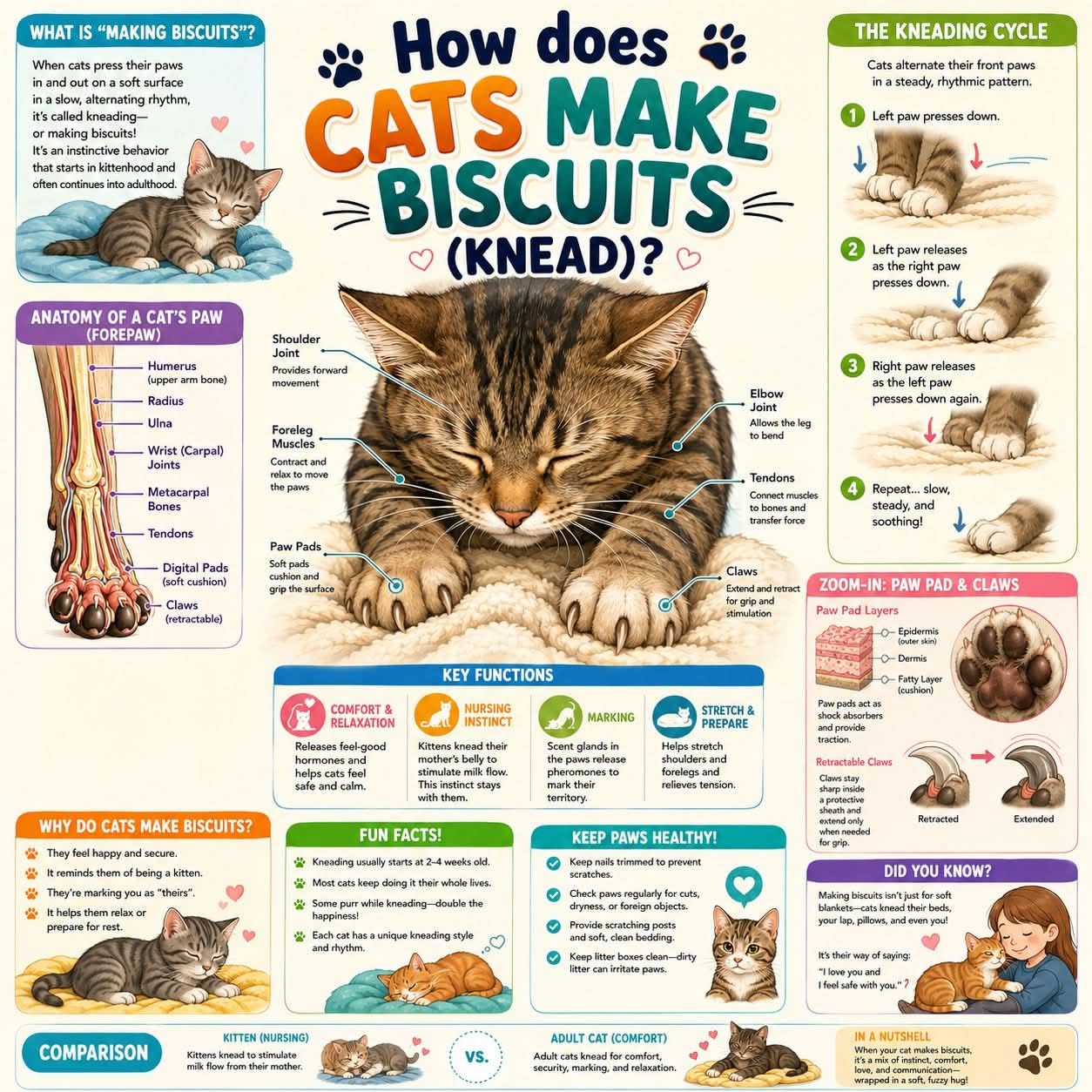
Cats knead, pushing their paws rhythmically against soft surfaces in an alternating left-right motion, because the behavior originates in kittenhood nursing, when kittens knead their mother's mammary glands to stimulate milk flow. In adult cats, the behavior is retained as a comfort reflex neurologically associated with positive emotional states, and it also serves a scent-marking function through the pheromone glands located in the paw pads.
What Is Kneading and Where Does It Come From?
Kneading is the alternating push-pull motion cats perform with their front paws on soft surfaces such as blankets, pillows, upholstered furniture, or their owner's lap. The motion mimics exactly the pressure a nursing kitten applies to the area around its mother's nipples to stimulate oxytocin release and increase milk flow.
The neurological link between nursing and this motor pattern is established early in development and appears to be retained in long-term memory as an association with warmth, safety, nutrition, and maternal presence. When adult cats knead, they are, from a behavioral neuroscience perspective, re-engaging a motor program laid down in the first weeks of life that their brains have tagged as deeply positive.
Not all cats knead with equal intensity. Cats who were weaned from their mothers earlier than the natural weaning age (approximately 8 to 10 weeks) often knead with greater intensity and duration as adults, and may also show associated oral behaviors such as suckling fabric. This pattern suggests that the nursing association is stronger in cats who had less opportunity to complete the natural weaning process, and that kneading in these individuals carries a stronger emotional loading.
"Kneading is an excellent example of how neonatal motor programs can be retained and repurposed in adult mammals. The behavior in adult cats is topographically identical to neonatal nursing behavior and is consistently associated with positive arousal states." Dr. John Bradshaw, Anthrozoology Institute, University of Bristol, Cat Sense, 2013
Why Do Adult Cats Knead on People?
When a cat kneads on a person's lap, thigh, or chest, it signals a high degree of trust and positive emotional association. The person, from the cat's experiential perspective, represents the same warmth, softness, and safety that the mother cat provided during nursing. This is not a simple analogy; it reflects the actual neurochemical state the cat is in during kneading, which evidence suggests involves elevated oxytocin and reduced cortisol.
Research on the human-cat bond has documented that interactions involving physical contact, including having a cat knead on or near the owner, produce measurable cortisol reductions in humans and are associated with the oxytocin release that characterizes secure attachment relationships in multiple species. The cat receiving the same kind of neurochemical reward during kneading means the interaction is genuinely mutually beneficial at a biological level.
Cats that knead on their owners tend to be cats that were socialized intensively to humans during the critical socialization window (2 to 7 weeks of age) and have formed secure attachments. Feral cats or poorly socialized cats rarely knead on humans.
Kneading as Scent Marking
Beyond the nursing association, kneading has a second and distinct function: scent marking. Cats have apocrine sweat glands concentrated in the soft skin between their digital paw pads. These glands produce pheromone-containing secretions that are deposited on surfaces the cat kneads. The chemical signals left behind communicate the cat's identity, reproductive status, and territorial presence to other cats who encounter the surface.
This function means that kneading is not purely a passive expression of contentment; it also actively marks territory and familiar objects. A cat that kneads its owner's clothing is, in part, depositing its scent on a highly valued social resource, a behavior that animal behaviorists interpret as "claiming" or affiliating with the target object.
In multi-cat households, kneading and the associated scent deposition are part of the complex system by which cats maintain their social environment, creating a shared "group scent" on common objects that reduces tension and signals familiar social bonds.
"Allomarking behaviors in cats, including those performed by paw glands, serve to create a communal olfactory signature within a social group. The owner and their belongings become olfactorily integrated into the cat's social territory through these repeated depositions." Turner, D. C., & Bateson, P. (Eds.), The Domestic Cat: The Biology of its Behaviour, Cambridge University Press, 2014
Do All Cats Knead?
Kneading is nearly universal in domestic cats but varies in frequency, intensity, and context. Some cats knead multiple times daily on multiple substrates; others knead rarely or only under specific conditions. Individual variation is driven by a combination of early weaning history, degree of human socialization, personality traits, and current emotional state.
Cats that were raised with extensive human contact from the first weeks of life tend to knead more on people and more frequently overall. Cats raised in feral or semi-feral conditions with minimal human contact during the socialization window knead less on humans and may knead primarily on inanimate objects if they knead at all.
Declawing does not eliminate kneading behavior, cats continue to perform the motor pattern even after onychectomy, confirming that the drive to knead is neurologically independent of the sensory feedback from extending claws, though many cats do extend their claws during the motion when they retain them.
Kneading Behaviors and Their Likely Signals
| Kneading Context | Likely Emotional State | Associated Behaviors |
|---|---|---|
| Kneading owner's lap while purring | High contentment, secure attachment | Purring, slow blinking, relaxed posture |
| Kneading before sleep on blanket | Pre-sleep arousal, comfort-seeking | Circling, lying down, self-grooming |
| Kneading with intense focus and vocalization | Possible early weaning, strong comfort drive | Fabric suckling, drooling, intense purring |
| Kneading new object or surface | Scent marking, territorial exploration | Rubbing face on object, sniffing |
| Kneading in owner's presence without lap contact | Social bonding, proximity display | Visual attention to owner, proximity seeking |
| Kneading during or after play | Post-arousal winding down | Slower breathing, reduced activity |
Why Do Cats Extend Their Claws While Kneading?
The extension of claws during kneading is an automatic component of the nursing motor program. Kittens extend their claws to get grip on the mother's abdomen and to apply more targeted pressure to specific areas around the nipple. In adults, the neural motor sequence includes claw extension as an integral step, not as a separate volitional decision.
This is why cats that have been raised in households where kneading-related scratching is discouraged can learn to reduce claw extension over time, through conditioning, not because the drive to extend them is absent. Providing a designated kneading surface, a thick blanket or soft mat, gives the cat a substrate where claw extension causes no damage and the behavior can be expressed freely.
Trimming claws regularly reduces the practical impact of kneading-related punctures on upholstery and on the owner's lap, without eliminating the behavior or causing the cat distress. Declawing, by contrast, is a surgical amputation of the last bone of each digit and is now banned or discouraged in many countries as a welfare intervention.
Is Kneading a Sign That a Cat Is Happy?
Kneading is one of the most reliable behavioral indicators of positive emotional state in cats. Unlike purring, which occurs in both positive and negative contexts, kneading is almost exclusively associated with relaxed contentment, pre-sleep comfort, or secure attachment interactions. A cat that is in pain, frightened, or under significant stress will not typically knead.
The combination of kneading with other positive signals, purring, slow blinking, relaxed body posture, and voluntary physical contact, constitutes a strong behavioral cluster indicating that the cat is in a state of calm positive arousal. Animal welfare scientists use behavioral clusters of this type to assess positive welfare states, and kneading features prominently in validated feline positive welfare indicators.
The exception is kneading combined with distress vocalization or excessive intensity in early-weaned cats, where the behavior takes on a more compulsive quality and may be accompanied by fabric suckling and drooling. In these individuals, the kneading is still neurologically associated with comfort-seeking, but it has become a coping behavior for chronic stress rather than an expression of genuine contentment.
Should You Let Your Cat Knead on You?
There is no welfare concern for the cat in allowing or discouraging kneading on people, either way, the cat's emotional needs are not harmed. However, allowing the behavior provides the cat with an opportunity for positive bonding interaction and social reward, while consistently redirecting it may reduce the frequency over time.
If the cat's claw extension makes kneading uncomfortable, placing a thick blanket between the cat's paws and your skin provides the soft substrate the cat is seeking while protecting you from punctures. Many cat owners find that a regular kneading ritual, often triggered by sitting down in the same spot at the same time each day, becomes a shared routine that both parties appear to value.
For further reading on related topics, see Why Do Cats Purr?, Why Do Cats Meow?, How Long Do Cats Live?, Signs of a Healthy Cat, and How Smart Are Cats?.
References
Bradshaw, J. W. S. (2013). Cat Sense: How the New Feline Science Can Make You a Better Friend to Your Pet. Basic Books. ISBN 978-0465031016
Turner, D. C., & Bateson, P. (Eds.). (2014). The Domestic Cat: The Biology of its Behaviour (3rd ed.). Cambridge University Press. ISBN 978-1107013148
Crowell-Davis, S. L., Curtis, T. M., & Knowles, R. J. (2004). Social organization in the cat: A modern understanding. Journal of Feline Medicine and Surgery, 6(1), 19-28. https://doi.org/10.1016/j.jfms.2003.09.013
Vitale, K. R., Behnke, A. C., & Udell, M. A. R. (2019). Attachment bonds between domestic cats and humans. Current Biology, 29(18), R864-R865. https://doi.org/10.1016/j.cub.2019.08.036
Overall, K. L. (2013). Manual of Clinical Behavioral Medicine for Dogs and Cats. Elsevier. https://doi.org/10.1016/B978-0-323-04292-7.00019-2
Heidenberger, E. (1997). Housing conditions and behavioural problems of indoor cats as assessed by their owners. Applied Animal Behaviour Science, 52(3-4), 345-364. https://doi.org/10.1016/S0168-1591(96)01134-9
Frequently Asked Questions
Why do cats knead?
Cats knead because the behavior originates in kittenhood nursing, when kittens knead their mother’s belly to stimulate milk flow. In adults it is retained as a comfort behavior neurologically linked to positive emotional states, and also serves as scent marking through paw glands.
Why do cats knead on people?
A cat kneading on a person signals deep trust and positive attachment. The person represents the same warmth and safety the mother cat provided during nursing, triggering the same neurochemical comfort response.
Why do early-weaned cats knead more?
Cats weaned before 8-10 weeks often have stronger nursing associations and may knead more intensely as adults, sometimes also suckling fabric. The nursing drive was not fully resolved through natural weaning.
Do cats extend their claws while kneading on purpose?
No. Claw extension is an automatic component of the nursing motor pattern. Kittens extend claws to grip the mother’s abdomen. Adults do it as part of the same motor sequence, not as a deliberate decision.
Is kneading a sign that a cat is happy?
Yes, kneading is one of the most reliable indicators of positive emotional state in cats. Unlike purring, it is almost exclusively associated with relaxed contentment and is rarely observed in stressed or frightened cats.
Why do cats knead blankets before sleeping?
Kneading before lying down mimics both the nursing comfort association and a likely ancestral behavior of patting down grass or vegetation to create a sleeping surface. It serves as a pre-sleep ritual signaling the transition to rest.