
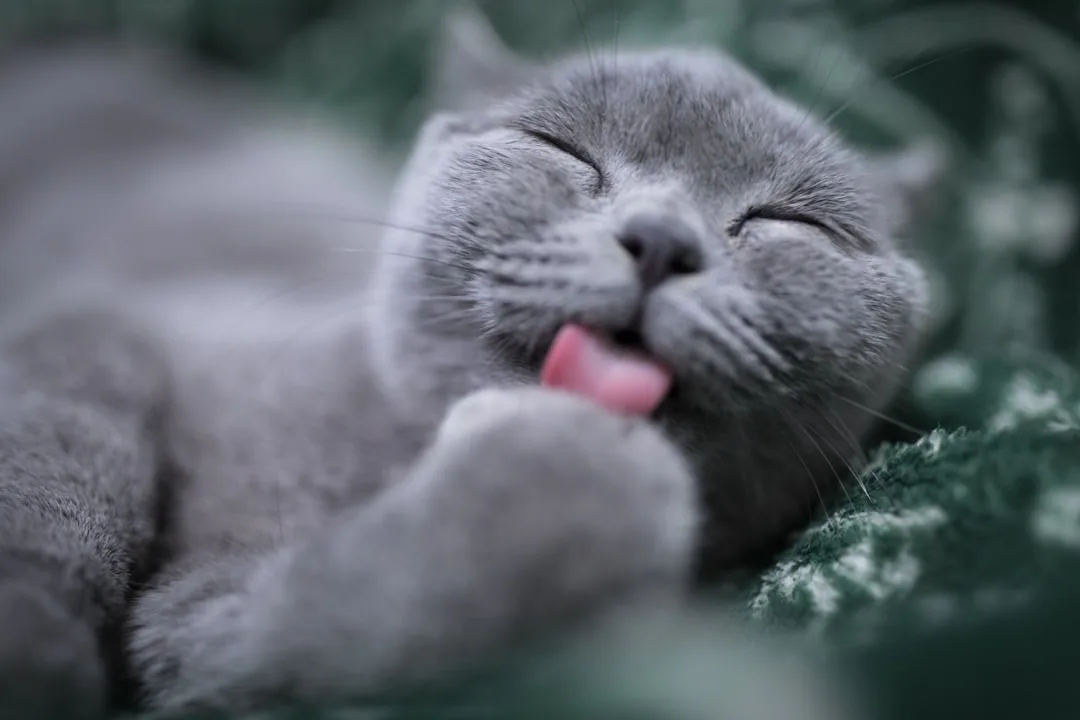
Cats purr by rapidly dilating and constricting the glottis, the part of the larynx surrounding the vocal cords, during both inhalation and exhalation, producing a continuous vibration at frequencies between 25 and 150 Hz. Purring signals contentment in many situations, but cats also purr when injured, frightened, in labor, or dying, suggesting the behavior serves multiple functions beyond simple happiness, including possible self-healing.
How Do Cats Physically Produce a Purr?
Cats produce purring through a neurological oscillator in the brainstem that sends repetitive signals to the laryngeal muscles, causing them to dilate and constrict the glottal opening rhythmically. This happens during both inhalation and exhalation, creating the characteristic continuous sound, unlike most vocalizations in mammals, which occur only on exhalation.
The movement creates turbulence in the airflow through the larynx, generating the audible vibration. High-speed laryngoscopy has confirmed this mechanism in domestic cats, ruling out earlier theories that purring was produced by turbulence in the vena cava or by activation of a specialized "purring organ." The frequency of vibration is determined by the rate of glottal opening and closing cycles, which the neural oscillator controls independently of voluntary muscle action.
This neural control means cats can purr continuously, even while eating or sleeping, because the process does not require the cat's conscious attention. It also means that purring can persist even when a cat is in considerable distress, the neural trigger does not require a positive emotional state.
What Frequency Do Cats Purr At?
Domestic cat purring falls within a frequency range of 25 to 150 Hz, with most individual cats purring at a fundamental frequency between 25 and 50 Hz. Some cats produce harmonics at higher frequencies simultaneously, giving the purr a richer, layered acoustic texture.
The specific range of 25 to 50 Hz has attracted scientific attention because of research demonstrating that mechanical vibration at these frequencies promotes bone density, fracture healing, and tendon repair in laboratory and clinical studies.
Reiter and colleagues, along with research published through the Fauna Communications Research Institute, have proposed that the domestic cat's purr frequency may serve a physiological function beyond communication, a form of endogenous vibrational therapy.
"Exposure to sound frequencies of 25 to 50 Hz has been shown to increase bone density and promote fracture healing in experimental models. The domestic cat purrs within this exact range, raising the hypothesis that purring may represent an energy-efficient mechanism for skeletal maintenance." Elizabeth von Muggenthaler, Fauna Communications Research Institute, 2001
Frequencies between 25 and 50 Hz have also been shown to promote muscle repair and reduce pain and swelling in some human clinical applications. Whether cats derive measurable physiological benefit from their own purring has not been definitively established, but the hypothesis is biologically plausible and consistent with the observation that cats are particularly resistant to bone fractures and heal from orthopedic injuries at rates that surprise veterinary surgeons.
Purr Frequency Uses Table
| Frequency Range | Documented Effect | Source Context |
|---|---|---|
| 25-50 Hz | Bone density increase, fracture healing | Von Muggenthaler, 2001; Clinical ultrasound literature |
| 25-50 Hz | Muscle repair, reduced atrophy | Vibration therapy research |
| 50-100 Hz | Pain reduction, edema reduction | Physical therapy literature |
| 100-200 Hz | Wound healing, tendon repair | Low-frequency ultrasound studies |
Do Cats Purr Only When Happy?
No. Cats purr in a wide range of emotional and physical states, including contentment, but also fear, stress, pain, illness, and the process of dying. Veterinarians and animal behaviorists recognize purring as a general comfort-seeking or self-soothing behavior rather than a pure happiness signal.
A frightened cat at the veterinary clinic may purr continuously throughout the examination. A cat in active labor commonly purrs between contractions. Cats in the final stages of illness or at the point of death are frequently observed purring, which some researchers interpret as a self-directed comfort behavior and others attribute to the neurological mechanism running on reduced or changed brain activity.
The key distinction is between what animal behaviorists term "solicitation purring" the purr a cat produces when seeking something from a human, typically food or attention, and "non-solicitation purring." Solicitation purrs embed a higher-frequency cry-like component within the lower-frequency purr, producing a sound that humans find more urgent and difficult to ignore.
Research by Karen McComb and colleagues at the University of Sussex identified this acoustic embedding and found that humans rated solicitation purrs as more unpleasant and demanding than non-solicitation purrs, even without prior cat ownership experience.
"Cats have learned to modify their purring to include a high-frequency acoustic component that exploits human sensitivity to infant distress vocalizations. This makes the solicitation purr disproportionately effective at prompting humans to respond." Karen McComb et al., Current Biology, 2009
Can Big Cats Purr?
The ability to purr and the ability to roar are mutually exclusive in the cat family, and the division closely tracks taxonomic groupings within Felidae. Big cats belonging to the genus Panthera, lions, tigers, leopards, and jaguars, can roar but cannot purr in the strict continuous-vibration sense. They can produce purr-like sounds on exhalation only, not continuously across both phases of breathing.
Small cats, including the domestic cat, cheetah, cougar (puma), ocelot, lynx, bobcat, and all other non-Panthera cats, can purr but cannot roar. The cheetah is notable because it is large and sometimes classified colloquially as a "big cat," but it belongs to the genus Acinonyx and purrs continuously like a domestic cat. Cheetahs also produce distinctive high-pitched yelps and chirps not found in domestic cats.
The anatomical difference underlying this split is in the hyoid apparatus, the set of small bones in the throat that support the larynx. In Panthera cats, the epihyoid bone is replaced by a flexible ligament that allows the larynx to move freely, enabling the deep pressure changes needed to roar. In purring cats, the hyoid bones are fully ossified, limiting laryngeal movement but enabling the rapid, bilateral vibration of purring.
Why Do Cats Purr When in Pain or Stressed?
The most widely accepted explanation is that purring functions as a self-soothing mechanism, similar to the way humans hum, rock, or engage in repetitive behaviors under stress. The vibration may stimulate endorphin release and provide tactile and auditory feedback that reduces the subjective experience of pain and anxiety.
This is consistent with the "healing purr" hypothesis: if vibrational frequencies in the purring range genuinely promote tissue repair and reduce pain, a cat recovering from injury or surgery would derive real physiological benefit from purring, not just psychological comfort. The behavior may have been positively selected in domestic cat ancestors because individuals who purred during recovery healed faster and survived at higher rates.
From a signaling perspective, a vulnerable cat that remains quiet may attract less predator attention than one that vocalizes; purring, being low-amplitude and not carrying far, may represent a compromise between self-soothing and maintaining acoustic stealth.
Does Purring Have Health Benefits for Humans?
Research on this question is preliminary and largely correlational, but several studies have found associations between cat ownership and reduced cardiovascular disease risk.
A 2008 study by Qureshi and colleagues published in the Journal of Vascular and Interventional Neurology found that former cat owners who no longer had cats had a significantly higher risk of dying from cardiovascular events than those who maintained cat ownership, an association that persisted after controlling for major cardiovascular risk factors.
Whether the purring specifically contributes to human health outcomes, versus other aspects of the human-cat bond such as reduced loneliness and stress, cannot be determined from epidemiological data. Experimental studies using recordings of purring have shown reduced cortisol levels in some participants, but sample sizes have been small and methodology variable.
The exposure of sleeping cat owners to purr vibrations at 25 to 50 Hz over years represents a form of low-dose vibrational therapy that, if the bone-healing literature applies, might contribute to bone density maintenance, though this remains speculative and has not been studied directly.
Purring Across the Cat Family
| Species | Purrs? | Roars? | Notes |
|---|---|---|---|
| Domestic cat | Yes | No | Continuous, 25-150 Hz |
| Cheetah | Yes | No | High-pitched, also chirps and yelps |
| Cougar / Puma | Yes | No | Largest purring cat |
| Lynx | Yes | No | Includes bobcat, Canada lynx |
| Ocelot | Yes | No | Also produces trill vocalizations |
| Lion | No | Yes | Can produce exhalation-only purr-like sound |
| Tiger | No | Yes | Largest roaring cat |
| Leopard | No | Yes | Also produces sawing rasp call |
| Jaguar | No | Yes | Deepest roar relative to size |
| Snow leopard | Unclear | Unclear | Cannot roar fully; produces unique chuff |
How to Interpret Your Cat's Purr
Context is the critical variable in interpreting feline purring. A cat purring while kneading a blanket, lying in a warm spot, or being stroked is almost certainly expressing contentment. A cat purring in the veterinary waiting room, during a car journey, or after a stressful encounter is likely self-soothing under duress.
A cat purring while showing other signs of illness, reduced appetite, hiding, unusual posture, labored breathing, may be using purring to manage pain, and the purring should not be taken as evidence that the cat is comfortable.
Solicitation purring, the embedded-cry type that McComb's research identified, is typically produced when a cat wants something: feeding time, attention, or access to a space. Many cat owners describe learning to distinguish these types intuitively after years with the same animal, which is consistent with research showing that long-term cat owners are more accurate at interpreting feline vocalizations than non-cat owners.
For further reading on related topics, see Why Do Cats Meow?, Why Do Cats Knead?, How Long Do Cats Live?, Signs of a Healthy Cat, and How Smart Are Cats?.
References
McComb, K., Taylor, A. M., Wilson, C., & Charlton, B. D. (2009). The cry embedded within the purr. Current Biology, 19(13), R507-R508. https://doi.org/10.1016/j.cub.2009.05.033
Von Muggenthaler, E. (2001). The felid purr: A healing mechanism? Journal of the Acoustical Society of America, 110(5), 2666. https://doi.org/10.1121/1.4777098
Qureshi, A. I., Memon, M. Z., Vazquez, G., & Fareed, M. S. (2009). Cat ownership and the risk of fatal cardiovascular diseases. Journal of Vascular and Interventional Neurology, 2(1), 132-135.
Remmers, J. E., & Gautier, H. (1972). Neural and mechanical mechanisms of feline purring. Respiration Physiology, 16(3), 351-361. https://doi.org/10.1016/0034-5687(72)90064-3
Smith, J. D., & Corrow, D. J. (2005). Vibration and acoustic stimuli as noninvasive bone-forming modalities. Journal of Musculoskeletal Research, 9(3), 111-122.
Frazer Sissom, D. E., Rice, D. A., & Peters, G. (1991). How cats purr. Journal of Zoology, 223(1), 67-78. https://doi.org/10.1111/j.1469-7998.1991.tb04749.x
Frequently Asked Questions
Why do cats purr?
Cats purr for multiple reasons: to signal contentment, to self-soothe when stressed or in pain, and potentially to stimulate bone and tissue healing through vibrational frequencies of 25-50 Hz.
Do cats purr only when happy?
No. Cats also purr when frightened, in pain, in labor, or dying. Purring appears to be a multi-purpose self-soothing and communication behavior, not an exclusive signal of happiness.
How do cats make the purring sound?
Cats purr by rapidly opening and closing the glottis during both inhalation and exhalation, driven by a neural oscillator in the brainstem. This creates continuous airflow turbulence that produces the vibration.
Can big cats purr?
Lions, tigers, leopards, and jaguars cannot produce a continuous purr. They can roar. Small cats including domestic cats, cheetahs, and cougars can purr but cannot roar.
Can purring heal cats?
There is scientific basis for the idea. Frequencies of 25-50 Hz, which match the domestic cat’s purr, are documented to promote bone density and fracture healing in laboratory research. Whether cats heal themselves through purring has not been definitively proven.
What is solicitation purring?
Solicitation purring is a type of purr cats use to request something, usually food or attention. It embeds a higher-frequency cry-like component within the standard purr, making it more urgent-sounding and harder for humans to ignore.