
The Airedale Terrier holds a title bestowed by admiring terrier fanciers more than a century ago and retained without serious challenge ever since: the King of Terriers.
It is the largest terrier breed, the most versatile in its working history, and the one that came closest to transcending the terrier category altogether, serving as a military working dog, a police dog, a hunt dog, a retriever, a guard dog, and a family companion across the full sweep of its history.
The Airedale is, in short, a remarkably capable dog packaged in the wiry, bearded, tan-and-black form that makes it one of the most immediately recognisable of all British terrier breeds.
The breed was developed in the Aire Valley of Yorkshire in the 19th century, where mill workers and gamekeepers crossed Otterhounds with Black-and-Tan Terriers to produce a dog that could work both the riverbanks of the Aire and the surrounding rough countryside.
The Otterhound provided size, swimming ability, and scenting talent; the Black-and-Tan Terrier provided the terrier gameness, the prey drive, and the characteristic wiry coat. The result was a dog that could hunt otter and rat with equal effectiveness, work all day in the field, and come home at night to be a companionable family dog.
Origins and History
The Aire Valley of Yorkshire, where the breed originated, was an industrial region of mid-19th century England characterised by textile mills, waterways, and a working population that kept dogs for sport, vermin control, and river work. The gamekeepers, mill workers, and sportsmen of the region developed the Airedale through practical working needs rather than the formal kennel breeding programmes that were simultaneously producing show-oriented breeds in the south.
The cross that formed the Airedale, Otterhound to Black-and-Tan Terrier, is clearly evidenced in the breed's dual capability for scent work (from the hound side) and terrier gameness. Early specimens were called Working Terriers, Waterside Terriers, and Bingley Terriers before the name Airedale Terrier was settled on in 1879, taking the name from the Aire Valley where the breed had been developed.
The Kennel Club (UK) recognised the Airedale Terrier in 1886. The American Kennel Club followed in 1888, placing the breed in the Terrier Group.
The breed's military career during the First and Second World Wars gave it an international profile beyond the terrier fancy. Airedales served as messenger dogs, carrying communications between troops in conditions where human runners would have been exposed to fire. They served as search and rescue dogs, locating wounded soldiers in no man's land and in debris.
Several Airedale war dogs received commendations for bravery, including Jack, who completed his final message-carrying mission despite severe wounds and died shortly after reaching the British lines. The breed's performance in military roles demonstrated its combination of intelligence, courage, physical soundness, and trainability that exceeded most other breeds of the era.
Physical Characteristics
The Airedale is a sturdy, well-balanced medium-large dog. The characteristic double coat has a dense, wiry, hard outer coat and a shorter, softer undercoat. The tan-and-black saddle pattern, black or dark grizzle on the back and sides, with warm tan on the legs, head, chest, and face, is consistent across the breed and gives the Airedale its distinctive appearance.
| Characteristic | Measurement |
|---|---|
| Height (males) | 58-61 cm (23-24 in) |
| Height (females) | Slightly smaller |
| Weight (males) | 23-29 kg (51-65 lb) |
| Weight (females) | 18-23 kg (40-51 lb) |
| Lifespan | 11-14 years |
| AKC Group | Terrier |
| Coat | Dense, wiry outer coat; soft undercoat |
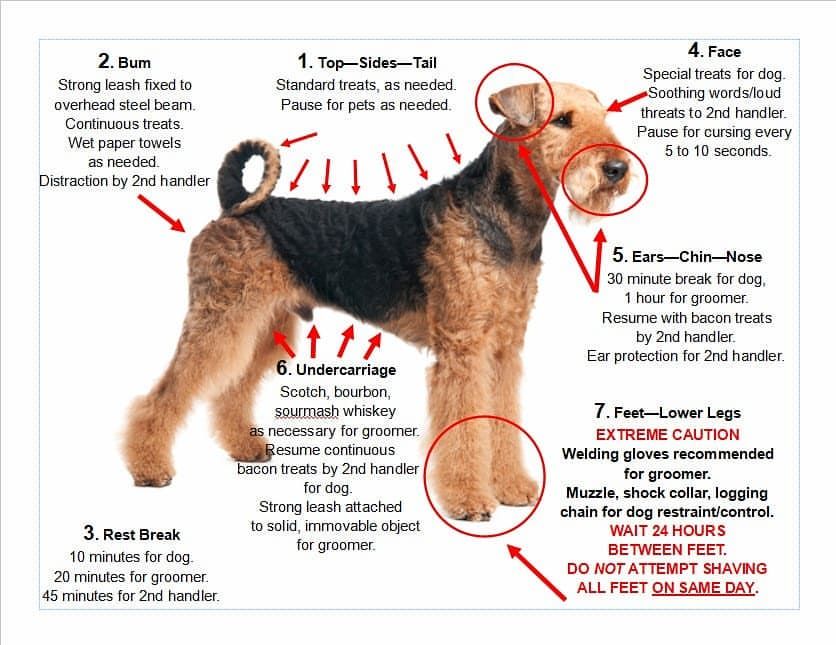
The Airedale's coat requires hand-stripping for show presentation, removing the dead outer coat by pulling rather than cutting, which maintains the correct harsh texture and colour. For pet Airedales, clipping is common and practical, though it softens the coat texture over time. The beard, eyebrows, and leg furnishings (the longer hair on the legs) require trimming as part of regular grooming. Professional grooming every 8 to 12 weeks is typical for most Airedale owners.
The breed's powerful, rectangular body, deep chest, strong neck, and confident carriage give it the impression of a dog larger than its actual measurements suggest. The Airedale looks and moves like a dog aware of its "King of Terriers" designation.
Temperament
The Airedale Terrier's temperament is characterised by a combination of qualities that set it apart from most other terriers: it retains the terrier's boldness, intelligence, and independence, but tempers these characteristics with a playfulness, a fondness for its family, and a sociability that makes it a more rounded companion than many in the terrier group.
The Airedale is less stubbornly independent than the Scottie or the Jack Russell, more willing to engage cooperatively with its owner, and genuinely playful and affectionate with its household.
The breed maintains a terrier's self-confidence and directness; it does not back down from challenges, does not tolerate rough handling, and will not pretend to enjoy interactions it finds objectionable, but it is generally a more amenable companion than the smaller, more intensely single-minded terrier breeds.
"The Airedale Terrier occupies a unique position in the terrier group: large enough and versatile enough to work alongside dogs of much larger working breeds, yet retaining the essential terrier character in a more socially accessible package. The breed's history in military and police work demonstrated that terrier intelligence and courage, scaled up and appropriately trained, produces a remarkably capable working dog." American Kennel Club. (2023). Airedale Terrier: Breed History and Character. Retrieved from https://www.akc.org/dog-breeds/airedale-terrier/
The prey drive is significant: Airedales were bred to hunt otter, rat, and other quarry, and the prey drive for small, fast-moving animals is consistent in the breed. Small pets should not be trusted with an unsupervised Airedale. The breed's size and strength mean that prey drive incidents are more consequential than in smaller terrier breeds.
The Airedale is also a guard dog by temperament: alert, watchful, and possessing the size and courage to be effective in this role. This guardian instinct, combined with the breed's intelligence, requires consistent training and socialisation to ensure it is channelled appropriately.
Health Conditions
The Airedale Terrier is a generally healthy breed. The combination of its modest size for a medium-large dog, its diverse working history, and the absence of extreme conformation has resulted in a health profile less troubled than many breed with heavier showing pressure.
| Health Condition | Prevalence / Notes |
|---|---|
| Hip dysplasia | ~17% prevalence (OFA data) |
| Degenerative myelopathy | DNA test available; progressive neurological disease affecting hindlimbs |
| Hypothyroidism | Present in the breed |
| Skin conditions | Elevated prevalence of dermatological issues |
| Bloat/GDV | Risk present, deep-chested medium-large breed |
Degenerative myelopathy (DM) is a progressive neurological disease affecting the spinal cord that has elevated prevalence in several breeds including the Airedale Terrier. The condition typically presents in older dogs (8 to 14 years) with progressive hindlimb weakness that advances to paralysis over months to years.
There is no effective treatment, though physiotherapy can temporarily maintain function and quality of life. A DNA test for the SOD1 mutation associated with DM is available and should be used in breeding programmes. Dogs that are genetically at risk (carrying two copies of the mutation) may develop the disease in later life; not all genetically affected dogs develop clinical DM.
See also Airedale Terrier Training Guide, Scottish Terrier, West Highland White Terrier, Exercise Needs by Dog Breed, and How to Groom a Dog at Home.
Training
The Airedale Terrier is the most trainable of the terrier breeds, a relative claim, but a meaningful one. The combination of intelligence, curiosity, and a genuine willingness to engage with training that exceeds most smaller terriers makes the Airedale capable of achieving high-level performance in obedience, agility, tracking, and field work.
The key training principles for Airedales:
Positive reinforcement is essential: The Airedale responds well to reward-based training and poorly to correction-based methods. Harsh handling produces a resistant, defensive dog.
Keep sessions varied: The Airedale's intelligence means it bores quickly with repetitive drilling. Varied tasks, new challenges, and progressive training maintain engagement.
Start early: The confident Airedale character can become challenging to manage in adulthood if clear expectations are not established in puppyhood. Early training and socialisation produce a substantially more manageable adult dog.
Manage independence: The terrier independence is always present. Off-lead reliability requires consistent, thorough training over many months, and should never be fully trusted in unfenced areas.
"The Airedale's capacity for high-level training reflects both its intelligence and the historical demands of its diverse working roles. A breed that needed to adapt to otter hunting, rat catching, military messaging, police work, and companion life across different handlers and contexts has developed a cognitive flexibility that most purpose-bred single-function breeds do not share." Fennell, J. (2002). The Dog Listener. HarperCollins.
Exercise
Airedales are active dogs with substantial exercise needs. An adult Airedale needs 1 to 2 hours of vigorous exercise daily. The breed was developed for full days of field work, and under-exercised Airedales can become destructive, restless, and difficult to manage.
Running, hiking, swimming (the Otterhound heritage makes many Airedales natural water dogs), and canine sports including agility, tracking, and nose work are all appropriate and enjoyable for the breed.
References
Orthopedic Foundation for Animals. (2023). Breed Health Statistics: Airedale Terrier. Retrieved from https://ofa.org
Coates, J. R., et al. (2007). Clinical characterisation and inheritance of degenerative myelopathy in dogs. Journal of Veterinary Internal Medicine, 21(6), 1332-1338. https://doi.org/10.1111/j.1939-1676.2007.tb02064.x
Airedale Terrier Club of America. (2023). Health Committee: Conditions in Airedales. Retrieved from https://www.airedale.org/health
The Kennel Club (UK). (2022). Breed Health and Conservation Plan: Airedale Terrier. Retrieved from https://www.thekennelclub.org.uk
American Kennel Club. (2023). Airedale Terrier Breed Standard. Retrieved from https://www.akc.org/dog-breeds/airedale-terrier/
Plummer, D. B. (1978). The Working Terrier. Boydell & Brewer.
Frequently Asked Questions
Why is the Airedale Terrier called the King of Terriers?
The Airedale Terrier earned the title King of Terriers from admiring fanciers in the late 19th century, reflecting its status as the largest of all terrier breeds and its remarkable versatility across working roles. No other terrier breed has successfully served as an otter hunter, rat-catcher, military messenger, police dog, guard dog, and family companion.
The breed’s physical size, combined with its intelligence, courage, and trainability, gave it capabilities that exceeded the specific, limited functions of most smaller terrier breeds. The title has been retained without serious challenge for over a century.
What is degenerative myelopathy in Airedale Terriers?
Degenerative myelopathy (DM) is a progressive neurological disease affecting the spinal cord that has elevated prevalence in Airedale Terriers (among other breeds). The condition typically presents in older dogs (8 to 14 years) with gradual hindlimb weakness, early signs include a dragging gait, difficulty rising, and reduced proprioception (awareness of foot placement).
The weakness advances to paralysis over months to years, and eventually affects bladder and bowel function. There is no effective treatment to halt progression. Physiotherapy can maintain function and quality of life for a period. A DNA test for the SOD1 mutation associated with DM is available. Not all dogs genetically at risk develop clinical disease.
How were Airedales used in World War I?
Airedale Terriers served extensively in the First World War as messenger dogs, search-and-rescue dogs, and guard dogs for the British military and allied forces. As messenger dogs, they carried communications between command posts and front-line troops, a function that required navigating terrain under fire, operating independently without handler guidance, and maintaining focus on the objective despite extreme conditions.
The breed’s intelligence, courage, and physical stamina made it well-suited to this role. Several Airedale war dogs received formal commendations for bravery. The breed’s wartime service is one of the most celebrated examples of dog military service in history.
Are Airedales good with other dogs?
Airedales are generally more dog-social than smaller terrier breeds, but the terrier character includes the potential for dog-dog confrontation, particularly with dogs that are perceived as challenging or dominant. With appropriate socialisation from puppyhood and careful introductions, most Airedales can coexist with other dogs. Same-sex aggression can be present in some individuals.
Dog parks with multiple unknown dogs are not the ideal setting for Airedales, a controlled social environment with known, well-matched dogs is more suitable. Multi-dog households with Airedales typically work well when dogs are introduced young, are of different sexes, and are managed to avoid resource competition.
How much does an Airedale Terrier shed?
Airedale Terriers shed moderately, less than many double-coated breeds, particularly when the coat is properly maintained through hand-stripping or regular grooming. The wiry outer coat does not shed in the same volume as a soft or double coat. Regular brushing (2 to 3 times weekly) manages the dead coat, and professional grooming every 8 to 12 weeks removes accumulated dead hair from the outer coat.
Clipped Airedales tend to shed slightly more than hand-stripped dogs, as clipping does not remove the dead hair from the follicle in the same way that stripping does.
Can Airedales swim?
Many Airedales take naturally and enthusiastically to water, reflecting the Otterhound ancestry in the breed’s background. The original Airedale was bred in part to hunt otter in the waterways of the Aire Valley, and the aptitude for water work is preserved in many modern Airedales.
Swimming is excellent exercise for the breed; it provides full-body conditioning without the joint impact of hard-surface running, and it engages the dog’s natural capabilities in a deeply satisfying way. Not all Airedales are equally enthusiastic about water, and early positive exposure to water activities from puppyhood produces better results than introducing an adult dog to swimming for the first time.