
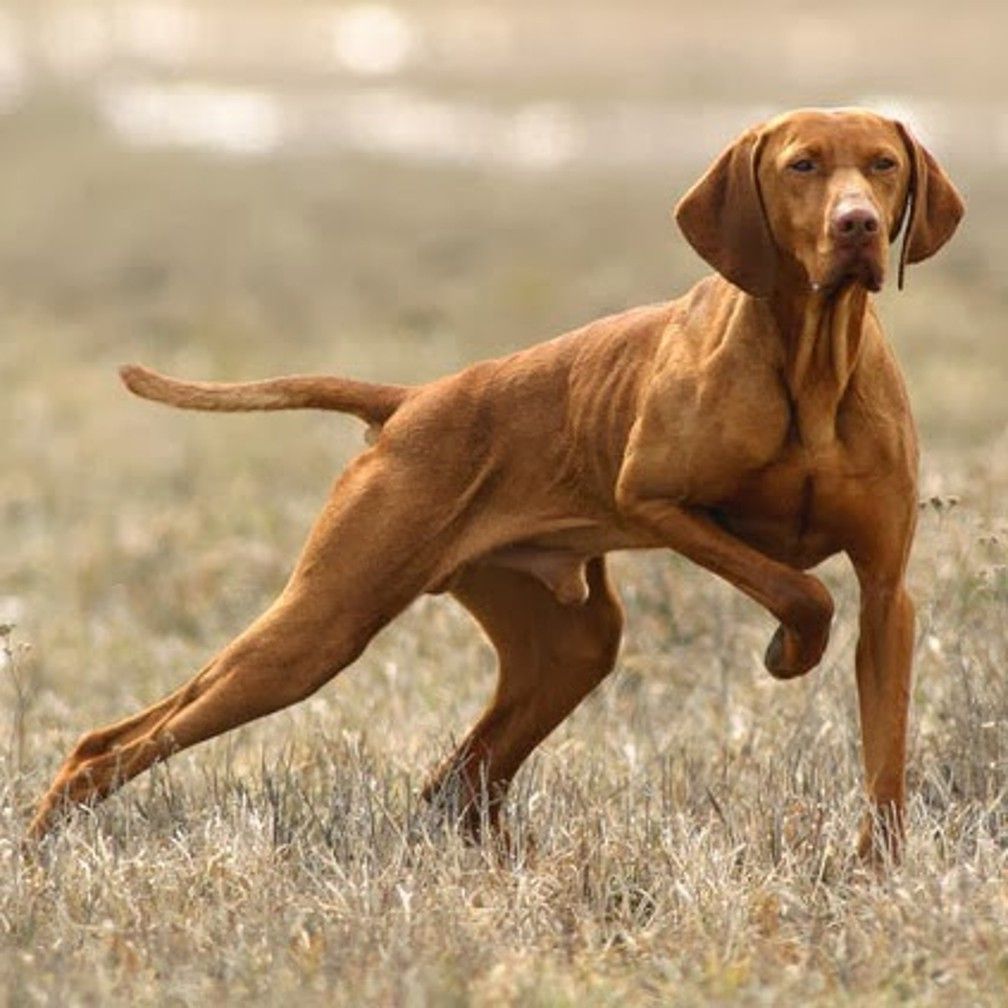
The Vizsla is Hungary's national dog and one of the most distinctive sporting breeds in the world, the only breed of its size that combines the functions of pointer and retriever in a single dog.
Everything about the Vizsla is golden: the rich, rust-coloured coat, the golden-brown eyes, the golden nose, even the eye rims and toenails carry the same warm, unified tone that makes the breed look as if it has been cast from the same piece of amber. This visual cohesion is so distinctive that the Vizsla is immediately recognisable and immediately unlike any other breed.
The Vizsla's most celebrated character trait is encapsulated in the breed's informal nickname: the Velcro Vizsla. This is a dog that seeks physical contact with its family with a consistency and intensity that goes beyond affectionate. Vizslas want to touch, to press against a leg, to rest a chin on a knee, to occupy the same physical space as the person they love.
Separation anxiety is common in the breed, not as a pathology but as an expression of the breed's fundamental orientation toward close human companionship.
Origins and History
The Vizsla is one of the oldest hunting dog breeds in Europe, with a documented history in Hungary extending back to at least the 10th century. Magyar hunters who settled the Carpathian Basin brought with them dogs of this general type, and the breed developed over the following centuries in the Hungarian plains as a versatile hunting companion for the nobility.
The name Vizsla is Hungarian for "pointer" or "alert." The breed was prized by Hungarian nobility as a hunting dog of exceptional versatility, able to work both as a pointing dog and as a retriever in the field, and as a companion in the home. The breed is depicted in 14th-century Hungarian etchings, and early breed histories document its presence in noble households from the medieval period.
The Vizsla came very close to extinction during the 20th century. Two world wars, the post-Second World War communist takeover of Hungary, and the associated persecution of the aristocratic class that had historically maintained the breed reduced the Vizsla population to near-zero at multiple points. Hungarian emigres who fled to Western Europe and North America after 1945 brought dogs with them, and these small populations formed the foundation of the modern Western Vizsla population.
The American Kennel Club recognised the Vizsla in 1960, placing it in the Sporting Group.
Physical Characteristics
The Vizsla's physical form is built for field work: lean, muscular, medium-sized, and proportioned for sustained movement at moderate speed. The breed is larger and more powerfully built than a typical pointing breed needs to be, reflecting its dual function as both pointer and retriever.
| Characteristic | Measurement |
|---|---|
| Height (males) | 56-61 cm (22-24 in) |
| Height (females) | 53-58 cm (21-23 in) |
| Weight (males) | 20-30 kg (45-65 lb) |
| Weight (females) | 18-25 kg (40-55 lb) |
| Lifespan | 12-14 years |
| AKC Group | Sporting |
The coat is one of the Vizsla's most striking characteristics: short, dense, and smooth, in a rich golden-rust colour described in the breed standard as the colour of a ripe wheat field at harvest. The coat colour is consistent throughout the breed; there are no marked or patterned Vizslas, no bi-colours or tri-colours.
The nose, eye rims, and toenails are a complementary golden brown rather than the typical black of most breeds. White markings on the chest and feet are permissible in small amounts but not preferred.
There is also a Wirehaired Vizsla, recognised as a separate breed by the FCI and increasingly by other kennel clubs, that has a dense, wiry, weather-resistant coat particularly suited to cold and wet field conditions.
Temperament
The Vizsla's temperament is characterised by three qualities that define the breed experience: athletic intensity in the field, profound affection for its family at home, and a sensitivity to emotional tone that makes the breed uniquely attuned to its owners.
The Velcro quality is one that owners consistently describe: this dog wants to be with you. Not near you, with you. On the sofa next to you, in bed with you, following you from room to room. This is not a dog that can be left alone in a separate room while the household goes about its business without some response, whining, scratching, or following along. Separation anxiety in Vizslas ranges from mild to severe, and management of this tendency is one of the primary challenges of the breed.
"The Vizsla's separation anxiety is not simply an individual behavioural issue; it is a breed-typical characteristic rooted in the dog's fundamental social orientation. This is a breed selected for centuries for close working partnership with a single hunter, spending every day in the field together. The expectation of close companionship is, for the Vizsla, a behavioural baseline, not a problem to be solved by desensitisation alone." Overall, K. L. (2013). Manual of Clinical Behavioral Medicine for Dogs and Cats. Elsevier.
The athletic energy of the Vizsla is substantial. This is a dog developed for long days in the field, and that energy requires consistent, vigorous daily outlets. An under-exercised Vizsla is a restless, anxious, potentially destructive Vizsla. The breed thrives in active households where running, hiking, swimming, or field sports provide the physical outlet the breed needs.
The Vizsla is also notably trainable, more so than many sporting breeds, because of the combination of high intelligence, the natural attunement to human cues, and the genuine desire for human approval. The breed responds very well to positive reinforcement and can achieve high levels of performance in obedience, agility, and field trials.
Health Conditions
The Vizsla is generally a healthy breed, with several hereditary conditions that warrant attention in breeding programmes.
| Health Condition | Prevalence / Notes |
|---|---|
| Hip dysplasia | ~10% prevalence (OFA data), relatively low for a sporting breed |
| Idiopathic epilepsy | Elevated breed prevalence; seizures typically begin between 1-5 years of age |
| Progressive retinal atrophy | DNA testing recommended for breeding stock |
| Inflammatory bowel disease | Elevated prevalence in the breed |
| Hyperuricosuria | Present in some lines; contributes to urate stone formation |
| Cancer | Elevated breed cancer rates in later life |
Idiopathic epilepsy is one of the most important hereditary health concerns in the Vizsla. The condition is heritable and elevated in prevalence compared to the general dog population. Seizures typically begin between 1 and 5 years of age.
A dog experiencing its first seizure should be evaluated by a veterinarian; multiple seizures or seizures lasting more than 2 to 3 minutes require emergency veterinary attention. Medical management with anti-epileptic medication controls seizure frequency effectively in many affected dogs.
"The heritability of idiopathic epilepsy in the Vizsla has been established through family studies and is consistent with a polygenic inheritance pattern. The prevalence in the breed population is elevated relative to most other sporting breeds, and this should be communicated clearly to all prospective Vizsla owners as part of responsible breeding practice." Ekenstedt, K. J., & Oberbauer, A. M. (2013). Inherited epilepsy in dogs. Topics in Companion Animal Medicine, 28(2), 51-58. https://doi.org/10.1053/j.tcam.2013.05.004
Training
The Vizsla is among the most trainable of the pointing breeds, combining high intelligence with a genuine desire to please that is less characteristic of more independent sporting dogs. The breed responds enthusiastically to positive reinforcement and is capable of complex, high-level training in obedience, agility, field work, and hunt tests.
The energy level means that training sessions can be vigorous, a Vizsla that has not been exercised before a training session is more difficult to focus than one that has had a run. Building exercise into the training routine (warm-up exercise, then training, then further exercise) produces better training outcomes.
The breed's sensitivity to emotional tone means that training sessions should be positive and ended on a success. A Vizsla that is pushed through failures or subjected to punitive correction becomes anxious and shuts down, making subsequent training sessions more difficult. Consistency, brevity when introducing new concepts, and enthusiastic reward for correct responses are the foundations of effective Vizsla training.
See also Vizsla Training Guide, Exercise Needs by Dog Breed, How to Socialize a Dog, and How to Train a Puppy.
Exercise
Vizslas need substantial daily exercise, a minimum of 1 to 2 hours of vigorous activity. The breed was developed for full days of field work and has the stamina to sustain extended activity. Running, swimming, hiking, cycling, and field sports are all appropriate activities. The Vizsla is among the best running companions of any dog breed, with the stamina to run alongside an active owner for several miles and the temperament to enjoy it.
A Vizsla that does not receive sufficient exercise is one of the most challenging dogs to live with. Restlessness, hyperactivity, and destructive behaviour in under-exercised Vizslas are breed-typical responses to unmet physical needs, not personality problems.
See Weimaraner for a comparison with the related German pointing breed.
References
Ekenstedt, K. J., & Oberbauer, A. M. (2013). Inherited epilepsy in dogs. Topics in Companion Animal Medicine, 28(2), 51-58. https://doi.org/10.1053/j.tcam.2013.05.004
Orthopedic Foundation for Animals. (2023). Breed Health Statistics: Vizsla. Retrieved from https://ofa.org
Vizsla Club of America. (2023). Health: Epilepsy and Progressive Retinal Atrophy in Vizslas. Retrieved from https://www.vcaweb.org/health
American Kennel Club. (2023). Vizsla Breed Standard and History. Retrieved from https://www.akc.org/dog-breeds/vizsla/
Buzhardt, L. (2019). Vizslas: A Breed Profile. VCA Animal Hospitals. Retrieved from https://vcahospitals.com/know-your-pet/vizsla
Fyfe, J. C., et al. (2011). Inherited selective cobalamin malabsorption in juvenile Beagles. Journal of Veterinary Internal Medicine, 25(1), 1-8. https://doi.org/10.1111/j.1939-1676.2010.0636.x
Frequently Asked Questions
What does Velcro Vizsla mean?
Velcro Vizsla is the informal nickname for the breed’s characteristic behaviour of maintaining constant physical contact with its owners. Vizslas do not merely want to be in the same room as their owners; they want to press against a leg, rest a head on a lap, or occupy the same piece of furniture.
This close physical orientation reflects the breed’s centuries of development as a close-working hunting partner that spent every day in direct collaboration with a single hunter. In the domestic context, this quality makes the Vizsla an extraordinarily affectionate companion, but it also means the breed is prone to separation anxiety when left alone. Management of separation anxiety should begin in puppyhood with gradual independence training.
Is the Vizsla a good family dog?
The Vizsla is an excellent family dog for active families with time to provide adequate exercise and companionship. The breed is gentle, patient with children, and deeply loyal. The high energy level is a good match for families with active lifestyles, children who enjoy running and outdoor activities will find an enthusiastic partner in a Vizsla.
The breed’s separation anxiety tendency means it does not do well in households where it is regularly left alone for long periods. First-time dog owners can succeed with a Vizsla if they are prepared for the exercise commitment and are willing to address the separation anxiety issue proactively.
Why is the Vizsla all one golden colour?
The Vizsla’s solid golden-rust coat is a fixed breed characteristic maintained by consistent selective breeding over many centuries. The breed standard specifies this golden-rust colour, described as the colour of a ripe wheat field, for the coat, eyes, nose, eye rims, and toenails, creating a unified monochromatic appearance.
Solid-coloured coats in dogs result from the absence of the patterning genes (e.g., agouti, merle, piebald) that create multi-coloured or marked coats. The Vizsla’s coat genetics produce uniform pigmentation distribution, resulting in the characteristic amber-gold appearance that makes the breed so distinctive. A small amount of white on the chest or feet is permissible under the AKC standard but is not preferred.
What is the Wirehaired Vizsla?
The Wirehaired Vizsla is a separate but closely related breed developed in Hungary in the 1930s by crossing the smooth-coated Vizsla with the German Wirehaired Pointer. The wiry, dense, weather-resistant coat was developed for hunting in cold, wet conditions in which the smooth Vizsla coat provided insufficient protection.
The Wirehaired Vizsla shares the same golden-rust colour and fundamental sporting temperament as the smooth Vizsla, but is somewhat larger and heavier-boned. The breed is recognised by the FCI and the AKC (since 2014) as a separate breed from the smooth Vizsla, though many registries continue to group them together.
How do I manage Vizsla separation anxiety?
Managing Vizsla separation anxiety begins in puppyhood with systematic independence training: teaching the puppy that brief periods of separation are safe and normal, gradually extending the duration of alone time over weeks and months.
Key strategies include: practising brief departures and returns without elaborate greetings that amplify the dog’s emotional state around owner absence; providing a settled, comfortable resting space with familiar scent items; ensuring adequate exercise before periods of alone time; and considering a companion dog for Vizslas that will regularly be left alone for several hours.
For established separation anxiety in adult dogs, a qualified veterinary behaviourist can provide a tailored behaviour modification plan, and medication may be appropriate in severe cases.
What are the signs of epilepsy in Vizslas?
Idiopathic epilepsy in Vizslas typically first presents between 1 and 5 years of age. Signs of a generalised seizure include: sudden collapse, loss of consciousness, uncontrolled limb paddling or stiffening, jaw chomping, drooling, involuntary urination or defecation, and a post-ictal period of confusion, disorientation, or temporary vision impairment lasting minutes to hours after the seizure ends.
Focal seizures may cause more subtle signs, facial twitching, repetitive chewing movements, or sudden unusual behaviour. A dog experiencing its first seizure should be evaluated by a veterinarian. Seizures lasting more than 2 to 3 minutes, or multiple seizures within 24 hours, constitute a veterinary emergency.