
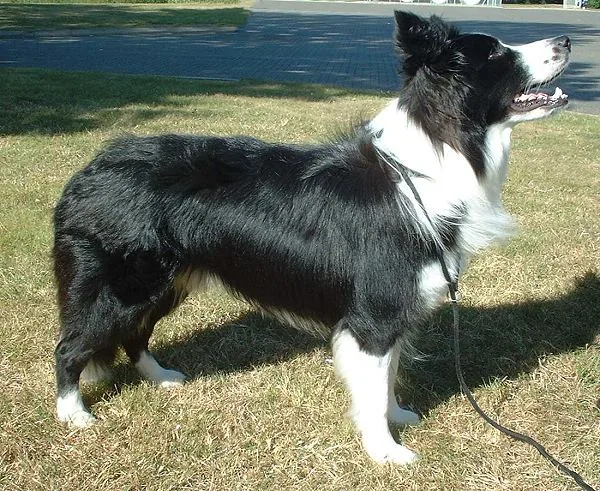
The Border Collie is widely considered the most intelligent dog breed in the world. Ranked first in Dr. Stanley Coren's landmark breed intelligence survey, the Border Collie learns new commands in fewer repetitions and obeys them more reliably than any other breed studied.
This remarkable cognitive capacity comes paired with an equally extraordinary working drive, boundless energy, and a deeply ingrained need to work that makes the Border Collie one of the most rewarding, and one of the most demanding, dogs a person can own.
Origins and Heritage
The Border Collie's name refers to the border region between England and Scotland, the hills and valleys of Northumberland, the Scottish Borders, and Cumbria, where the breed was developed over centuries to herd sheep on open, unfenced hillsides.
Unlike the livestock dogs of many continental European traditions, which drove and guarded flocks over long distances, the Border Collie's role was to gather and control sheep through a combination of intense sustained pressure, precise positioning, and, most distinctively, an penetrating, fixed stare known as "the eye."
The breed as we know it today traces to a single dog born in 1893 in Northumberland: Old Hemp, bred by Adam Telfer. Old Hemp was described by his contemporaries as working sheep with a calm, silent intensity unlike anything they had seen, no barking, no chasing, simply the fixed gaze and crouching approach that moved sheep through the power of controlled psychological pressure.
Old Hemp became an extraordinary stud dog, siring hundreds of offspring, and is considered the foundation sire of the modern Border Collie.
The International Sheep Dog Society (ISDS) was founded in 1906, and for most of the following century, the Border Collie was defined not by its appearance but by its ability to work. The ISDS Sheepdog Trials became the defining selection events for the breed, and champions at these trials, which test a dog's ability to gather, drive, and pen sheep with precision and control, were the most sought-after breeding dogs.
The AKC recognized the Border Collie as a breed in 1995, placing it in the Herding Group. This was controversial among working dog enthusiasts, who feared that show ring selection would erode the breed's working ability. The debate between working-line and show-line Border Collies continues to this day.
Physical Characteristics
The Border Collie is a medium-sized, athletic dog of deceptive power, its muscular frame and tireless endurance are not immediately apparent from its moderate dimensions. The breed comes in two coat varieties: the more common rough (medium-length) coat, and a less common smooth (short) coat. Both are double-coated with a weather-resistant outer coat and soft dense undercoat.
| Physical Characteristic | Males | Females |
|---|---|---|
| Height | 48-56 cm (19-22 in) | 46-53 cm (18-21 in) |
| Weight | 14-20 kg (31-44 lbs) | 12-19 kg (26-42 lbs) |
| Body type | Athletic, medium-length body, agile | |
| Coat (rough variety) | Medium, flat or slightly wavy | |
| Coat (smooth variety) | Short, dense | |
| Eye color | Brown (most common), blue in merles, odd-eyed | |
| Ear type | Semi-erect or erect, with tips folding forward | |
| Lifespan | 12-15 years |
Color is highly variable in the breed: the classic black-and-white is most common, but Border Collies come in blue merle, red (chocolate), red merle, blue, sable, tricolor, and other patterns. Color has no bearing on working ability or intelligence. The intense, oval-shaped eyes with a concentrated, focused expression are considered a defining feature of the breed's working character.
Exceptional Intelligence
The Border Collie's intelligence is not merely anecdotal. Dr. Stanley Coren's survey of obedience instructors, published in The Intelligence of Dogs (1994), placed the Border Collie first out of 138 breeds. The criteria used were working and obedience intelligence: how quickly a breed learned new commands and how reliably it obeyed on the first command given. Border Collies learned new commands in under five repetitions and obeyed on the first command 95% or more of the time.
"The Border Collie is, by virtually every measure we have, the most cognitively capable dog breed. This is not about tricks; it is about working memory, problem-solving ability, and learning speed that is genuinely remarkable compared to other dogs." Dr. Stanley Coren, Professor Emeritus, Department of Psychology, University of British Columbia
The most dramatic demonstration of Border Collie intelligence came from the documented case of Chaser, a Border Collie owned and trained by retired psychology professor John W. Pilley at Wofford College, South Carolina.
Through years of systematic training, Chaser learned to identify, by individual name, more than 1,022 distinct objects, the largest demonstrated vocabulary of any non-human animal ever tested scientifically.
Chaser could categorize objects by both name and function, and could learn new words through "fast mapping" (inferring that a new word referred to an unfamiliar object among familiar ones), a skill previously thought unique to human children.
Pilley published his findings in the peer-reviewed journal Behavioural Processes in 2011. Chaser died in 2019 at age 15, having become the most scientifically studied dog in history.
The Working Drive: A Double-Edged Gift
The Border Collie's intelligence is inextricable from its working drive, the intense, focused, purposeful energy that makes it an extraordinary sheepdog. This drive is not simply high energy; it is specifically channeled energy with a strong compulsion toward herding behaviors: gathering, eye, stalking, and driving. A Border Collie deprived of an outlet for this drive does not simply become bored; it develops serious behavioral problems.
Well-documented maladaptive behaviors in under-stimulated Border Collies include:
Obsessive ball fixation: Many Border Collies that are given balls as exercise substitutes for herding develop compulsive fixation, staring at, carrying, or obsessively seeking the ball for hours. This is a stress behavior, not play.
Shadow and light chasing: Compulsive chasing of shadows, reflected light, and moving patterns. Once established, this behavior is difficult to extinguish and can be distressing to the dog.
Repetitive circling and fence-running: Stereotypic motor behaviors that develop when herding instincts have no appropriate outlet.
Destructive behavior and self-harm: Dogs without sufficient mental and physical stimulation may destroy furniture, household objects, or harm themselves.
Border Collies are not suitable pets for sedentary households, for people who are away from home for long periods, or for those who cannot provide at least two hours of vigorous, mentally engaging activity daily. For exercise guidance see Exercise Needs by Dog Breed.
Health Conditions
The Border Collie is a generally healthy breed with a lifespan of 12-15 years, reflecting its origin as a functional working breed where only fit, healthy dogs were selected for breeding. However, several hereditary conditions are present in the breed and should be screened for. Full details at Border Collie Health Problems.
Collie Eye Anomaly (CEA): A congenital developmental defect affecting the choroid, retina, and sclera of the eye, shared with the Rough Collie and Shetland Sheepdog. Severity ranges from subclinical to vision-threatening. A reliable DNA test exists. Responsible breeding programs test all dogs and do not breed dogs that would produce severely affected offspring.
Hip dysplasia: Approximately 12% of Border Collies evaluated by the OFA have hip dysplasia, elevated compared to many herding breeds, though lower than many larger working breeds. Hip evaluation of breeding stock is recommended.
Trapped Neutrophil Syndrome (TNS): A severe inherited immune deficiency causing profound inability to fight infection. Affected puppies die young, typically within months of birth. DNA testing is available and completely prevents the birth of affected dogs when used responsibly.
MDR1 (ABCB1) mutation: Shared with Collies and Shelties, the MDR1 mutation causes dangerous sensitivity to several drugs including ivermectin, loperamide, and certain chemotherapy agents. DNA testing is available.
Epilepsy: Idiopathic epilepsy is more common in Border Collies than in many breeds. The genetic basis involves multiple loci and is not fully characterized. Affected dogs should not be used in breeding.
Neuronal ceroid lipofuscinosis (NCL): A progressive, fatal neurodegenerative disease caused by accumulation of lysosomal storage material in nerve cells. DNA testing is available for the form affecting Border Collies, and responsible breeders test all breeding stock.
| Health Condition | DNA Test | Frequency |
|---|---|---|
| Collie Eye Anomaly | Yes | Common |
| Trapped Neutrophil Syndrome | Yes | Moderate |
| MDR1 mutation | Yes | Present in breed |
| Neuronal ceroid lipofuscinosis | Yes | Uncommon |
| Hip dysplasia | OFA X-ray | ~12% OFA |
| Epilepsy | No | Elevated |
Training and Sport
Training a Border Collie is an extraordinary experience for an experienced dog handler and a potential nightmare for someone who does not understand the breed's requirements. They are capable of learning virtually any skill taught to dogs, including complex trick sequences, elite competitive obedience, search and rescue, detection work, and of course herding. For training guidance see Border Collie Training Guide and How to Train a Puppy.
Border Collies dominate agility competition internationally at the highest levels. Their combination of speed, tight turning ability, and cooperative working relationship with handlers makes them consistently competitive across all agility venues. They are equally dominant in disc dog (flying disc) competition, competitive obedience, and flyball.
Their intelligence means they can learn bad habits as readily as good ones. Inconsistent handling, ambiguous cues, or accidental reinforcement of unwanted behaviors will produce a clever, creative dog that has learned to get what it wants in ways its owner finds frustrating. Clear, consistent, positive training from the very start is essential. The Intelligence of Dogs comparison is explored further at How Smart Are Dogs.
Living with a Border Collie
The ideal Border Collie household is one where:
- At least one household member has genuine experience with high-drive herding breeds
- The dog receives a minimum of 2 hours of varied, vigorous, mentally engaging activity daily
- There is space to run, a house with a securely fenced yard is strongly preferred over apartments
- The owner is committed to continued training and engagement throughout the dog's life
- Children in the household are old enough to understand that the dog is not a toy and may attempt to herd them
Border Collies are not recommended for first-time dog owners unless those owners are prepared to invest heavily in education about the breed and commit to an unusually high level of daily engagement.
Summary
The Border Collie is the pinnacle of working dog development, a breed of extraordinary intelligence, physical capability, and purposeful drive, developed over centuries for a demanding and specific task. In the right hands and environment, the Border Collie is deeply rewarding, capable of achievements that no other breed can match.
In the wrong environment, the same qualities produce a miserable, behaviorally disturbed dog. Prospective owners owe it to the breed, and to themselves, to honestly evaluate whether they can meet the Border Collie's exceptional requirements.
References
Coren, S. (1994). The Intelligence of Dogs: A Guide to the Thoughts, Emotions, and Inner Lives of Our Canine Companions. Free Press. ISBN 9780029066836.
Pilley, J.W., & Reid, A.K. (2011). Border collie comprehends object names as verbal referents. Behavioural Processes, 86(2), 184-195. https://doi.org/10.1016/j.beproc.2010.11.007
Acland, G.M., Blanton, S.H., Hershfield, B., & Aguirre, G.D. (1994). XLPRA: A canine retinal degeneration inherited as an X-linked trait. American Journal of Medical Genetics, 52(1), 27-33. https://doi.org/10.1002/ajmg.1320520106
Shearman, J.R., & Wilton, A.N. (2007). A canine model of Cohen syndrome: Trapped neutrophil syndrome. BMC Genomics, 8, 258. https://doi.org/10.1186/1471-2164-8-258
Mealey, K.L., Bentjen, S.A., Gay, J.M., & Cantor, G.H. (2001). Ivermectin sensitivity in collies is associated with a deletion mutation of the mdr1 gene. Pharmacogenetics, 11(8), 727-733. https://doi.org/10.1097/00008571-200111000-00012
Frequently Asked Questions
Are Border Collies really the smartest dog breed?
Border Collies rank first in Dr. Stanley Coren’s comprehensive survey of breed working and obedience intelligence. They learn new commands in under five repetitions and obey on the first command 95%+ of the time. Chaser, a Border Collie, learned the names of over 1,022 individual objects, the largest documented vocabulary of any non-human animal.
Are Border Collies good family pets?
Border Collies can be good family dogs in the right households, but they are not for everyone. They require a minimum of 2 hours of vigorous, mentally stimulating activity daily, an experienced handler, space to run, and ongoing training commitment. They are not suitable for sedentary families, small apartments, or first-time owners without significant preparation.
Why do Border Collies develop obsessive behaviors?
Border Collies have an intense hardwired herding drive. When this drive has no appropriate outlet, it gets redirected into compulsive behaviors such as obsessive ball fixation, shadow/light chasing, or repetitive pacing. These are stress responses, not simply boredom. The solution is providing appropriate work or structured sport activities.
What health tests should Border Collie breeders perform?
Responsible Border Collie breeders test for Collie Eye Anomaly (DNA test), Trapped Neutrophil Syndrome (DNA test), MDR1 mutation (DNA test), and Neuronal Ceroid Lipofuscinosis (DNA test), plus OFA hip evaluation. These tests collectively prevent several preventable genetic diseases from being passed to offspring.
How much exercise does a Border Collie need?
A minimum of 2 hours of vigorous, varied, mentally engaging activity daily. Physical exercise alone is insufficient, Border Collies need intellectual challenges through training, sport, or work. They thrive with activities like agility, herding, disc dog, nose work, and competitive obedience.
What is the MDR1 mutation and why does it matter for Border Collies?
The MDR1 (ABCB1) mutation affects how the brain processes certain drugs. Dogs with two mutant copies can experience severe neurological toxicity from drugs like ivermectin at normal doses. DNA testing is available and all Border Collies should be tested before receiving any potentially affected medications.