
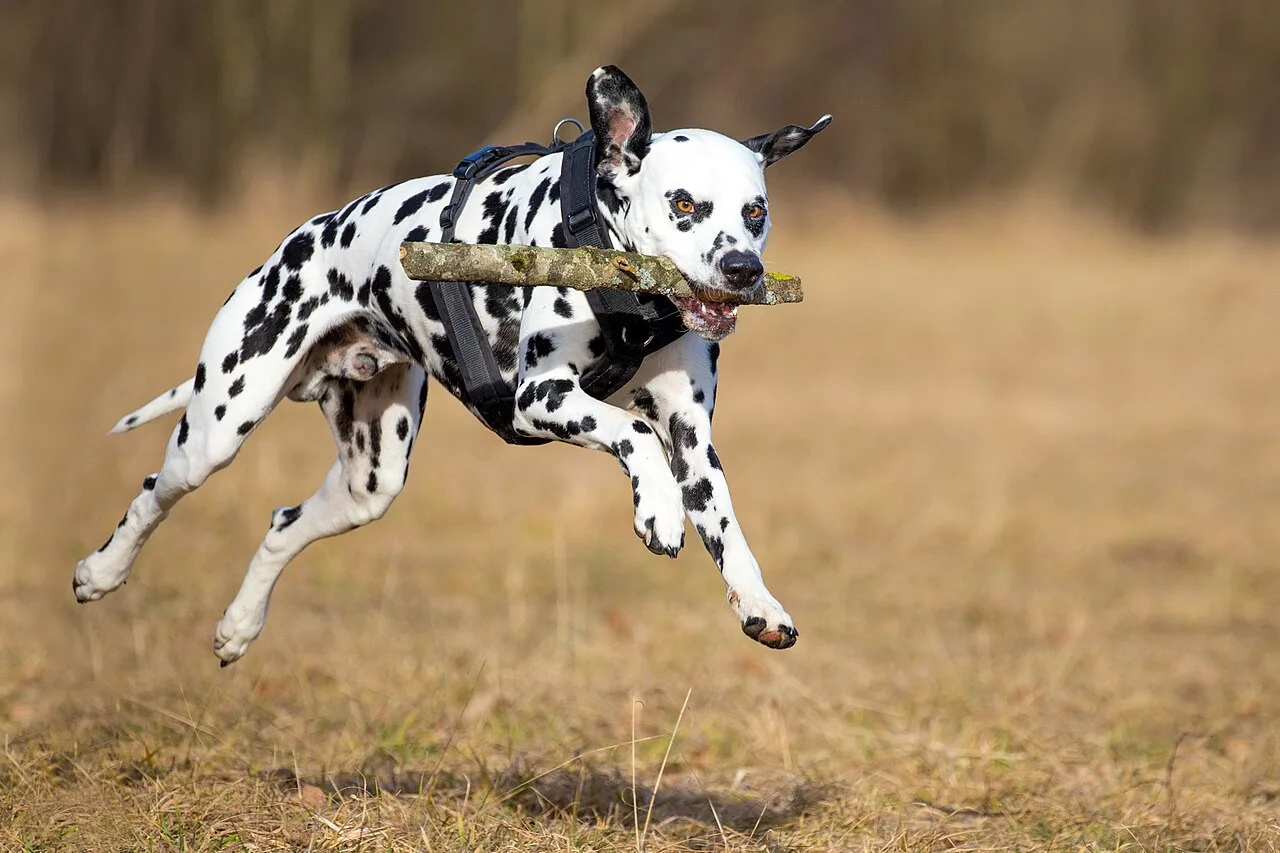
The Dalmatian is the only dog breed characterised by a spotted coat, and those spots carry a remarkable biological story. Dalmatian puppies are born completely white, every single one of them. The black or liver spots that define the breed's appearance develop in the days and weeks following birth, as pigment-producing melanocytes migrate to the skin and hair follicles. By the age of 4 weeks, the spots are clearly visible. By 18 months, the final spot pattern is established.
That spotted coat is connected, through shared genetics, to two of the breed's most significant health characteristics: a very high prevalence of hereditary deafness (approximately 8 percent of Dalmatians are bilaterally deaf from birth, and a further 22 to 24 percent are deaf in one ear) and a unique metabolic abnormality affecting uric acid processing.
The Dalmatian is simultaneously one of the most visually iconic breeds in the world, one of the most historically interesting, and one of the most medically complex.
Origins and History
The Dalmatian's geographical origin is one of the most debated questions in canine breed history. Despite the name suggesting derivation from the Dalmatia region of present-day Croatia, the evidence for this is not conclusive. Early depictions of spotted dogs appear in ancient Egyptian frieze art and in Italian Renaissance paintings that predate the establishment of Croatian Dalmatia as a clearly defined region.
A 17th-century painting by the Italian artist Savery depicting a spotted dog that closely resembles the modern Dalmatian is one of the earliest specific documentary records.
Regardless of geographic origin, the breed was well-established in Europe by the 18th century, where it fulfilled a distinctive and unusual role: the coaching dog. Dalmatians were trained to run beneath or alongside horse-drawn carriages for long distances, maintaining position under the carriage axles and alongside the horses.
This role required exceptional stamina, a close working relationship with horses (Dalmatians are uniquely horse-compatible among dog breeds, a characteristic that persists today), and the physical capacity to cover the ground between aristocratic estates and urban centres, distances that could total 20 to 40 miles per day.
The breed's association with fire stations in the United States traces to this coaching heritage: firehouse horses required the same management as coaching horses, and Dalmatians transitioned naturally to the role of firehouse mascot and horse companion when fire departments were still horse-drawn.
The American Kennel Club recognised the Dalmatian in 1888. The breed achieved international cultural fame with the publication of Dodie Smith's novel The Hundred and One Dalmatians (1956) and the subsequent Disney film (1961) and its remake (1996).
Physical Characteristics
The Dalmatian is a medium-to-large, well-muscled, athletic dog. The body is built for endurance, the deep chest provides cardiovascular capacity for long-distance movement, and the limbs are proportioned for sustained trotting rather than explosive sprinting.
| Characteristic | Measurement |
|---|---|
| Height (males) | 56-61 cm (22-24 in) |
| Height (females) | 53-58 cm (21-23 in) |
| Weight | 20-32 kg (45-70 lb) |
| Lifespan | 11-13 years |
| AKC Group | Non-Sporting |
| Birth coat colour | White (spots develop from day 3-4) |
The spots are the breed's defining characteristic. Standard Dalmatian spots are round, well-defined, and between 2 and 3 centimetres in diameter. Spots that run together (patches) are considered a conformation fault in show dogs. Two spot colours are recognised: black (the most common) and liver (a rich brown). The spots are distributed over the entire body surface, including the tail.
Ticking, small spots smaller than standard breed spots, is present in many Dalmatians and results from the continued migration of melanocytes throughout the first year of life. Tri-coloured Dalmatians (with tan markings in addition to the standard spots), blue-eyed Dalmatians, and lemon (pale yellow) spotted Dalmatians occur but are not standard.
The coat is short, dense, and lies flat against the body. It sheds consistently year-round, Dalmatian hair is short, white, and tends to weave into fabric, requiring regular vacuuming and lint-rolling.
The Deafness Problem
Congenital sensorineural deafness in Dalmatians is one of the most thoroughly studied hereditary health conditions in any dog breed, and it requires detailed understanding from all prospective owners.
Dalmatian deafness is linked to the extreme white spotting gene (the piebald gene, S locus) that produces the white coat and the pattern of spots. The same melanocyte deficiency responsible for the lack of background coat pigmentation also affects the stria vascularis of the cochlea, a melanocyte-rich tissue in the inner ear that is essential for normal auditory function. Dalmatians with insufficient cochlear melanocytes are born deaf in the affected ear(s).
Prevalence statistics from multiple studies are consistent:
- Approximately 8 percent of Dalmatians are bilaterally deaf (deaf in both ears)
- Approximately 22 to 24 percent are unilaterally deaf (deaf in one ear)
- This means approximately 30 percent of all Dalmatians are affected by some degree of congenital deafness
"Congenital sensorineural deafness in Dalmatians is among the highest prevalence hereditary deafness conditions in any domestic animal species. The association with extreme white spotting and the piebald gene complex has been established through multiple independent studies. BAER (Brainstem Auditory Evoked Response) testing is the only reliable method for detecting unilateral deafness, as affected dogs show no obvious behavioural signs of hearing loss in one ear." Strain, G. M. (2004). Deafness prevalence and pigmentation and gender associations in dog breeds at risk. The Veterinary Journal, 167(1), 23-32. https://doi.org/10.1016/S1090-0233(03)00095-5
| Hearing Status | Percentage of Dalmatians |
|---|---|
| Bilaterally hearing | ~70% |
| Unilaterally deaf | ~22-24% |
| Bilaterally deaf | ~8% |
BAER (Brainstem Auditory Evoked Response) testing is the only reliable method for determining hearing status, as unilaterally deaf dogs show no obvious behavioural differences from hearing dogs. Reputable breeders should BAER test all puppies before sale and should not breed from bilaterally deaf dogs or from lines with very high rates of deafness. Bilaterally deaf puppies require specialised management but can live full, happy lives with experienced owners using visual cue training.
The Uric Acid Defect
The Dalmatian has a unique genetic mutation that distinguishes it from all other dog breeds in its uric acid metabolism. In all other dogs, uric acid is metabolised to allantoin before excretion by the kidneys and bladder. In Dalmatians, a mutation in the SLC2A9 gene prevents this conversion, Dalmatians excrete urates (uric acid salts) rather than allantoin.
The practical consequence is that Dalmatians are predisposed to forming urate bladder and kidney stones. Urate stones can cause bladder irritation, infection, and in severe cases urethral obstruction, which is a life-threatening emergency in male dogs.
Management strategies include: feeding a low-purine diet (avoiding high-purine foods including organ meats, sardines, anchovies, game meats, and some legumes); ensuring continuous access to fresh water to maintain dilute urine; monitoring for signs of urinary obstruction (straining to urinate, crying during urination, blood in urine).
See also Dalmatian Health Problems for a complete health reference.
Temperament
Dalmatians are energetic, intelligent, and playful, traits that made them excellent coaching dogs and that, in the domestic context, require consistent exercise and mental stimulation to prevent restlessness and destructive behaviour. The breed is people-oriented and generally good with children in active households, though the high energy level can overwhelm very small children.
Dalmatians are sensitive and respond best to positive reinforcement training. They can be stubborn and independent, but the stubbornness is generally less pronounced than in terrier or Nordic breeds. Early socialisation and consistent training from puppyhood produces a well-mannered companion. Without consistent training and adequate exercise, Dalmatians can be challenging: jumping, barking, counter-surfing, and general hyperactivity are common complaints in under-stimulated individuals.
"The Dalmatian's historical function as a coaching dog required a specific combination of traits: stamina, equine compatibility, trainability, and the ability to work for extended periods with minimal supervision. The modern Dalmatian retains the energy and drive of its working heritage, which is its greatest asset in active homes and its greatest challenge in sedentary ones." American Kennel Club. (2023). Dalmatian Breed Standard and History. Retrieved from https://www.akc.org/dog-breeds/dalmatian/
Exercise and Training
Dalmatians need substantial daily exercise, a minimum of 1 to 2 hours of vigorous activity. The breed's coaching dog heritage produced a dog with genuine endurance: Dalmatians can run for hours, and inadequate exercise produces behavioural problems. They are excellent jogging, hiking, and cycling companions.
See Exercise Needs by Dog Breed, Dog Vaccination Schedule Explained, and How Much to Feed a Dog by Weight for routine care guidance.
References
Strain, G. M. (2004). Deafness prevalence and pigmentation and gender associations in dog breeds at risk. The Veterinary Journal, 167(1), 23-32. https://doi.org/10.1016/S1090-0233(03)00095-5
Bannasch, D. L., et al. (2008). Mutations in the SLC2A9 gene cause hyperuricosuria and hyperuricemia in the dog. PLOS Genetics, 4(11), e1000246. https://doi.org/10.1371/journal.pgen.1000246
Orthopedic Foundation for Animals. (2023). Breed Health Statistics: Dalmatian. Retrieved from https://ofa.org
Dalmatian Club of America. (2023). Health Issues in the Dalmatian: Urinary Stones and Deafness. Retrieved from https://www.thedca.org/health
Strain, G. M. (2011). Deafness in Dogs and Cats. CABI Publishing.
Haskins, M. E., et al. (1989). The Dalmatian mutation and uric acid metabolism. Journal of Animal Science, 67(5), 1399-1404. https://doi.org/10.2527/jas1989.6751399x
Frequently Asked Questions
Are Dalmatians born without spots?
Yes. Dalmatian puppies are born completely white. The spots develop in the days and weeks following birth as melanocytes (pigment-producing cells) migrate to the skin and hair follicles and begin producing melanin. The first spots become visible around 3 to 4 days of age. The spot pattern develops progressively over the first several weeks of life, and the final pattern is generally established by 18 months.
The white birth coat is determined by the extreme white spotting gene (S locus, piebald gene) that also underlies the breed’s characteristic spotted adult pattern, and is genetically linked to the breed’s high prevalence of hereditary deafness.
Why are so many Dalmatians deaf?
Dalmatian deafness is directly linked to the same gene responsible for the breed’s white coat and spotted pattern. The extreme white spotting gene that produces the lack of background pigmentation also affects melanocytes in the stria vascularis of the cochlea (inner ear), a tissue that requires melanocytes for normal auditory function. Without sufficient cochlear melanocytes, the dog is born deaf in the affected ear.
Approximately 8 percent of Dalmatians are bilaterally deaf and 22 to 24 percent are unilaterally deaf. BAER (Brainstem Auditory Evoked Response) testing, a neurological test performed in puppies at 5 to 7 weeks of age, is the only reliable method for determining hearing status. Unilateral deafness produces no obvious behavioural signs.
What is the Dalmatian uric acid problem?
Dalmatians carry a mutation in the SLC2A9 gene that prevents them from converting uric acid to allantoin (the form in which all other dog breeds excrete purines). Instead, Dalmatians excrete urates, uric acid salts, in their urine, which predisposes them to forming urate bladder and kidney stones.
Management involves: feeding a low-purine diet (avoiding organ meats, game meats, sardines, anchovies); ensuring the dog has continuous access to fresh water to produce dilute urine; and monitoring for urinary symptoms (straining, blood in urine, crying during urination). Male Dalmatians are at higher risk of urethral obstruction from stones, which is a life-threatening emergency requiring immediate veterinary attention.
How much exercise does a Dalmatian need?
Dalmatians need 1 to 2 hours of vigorous exercise daily, significantly more than many breeds of comparable size. The breed’s heritage as a coaching dog that ran alongside horse-drawn carriages for distances of 20 to 40 miles per day produced a dog with genuine endurance and a high activity drive. Dalmatians that do not receive adequate exercise develop behavioural problems: hyperactivity, destructive behaviour, excessive barking, and anxiety.
They make excellent jogging and cycling companions, and their stamina means they can handle very long hikes and extended activity sessions. They are not suitable for inactive households or for owners who cannot commit to consistent, substantial daily exercise.
Are Dalmatians good family dogs?
Dalmatians are people-oriented, playful, and generally good with children in active families. The breed’s high energy level is a good match for active households with older children. Very young children can be overwhelmed by a Dalmatian’s enthusiasm and size. The breed requires consistent training from puppyhood to manage jumping and exuberant behaviour.
Dalmatians are sensitive and respond well to positive reinforcement; they are not suited to harsh or punitive training methods. With adequate exercise, consistent training, and a household that appreciates an active dog, Dalmatians are loyal and entertaining family companions.
What food should I avoid feeding a Dalmatian?
Due to the Dalmatian’s unique uric acid metabolism, high-purine foods should be avoided or strictly limited. High-purine foods that increase urate production include: organ meats (liver, kidney, heart), game meats (venison, rabbit), sardines, anchovies, mussels, herring, and some legumes (in very large quantities).
Commercial foods formulated specifically for Dalmatians or for dogs with urate urinary concerns are available and designed with appropriate purine levels. Fresh water should always be available to encourage dilute urine production. If a Dalmatian shows any urinary symptoms, straining, blood in urine, frequent unsuccessful attempts to urinate, veterinary evaluation is urgent.