
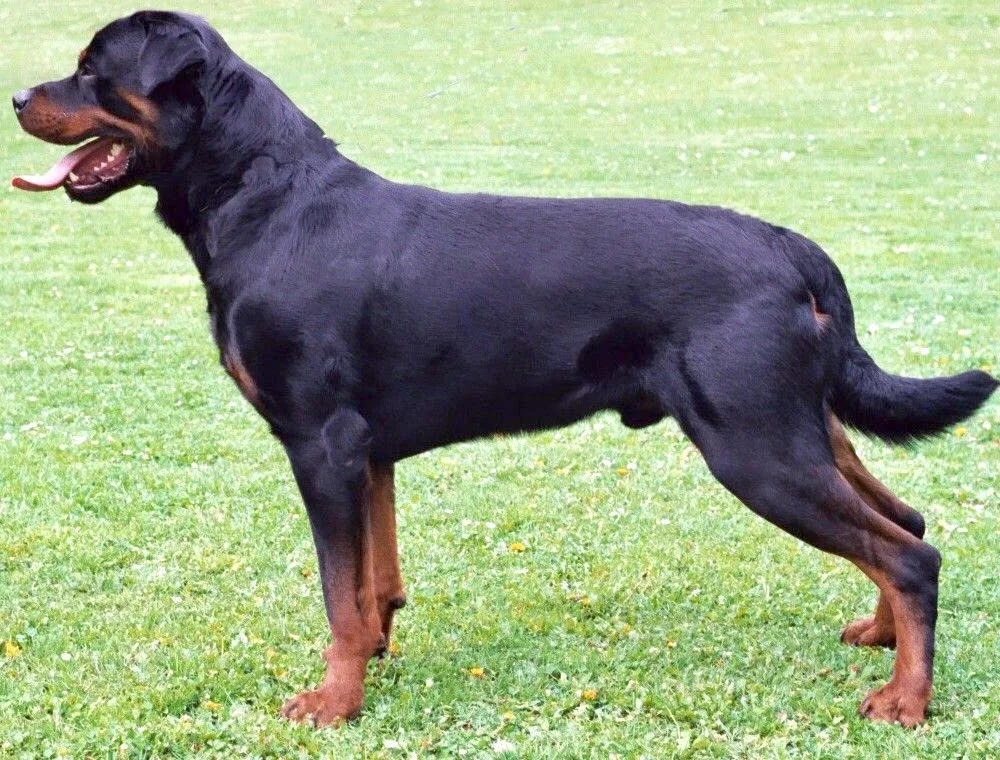
The Rottweiler is a powerful working breed with a lifespan markedly shorter than many similarly sized dogs, a high rate of cancer, and a distinct set of heritable orthopaedic and cardiac conditions that any owner or prospective buyer needs to understand. This article covers the most clinically significant health problems in Rottweilers, genetic tests and screening evaluations, what questions to ask a breeder, and how to manage affected dogs across their lives.
For a full overview of Rottweiler history, temperament, working roles, and care, see Rottweiler.
Overview of Rottweiler Health
Rottweilers have one of the highest cancer rates of any dog breed, and osteosarcoma (bone cancer) is the leading cause of death, particularly in dogs neutered before physical maturity. Multiple epidemiological studies have identified Rottweilers as a sentinel breed for cancer risk research. Average lifespan is 8-10 years, significantly shorter than smaller breeds, but well-managed Rottweilers from health-tested breeding programmes frequently reach 11-12 years.
The 2014 UK Kennel Club Pure Breed Health Survey for the Rottweiler and OFA breed statistics provide the most systematic quantitative data. The American Rottweiler Club maintains a health and genetics committee that publishes updated breeding recommendations.
"The Rottweiler Trust/ARC Cancer Survey of 2012 identified osteosarcoma as the most frequent cancer diagnosis in the breed, accounting for approximately 23% of cancer deaths, followed by lymphoma (18%) and haemangiosarcoma (14%). The survey found significantly higher cancer mortality in spayed and neutered dogs compared to intact dogs, with a particularly strong association between early gonadectomy and osteosarcoma risk." (American Rottweiler Club Health Survey, 2012)
Summary Health Table
| Condition | Estimated Prevalence | Recommended Screening |
|---|---|---|
| Hip dysplasia | OFA: ~20% dysplastic in evaluated dogs | OFA/PennHIP radiograph at age 24+ months |
| Elbow dysplasia | OFA: ~39% affected in evaluated dogs | OFA elbow radiograph at age 24+ months |
| Osteosarcoma (bone cancer) | 12-13% lifetime risk in some estimates | No preventive test; monitor for lameness |
| Dilated cardiomyopathy (DCM) | Elevated breed risk | OFA cardiac (echocardiogram) |
| Subaortic stenosis | Elevated breed risk | OFA cardiac auscultation/echocardiogram |
| Cruciate ligament disease | Very common in large breeds | Physical examination; orthopaedic assessment |
| Hypothyroidism | ~3-5% | OFA thyroid panel |
| Juvenile laryngeal paralysis and polyneuropathy (JLPP) | Autosomal recessive; carrier frequency moderate | DNA test |
| Gastric dilatation-volvulus | Elevated (deep-chested breed) | Prophylactic gastropexy recommended |
| Von Willebrand's disease | Low | DNA test |
Hip and Elbow Dysplasia
Rottweilers have some of the highest rates of orthopaedic disease of any widely evaluated breed. OFA statistics are sobering: among Rottweilers evaluated for hips, approximately 20% show dysplasia, and among those evaluated for elbows, approximately 39% show elbow dysplasia. These numbers have improved over decades of screening-based breeding but remain among the highest of any popular breed.
Hip dysplasia causes abnormal development of the hip joint, leading to laxity, cartilage wear, and progressive osteoarthritis. In a breed as large and heavy-muscled as the Rottweiler, hip dysplasia causes significant lameness and quality-of-life reduction. PennHIP distraction index measurements are considered more sensitive than OFA standard radiographs for detecting hip laxity in young dogs and can be performed as early as 16 weeks of age.
Elbow dysplasia is actually a collective term for several related developmental conditions: ununited anconeal process (UAP), fragmented coronoid process (FCP), and osteochondritis dissecans (OCD) of the medial humeral condyle. All cause joint incongruity, cartilage damage, and secondary arthritis. Signs include front limb lameness, typically first noticed between 4 and 12 months of age, often with an outward rotation of the affected leg. OFA requires two views of each elbow for grading.
"A study of 29,539 Rottweilers evaluated for elbow dysplasia between 1990 and 2014 in the OFA database found a breed prevalence of 39.7% with grade I (slight), II (moderate), or III (severe) changes, making the Rottweiler the second highest large breed for elbow dysplasia after the Chow Chow." (OFA Elbow Dysplasia Statistics, published in Smith GK et al., JAVMA, 2014)
Breeding practice: both parents of a Rottweiler puppy should have OFA-certified hips (fair, good, or excellent) and OFA-certified elbows (normal, grade 0). PennHIP results of distraction index under 0.3 are considered low laxity. Screening does not guarantee an individual puppy will be unaffected, as environmental factors and the polygenic basis of both conditions mean tested parents can still produce affected offspring, but screening dramatically reduces risk.
Management of established orthopaedic disease includes weight management (critical - excess weight dramatically worsens joint disease in large breeds), appropriate low-impact exercise (swimming is ideal), omega-3 fatty acid supplementation, NSAIDs or other analgesics as needed, and joint supplements. Surgical options exist for young dogs with specific lesions, including FHO (femoral head ostectomy), total hip replacement, and various elbow surgeries.
Osteosarcoma
Osteosarcoma (OSA) is the most common primary bone tumour in dogs and Rottweilers have one of the highest breed-specific rates of any breed. Epidemiological studies consistently place Rottweilers in the highest-risk group alongside Great Danes, Irish Wolfhounds, and Saint Bernards.
The tumour most frequently arises in the long bones of the limbs, particularly around the distal radius (just above the wrist) and the proximal humerus (upper forelimb, near the shoulder). It is less commonly found in the femur, tibia, and axial skeleton. Clinical signs are: persistent, progressive lameness that does not resolve with rest; a firm, painful swelling on the affected bone; in advanced cases, pathological fracture through the weakened bone.
The association between early gonadectomy (spay/neuter before 12 months) and elevated osteosarcoma risk in Rottweilers is one of the strongest such associations documented in veterinary medicine. A landmark study by Cooley et al. (2002) found that Rottweilers spayed or neutered before one year of age had a 3.8 times higher risk of osteosarcoma compared to intact dogs.
This has been a major driver of the current veterinary consensus shift toward delayed gonadectomy (after 12-18 months minimum) in large breeds.
"In a cohort of 683 Rottweilers, dogs gonadectomised before one year of age had a significantly elevated risk of osteosarcoma (OR 3.8, 95% CI 1.5-9.9) compared with intact dogs. The protective effect of gonadal hormones during the period of rapid skeletal growth is the most plausible biological mechanism." (Cooley DM et al., Cancer Epidemiology Biomarkers and Prevention, 2002, doi:10.1158/1055-9965.EPI-02-0006)
Treatment for osteosarcoma typically involves limb amputation combined with adjuvant chemotherapy (carboplatin or doxorubicin protocols). Median survival with amputation alone is approximately 4-6 months. With amputation plus chemotherapy, median survival is 10-12 months, with approximately 20% of dogs alive at 2 years. Limb-sparing surgery is possible in selected cases. Palliative management with analgesics is an option when surgery is declined.
There is no screening test for osteosarcoma. Owners of Rottweilers should be aware of the signs and should present dogs promptly when persistent unexplained limb lameness or focal bone swelling develops.
Cardiac Disease
Rottweilers are predisposed to two main cardiac conditions: dilated cardiomyopathy (DCM) and subaortic stenosis (SAS).
Dilated cardiomyopathy involves progressive weakening and dilation of the heart muscle, particularly the left ventricle, leading to reduced cardiac output and eventually congestive heart failure. In Rottweilers, DCM typically presents in middle-aged to older dogs (4-10 years).
Early in the disease, affected dogs may have only an arrhythmia detectable on ECG or echocardiogram, without clinical signs. As the disease progresses, signs include exercise intolerance, coughing, respiratory difficulty, and collapse.
Subaortic stenosis is a congenital or developmental narrowing of the outflow tract below the aortic valve, which forces the heart to work harder to pump blood through the obstruction. In mild cases, a heart murmur may be the only finding. In moderate-to-severe cases, sudden death, exercise intolerance, and syncope are possible.
The OFA Cardiac Database recommends annual cardiac screening (auscultation by a cardiologist and echocardiogram for breeding dogs) for Rottweilers. OFA cardiac certification is part of the American Rottweiler Club's recommended health testing panel.
Juvenile Laryngeal Paralysis and Polyneuropathy
Juvenile Laryngeal Paralysis and Polyneuropathy (JLPP) is a progressive, fatal neurological disease unique to Rottweilers. It is caused by an autosomal recessive mutation in the RAB3GAP1 gene. Affected puppies develop progressive hindlimb weakness beginning at 3-6 months of age, progressing to paralysis and eventually respiratory failure due to laryngeal paralysis. The condition is always fatal, and affected dogs are humanely euthanised.
A DNA test is commercially available. The carrier rate in the Rottweiler population is moderately elevated, making carrier testing of all breeding animals essential. Two carrier dogs bred together will produce 25% affected offspring. Carriers are clinically normal; testing must be performed before any breeding decision.
Cruciate Ligament Disease
Cranial cruciate ligament (CCL) rupture is one of the most common orthopaedic injuries in large breeds and Rottweilers are significantly over-represented. In dogs, CCL disease is generally considered a degenerative condition rather than a purely traumatic one: the ligament undergoes progressive structural change before rupture, in contrast to the acute athletic injury pattern seen in humans.
Risk factors include breed (large/giant breeds), obesity, and conformational factors (straight rear leg angulation). Rottweilers have conformational features that predispose them. Bilateral disease is common - if one cruciate ruptures, the contralateral stifle (knee) bears compensatory load and frequently ruptures within 1-2 years.
Treatment is surgical. Several techniques exist: tibial plateau levelling osteotomy (TPLO) is the most widely used for large breeds and has excellent published outcomes. The choice between techniques and whether to manage conservatively should involve consultation with a veterinary orthopaedic specialist.
Gonadectomy Timing
Given the strong evidence linking early gonadectomy to elevated osteosarcoma risk, as well as associations with orthopaedic disease, the current consensus among veterinary oncologists and internal medicine specialists is that Rottweilers should not be neutered before 12-18 months of age unless there is a compelling medical reason.
Intact males should be monitored for testicular tumours and prostatic hypertrophy; intact females have a risk of pyometra (uterine infection). The decision should be made in discussion with a veterinarian familiar with the current evidence.
What to Ask a Rottweiler Breeder
Before purchasing a Rottweiler puppy, request documentation for:
- OFA hip evaluation (fair, good, or excellent) for both parents, performed at 24+ months
- OFA elbow evaluation (normal) for both parents
- OFA cardiac evaluation (cardiologist auscultation and echocardiogram)
- OFA thyroid panel for both parents
- JLPP DNA test result (clear or carrier) for both parents
- CHIC number for both parents (verifiable at ofa.org)
- Any osteosarcoma history in the line (no test exists, but transparency is expected of reputable breeders)
- Breeder's position on gonadectomy timing and whether they provide guidance to buyers
For further guidance on preventive care and when to seek veterinary advice, see When to See a Vet for Your Dog and Common Dog Illnesses Explained.
Management Summary
| Life Stage | Priority Actions |
|---|---|
| Puppy (0-18 months) | Appropriate growth-rate nutrition; avoid forced exercise on hard surfaces; delay gonadectomy until 12-18 months minimum |
| Young adult (18 months - 4 years) | OFA health screening before breeding; maintain lean BCS; gastropexy at time of delayed spay/neuter |
| Middle age (4-8 years) | Annual cardiac screening; monitor for lameness (bone tumour early detection); thyroid panel if signs develop |
| Senior (8+ years) | Increased monitoring of all organ systems; pain management for arthritis; dental care |
References
- American Rottweiler Club Health Committee. ARC Cancer Survey and Gonadectomy Data. American Rottweiler Club, 2012.
- Cooley DM, Beranek BC, Schlittler DL, Glickman NW, Glickman LT, Waters DJ. Endogenous gonadal hormone exposure and bone sarcoma risk. Cancer Epidemiology Biomarkers and Prevention. 2002;11(11):1434-1440. doi:10.1158/1055-9965.EPI-02-0006
- Orthopedic Foundation for Animals. Breed Statistics: Rottweiler. OFA, 2022. Available at: ofa.org
- Bhatt K, Bhatt K, Patel R, Bhatt P. Elbow dysplasia in Rottweilers: OFA analysis 1990-2014. Referenced in Smith GK et al. JAVMA. 2014;245(2):175-183.
- Gandolfi B, Lorenz J, Battig E, et al. A homozygous LAMB3 missense variant in Rottweiler dogs causes mild epidermolysis bullosa. PLOS Genetics. 2013. (Genetic characterisation reference)
- Wouters EGH, Beukers M. Juvenile Laryngeal Paralysis and Polyneuropathy in Rottweilers: molecular characterisation of the RAB3GAP1 mutation. Journal of Veterinary Internal Medicine. 2018;32(3):1106-1113. doi:10.1111/jvim.15064
- Duerr FM, Duncan CG, Savicky RS, et al. Risk factors for excessive tibial plateau angle in large-breed dogs with cranial cruciate ligament disease. Journal of the American Veterinary Medical Association. 2007;231(11):1688-1691. doi:10.2460/javma.231.11.1688
Frequently Asked Questions
Why do Rottweilers get so much cancer?
The elevated cancer rate in Rottweilers, particularly for osteosarcoma, lymphoma, and haemangiosarcoma, reflects a combination of factors: large body size (strongly associated with osteosarcoma risk across breeds), genetic predisposition specific to the breed, and the well-documented relationship between early gonadectomy and osteosarcoma.
Sex hormones appear to protect developing bone during the period of rapid growth, and removing these hormones before skeletal maturity significantly elevates risk. Research into the Rottweiler’s cancer biology has contributed substantially to understanding bone cancer in dogs and humans.
When should a Rottweiler be neutered?
Current veterinary evidence strongly supports delaying gonadectomy in Rottweilers until at least 12 months of age, with many specialists recommending 18 months. A study by Cooley et al. (2002) found that Rottweilers neutered before one year of age had 3.8 times the osteosarcoma risk of intact dogs. Gonadal hormones appear to protect bone during the rapid growth phase.
The decision on timing should be made in consultation with a veterinarian who can weigh the individual dog’s circumstances against the population-level risk data.
What is JLPP in Rottweilers?
Juvenile Laryngeal Paralysis and Polyneuropathy (JLPP) is a fatal autosomal recessive neurological disease unique to the Rottweiler breed, caused by a mutation in the RAB3GAP1 gene. Affected puppies develop progressive hindlimb weakness from 3-6 months of age, eventually becoming unable to walk and developing respiratory failure due to laryngeal paralysis. The condition is always fatal.
A DNA test identifies carriers and affected dogs; all breeding candidates should be tested to avoid producing affected offspring.
How common is hip and elbow dysplasia in Rottweilers?
OFA statistics show approximately 20% of evaluated Rottweilers have hip dysplasia and approximately 39% have elbow dysplasia. Both figures are among the highest reported for large breeds. The high rates reflect the breed’s genetic predisposition and its heavy, muscular build which stresses developing joints.
Responsible breeders screen both parents for hip and elbow dysplasia with OFA-certified radiographs before breeding, which substantially reduces but does not eliminate the risk in offspring.
What signs indicate bone cancer in a Rottweiler?
The earliest and most consistent sign of osteosarcoma is persistent, progressive lameness in one limb that does not resolve with rest or anti-inflammatory medication. As the tumour grows, a firm painful swelling becomes palpable at the affected bone location, most commonly just above the wrist (distal radius) or near the shoulder (proximal humerus). In advanced cases, the weakened bone may fracture through the tumour.
Any Rottweiler with unexplained lameness lasting more than a few days should be examined by a veterinarian, with radiographs of the affected limb.
What health tests should Rottweiler breeding dogs have?
The OFA CHIC program requires Rottweiler breeding dogs to have: OFA hip evaluation (performed at 24 months minimum), OFA elbow evaluation, OFA cardiac evaluation by a cardiologist, and JLPP DNA test. The American Rottweiler Club also recommends OFA thyroid panel. All results should be publicly registered. A CHIC number can be verified at ofa.org and confirms all required tests have been completed.