
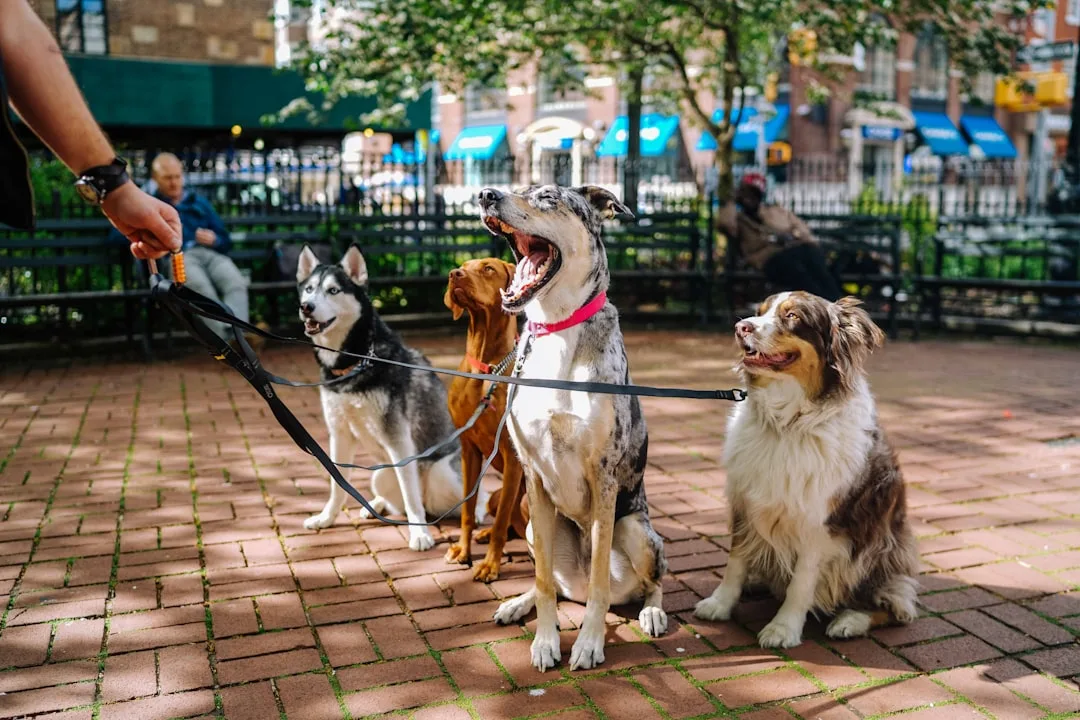
Leash training teaches a dog to walk on a loose leash without pulling, lunging, or lagging. The goal is a relaxed walk with slack in the leash at all times. Leash manners are one of the most practical and one of the most commonly neglected training skills, an untrained pulling dog makes walks miserable, can injure both dog and owner, and limits the exercise the dog receives. With consistent technique, most dogs improve significantly within 2 to 4 weeks of daily 10 to 15 minute sessions.
Why Dogs Pull on the Leash
Dogs pull for a simple reason: it works. A dog that pulls forward gets to go forward. This is a consequence of inadvertent reinforcement, owners who follow the pulling dog are rewarding pulling with forward movement every time it occurs. After hundreds of repetitions, the dog has a thoroughly trained behavior: pull the leash, move forward.
Additionally, dogs naturally move faster than humans. At a comfortable trot, a dog's pace exceeds a human's comfortable walking pace. The dog is not being defiant or dominant; it is simply moving at its natural pace while the human struggles to keep up.
High-arousal environments (interesting smells, other dogs, traffic) increase pulling dramatically, as the dog's motivational drive to reach the stimulus overrides any loose-leash training in low-distraction environments. This is why loose-leash training must progress through increasing levels of distraction to be practically useful.
"Pulling on the leash is almost universally human-created. Every step taken while the dog is pulling reinforces the pull. Training loose-leash walking is fundamentally a project of stopping the reinforcement of pulling and redirecting the dog's attention back to the human." Dr. Ian Dunbar, veterinary behaviorist
Equipment: Choosing the Right Tool
The choice of walking equipment affects both training effectiveness and physical safety.
Flat collar: Suitable for well-trained dogs and dogs in training who pull lightly. Hard pulling against a flat collar concentrates pressure on the trachea and can cause or exacerbate tracheal damage, particularly in small breeds with delicate tracheas.
Martingale collar: Tightens to a fixed limit when the dog pulls, preventing escape without the continuous pressure of a choke collar. Useful for sighthounds and dogs with narrow heads who slip flat collars.
Front-clip harness: Attaches the leash at the dog's chest. When the dog pulls, the attachment point causes the dog's body to swing sideways toward the handler rather than propelling forward. Significantly reduces pulling without requiring training compliance and without putting pressure on the neck. The most recommended tool for dogs in training or dogs with tracheal sensitivity.
Back-clip harness: Attaches at the back. More comfortable than front-clip for many dogs but provides no mechanical pulling reduction; it actually makes pulling easier by giving the dog more efficient forward leverage (similar to a sled dog harness).
Head halter: Fits over the muzzle with control at the head. Very effective for large, powerful pullers. Requires careful introduction, most dogs dislike head halters initially and require gradual acclimatization. Not suitable as a quick-fix without introduction.
Choke chains and prong collars: These suppress pulling through pain or discomfort. They do not teach the dog what to do instead. The American Veterinary Society of Animal Behavior recommends against them. Physical and behavioral side effects include tracheal damage, neck injury, and increased aggression (suppressing forward movement with pain elevates stress and can increase reactivity).
The Foundation: Stop-and-Reward Method
The most reliable, positive reinforcement-based method for loose-leash training:
Step 1: Load the marker. Before training begins, establish a reward marker, a clicker or a specific word ("yes"). Mark and reward rapidly 20 to 30 times in a stationary context until the dog clearly understands that the marker predicts a reward.
Step 2: Start in zero distraction. Begin in the least distracting environment possible, ideally indoors or in a quiet, enclosed backyard. Take one step. If the leash is loose, mark and reward. If the leash is taut, stop immediately. Wait for the dog to release tension (step back, look at you) before taking another step.
Step 3: Build duration. Gradually increase the number of steps between marks and rewards. Start with marking every 1 to 2 steps, then extend to every 5, then 10, then 20 steps. The dog is learning that a loose leash is the condition that produces rewards.
Step 4: Add turns. Practice frequent direction changes. Every time the dog is ahead and you turn, the dog has to reorient to catch up, this naturally puts you ahead and the leash loose. Reward generously when the dog catches up and walks beside you.
Step 5: Add distractions gradually. Once the dog walks reliably in a zero-distraction environment, move to progressively higher-distraction environments: quiet street, busier street, near other dogs. Every increase in distraction resets the rate of reward, reward more frequently in higher distraction to maintain attention.
| Training Phase | Environment | Steps Between Rewards | Sessions Per Day |
|---|---|---|---|
| Foundation (days 1-3) | Indoor/quiet backyard | 1-2 | 3 x 5 min |
| Building duration (days 4-10) | Quiet outdoor area | 5-15 | 2 x 10 min |
| Adding direction changes (days 7-14) | Quiet outdoor area | Reward each successful turn response | 2 x 10 min |
| Low distraction street (days 10-21) | Quiet neighborhood | 5-10 (distraction resets rate) | 1-2 x 15 min |
| Increasing distraction (weeks 3-6) | Varied, busier environments | Variable by distraction level | Daily 15-20 min |
The Stand-Still Method
An alternative or complement to the stop-and-reward method:
When the dog pulls, stop completely. Plant your feet. Do not move forward and do not drag the dog back. Wait for the dog to return its attention to you, even glancing back briefly, then mark and take one step forward. If the dog immediately pulls again, stop again.
This method is slower than the direction-change method in initial stages but is effective for dogs that do not respond well to abrupt direction changes or for handlers who find constant direction changes physically difficult.
Dealing with Reactive Pulling: Dogs That Lunge at Triggers
Some dogs do not merely pull forward; they lunge at specific triggers: other dogs, cyclists, joggers, squirrels. This is a higher-difficulty training situation that goes beyond basic loose-leash work.
For reactive dogs, threshold management is critical. The "threshold" is the distance from the trigger at which the dog can still pay attention and respond to the owner. Within threshold: the dog is manageable. Beyond threshold: the dog is in reactive state and training is ineffective (the dog cannot learn in that arousal state).
Begin training reactive dogs at comfortable distances from triggers, far enough to maintain the dog below threshold. Mark and reward looking at the trigger calmly (a protocol called "look at that" from Leslie McDevitt's Control Unleashed). Gradually decrease distance as the dog's comfort level builds. This process typically takes weeks to months for strongly reactive dogs, not days.
Severely reactive dogs benefit significantly from working with a certified applied animal behaviorist or a certified professional dog trainer with experience in reactivity.
Common Leash Training Mistakes
- Inconsistency: Allowing pulling some of the time while training at other times. Intermittent reinforcement makes the behavior more persistent, not less.
- Rewards too rare in high distraction: Not increasing reward rate when distraction increases. The dog cannot maintain attention without sufficient reward density in high-arousal environments.
- Sessions too long: Training sessions over 15 minutes produce fatigue and frustration. Shorter, more frequent sessions are more effective.
- Moving forward while pulling: The single most common error. Every step taken while the leash is taut is a pulling reinforcement.
- Punishment-based suppression without teaching the alternative: A dog taught only "don't pull" without being taught the rewarded behavior of walking beside the handler will revert to pulling when distractions increase.
For more training guidance, see How to Train a Puppy, How to House Train a Dog, How to Stop a Dog from Barking, How to Socialize a Dog, and How Do Dogs Communicate?.
References
Dunbar, I. (2004). Before and After Getting Your Puppy. New World Library.
McDevitt, L. (2007). Control Unleashed: Creating a Focused and Confident Dog. Clean Run Productions.
American Veterinary Society of Animal Behavior (AVSAB). (2021). AVSAB Position Statement on Humane Dog Training. Retrieved from https://avsab.org/resources/position-statements/
Rooney, N. J., & Cowan, S. (2011). Training methods and owner-dog interactions: Links with dog behaviour and learning ability. Applied Animal Behaviour Science, 132(3-4), 169-177. https://doi.org/10.1016/j.applanim.2011.03.007
Herron, M. E., Shofer, F. S., & Reisner, I. R. (2009). Survey of the use and outcome of confrontational and non-confrontational training methods in client-owned dogs showing undesired behaviors. Applied Animal Behaviour Science, 117(1-2), 47-54. https://doi.org/10.1016/j.applanim.2008.12.011
Frequently Asked Questions
How do I stop my dog from pulling on the leash?
Stop completely every time the leash becomes taut. Wait for the dog to release tension, then mark and move forward. Never take a step while pulling, every forward step reinforces the pull. Add direction changes frequently and reward the dog for remaining beside you.
What is the best equipment for leash training a pulling dog?
A front-clip harness is the most widely recommended option for dogs in training or with tracheal sensitivity. It mechanically redirects pulling without neck pressure. Head halters are effective for powerful pullers but require careful introduction.
How long does leash training take?
Most dogs show significant improvement within 2 to 4 weeks of daily 10 to 15 minute sessions using the stop-and-reward method. Reliable performance in high-distraction environments typically takes 4 to 8 weeks of consistent progressive training.
Why does my dog pull only in high-distraction environments?
High-distraction environments (other dogs, interesting smells, traffic) increase arousal and competing motivation. Loose-leash behavior trained only in low-distraction environments does not automatically transfer. Training must be progressively repeated at increasing distraction levels.
Are prong collars or choke chains good for leash training?
No. The American Veterinary Society of Animal Behavior recommends against aversive tools. These devices suppress pulling through pain without teaching the alternative behavior. Side effects include tracheal damage, neck injury, and increased aggression from elevated stress.
My dog lunges at other dogs on leash, is this a leash training problem?
Leash reactivity toward other dogs goes beyond basic leash training and requires threshold management and desensitization. Work at distances where the dog remains calm, reward for calm attention to the trigger, and gradually decrease distance over weeks. Severely reactive dogs benefit from professional help.