
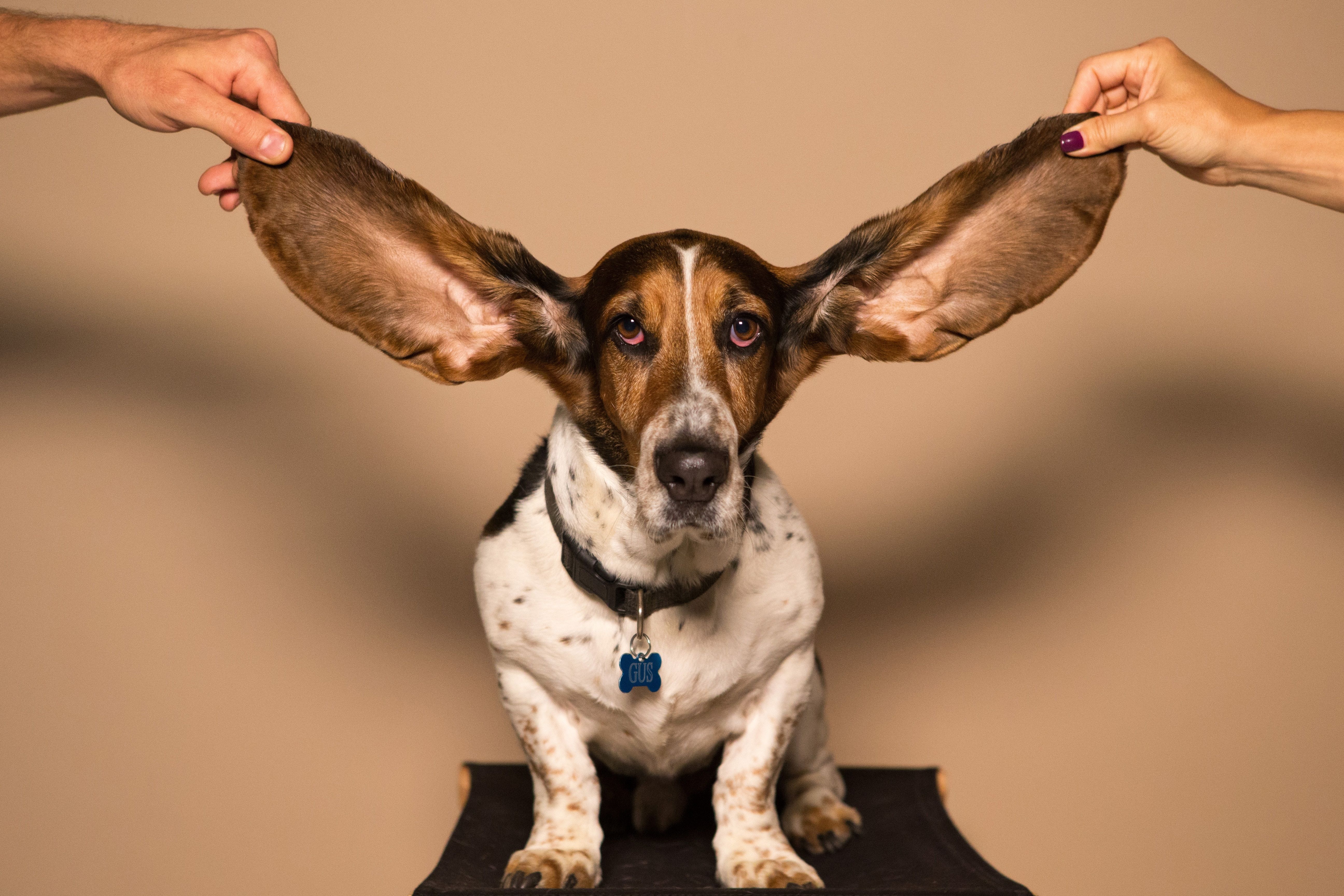
How well dogs hear comes down to two numbers: roughly four times better than humans in sensitivity and can detect frequencies up to 65,000 Hz, compared to the human upper limit of approximately 20,000 Hz. They can also hear sounds from roughly four times the distance at which humans detect the same sound. This superior hearing is an evolutionary adaptation that underpins hunting, predator detection, and social communication. Dogs can independently move each ear up to 180 degrees to precisely localize sound sources.
The Dog's Hearing Range Compared to Humans
Human hearing spans approximately 20 Hz to 20,000 Hz (20 kHz). Dogs hear from approximately 40 Hz to 65,000 Hz (65 kHz). The upper frequency range of dogs overlaps with the ultrasonic communication frequencies of many small mammals, rodents, for instance, communicate primarily in frequencies above 20 kHz, entirely outside human hearing range. Dogs' ability to detect these frequencies was likely a key hunting advantage in ancestral environments.
At the low end, humans and dogs have similar sensitivity, both detect sounds down to about 40 Hz. But at the high end, dogs decisively outperform humans. This high-frequency sensitivity explains why dogs react to ultrasonic deterrent devices, certain electronic equipment (particularly older monitors and fluorescent lights that emit high-frequency harmonic sounds), and some alarms that humans cannot perceive.
"The dog's auditory system evolved for a very different acoustic ecology than our own. Their extended high-frequency range is not incidental; it maps precisely to the communication frequencies of the prey species that ancestral canids hunted, particularly small rodents whose alarm and distress calls are predominantly ultrasonic." Dr. Alexandra Horowitz, Horowitz Dog Cognition Lab, Barnard College
Ear Anatomy and Sound Localization
The external ear (pinna) serves as a sound-collection antenna. Dogs have 18 muscles controlling the pinna, allowing precise, independent positioning of each ear. This mobility allows dogs to:
- Rotate each ear toward a sound source independently
- Focus attention on a specific auditory location while maintaining awareness of others
- Filter directional information by comparing arrival time and intensity between ears
The pinnal mobility is why dogs often appear to "angle" their heads toward sounds; they are physically repositioning their auditory receivers to maximize the signal from a specific direction. This is not merely curiosity behavior but a precision auditory localization tool.
The cochlea (inner ear structure responsible for frequency discrimination) in dogs is proportionally similar in structure to the human cochlea but tuned to a higher frequency range. The auditory cortex in dogs is larger relative to total brain volume than in humans, reflecting the greater importance of auditory processing in canine cognition.
Ear shape and hearing: Ear shape varies enormously across breeds, from erect ears (German Shepherd, Husky) to folded ears (Labrador, Beagle) to very long pendulous ears (Bloodhound, Basset Hound). Erect ears are generally most efficient at collecting high-frequency sounds and locating their direction. Pendulous ears reduce directionality and high-frequency collection, an evolutionary tradeoff since scent (not hearing) was the primary hunting tool for these breeds.
How Far Can Dogs Hear?
Dogs can hear sounds at roughly four times the distance that humans can detect the same sound under equivalent conditions. This varies with frequency and environment: high-frequency sounds propagate less effectively over distance than lower frequencies, and environmental factors (wind, terrain, vegetation) all affect propagation.
In practical terms: a dog may hear a car approaching from a mile away that a human would not detect until it was a quarter mile away. Dogs in quiet rural environments show behavioral responses to sounds (door openings, vehicle engines, visitor footsteps on gravel) that precede human awareness by 20 to 60 seconds in many cases.
This long-distance hearing range underpins the common experience of dogs knowing their owner is returning home before any visible cues are present, the specific sound of their owner's car engine, footsteps, or keys is detectable at distances far beyond human auditory range.
Dog Hearing Compared to Other Animals
The dog occupies an intermediate position in the animal kingdom's hearing spectrum. Cats outperform dogs in high-frequency hearing, while many insects and bats hear at far higher frequencies. At the lower end, large animals generally hear better than dogs and humans.
| Animal | Low Frequency Limit (Hz) | High Frequency Limit (kHz) | Notes |
|---|---|---|---|
| Human | 20 | 20 | Reference standard |
| Dog | 40 | 65 | Superior high-frequency; 4x distance sensitivity |
| Cat | 45 | 79 | Best high-frequency among common pets |
| Rabbit | 360 | 42 | Evolved for predator detection |
| Rat | 200 | 90 | Communicates ultrasonically |
| Horse | 55 | 33 | Good low-frequency sensitivity |
| Elephant | 14 | 12 | Exceptional low-frequency (infrasound) |
| Bat | 1,000 | 120,000 | Echolocation dominant |
| Dolphin | 75 | 150,000 | Echolocation; exceptional ultrasonic range |
Hearing Loss in Dogs: Causes and Recognition
Dogs can develop hearing loss from multiple causes, and the presentation can be subtle enough that owners do not notice for months.
Congenital deafness: Some breeds have very high rates of congenital deafness, typically associated with the piebald or merle genes that also produce white coat coloring. The pigmentation gene affects inner ear development in the cochlea. Breeds with highest congenital deafness rates include Dalmatians (approximately 8% unilaterally deaf, 2.2% bilaterally deaf), Australian Shepherds (merle gene), White Bull Terriers, and English Setters.
Age-related hearing loss (presbycusis): Dogs develop hearing loss with aging, typically beginning around 8 to 10 years. High frequencies are lost first (the same pattern as human aging). The loss is gradual and often goes unnoticed until significant hearing reduction has occurred.
Noise-induced hearing loss: Prolonged exposure to loud environments causes progressive cochlear damage in dogs just as in humans. Dogs used in noisy work environments (hunting with gunfire, military work) are at elevated risk.
Otitis media/interna: Middle or inner ear infections can cause hearing loss ranging from temporary to permanent depending on severity and treatment timing.
| Hearing Loss Type | Typical Age of Onset | Cause | Breeds Most Affected |
|---|---|---|---|
| Congenital unilateral | Birth | Piebald/merle gene effect on cochlea | Dalmatian, ACD, White Bull Terrier |
| Congenital bilateral | Birth | Same | Same; less common |
| Age-related (presbycusis) | 8-12 years | Progressive cochlear cell loss | All breeds; earlier in large breeds |
| Noise-induced | Any (chronic exposure) | Cochlear hair cell damage | Hunting dogs, working dogs |
| Infection-related | Any | Otitis media/interna | Dogs prone to ear infections |
Behavioral Signs of Hearing Loss
Dogs compensate effectively for partial hearing loss and often appear normal to their owners for extended periods. Signs that warrant veterinary audiological evaluation include:
- Failure to respond to verbal commands the dog previously responded to reliably
- Not waking from sleep when called (particularly concerning if previously responsive)
- Startling when touched unexpectedly (loss of auditory early warning)
- Failure to respond to sounds that previously elicited a response (doorbell, refrigerator, packaging sounds)
- Vocalization changes, some deaf dogs bark more frequently without self-modulating volume
- New-onset aggression in situations where the dog cannot hear approach
The BAER test (Brainstem Auditory Evoked Response) is the standard diagnostic for hearing loss in dogs. It is performed by veterinary neurologists and audiologists and can measure hearing threshold across frequencies in each ear independently.
Protecting Dogs' Hearing
Chronic noise exposure causes permanent cochlear damage. Dogs at elevated risk include hunting dogs exposed to gunshot without hearing protection, military and police working dogs, and dogs living in consistently noisy environments.
Canine hearing protection is available and effective, specialized canine ear protection (muffs and plugs) attenuates impulse noise. Hunting dogs and dogs in high-noise work environments benefit significantly from this protection.
At home, extended exposure to very loud music, power tools, or fireworks should be minimized. During fireworks events, a particular stress trigger for many dogs, moving dogs to interior rooms with background noise to mask the booming sounds reduces both auditory stress and the risk of noise-induced fear responses.
For more on dog senses and health, see How Far Can Dogs Smell?, How Do Dogs See the World?, Signs of a Healthy Dog, How Long Do Dogs Live?, and Common Dog Illnesses Explained.
References
Heffner, R. S., & Heffner, H. E. (1985). Hearing range of the domestic cat. Hearing Research, 19(1), 85-88. https://doi.org/10.1016/0378-5955(85)90100-5
Strain, G. M. (2012). Canine deafness. Veterinary Clinics of North America: Small Animal Practice, 42(6), 1209-1224. https://doi.org/10.1016/j.cvsm.2012.08.010
Heffner, H. E. (1998). Auditory awareness. Applied Animal Behaviour Science, 57(3-4), 259-268. https://doi.org/10.1016/S0168-1591(98)00101-4
Ter Haar, G., Mulder, J. J., Venker-van Haagen, A. J., van Sluijs, F. J., Snik, A. F., & Smoorenburg, G. F. (2008). Treatment of age-related hearing loss in dogs with the vibrant soundbridge middle ear implant. Journal of Veterinary Internal Medicine, 22(6), 1273-1281. https://doi.org/10.1111/j.1939-1676.2008.0217.x
Strain, G. M. (2004). Deafness prevalence and pigmentation and gender associations in dog breeds at risk. The Veterinary Journal, 167(1), 23-32. https://doi.org/10.1016/S1090-0233(03)00104-7
Frequently Asked Questions
How well do dogs hear compared to humans?
Dogs hear about four times better than humans in terms of sensitivity and distance. Their hearing range extends to 65,000 Hz versus the human limit of 20,000 Hz. Dogs can hear sounds from roughly four times the distance at which humans detect the same sound.
What frequencies can dogs hear?
Dogs hear from approximately 40 Hz to 65,000 Hz (65 kHz). The high-frequency upper range is particularly significant; it covers the ultrasonic communication frequencies of small rodents and explains why dogs respond to ultrasonic devices humans cannot hear.
Can dogs hear ultrasound?
Yes. Dogs can hear frequencies up to 65,000 Hz, well into the ultrasonic range (above 20,000 Hz). This makes them responsive to ultrasonic training devices, certain electronic equipment harmonics, and the communication calls of small prey animals.
Which dog breeds are most prone to deafness?
Dalmatians have the highest documented deafness rates: approximately 8% unilateral and 2.2% bilateral. Other high-risk breeds include Australian Shepherds (merle gene), White Bull Terriers, English Setters, and Australian Cattle Dogs. Deafness is linked to pigmentation genes affecting cochlear development.
How can I tell if my dog is losing its hearing?
Signs include failure to respond to previously reliable commands, not waking when called, startling when touched unexpectedly, failure to respond to familiar sounds (doorbell, car), and vocalization changes. The BAER test (Brainstem Auditory Evoked Response) is the definitive diagnostic.
Do dogs ears affect their hearing?
Yes. Erect-eared breeds can rotate each pinna independently up to 180 degrees using 18 ear muscles, enabling precise sound localization. Pendulous-eared breeds have reduced high-frequency collection and directional accuracy, a tradeoff for breeds where scent was the primary hunting tool.