
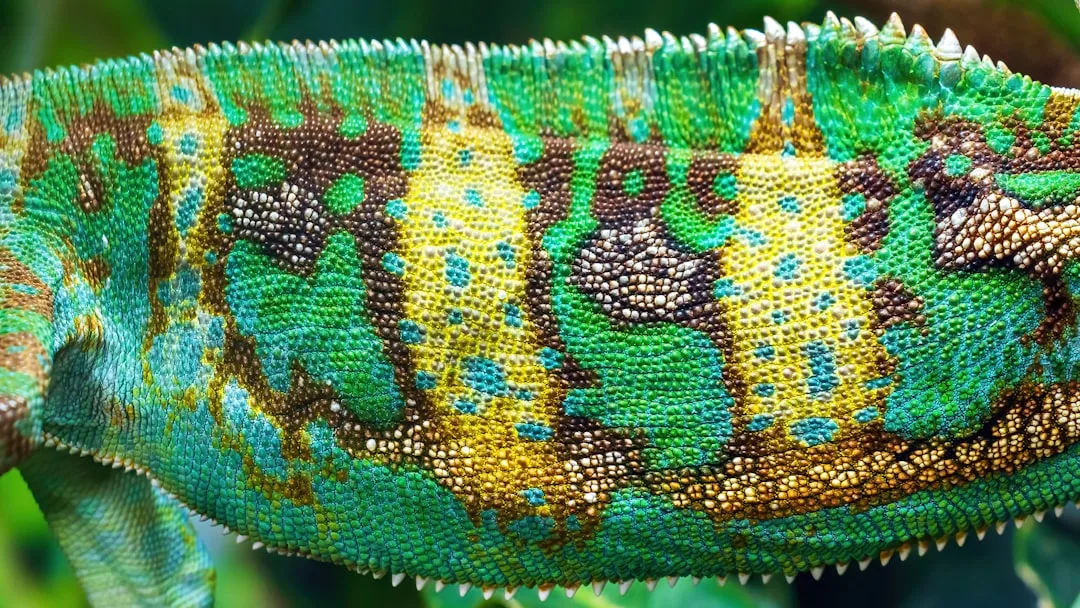
The veiled chameleon is one of the most distinctive lizards on Earth. It is built around a towering helmet-like casque, a pair of independently rotating turret eyes, a ballistic tongue longer than its own body, and a colour-changing skin that signals mood, temperature, and readiness to fight. Unlike most chameleons, the veiled chameleon is not a fragile rainforest specialist.
It is a hardy mountain reptile from the dry highlands of the Arabian Peninsula that has learned how to eat plants when insects run short, drink dew off its own skull, and breed so successfully that escapees have founded invasive populations on three continents.
This guide is a reference entry on Chamaeleo calyptratus - its taxonomy, anatomy, habitat, diet, reproduction, behaviour, conservation status, and relationship with humans. Expect specifics: centimetres, Celsius, clutch sizes, elevations, and documented geographic records.
Etymology and Classification
The species was first described by the French zoologist Andre-Marie Constant Dumeril and his son Auguste Dumeril in 1851. The scientific name Chamaeleo calyptratus combines the genus Chamaeleo - from the Greek words for "ground lion" - with the Latin calyptratus, meaning "veiled" or "covered", a reference to the extraordinary hood-like casque rising from the top of the head.
In Arabic the species is called hirba, a general term applied to several local chameleons. English common names include veiled chameleon, Yemen chameleon, and cone-head chameleon.
Chamaeleo calyptratus sits inside the true chameleon family Chamaeleonidae, which contains more than 200 species spread across Africa, Madagascar, southern Europe, and southwestern Asia. Within Chamaeleonidae, the veiled chameleon belongs to the genus Chamaeleo, a group of ground-based to mid-canopy chameleons distributed across Africa and the Arabian Peninsula.
Two subspecies are currently recognised: C. calyptratus calyptratus from the higher mountains of Yemen and C. calyptratus calcarifer from the coastal plains, which is smaller and has a shorter casque.
Geographic Range and Habitat
The veiled chameleon is native to a narrow strip of the Arabian Peninsula running through the mountain spine of western Yemen and crossing into the extreme southwestern corner of Saudi Arabia, near the Asir province. The species is not a generalist in the sense of living everywhere, but it occupies a surprisingly wide range of elevations and habitats within its native corridor.
Core habitat types include:
- Monsoon-influenced mountain woodlands between 1,000 and 2,800 metres elevation
- Semi-arid wadi systems lined with acacia and ficus trees
- Terraced farmland, especially coffee, qat, and fruit plantations
- Dry coastal plains with scattered shrubs, typically below 500 metres
- Urban gardens and roadside shrubbery in Yemeni cities such as Sanaa and Taiz
What unites these habitats is structural verticality and at least seasonal access to water. Veiled chameleons are arboreal climbers that need branches to move through and moisture - either morning dew, seasonal monsoon rains, or irrigation - to drink. They can tolerate brief droughts, night temperatures dropping to near 10 degrees Celsius, and daytime highs above 35, which is a wider temperature envelope than most tropical chameleons can survive.
Outside their native range, breeding wild populations are now established in at least three US states, all traced to released or escaped pets. Florida hosts the most widespread population, with records across multiple southern counties. Hawaii has populations on Oahu and Maui. Southern California has localised clusters. The species has also appeared as isolated records in Puerto Rico and the Canary Islands.
Size and Physical Description
Veiled chameleons are medium-to-large by chameleon standards. Sexual dimorphism is pronounced - males are dramatically larger, more colourful, and more heavily ornamented than females.
Males:
- Total length: 43-61 cm, including tail
- Snout-to-vent length: 20-30 cm
- Casque height: up to 8 cm in mature individuals
- Weight: typically 100-200 g
- Spur on the hind foot: present (a bony projection called a tarsal spur, visible from hatching)
Females:
- Total length: 25-38 cm, including tail
- Casque height: 2-4 cm, much lower
- Weight: typically 80-120 g, rising during gravidity
- No tarsal spur
Hatchlings:
- Total length: 5-6 cm
- Weight: 1-2 g
- Fully independent from the moment of hatching
The body is laterally compressed, giving the animal a leaf-like silhouette when viewed from the front. The tail is prehensile and roughly half the total body length, functioning as a fifth limb for climbing. Each foot is zygodactylous - two toes face one way and three the other - forming a pincer-like grip that clamps branches.
The eyes are mounted in conical turrets that rotate independently through almost 180 degrees each, enabling the animal to watch the sky for predators with one eye while scanning for prey on the branch below with the other.
The casque is the feature that gives the species its name. In mature males it rises as a bony crest up to 8 cm high, triangular in side view, and lined internally with blood vessels. Juveniles of both sexes have only a modest casque; the male structure grows rapidly once sexual maturity begins at around five to six months.
The Casque - Three Functions in One Structure
No other chameleon has a casque quite like the veiled chameleon's. For decades researchers argued about what it was for. Modern work suggests that the structure is multifunctional, serving at least three roles simultaneously.
1. Water collection. The casque's ridged surface channels dew and light rain down its slopes and around the head toward the mouth. Field observers in Yemen have watched chameleons tilt the head during morning dew, allowing droplets to trickle from the casque along the lips, where they are licked into the mouth. In an environment where standing water is rare and seasonal, this is a non-trivial hydration strategy.
2. Sexual and dominance signalling. Male casque height correlates with body condition and social status. Males with taller casques win more dominance displays and copulate with more females. The casque is a target of sexual selection: it grows disproportionately fast during puberty, reaches maximum size in mature males, and is flashed prominently during lateral display behaviour.
3. Thermoregulation. The casque is riddled with blood vessels close to the surface, which means it can dump or absorb heat efficiently. During morning basking, blood flow into the casque warms the animal. During midday heat, the same network radiates heat away. It is a biological radiator bolted to the skull.
Colour and Colour Change
Chameleons are famous for changing colour, and the veiled chameleon is no exception. But the popular idea that they match their background is largely wrong. Colour change in C. calyptratus is driven by three things - in order of importance: mood and social state, temperature, and to a limited extent reflectance matching.
Resting colouration. A calm veiled chameleon is usually a uniform green or green-and-cream with faint vertical bands. This tone is the default, similar to surrounding foliage, but it is not actively selected to match the background.
Dominant male. A territorial adult male flashes bright turquoise, yellow, and orange bands along the body with jet-black accents on the casque and throat. These displays escalate during territorial disputes and courtship.
Stressed or submissive. A threatened animal turns dark with heavy black blotches, flattens laterally, gapes its mouth, hisses, and sometimes lunges.
Gravid female. Perhaps the most striking: a gravid (carrying eggs) female displays a dark brown or black background with vivid turquoise spots. This pattern broadcasts her reproductive state to males - she will reject any advance, sometimes violently, because mating while gravid offers no reproductive benefit.
Thermoregulatory shifts. A cool morning animal darkens overall to absorb solar radiation; an overheated midday animal pales to reflect it. These shifts can happen within minutes.
Colour is produced by two layers of specialised skin cells. Pigment cells (chromatophores) contain melanin and other pigments that can expand or contract. Below them sits a lattice of iridophores - cells containing nanocrystals of guanine. When the spacing between crystals changes, different wavelengths of light are reflected.
Expanding the lattice shifts colour toward red; contracting it shifts toward blue. Combining the two layers produces the full palette of greens, blues, yellows, and oranges seen in the species.
Diet and the Plant-Eating Exception
The veiled chameleon is one of very few chameleons that deliberately and regularly eats plants. Most chameleon species are near-strict insectivores. The veiled chameleon supplements insect prey with leaves, flowers, blossoms, fruit pulp, and tender shoots, especially during hot and dry weather.
Animal prey commonly recorded in the wild:
- Grasshoppers and locusts
- Crickets and katydids
- Moths and butterflies
- Flies and wasps
- Caterpillars and beetles
- Occasional small lizards and nestling birds
Plant matter commonly eaten:
- Acacia leaves and flowers
- Ficus leaves
- Fruit pulp of figs, dates, and melons
- Succulent stems in dry months
The plant-eating habit is thought to have evolved as a drought strategy. Juicy leaves double as hydration when insects are scarce and standing water is rare. Captive veiled chameleons that are offered only insects often fail to thrive long term; the best husbandry protocols include daily fresh leafy greens such as collard, mustard, and hibiscus.
The hunting method is the classic chameleon ambush. The animal perches motionless on a branch, scanning with rotating eyes. When prey is detected, both eyes lock on and converge for stereoscopic depth perception. The tongue is then launched from a coiled muscular launcher at the back of the mouth.
Acceleration exceeds 40 g - faster than a fighter-jet ejection seat - and the sticky tongue tip, which actually forms a suction cup on impact, adheres to the prey and retracts in roughly a tenth of a second. The reach can exceed 1.5 times body length.
Reproduction and Life Cycle
Veiled chameleons are oviparous - they lay eggs - and the species produces the largest clutches of any chameleon.
Reproductive schedule:
- Sexual maturity: 5-7 months, earlier in males
- Breeding season in native range: primarily with the monsoon
- Captive breeding: year-round under stable conditions
- Clutches per year: 1-3
- Eggs per clutch: 20-70, rarely up to 85
- Incubation: 5-9 months at 27-29 degrees Celsius
Courtship starts with the male's full-colour display. A receptive female remains lightly coloured and allows the male to approach; a non-receptive female turns dark and lunges with mouth agape. Copulation lasts 10-30 minutes.
Once gravid, a female carries her eggs for roughly three to six weeks before laying. She selects a moist soil patch, digs a tunnel 15-30 cm deep, deposits the full clutch, then covers the nest and returns to the canopy. There is no parental care whatsoever. The eggs incubate underground for half a year or more, hatchlings dig themselves out, and life begins in complete independence.
Egg-laying is the single greatest source of adult female mortality. Even unmated females lay infertile clutches - a physiological quirk that makes the species prolific but also fragile. Each clutch drains calcium, fat, water, and energy. Without proper substrate to dig in, females can become egg-bound and die. This is the major reason captive females average only 4-5 years compared with 5-8 years for males.
Hatchlings are tiny replicas of the adult, minus the casque. They are immediately aggressive toward one another. Juvenile veiled chameleons kept together in captivity often cannibalise smaller siblings. In the wild they disperse across the canopy and begin feeding on fruit flies and gnats within hours of emerging from the nest.
Behaviour and Temperament
Veiled chameleons are solitary, territorial, and aggressive for their size. Adults almost never tolerate another individual within visual range. Outside mating, an encounter between two adults usually ends in a dominance display, a chase, or a fight. Displays include lateral body flattening, casque inflation, gaping, tongue flicking, and full-colour broadcast. Physical fighting is uncommon but can lead to bite wounds.
Despite their reputation as the "friendliest" chameleon in the pet trade, they are observation animals rather than social companions. Even tolerant captive individuals show subtle stress responses - darker colours, stillness, eye closure - when handled. Long-term welfare is best served by minimal contact and a rich arboreal enclosure.
The species is diurnal. Activity begins shortly after sunrise with basking, peaks during mid-morning when body temperature is optimal for foraging, and tapers in the hottest part of the day, when animals retreat into shade. A second feeding window opens in late afternoon. At night they sleep on a thin terminal branch, usually pale and apparently vulnerable, relying on height and isolation for safety from ground predators.
Activity Data
| Metric | Value |
|---|---|
| Active body temperature | 28-32 degrees Celsius |
| Basking temperature | 32-35 degrees Celsius |
| Night temperature tolerance | Down to 10 degrees Celsius short-term |
| Typical home range (wild) | 50-300 square metres |
| Daily water intake (adult) | 2-5 ml, mostly from dew and plant tissue |
| Tongue strike duration | Less than 0.1 seconds |
| Maximum tongue reach | ~1.5x body length |
| Egg clutch size | 20-70 eggs (up to 85 recorded) |
| Incubation period | 5-9 months |
Populations, Geography, and Introduced Range
Reliable wild population figures do not exist for Chamaeleo calyptratus, but it is considered common and locally abundant across its native range. The IUCN Red List classifies the species as Least Concern with a stable population trend.
| Region | Status | Notes |
|---|---|---|
| Western Yemen highlands | Native, abundant | Core range, all elevations to ~2,800 m |
| Southwest Saudi Arabia (Asir) | Native, localised | Northern range edge |
| Yemen coastal plain | Native, smaller form | Subspecies C. c. calcarifer |
| Southern Florida, USA | Introduced, established | Invasive exotic, pet-trade origin |
| Oahu and Maui, Hawaii | Introduced, established | Illegal to own or release |
| Southern California, USA | Introduced, localised | Patchy populations |
| Puerto Rico | Reported, status unclear | Likely pet releases |
| Canary Islands, Spain | Reported, status unclear | Occasional wild records |
Invasive populations are a growing concern. Veiled chameleons prey on native insects, small lizards, tree frogs, and nesting bird eggs. In Florida they are listed as prohibited or regulated by the state Fish and Wildlife Conservation Commission, and capture-and-remove programmes operate in known populated areas.
Conservation Status and Threats
The IUCN lists Chamaeleo calyptratus as Least Concern. It is included on CITES Appendix II, which regulates international trade but does not ban it. Unlike many chameleon species - several Madagascan endemics are Endangered or Critically Endangered - the veiled chameleon is ecologically flexible enough to persist in modified landscapes, including Yemeni farmland and gardens.
Current threats in the native range include:
- Armed conflict in Yemen, which has disrupted habitat monitoring and enforcement
- Agricultural expansion, especially qat farming, which reduces natural shrub cover
- Unregulated collection for the pet trade, though most traded animals today are captive-bred
- Pesticide runoff affecting insect prey populations
- Climate stress, with the Arabian highlands warming faster than the global average
The species is heavily commercialised in the global pet trade. Captive breeding is widespread and reliable, which reduces pressure on wild populations. A responsibly captive-bred animal is inexpensive, widely available, and will not contribute to wild decline. Wild-caught imports are rare but occur, and buyers should verify provenance.
The Veiled Chameleon in Captivity
No other chameleon is kept in such large numbers by hobbyists. Two traits explain this: they tolerate a wider range of conditions than more delicate species, and they breed reliably in captivity. A well-set-up enclosure includes the following elements.
- A tall, ventilated screen cage, at least 60 x 60 x 120 cm for an adult male
- A vertical climbing framework of live plants and branches
- A UVB bulb running across the top of the enclosure
- A basking spot around 32 degrees Celsius, with an overnight drop to 18-21
- Daily misting or an automatic dripper, because the species will not drink from a bowl
- A varied diet of gut-loaded insects plus fresh leafy greens
- Calcium and vitamin D3 supplementation to prevent metabolic bone disease
- Solitary housing - veiled chameleons fight when kept together, even juveniles
Common husbandry problems include dehydration, metabolic bone disease from insufficient calcium or UVB, egg-binding in females without a laying substrate, and stress from excessive handling. These are all preventable with basic knowledge.
Veiled Chameleons and Humans
In Yemen, chameleons are often regarded with superstition rather than affection. Local folklore associates them with bad luck or the supernatural, which has historically offered de facto protection - few people kill them. Traditional use is rare.
Globally, the species is a fixture of the exotic pet industry. It has appeared in countless nature documentaries and online videos, largely because of its expressive eyes, ballistic tongue, and dramatic colour changes. Captive breeding has made it one of the most accessible exotic reptiles on the market.
Scientifically, the veiled chameleon has become a model organism for research into visual systems, high-speed tongue mechanics, iridophore-based colour production, and thermoregulation in arid-adapted reptiles. Studies using high-speed imaging of its tongue strike helped researchers understand how elastic tissues can outperform direct muscle action, with applications in soft robotics. Work on its iridophore lattice contributed to the broader field of structural colour.
Related Reading
References
Relevant peer-reviewed and governmental sources consulted for this entry include the IUCN Red List assessment for Chamaeleo calyptratus, CITES Appendix II trade data, the Florida Fish and Wildlife Conservation Commission species profile, and published research in Journal of Experimental Biology, Nature Communications, Zootaxa, Herpetological Review, and Salamandra.
Specific biological figures reflect consolidated data from captive-husbandry literature, field surveys in Yemen and Saudi Arabia, and invasive-species monitoring reports from Florida and Hawaii.
Frequently Asked Questions
How big do veiled chameleons get?
Adult male veiled chameleons (Chamaeleo calyptratus) reach 43-61 cm in total length, including a prehensile tail that is roughly half the body length. Females are considerably smaller at 25-38 cm. Males also develop a much taller casque - the helmet-like crest on top of the head - which can rise up to 8 cm in mature individuals.
Hatchlings emerge from the egg at about 5-6 cm long and grow rapidly during their first year, typically reaching adult size by 9-12 months when food and temperature conditions are favourable.
What do veiled chameleons eat?
Veiled chameleons are unusual among chameleons because they are genuine omnivores. Their diet is built around insects - crickets, grasshoppers, locusts, moths, flies, beetles, and caterpillars - but adults regularly feed on plant matter including leaves, flowers, blossoms, fruit pulp, and tender shoots.
This plant-eating habit is thought to have evolved as a water-conservation strategy in Yemen’s dry mountain environment, where juicy leaves serve as both food and hydration. Captive keepers must provide a varied insect menu plus fresh greens such as collard, mustard, and hibiscus leaves. Some individuals will even accept small pieces of fruit or vegetable.
Where do veiled chameleons live in the wild?
Veiled chameleons are native to the mountainous regions of western Yemen and extreme southwestern Saudi Arabia. They thrive at elevations between roughly 150 and 2,800 metres in a surprising variety of habitats: monsoon-fed coastal woodlands, semi-arid wadi systems with scattered acacia, terraced farmland, and seasonal shrublands.
The species tolerates both humidity and heat, which has helped feral populations establish themselves in introduced ranges such as southern Florida, the Hawaiian islands of Oahu and Maui, and parts of southern California. In Florida the veiled chameleon is classified as an invasive exotic species.
What is the casque on a veiled chameleon for?
The casque is the tall bony ridge that rises from the top of the skull. It serves at least three functions. First, it collects moisture - dew and light rain run down the ridges and channel toward the mouth, letting the chameleon drink in habitats where standing water is rare. Second, it is a social signal - males with larger casques win more dominance displays and attract more mates, so casque size is a target of sexual selection.
Third, it helps with thermoregulation, since the casque’s network of blood vessels allows heat exchange during basking and cooling. Males develop much taller casques than females.
How long do veiled chameleons live?
In captivity, male veiled chameleons typically live 5-8 years under good husbandry, with a small number reaching 9-10. Females have noticeably shorter lifespans of 4-5 years, largely because egg production is physically expensive. Even unbred females lay infertile clutches, and each laying event places heavy demands on calcium, fat, and water reserves. Poor diet, dehydration, or lack of a suitable laying substrate frequently lead to fatal egg-binding.
Wild lifespans are thought to be shorter due to predation, seasonal food shortages, and exposure, though reliable long-term field data is limited.
Are veiled chameleons good pets?
Veiled chameleons are among the most widely kept chameleons in the world, partly because they tolerate a wider range of conditions than most species. However, they are not ideal beginner reptiles.
They need a tall screen enclosure with a vertical climbing framework, bright UVB lighting, a basking zone around 32 degrees Celsius, an overnight drop to 18-21, regular misting or a dripper because they will not drink from a standing bowl, a calcium-dusted insect diet, and fresh leafy greens. Males are territorial and must be housed alone after about four months old. Handling stresses them even when tolerated - they are observation pets first.
Are veiled chameleons invasive in the United States?
Yes. Escaped and deliberately released pet veiled chameleons have produced breeding wild populations in at least three US states. Florida populations are well documented across multiple counties, and the state Fish and Wildlife Conservation Commission classifies the species as an invasive exotic. Hawaii has established populations on Oahu and Maui, where the species is illegal to own or release. California has reported localised populations in the south.
Invasive veiled chameleons are a concern because they prey on native insects, small lizards, and nesting birds’ eggs, and because they can outcompete or displace native reptiles.
Do veiled chameleons really change colour?
Yes, but not for the reason most people think. Veiled chameleons change colour mainly for social signalling and thermoregulation, not to match their background. A relaxed animal shows bright resting green with pale cream stripes. A threatened individual darkens and flattens its body laterally, flashing yellow and black bands. Dominant males display vivid turquoise, orange, and yellow to warn rivals or court females.
A gravid female shows a striking black background with turquoise spots and will violently reject males. Colour is produced by nanocrystals in specialised skin cells (iridophores) that shift spacing to reflect different wavelengths, combined with pigment cells. Temperature also drives colour - a cool bear basking animal darkens to absorb heat, while an overheated one pales to reflect light.