
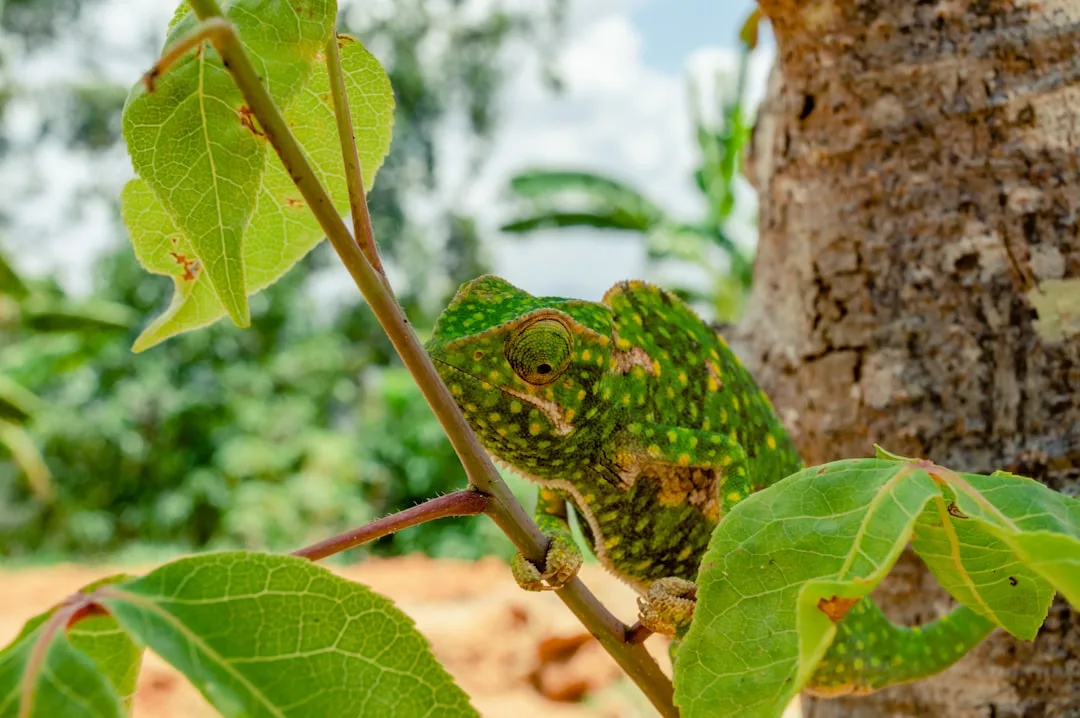
Parson's chameleon is the largest chameleon species alive today and, by most credible measures, the longest-lived. Unlike the flashy, fast-breeding veiled or panther chameleons familiar from the pet trade, Calumma parsonii lives slowly, grows slowly, matures slowly, and reproduces rarely.
A wild adult male can reach 68 centimetres from snout to tail tip, weigh close to 700 grams, and spend 4-5 years in a juvenile stage before producing a single offspring.
It lives high in the canopy of Madagascar's eastern rainforests, hunts with a ballistic tongue fired at over eight metres per second squared of acceleration, and watches the world through two independently steerable eyes that together sweep almost a full circle.
This guide covers every aspect of Parson's chameleon biology and ecology: taxonomy and subspecies, size and anatomy, habitat and range, hunting and diet, reproduction and the extraordinary egg incubation period, lifespan, conservation status, and the cultural significance of the animal in Malagasy society. It is a reference entry, not a summary - expect specifics: grams, centimetres, months, temperatures, and verified records.
Etymology and Classification
The species was first described by British naturalist George Kearsley Shaw in 1824 and named in honour of the naturalist James Parsons. The genus name Calumma derives from a Greek word meaning 'veil' or 'hood', a reference to the fleshy crests and casques typical of the genus. Malagasy people use several regional names including tanalahy and kapidrano, depending on the district.
Parson's chameleon sits within the family Chamaeleonidae, which contains roughly 200 described species distributed across Africa, Madagascar, southern Europe, south Asia, and the Middle East. Madagascar alone hosts nearly half of the world's chameleon species and the majority of its largest forms.
Calumma is one of the two endemic Malagasy chameleon genera along with Furcifer, and molecular work suggests the lineage is among the oldest surviving within the family, with origins likely pre-dating the breakup of Gondwana.
Two subspecies are currently recognised:
- Calumma parsonii parsonii - the giant form. Accounts for every record-sized individual. Males display the classic turquoise-green body with bright yellow eyelids and prominent rostral warts.
- Calumma parsonii cristifer - the smaller crested form. Generally tops out around 47 centimetres and shows a pronounced dorsal crest with more muted green and brown colouration.
The taxonomic status of these two forms remains debated. Recent genetic studies have found divergence levels between the two that approach or exceed those seen between some recognised sister species of chameleon. Several researchers have proposed elevating C. p. cristifer to full species status, but the case has not yet been formally resolved. For now, most authorities retain the subspecies designation while acknowledging that the situation may change.
Size and Physical Description
Parson's chameleon is the heaviest chameleon on Earth. The Oustalet's chameleon (Furcifer oustaleti) is sometimes quoted as a rival in length, but by weight there is no contest: a prime adult male Parson's routinely outweighs any other chameleon by a wide margin.
Males (C. p. parsonii):
- Length: 50-68 cm from snout to tail tip
- Weight: typically 450-700 g, record individuals over 700 g
- Body distinguishing features: bright yellow eyelids, rostral warts above each nostril, broad turquoise or green body with orange and yellow highlights
Females:
- Length: 40-50 cm
- Weight: 350-500 g
- Usually plainer: olive green to brown with subtle banding, no rostral warts
Hatchlings:
- Length: roughly 8 cm
- Weight: under 2 g - lighter than a one-pound coin
The body is laterally compressed into a deep keel shape, which makes the animal look narrower from the front than it actually is. This silhouette is an effective anti-predator adaptation: seen against a slender branch, Parson's chameleon looks like a leaf. The feet are zygodactyl, with two toes fused on one side and three on the other, forming pincer-like grips perfectly suited to grasping twigs. The prehensile tail, which can be up to half the total body length, acts as a fifth limb.
The most remarkable feature is the eye. Each turret rotates independently through almost 180 degrees vertically and 90 degrees horizontally, producing a combined field that approaches 360 degrees. The animal can watch two different moving prey items at once before committing both eyes forward for binocular ranging.
Research on chameleon vision suggests the convergence is triggered by a brain-level 'decision' rather than reflexive tracking, and that the animal can estimate distance to within a few millimetres using retinal image clarity rather than stereopsis.
Colour and the Myth of Camouflage
Popular culture persistently misrepresents chameleon colour change. Parson's chameleon cannot blend into any background on command. The species does not mimic patterns. It does not turn into a tartan to sit on a plaid shirt. What it can do is adjust its colouration rapidly based on internal state - temperature, mood, social display - and on environmental lighting.
The mechanism involves two layers of specialised pigment cells in the dermis. The upper layer contains melanophores with black pigment. The lower, structural layer contains guanine nanocrystals arranged in a lattice. The chameleon can contract or relax tiny muscles around each cell to alter the spacing of the crystal lattice, which shifts which wavelengths of light are reflected back through the skin. A tight lattice reflects blue; a loose lattice reflects yellow, orange, and red.
Resting adult males of C. p. parsonii are typically a vivid turquoise or green with an orange underside and a bright yellow eyelid that is visible across the canopy. Courting males add brighter yellows and deeper blues. Stressed or threatened animals go dark green with black crossbars. Female colour is generally muted: olive green to mottled brown, with more dramatic shifts during gravidity.
Gravid females often turn blackish-brown with orange spots, a strong 'I am already pregnant, do not approach' signal to males.
Habitat and Range
Parson's chameleon is strictly endemic to eastern Madagascar. Its range forms a narrow, discontinuous band of humid primary and secondary forest running from the Marojejy Massif in the north, through the central eastern escarpment around Andasibe-Mantadia and Zahamena, and south into the Ranomafana and Andohahela regions. The species is entirely absent from the dry west, the spiny forest south, and the high central plateau.
Preferred habitat features:
- Elevation: 400 to 1,200 metres
- Temperature: 18 to 24 degrees Celsius daytime, dropping to 10-14 degrees at night
- Humidity: consistently above 75 per cent
- Canopy structure: mid to upper canopy, 5 to 25 metres above the ground
The cool, cloud-saturated microclimates typical of eastern Madagascar rainforests are essential. Parson's chameleons do not tolerate prolonged exposure to temperatures above 28 degrees Celsius, and this sensitivity is increasingly significant as regional climate shifts push the base of cloud cover higher and thin the cool refuges the species depends on.
Adults are solitary and highly territorial. A typical male occupies a canopy territory of perhaps half a hectare and defends it against other males through visual display - body flattening, colour flares, and head bobbing - rather than physical combat. Females range more widely, especially before and after egg-laying.
Diet and Hunting
Parson's chameleon is a generalist insectivore with a preference for large-bodied prey matching its own size. Wild diet has been reconstructed from stomach contents, scat analysis, and direct field observation.
Primary prey:
- Large beetles - rhinoceros beetles, stag beetles, longhorn beetles
- Orthopterans - grasshoppers, katydids, giant crickets
- Phasmids (stick insects)
- Cicadas and large moths
- Spiders, including orb-weavers and huntsmen
Secondary prey:
- Small tree geckos (Phelsuma, Paroedura)
- Small chameleons of other species
- Tree frogs
- Newly hatched birds, when accessible
- Occasional fruit and leaf material, especially in gravid females
The tongue strike is a spectacle of biomechanics. At rest the tongue is folded inside the mouth around a specialised hyoid bone. To strike, the chameleon contracts a ring of accelerator muscles along the tongue shaft. Because the tongue is loaded with elastic collagen layers before the strike, energy is released in a single ballistic burst.
Peak acceleration approaches 264 metres per second squared - roughly twenty-seven times the acceleration of gravity. The full extension and retraction cycle takes well under a second. Peak tongue length reaches around 1.5 times the body length.
The tongue tip is not a simple sticky pad. It combines three capture mechanisms: a suction cup formed by the retractor muscles pulling inward, a layer of high-viscosity mucus two hundred times thicker than human saliva, and two small fingers of muscle that can curl around prey to create mechanical grip. These three mechanisms operate in under fifty milliseconds.
Reproduction and the 12-24 Month Egg
The reproductive cycle of Parson's chameleon is the strangest feature of the species and the single biggest reason it is so vulnerable to habitat loss. Where most chameleon species race through generations - maturing in under a year, laying multiple large clutches, and often dying within two breeding seasons - Parson's chameleon plays the opposite game.
Timeline:
- Age at sexual maturity: 4-5 years
- Breeding frequency: once every 2-3 years for mature females
- Clutch size: 30-50 eggs per clutch
- Egg incubation: 12-24 months
- Lifespan: 5-10 years in the wild, 8+ years in captivity
After mating, the gravid female leaves the canopy and travels down the trunk to the forest floor. She excavates a burrow up to 50 centimetres deep in moist soil, lays the clutch in a single session, and carefully backfills the chamber before climbing back into the canopy. Egg-laying is exhausting - a 500-gram female may deposit 100 grams or more of egg mass in one night.
The eggs then sit in the soil for between 12 and 24 months depending on soil temperature and moisture. This is one of the longest incubation periods of any reptile on Earth and exceeds the gestation of many large mammals including bears and dolphins. The long incubation appears to be an adaptation to Madagascar's seasonal climate, synchronising hatching with the warm, wet early rains when small insect prey is abundant.
The clutch of 30-50 eggs is comparatively small. The unrelated veiled chameleon (Chamaeleo calyptratus) often lays 70 to 90 eggs per clutch and breeds annually. Parson's chameleon trades raw fecundity for larger eggs, larger hatchlings, and a longer incubation period that synchronises the next generation with optimal conditions. It is a textbook example of K-selection in reptiles.
Life Cycle and Lifespan
Parson's chameleon is the longest-lived chameleon species known. Captive records are the most reliable source because wild animals are nearly impossible to track for full lifespans, and field mark-recapture studies are limited.
| Life stage | Duration | Notes |
|---|---|---|
| Egg | 12-24 months | Subterranean, temperature-dependent |
| Hatchling | 0-6 months | Low vegetation, small insect prey |
| Juvenile | 6 months - 4 years | Ascends into the canopy, rapid body growth |
| Sub-adult | 4-5 years | Sexual characters develop |
| Adult | 5+ years | Breeding, territorial |
| Senescent | 8+ years | Slower tongue, reduced colour intensity |
In captivity, well-kept individuals routinely reach 8 years and several have passed 12. Wild longevity is harder to pin down but is credibly estimated at 5-10 years based on growth-ring analysis of bone sections, body-size frequency distributions, and long-term observation in protected areas such as Andasibe-Mantadia.
The ecological consequence of this long lifespan paired with slow maturity is straightforward: Parson's chameleon populations cannot rebound quickly. A forest patch that loses its adult breeders will not see replacements appear for at least five years even if habitat is restored immediately.
Sexual Dimorphism and Social Behaviour
Males and females of C. parsonii are so different that early naturalists occasionally described them as separate species. Key male-specific features include:
- Rostral warts - paired fleshy bumps above each nostril
- Bright yellow eyelids that flash during display
- Larger casque and more pronounced dorsal ridge
- Substantially larger body (up to 200 grams heavier than comparable females)
- More saturated colouration, especially blues and yellows
Social behaviour is low-intensity but highly visual. Adults are solitary and defend loose territories in the canopy. Male-male encounters typically proceed through a sequence of visual displays - body flattening, gular extension, colour flares, slow head-bobs - that allows both animals to assess each other without combat. Physical fights are rare and usually short.
Males display to females using the same visual vocabulary inverted: exaggerated colour saturation, slow bobbing, and careful lateral approach.
Parson's chameleons do not vocalise meaningfully. Communication is almost entirely visual, supplemented by posture and substrate vibration at close range.
Conservation Status and Threats
The IUCN Red List classifies Parson's chameleon as Near Threatened with a decreasing population trend. The species is listed on CITES Appendix II, which regulates international trade under export quotas. Madagascar imposes additional national protections and has included the species in several key protected-area designations.
Primary threats:
- Deforestation. Madagascar's eastern rainforests have lost more than 80 per cent of their original extent. Remaining habitat is fragmented by slash-and-burn agriculture (tavy), commercial logging, mining, and charcoal production. Fragmentation is especially damaging to a canopy specialist because discontinuous forest breaks up breeding territories and blocks dispersal of hatchlings.
- Pet trade collection. Parson's chameleon commands very high prices in the international reptile trade - individual animals can sell for over USD 2,000. Legal export is regulated through CITES quotas, but illegal collection is widespread and extremely difficult to police in remote eastern forests. Collection pressure falls hardest on large males, removing the breeding core of local populations.
- Climate shifts. The species is adapted to cool, cloud-saturated microclimates. Rising temperatures and shifting cloud layers push the comfortable elevation band upward, and some lower-elevation populations may already be at the edge of their tolerance.
- Slow reproduction. The 4-5 year juvenile period and the 12-24 month egg incubation mean that Parson's chameleon populations recover extraordinarily slowly from any local decline. A forest patch cleared and then replanted may not see breeding adults return for more than a decade.
- Fire. Dry-season fires set for land clearance have increased in frequency and severity. Even when fire does not reach an occupied forest patch, the smoke and heat exposure can affect canopy specialists that cannot escape quickly.
Protected areas containing important Parson's chameleon populations include Andasibe-Mantadia National Park, Ranomafana National Park, Marojejy National Park, Zahamena Reserve, and Andohahela National Park. These reserves collectively cover a meaningful fraction of remaining suitable habitat but are under constant pressure from surrounding agricultural communities.
Cultural Significance
Parson's chameleon occupies a distinctive place in Malagasy culture. In some communities the animal is considered an 'adventurer' - a creature that walks between worlds, able to see in two directions at once. In several eastern districts it is treated as fady, a cultural taboo that forbids killing or harming the animal. Fady protections vary by village and have, in practice, offered real conservation benefits by shielding individual chameleons from casual persecution.
Malagasy folk beliefs about chameleons reflect a broader cultural attentiveness to the animals that made the island famous among naturalists. Many Malagasy people distinguish between several local chameleon species by name and behaviour, and traditional stories often cast the chameleon as a patient, watchful trickster who outwits more impulsive animals.
The broader international public knows Parson's chameleon mainly from wildlife documentaries and the exotic pet trade. Documentary footage of the species tongue-striking a locust in slow motion is a staple of reptile-themed nature programming. Unfortunately that visibility has also driven the commercial collection that now threatens wild populations.
Evolutionary Context
Chameleons are an ancient lineage. Fossil evidence and molecular clock analyses place the family's origins in the late Cretaceous, at least 65 million years ago, with some estimates pushing the date significantly earlier. The Madagascar lineage, including Calumma, is one of the oldest surviving branches of the family tree. Genetic work suggests that Calumma diverged from its sister genus Furcifer between 40 and 60 million years ago, well after Madagascar split from mainland Africa.
Within Calumma, Parson's chameleon represents the giant end of a spectrum. The genus contains over thirty described species ranging from the tiny 5-centimetre leaf chameleons up to C. parsonii itself. This wide body-size range from a single ancestral stock is a classic example of adaptive radiation following colonisation of a large, ecologically varied island.
Related Reading
- Chameleons of the World: Masters of Colour and Camouflage
- Veiled Chameleon: Desert Survivor of the Arabian Peninsula
- Panther Chameleon: Madagascar's Technicolor Reptile
- How Chameleon Tongues Work
References
Relevant peer-reviewed and governmental sources consulted for this entry include the IUCN Red List assessment for Calumma parsonii, CITES trade data reports, Madagascar National Parks population surveys, and published research in Salamandra, Journal of Herpetology, Zootaxa, and Molecular Phylogenetics and Evolution.
Subspecies taxonomy reflects the most recent consolidated treatment as of current published work, with the acknowledgement that genetic evidence may soon elevate C. p. cristifer to full species status.
Frequently Asked Questions
How big is Parson's chameleon?
Parson’s chameleon (Calumma parsonii) is the largest chameleon species alive today by weight and among the longest by body length. Adult males routinely reach 50-68 centimetres from snout to tail tip and weigh up to 700 grams, which is comparable to a small pineapple or a bag of sugar. Females are noticeably smaller at 40-50 centimetres and 350-500 grams. Hatchlings emerge at roughly 8 centimetres long and under 2 grams.
The giant subspecies, C. p. parsonii, accounts for nearly every record-sized individual. The smaller crested form, C. p. cristifer, typically tops out around 47 centimetres in total length.
Where does Parson's chameleon live?
Parson’s chameleon is endemic to the humid rainforests of eastern Madagascar, ranging along a narrow band of surviving primary and secondary forest from Marojejy in the north down through Andasibe-Mantadia, Ranomafana, and into the southeast around Ranomafana and Andohahela. Individuals stay almost entirely in the mid to upper canopy, moving slowly between branches 5 to 25 metres above the forest floor.
They prefer cool, cloud-saturated microclimates at elevations of 400 to 1,200 metres, where daytime temperatures stay between 18 and 24 degrees Celsius and humidity seldom drops below 75 per cent. Habitat fragmentation is the greatest threat to remaining populations.
What do Parson's chameleons eat?
Parson’s chameleons are opportunistic insectivores with a strong preference for large prey appropriate to their body size. Wild diet consists primarily of beetles, grasshoppers, stick insects, cicadas, katydids, moths, and large spiders. Adults will also take small vertebrates - geckos, tree frogs, newborn birds, and even smaller chameleons - when the chance arises.
Occasional fruit, leaves, and flower material have been reported in stomach contents, especially for females building up nutrient reserves before egg-laying. The ballistic tongue strike can extend more than 1.5 body lengths in under a tenth of a second, using a combination of suction, sticky mucus, and a muscular tip that wraps around prey like a hand.
How long do Parson's chameleons live?
Parson’s chameleon is the longest-lived member of the chameleon family. Wild individuals typically live 5-10 years, which is extraordinary for a chameleon - most species rarely exceed 3 years in the wild. Captive specimens with careful husbandry have reached 8 years consistently, with credible reports of individuals passing 12 years. The slow lifespan pairs with an unusually slow developmental schedule: hatchlings take 4-5 years to reach sexual maturity.
This ‘live slow, reproduce rarely’ strategy contrasts sharply with most other chameleon species, which mature in under a year and rarely survive a second breeding season. The trade-off makes Parson’s chameleon more vulnerable to habitat loss.
How does Parson's chameleon reproduce?
Reproduction in Parson’s chameleon is remarkably slow. Females mature at 4-5 years of age and typically breed only once every 2-3 years. After mating, the female descends from the canopy to the forest floor and digs a tunnel up to 50 centimetres deep, where she deposits a clutch of 30-50 eggs - a small clutch compared with the 70+ eggs produced by some smaller chameleon species such as the veiled chameleon.
She covers the nest carefully and returns to the canopy. Incubation takes an extraordinary 12 to 24 months depending on soil temperature and moisture, one of the longest incubation periods of any reptile. Hatchlings emerge independently and disperse upward into low vegetation.
Are Parson's chameleons endangered?
The IUCN classifies Parson’s chameleon as Near Threatened with a decreasing population trend. The primary threat is deforestation: Madagascar’s eastern rainforests have lost more than 80 per cent of their original extent, and remaining habitat is heavily fragmented by slash-and-burn agriculture (tavy), logging, and charcoal production.
Secondary threats include collection for the international pet trade, where the species commands high prices; climate shifts that alter the narrow temperature and humidity bands the animal tolerates; and the extraordinarily slow reproductive rate, which makes recovery from local declines extremely difficult.
Export quotas under CITES Appendix II regulate legal trade, and several protected areas such as Andasibe-Mantadia and Ranomafana safeguard key populations.
How good is Parson's chameleon eyesight?
Parson’s chameleon has some of the most sophisticated eyes in the vertebrate world. Each eye is set in a conical turret covered almost entirely by scaly skin, leaving only a small central pupil exposed. The two eyes rotate independently through nearly 360 degrees of total field, letting the animal simultaneously track two different moving targets.
When the brain commits to a prey item, both eyes converge forward for binocular depth estimation - accurate to within a few millimetres at strike range. The species can also detect ultraviolet wavelengths invisible to humans, which is thought to play a role in choosing basking sites and reading the social signals of conspecifics. Visual acuity is exceptional for a reptile of this size.
Can Parson's chameleon actually change colour?
Yes, but not in the way cartoons suggest. Parson’s chameleon cannot blend into any background on command. Its colour shifts are driven primarily by mood, temperature, light, and social context rather than by trying to match surroundings.
The colour-change mechanism relies on layers of specialised cells containing guanine nanocrystals; the animal adjusts the spacing of these crystals through nervous control, which alters how different wavelengths of light are reflected. Resting males are typically bright turquoise, green, or yellow with a vivid yellow or orange eyelid; stressed or threatened individuals darken and display black bars.
Subspecies C. p. parsonii shows the famous ‘yellow lip’ phase, while C. p. cristifer tends toward green and brown patterns with subtler colour vocabulary.