
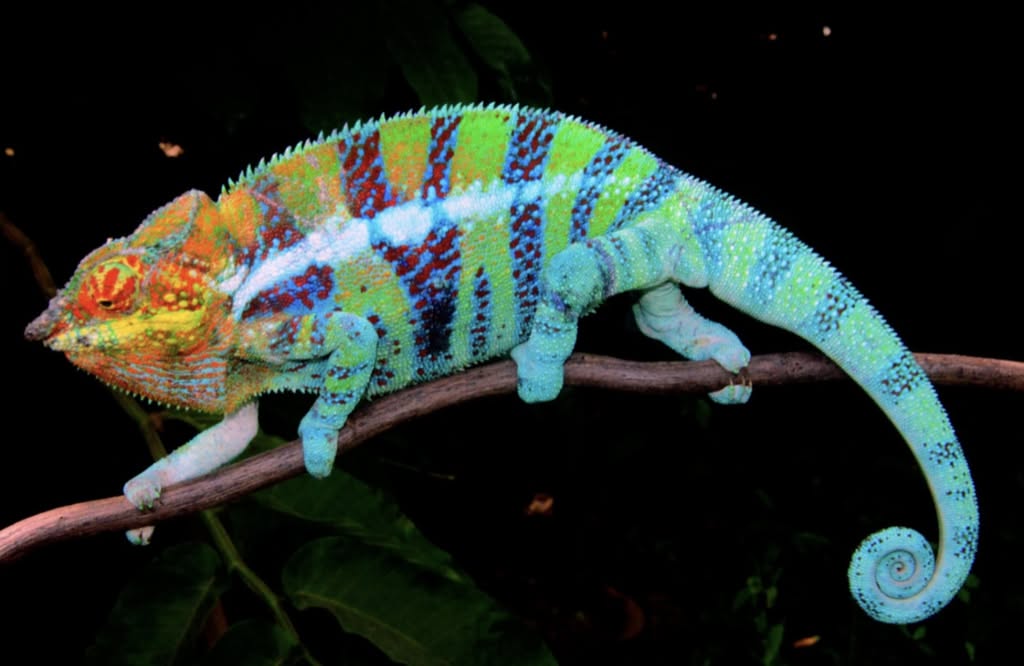
The panther chameleon is one of the most visually spectacular reptiles on Earth and, by most measures, the most photographed. Native to the warm coastal forests of northern and eastern Madagascar, Furcifer pardalis is famous for two things: the almost unbelievable range of colours it can display, and the fact that those colours differ dramatically between populations living only a few dozen kilometres apart.
A male from Ambilobe looks nothing like a male from Nosy Be, and a male from Nosy Be looks nothing like a male from Ambanja. For more than a century biologists assumed they were different species. They are not. The differences are real, but a 2015 genetic study confirmed that every one of these regional colour forms belongs to a single, widely distributed species.
This guide covers every major aspect of panther chameleon biology: taxonomy, size, habitat, diet, the structural mechanism behind colour change, the ballistic tongue, the independently rotating eyes, reproduction, lifespan, locale variation, and the uneasy relationship between this small Madagascan reptile and the global pet trade. It is a reference entry - so expect specific numbers and verified detail.
Etymology and Classification
The genus name Furcifer comes from the Latin furca, meaning fork, and refers to the split foot structure that characterises the genus. The species name pardalis means 'leopard-like' or 'spotted'. The species was first described by Georges Cuvier in 1829 from specimens collected in Madagascar, and the name reflects the mottled, high-contrast patterns of typical wild males.
Full taxonomy of the panther chameleon:
- Kingdom: Animalia
- Phylum: Chordata
- Class: Reptilia
- Order: Squamata
- Family: Chamaeleonidae
- Genus: Furcifer
- Species: F. pardalis
The genus Furcifer is endemic to Madagascar and the neighbouring Comoros and contains roughly two dozen recognised species, including the well-known Oustalet's chameleon (F. oustaleti) and the short-lived Labord's chameleon (F. labordi). The family Chamaeleonidae itself contains over two hundred species spread across Africa, Madagascar, southern Europe, the Middle East, and parts of the Indian subcontinent. Panther chameleons are among the largest and most colourful members of the family.
The Madagascan common name varies by region; the French colonial name caméléon panthère is the ancestor of the modern English name.
Size and Physical Description
Panther chameleons are moderately large chameleons, with the heaviest sexual size dimorphism of any Furcifer species. Males are not merely bigger than females but can be more than twice the weight.
Males:
- Total length (including tail): 40-55 cm
- Snout-to-vent length: 18-23 cm
- Weight: 140-180 g (record individuals exceed 200 g)
- Casque (head crest): prominent, laterally compressed
- Colour: highly variable by locale; vivid reds, blues, greens, yellows, oranges when excited
Females:
- Total length: 25-35 cm
- Snout-to-vent length: 12-16 cm
- Weight: 60-100 g
- Casque: smaller and less elevated than in males
- Colour: generally peach, tan, or pale orange; pink or salmon when receptive; dark brown to black with bright warning markings when gravid
Hatchlings:
- Length: 5-7 cm including tail
- Weight: roughly 1 g
- Colour: dull grey-brown; cannot yet display locale-specific adult colouration
The body is laterally compressed - flattened side to side rather than top to bottom - which serves two functions. It helps the animal hide behind branches by presenting a narrow silhouette from the front, and it increases surface area for thermoregulation when basking perpendicular to the sun. A flap-sided body shape is a hallmark of arboreal chameleons.
The tail is prehensile, muscular, and roughly the same length as the body. Unlike many lizards, chameleons cannot voluntarily drop their tails and do not regenerate them. A damaged tail is permanent. The feet are zygodactyl, with toes fused into two opposed bundles (two toes on one side and three on the other, arrangement mirrored on front and rear feet), producing a grip like a pair of opposing pliers.
Combined with the prehensile tail, this gives panther chameleons five independent points of contact with branches at all times - four feet plus tail.
How Panther Chameleons Change Colour
The colour change of panther chameleons is probably the single most misunderstood feature in popular biology. Three myths in particular need correcting:
- Panther chameleons do not change colour by moving pigment around.
- They do not primarily use colour change for camouflage.
- They do not become 'whatever colour they are sitting on'.
The real mechanism is structural. In 2015 a Swiss research team led by Michel Milinkovitch demonstrated that chameleons (using panther chameleons specifically) possess two superimposed layers of specialised skin cells called iridophores. Each iridophore contains a lattice of guanine nanocrystals. By relaxing or contracting the cells, the chameleon changes the spacing between the crystals. Different spacings reflect different wavelengths of visible light:
- Tight crystal spacing: reflects blue and green
- Intermediate spacing: reflects yellow
- Wider spacing: reflects orange and red
A deeper, second layer of larger iridophores reflects near-infrared light and probably helps the animal manage heat - a relaxed chameleon can reflect more warming infrared, while a heat-stressed one can reflect less.
Pigment cells (xanthophores and erythrophores) sit above the iridophore layer and add yellow and red overtones, while melanophores below can darken the overall appearance. The combination of structural colour (iridophores) and pigment (melanin and carotenoids) gives panther chameleons their extraordinary palette. Males in full display can shift from dull green to neon red with electric blue bands in under two minutes.
Most colour change is driven by:
- Social context (dominance display, mating, aggression)
- Temperature regulation (dark when cold, pale when hot)
- Stress (dark or drab in the presence of a predator)
- Reproductive state (gravid females turn strikingly dark)
Background matching is a minor factor, if it is a factor at all. An excited adult male is trying to be seen, not hidden.
Locale Variation: One Species, Many Colours
The Madagascan coastline hosts a patchwork of isolated or semi-isolated panther chameleon populations. Each population has evolved its own characteristic adult male colouration, and the locale name is considered so important that pet trade animals are routinely advertised by locale first and species second. Some of the most distinctive locales:
| Locale | Typical adult male colours | Region of Madagascar |
|---|---|---|
| Ambilobe | Red, blue, green, yellow bars in one animal | North-west |
| Nosy Be | Deep turquoise-blue with green highlights | Island off north-west coast |
| Ambanja | Cobalt blue with red vertical bands | North-west mainland |
| Sambava | Red-orange with green flanks | North-east |
| Maroantsetra | Green with yellow and red accents | Eastern rainforest |
| Nosy Mitsio | Bright blue with green and red | Small offshore island |
| Nosy Faly | Pink-red with blue undertones | Small offshore island |
| Tamatave | Red with green and yellow highlights | East coast |
For over a century these regional forms were treated as distinct species or subspecies. In 2015, Grbic and colleagues sequenced mitochondrial and nuclear DNA from panther chameleons across the native range and concluded that all locales belong to a single species with significant population structure.
Gene flow still occurs at locale boundaries, but the colour differences are maintained in large part by female mate choice - females from a given locale prefer males displaying the locale colours, which keeps the regional palettes stable without full reproductive isolation.
The practical consequence for collectors, breeders, and researchers is that locale crossbreeding produces fertile but visually inconsistent offspring. Responsible captive breeders therefore try to keep locales 'pure' even though the animals are biologically one species.
The Projectile Tongue
The panther chameleon's tongue is one of the fastest ballistic feeding systems in the animal kingdom. When prey is spotted - both eyes swing forward, the brain calculates distance using stereo vision, and the tongue fires.
Tongue performance figures:
- Reach: up to 1.5 times total body length (so roughly 60-80 cm in a large adult male)
- Launch time from rest to full extension: approximately 0.07 seconds
- Peak acceleration: more than 2,500 metres per second squared, exceeding 41 g
- Deceleration at impact: similar magnitudes in the opposite direction
These numbers put the chameleon tongue strike in the same league as high-performance military ballistic systems in terms of raw acceleration, and well beyond what any mammal muscle can achieve. The secret is an elastic recoil mechanism rather than direct muscle contraction. A set of concentric sheath muscles stretches a collagen-based elastic structure around the hyoid bone.
When the animal fires, the collagen releases its stored elastic energy almost instantaneously, launching the tongue tip forward at speeds muscles alone could never generate.
The tongue tip itself is a specialised muscular pad. On impact it flattens into a suction-cup-like shape and sticks to prey through a combination of wet adhesion and a partial vacuum seal. Retraction is slower than launch, pulled back by a different muscle system that telescopes the tongue base back into the mouth. Successful strikes occur so fast that without high-speed video the prey simply 'vanishes'.
Eyes: Independent 360-Degree Vision
Each panther chameleon eye sits inside a fused conical eyelid that covers the eye almost entirely, leaving only a small central opening for the pupil. This 'turret' rotates as a unit, powered by its own set of muscles. Coverage:
- Horizontal rotation per eye: roughly 180 degrees
- Vertical rotation per eye: roughly 90 degrees
- Combined visual field with both eyes: effectively 360 degrees around the body
The two eyes operate in separate neural streams until prey is identified. A panther chameleon can, at the same instant, watch a cricket on a branch below and a bird overhead. When the animal decides to strike, both eyes snap forward into a binocular configuration, producing the stereo depth perception needed to range-find for the tongue shot.
The switch from independent to coordinated eye control is so fast and precise that neuroscientists use chameleon vision as a model for studying how vertebrate brains integrate parallel visual streams.
Panther chameleons also perceive ultraviolet light. UV vision is used for assessing basking spots - UV helps the animal find sunlit perches where vitamin D synthesis is most efficient - and for reading signals from other chameleons, since certain skin patches reflect UV differentially between dominant and subordinate males.
Diet and Feeding
Panther chameleons are insectivores throughout life. Wild diet studies document a large range of prey:
- Crickets and grasshoppers
- Locusts
- Mantises
- Stick insects
- Moths and butterflies
- Flies, bees, and wasps
- Beetles
- Spiders and scorpions
- Occasional small vertebrates (hatchling geckos, small skinks)
Feeding behaviour is ambush-based. A chameleon waits motionless on a branch, scans the surroundings with independently rotating eyes, and fires its tongue when suitable prey comes within range. Success rates are very high - published field observations report strike success of over 90 per cent for stationary insect prey - far higher than any mammalian predator achieves.
Captive diet recommendations emphasise variety and supplementation:
- Staple: crickets, dubia roaches, locusts
- Treats: silkworms, hornworms, butterworms, flies
- Supplementation: calcium daily, calcium with vitamin D3 twice weekly, multivitamin biweekly
- Hydration: chameleons rarely drink from standing water, preferring to lap droplets from misted leaves
Metabolic bone disease from inadequate calcium and UVB is the single most common captive health problem.
Reproduction and Life Cycle
Panther chameleon reproduction is rapid, prolific, and brutal in terms of energy cost for females.
Mating:
- Males patrol territories and display to females using colour change
- Receptive females display soft pastel tones, typically peach or pink
- Unreceptive or gravid females turn dark brown or black with bright orange, red, or pink spots - an unambiguous visual 'no'
- Copulation is brief, often less than five minutes
- Females store viable sperm, sometimes laying fertile clutches up to six months later
Egg-laying:
- Clutch size: 20-40 eggs, occasionally more
- Egg deposition: female descends from the canopy, digs a tunnel in moist soil, deposits eggs, covers them carefully
- Egg-laying can take most of a day and leaves the female exhausted
- Females can produce multiple clutches per year, which is the dominant cause of their short life expectancy
Incubation:
- Duration: 6-12 months, sometimes longer
- Temperature: roughly 24-27 degrees Celsius for normal development
- Embryos can enter a developmental diapause, pausing growth until favourable conditions resume
- Hatchlings dig their way to the surface and disperse immediately - there is no parental care
Hatchling to adult:
- Independence: immediate
- First prey (pinhead crickets, fruit flies): within the first day
- Sexual maturity: 6-9 months in ideal captive conditions, somewhat later in the wild
- Coloration develops progressively; adult locale colours appear over the first year
The combination of large clutches, long incubation, and no parental care means most hatchlings never reach adulthood - predation, desiccation, and failure to find food cut survival sharply in the first weeks.
Lifespan
Panther chameleons live short, high-intensity lives.
| Category | Typical lifespan |
|---|---|
| Wild males | 2-3 years |
| Wild females | 1.5-2.5 years |
| Captive males | 5-7 years |
| Captive females | 2-4 years |
| Record captive male | 8+ years |
The female penalty is driven almost entirely by reproduction. Repeated clutches of calcium-rich eggs deplete bone mineral density and fat reserves faster than the animal can recover. Experienced keepers extend female lifespans by keeping them slightly cooler, separating them visually from males to suppress ovulation, and providing aggressive calcium supplementation. Even so, females rarely match male lifespan.
In the wild, panther chameleons join a short list of vertebrates in which the entire adult population effectively turns over each year or two. The related species Furcifer labordi goes even further - it is essentially a one-year annual vertebrate, one of the few known.
Habitat and Range
Panther chameleons are native to Madagascar and occur across the warm lowland and mid-elevation forests of the north and east of the island. The native range extends from the Sambirano region on the north-west coast around the tip of Madagascar and down the east coast past Maroantsetra, taking in most of the major north-eastern and north-western rivers and offshore islands. They occupy:
- Primary coastal rainforest
- Secondary and regrowth forest
- Plantation edges (cacao, coffee, vanilla, banana)
- Village gardens
- Scrub and degraded woodland
The species tolerates human-modified habitat better than most chameleons, which is one reason it remains abundant while more specialised Madagascan reptiles decline. Preferred microhabitat is humid forest edge with mixed tree and shrub layers - plenty of perching structure, partial canopy, and access to sun patches for basking.
Introduced populations exist on the French island of Reunion and on Mauritius, descended from pet-trade escapes or releases. These populations are small, localised, and not currently considered invasive threats.
Climate conditions across the native range:
- Daytime temperature: 24-30 degrees Celsius
- Night temperature: 16-22 degrees Celsius
- Humidity: 60-90 per cent, often higher at night
- Rainfall: highly seasonal, with a pronounced wet season from November to April
The species is strongly arboreal and rarely descends to the ground except for females laying eggs.
Conservation Status
The IUCN Red List currently classifies Furcifer pardalis as Least Concern with a stable population trend. The species is listed on CITES Appendix II, which means international commercial trade is regulated but not banned, and Madagascar sets an annual export quota.
Several factors keep the species secure:
- Large geographic range
- Tolerance of secondary and modified habitat
- High reproductive output
- Rapid generation turnover
Several factors generate ongoing concern:
- Pet trade pressure. Tens of thousands of panther chameleons are exported or captive-bred annually. Legal Madagascan exports are joined by poorly documented illegal collection. Small-range locales (Nosy Mitsio, Nosy Faly) are especially exposed.
- Deforestation. Even with the species' tolerance of modified habitat, complete clearance for charcoal and slash-and-burn agriculture reduces population density.
- Pesticide exposure. Insecticide use in plantations poisons both the chameleons directly and their insect prey base.
- Road mortality. The recent expansion of paved roads across northern Madagascar increases fatalities of egg-laying females that descend to the ground.
- Climate change. Shifts in rainy-season timing may affect incubation success, though the data remain limited.
Conservation programmes in Madagascar focus on habitat protection, locale-specific population monitoring, and enforcement of export quotas. The captive-bred supply chain increasingly reduces wild collection pressure for the most common locales, while the rarer locales remain under heavier wild-collection demand.
Panther Chameleons and Humans
Panther chameleons are among the most economically important reptiles on the planet within the pet trade. They are charismatic, visually spectacular, and breed well in captivity. The global captive population is large and stable, and well-run breeding operations produce tens of thousands of captive-bred hatchlings every year.
For keepers, the species demands specialist care:
- Large mesh enclosure with strong ventilation
- Live plants and horizontal branch network for climbing
- UVB lighting for vitamin D3 synthesis
- Basking spot of 30-35 degrees Celsius
- Overall ambient temperature 24-28 degrees Celsius, with night drop to 18-20
- Daily misting with purified water
- Varied, supplemented insect diet
- No cohabitation with other chameleons (adults are strictly solitary)
Panther chameleons do not enjoy handling. Repeated handling causes chronic stress colours (dark, muted), appetite loss, and reduced lifespan. Most experienced keepers treat them as display animals rather than pets in the interactive sense.
For Madagascan communities, the species provides a modest but real income through regulated export, eco-tourism photography, and locally guided chameleon walks. Panther chameleons are not traditionally hunted or eaten - Madagascan folklore treats chameleons with a mix of respect and superstition, and many communities avoid harming them.
Related Reading
- Veiled Chameleon: Desert Survivor of Arabia
- How Chameleons Change Colour
- Chameleons of Madagascar
- Reptile Vision: How Lizards Really See
References
Relevant peer-reviewed and governmental sources consulted for this entry include the IUCN Red List assessment for Furcifer pardalis, the CITES Appendix II trade records, Grbic et al. (2015) in Molecular Ecology on locale genetics, Teyssier et al.
(2015) in Nature Communications on iridophore-based colour change, published research in Journal of Experimental Biology on tongue ballistics, Anderson and Deban studies on chameleon feeding mechanics, and field surveys by Madagascan herpetological research groups. Specific population and trade figures reflect the most recent CITES trade database and Madagascan export quota publications.
Frequently Asked Questions
How big do panther chameleons get?
Adult male panther chameleons (Furcifer pardalis) reach 40-55 cm in total length including the tail, with the tail making up roughly half of that figure. Healthy adult males weigh 140-180 grams. Females are markedly smaller at 25-35 cm and 60-100 grams. Hatchlings emerge at about 5-7 cm and roughly one gram. Growth is rapid in the first year - a well-fed captive male can reach adult size by twelve to fifteen months.
Size varies slightly between locales, with Ambilobe and Nosy Be males tending toward the upper end of the range and smaller-bodied locales such as Nosy Mitsio producing noticeably more compact adults.
How does a panther chameleon change colour?
Panther chameleons change colour using a structural mechanism, not pigment rearrangement. Beneath the outer skin sits a layer of specialised cells called iridophores, each packed with tiny guanine crystals arranged in a lattice. When the chameleon relaxes or tightens these cells the spacing between crystals changes, which changes the wavelength of light reflected.
Wider spacing reflects longer wavelengths like yellow, orange, and red; tighter spacing reflects blue and green. A deeper iridophore layer reflects near-infrared to help with heat regulation. Colour shifts communicate mood, dominance, readiness to mate, and temperature state. Camouflage is a secondary use at best - the dramatic display colours would be terrible camouflage in rainforest.
Where do panther chameleons live?
Panther chameleons are native to the warm coastal forests of northern and eastern Madagascar, from the Sambirano region on the north-west coast around to the eastern rainforest belt south of Maroantsetra. They occupy lowland and mid-elevation forest, forest edges, plantations, and gardens up to roughly 950 metres altitude. The species does not inhabit the dry south or the central highland plateau.
Small introduced populations live on Reunion and Mauritius after escapes or releases from the pet trade. Panther chameleons are strongly arboreal and rarely descend except for females to lay eggs. They prefer humid conditions with daytime temperatures of 24-30 degrees Celsius and nightly drops into the high teens.
What do panther chameleons eat?
Panther chameleons are insectivores. Wild diets are dominated by crickets, grasshoppers, locusts, stick insects, mantids, moths, and flies, with occasional spiders and small vertebrates such as hatchling geckos taken when available. Prey is ambushed from a branch using the projectile tongue, which can reach up to one and a half times the chameleon’s body length and strikes in roughly 0.07 seconds.
The tongue tip is a sticky, suction-cup-shaped muscular pad that grips prey through both adhesion and a vacuum seal. Captive animals require a varied insect diet supplemented with calcium and vitamin D3 to avoid metabolic bone disease, and adults typically eat daily while juveniles eat twice a day.
How long do panther chameleons live?
Panther chameleon lifespan is short and strongly sex-skewed. Wild individuals typically live only 2-3 years, often less. In captivity with stable temperatures, controlled humidity, no predation, and supplemented food, males commonly reach 5-7 years and exceptional individuals exceed eight. Females live significantly shorter lives in both wild and captive settings - usually 2-4 years - because repeated egg production is extremely taxing.
A single clutch of 20-40 calcium-rich eggs drains a gravid female’s reserves dramatically, and females may lay multiple clutches per year. Keepers sometimes extend female lifespans by keeping them at cooler temperatures and avoiding visual exposure to males, both of which reduce ovulation rates.
Why are panther chameleons different colours in different places?
The colour variation across Madagascar locales is one of the most striking features of the species. Ambilobe males flash red, blue, green, and yellow bars. Nosy Be males are deep turquoise-blue. Ambanja males run to cobalt with red bands. Sambava, Maroantsetra, and Nosy Mitsio produce distinct palettes of their own. For over a century these were treated as separate species because the differences looked too large for a single taxon.
A 2015 genetic study by Grbic and colleagues sequenced panther chameleons from across Madagascar and confirmed they are a single species with strong population structure, meaning the locale lineages are real but interbreed successfully. The colour differences are maintained by female mate choice rather than reproductive isolation.
Can panther chameleons really aim each eye separately?
Yes. Panther chameleon eyes operate with almost complete independence. Each eye sits inside a turret-like scaly cone, and each cone rotates roughly 180 degrees horizontally and 90 degrees vertically using its own muscle system. Effective coverage is close to 360 degrees around the body because the two cones together sweep the entire visual field.
The brain processes the two monocular streams in parallel, allowing the animal to track a predator overhead with one eye while watching prey below with the other. When prey is identified, both eyes snap forward to lock onto the target, generating stereo depth perception that allows the tongue strike to be aimed with millimetre accuracy. The species also perceives ultraviolet light.
Are panther chameleons endangered?
The IUCN currently classifies Furcifer pardalis as Least Concern, with a stable population trend across most of its native range. The species is adaptable, tolerates plantation and secondary-growth habitat, and reproduces prolifically. However, pressure from the international pet trade is substantial and growing - tens of thousands of animals are exported or captive-bred each year, with Madagascar’s legal export quotas joined by illegal collection.
Localised deforestation, pesticide exposure, and road mortality further affect some populations. The species is listed on CITES Appendix II, which regulates international trade. Conservation concern focuses more on specific locales with small ranges (such as Nosy Mitsio) than on the species as a whole, though the situation is monitored closely.