
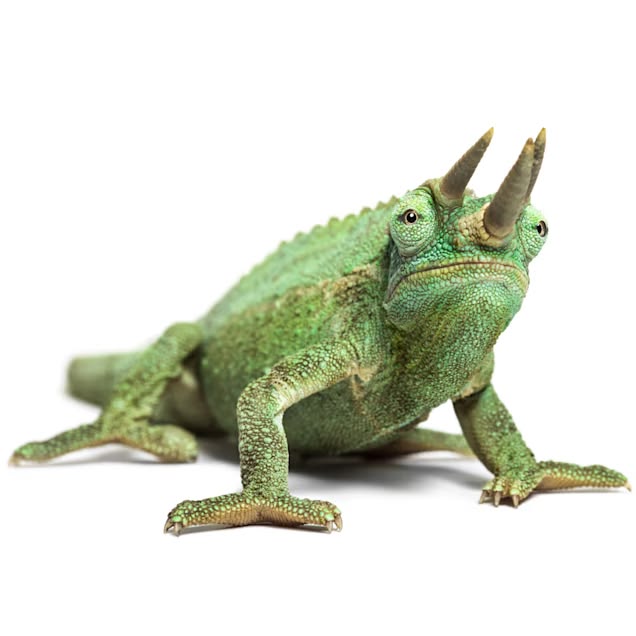
Jackson's chameleon is the lizard that looks like it borrowed its face from a dinosaur. Adult males carry three forward-pointing horns - one above each eye, one jutting from the snout - which is why naturalists, keepers, and Kenyan schoolchildren have all, at one time or another, called it the "triceratops chameleon".
Trioceros jacksonii is small, deliberate, astonishingly colourful, and one of the best-known chameleons in the world, thanks largely to a 1972 pet-shop release that seeded a thriving feral population across the Hawaiian islands.
This guide is a working reference entry on the species. It covers taxonomy, range, anatomy, horn biology, the peculiar live-bearing reproduction that sets Jackson's chameleons apart from most of their relatives, diet and hunting mechanics, thermoregulation tricks, subspecies, conservation status, the invasive Hawaiian population, and the species' relationship with the people who collect, keep, and study it.
Expect specifics: measurements in centimetres and grams, elevations in metres, litter sizes, tongue acceleration in g-forces, and dates for the key events in the species' recent history.
Etymology and Classification
The scientific name Trioceros jacksonii means, literally, "Jackson's three-horn". The genus name Trioceros comes from the Greek tri (three) and keras (horn), a direct reference to the triple-horned males that dominate the genus.
The specific epithet jacksonii honours Frederick John Jackson, a British explorer, colonial administrator, and keen amateur ornithologist who served in East Africa during the 1880s and 1890s and later became Governor of Uganda. Jackson collected the type specimens near Mount Kenya in the late nineteenth century, and the German herpetologist George Albert Boulenger formally described the species in 1896.
For most of the twentieth century the species was placed in the genus Chamaeleo. A 2009 molecular revision split the old "true chameleons" into several genera, and Jackson's chameleon was reassigned to Trioceros along with a number of other African montane species. Older literature and many hobbyist websites still use Chamaeleo jacksonii, which is now technically a synonym.
Three subspecies are currently recognised:
- T. j. jacksonii - the nominate form, from the Kenyan highlands around the Aberdare Range and Mount Kenya.
- T. j. merumontanus - a smaller subspecies restricted to the slopes of Mount Meru in Tanzania, with comparatively long horns relative to body size.
- T. j. xantholophus - the yellow-crested Jackson's chameleon from the slopes of Mount Kenya. This is the largest subspecies and the one almost universally traded as a pet. It is also the ancestor of the invasive Hawaiian population.
Kikuyu and other East African communities living within the species' range have their own long-standing names for the animal, and local folklore around chameleons generally is rich and often unflattering - chameleons are widely considered bad omens in the region.
Size and Physical Description
Jackson's chameleons are medium-sized by chameleon standards. Adult males typically reach 25 to 38 centimetres in total length, including a long prehensile tail that accounts for roughly half of that measurement. Females are usually shorter and more thickset. Body mass in healthy adults ranges from about 80 to 150 grams, with T. j. xantholophus at the top end and T. j. merumontanus at the bottom.
Males:
- Total length: 25-38 cm (including tail)
- Snout-to-vent length: 12-18 cm
- Weight: 100-150 g
- Three forward-pointing horns (one preocular horn above each eye, one rostral horn)
- Raised dorsal crest along the back
- More vivid colouration - greens, yellows, blues, and turquoise tints during display
Females:
- Total length: 20-30 cm
- Weight: 80-120 g
- Smooth snout or very small nub remnants where horns would grow
- Lower dorsal crest
- Generally duller brown or olive-green baseline colouration, with sharper contrast during pregnancy
Neonates at birth:
- Length: 4-6 cm
- Weight: 0.3-0.5 g
- Fully formed, mobile, and feeding within twenty-four hours
Body shape is classic chameleon: laterally flattened, crested along the spine, with a casque (a raised bony projection) on the back of the head. The eyes are set in turret-like conical sockets that rotate independently. The feet are zygodactyl - each foot splits into two opposed bundles of fused toes, two fingers gripping one way and three the other, forming a pincer ideal for wrapping around narrow branches. The tail is prehensile and strong enough to hold the animal's full body weight.
Colour ranges through the greens, with individuals shifting through turquoise, yellow, brown, and near-black depending on temperature, mood, reproductive state, and social context. Colour change is not camouflage in any simple sense; it is a combination of signalling, thermoregulation, and stress response.
The Three Horns
The horns are the feature that everyone remembers, and they deserve a closer look. In males, three keratin-sheathed bony projections grow from the front of the skull. Two are preocular, growing above and slightly forward of the eye sockets. The third - the rostral horn - projects straight forward from the front of the snout. In large males these horns can reach two to three centimetres in length and curve gently upward.
The horns are not used for hunting, nor for defence against predators. They are combat weapons used in ritualised male-male contests over territory and mates. When two males meet, they inflate their dewlaps, gape, and sway their bodies. If neither backs down, they lock horns and push. The goal is not to injure but to unbalance the opponent and force him off the branch. Serious injury is rare. These contests resemble the horn-wrestling seen in deer or beetles more than a predator-prey clash.
Females, by contrast, are almost hornless. In the nominate subspecies and in T. j. xantholophus they have a smooth snout, sometimes with a pair of tiny rounded bumps. T. j. merumontanus females can have small but visible nubs. The evolutionary reasoning is straightforward: horns are expensive to grow and maintain, they would be wasted on females who do not fight, and the energy that would go into them is redirected into producing eggs and nourishing live young.
Built for the Cool Highlands
Most people picture chameleons in sweltering jungles. Jackson's chameleons live somewhere very different: the cool, misty, high-elevation forests of central Kenya and northern Tanzania, at altitudes between 1,600 and 2,400 metres. Daytime temperatures rarely exceed 25 degrees Celsius, and nighttime temperatures can drop into single digits. The animals' anatomy and behaviour reflect that climate.
Thermoregulation techniques:
- Turning darker - brown, nearly black - in the early morning to absorb more solar radiation and warm up quickly.
- Turning paler green during the hottest part of the day to reflect light and avoid overheating.
- Using the bony casque as a heat exchanger that bleeds excess warmth to the air.
- Flattening the body laterally when basking, with the broad side aimed toward the sun, to maximise the surface exposed to warmth.
- Moving into deep shade or the undersides of broad leaves during midday peaks.
This is why Jackson's chameleons are fundamentally bad pets for warm, humid apartments. Without a cool nighttime drop, consistent moderate humidity, and strong UVB, they develop metabolic bone disease, respiratory infections, and early death. Husbandry guides often emphasise a night temperature of 13-18 degrees Celsius, a daytime range of 21-27, and high airflow - conditions closer to a misty Kenyan hillside than a tropical terrarium.
Hunting and Diet
Jackson's chameleons are insectivores, and the star of their feeding apparatus is the projectile tongue. At rest the tongue sits folded inside the mouth around the hyoid bone. When a target is sighted, the tongue muscle squeezes, a cartilage accelerator launches the sticky pad at the tip, and the entire structure fires outward at acceleration up to 41 g. The strike reaches the prey in roughly fifty milliseconds - faster than a human can blink - and retracts with the insect attached.
Typical wild prey:
- Crickets and grasshoppers
- Caterpillars and moth larvae
- Beetles, including weevils
- Flies, wasps, and bees
- Mantids and stick insects
- Small land snails (swallowed shell-and-all)
- Slugs and millipedes
- Occasionally small lizards, including hatchlings of other species
Eye movement is the setup to every strike. Each eye rotates through nearly 180 degrees in its conical turret, independently of the other. A hunting Jackson's chameleon will typically track prey with one eye, scan for threats with the other, and then swivel both eyes forward for binocular depth perception just before firing the tongue. This is one of the few vertebrate systems in which both monocular and binocular vision are used seamlessly in sequence.
Success rates for the tongue strike are high under ideal conditions - over 80 per cent in captive studies. Failed strikes usually reflect miscalculated distance, wet conditions that reduce tongue-pad adhesion, or prey that moves at the last instant.
In Hawaii the invasive population has added native arthropods, spiders, and - most damagingly - native land snails to its diet. Several Hawaiian endemic snail species are critically endangered, and predation by feral Jackson's chameleons is one of the documented pressures on their remaining populations.
Reproduction and Live Birth
Most chameleons lay eggs. Jackson's chameleons do not. Instead the species is ovoviviparous: the eggs develop inside the mother's body and hatch either just before or during delivery. The neonates emerge wrapped in thin transparent membranes that split as the babies wriggle free, usually within a minute of being deposited on a branch.
Reproductive cycle:
- Courtship and mating. Males perform a slow side-to-side rocking display with dewlap extended and colours intensified. Receptive females remain still or mirror the colour change; unreceptive females turn dark, hiss, and may bite.
- Gestation. Pregnancy lasts about five to six months. The female's flanks swell visibly and her colouration darkens and intensifies. She becomes more willing to bask, more aggressive toward males, and eats heavily.
- Birth. Over a period of several hours, the female moves along a branch depositing 8-30 neonates, usually onto leaves and small twigs where they can grip. Each newborn is 4-6 centimetres long, fully coloured, and able to catch small insects almost immediately.
- No parental care. Once delivery ends the female leaves. Neonates disperse on their own, climbing into surrounding foliage within minutes.
The live-birth adaptation almost certainly evolved in response to the cool highland habitat. Soil temperatures in the Aberdares and Mount Kenya foothills are simply too cold and too variable for reliable egg incubation. Carrying embryos internally allows the female to bask and actively regulate their temperature via her own body.
Typical reproductive data:
| Metric | Value |
|---|---|
| Age at sexual maturity | 5-9 months |
| Gestation length | 5-6 months |
| Litter size | 8-30 neonates (typical 15-20) |
| Neonate length | 4-6 cm |
| Neonate weight | 0.3-0.5 g |
| Litters per female (wild) | 1-2 per year |
| First-year survival | Low - roughly 10-20% of neonates |
Range, Habitat, and Subspecies
Native Jackson's chameleons occur across a relatively narrow band of East African highlands. The nominate T. j. jacksonii is found from the Aberdare Range east across the foothills of Mount Kenya, through the Nairobi highlands and into parts of the Kenyan Rift Valley. T. j. merumontanus is restricted to Mount Meru in northern Tanzania.
T. j. xantholophus, the yellow-crested Jackson's chameleon, is tied closely to the slopes of Mount Kenya itself, where the cooler, wetter forest conditions favour its larger body size.
Outside Africa, Jackson's chameleons occur as introduced feral populations:
| Location | Status | Origin year | Source |
|---|---|---|---|
| Oahu, Hawaii | Established | 1972 | Deliberate backyard release |
| Maui, Hawaii | Established | 1980s | Secondary spread from Oahu |
| Hawaii (Big Island) | Established | 1980s-1990s | Secondary spread and further releases |
| Kauai, Hawaii | Established | 1990s+ | Secondary spread |
| California (scattered) | Localised | Various | Pet releases and escapes |
| Florida (scattered) | Localised | Various | Pet releases and escapes |
The Hawaiian story is worth telling in full. In 1972 a single pet importer brought a shipment of T. j. xantholophus into Oahu. The animals arrived stressed and dehydrated. To try to save them, the importer released roughly three dozen individuals into a garden in the Kaneohe area, expecting them to recover and be re-collected. They recovered, dispersed, and bred.
Because females can give birth to 8-30 live young after a single mating, and because chameleons can store sperm, a single pregnant female is enough to found a new population. Within a decade Jackson's chameleons had spread across Oahu, and within three decades they occupied suitable habitat on four major Hawaiian islands.
Hawaii now prohibits their transport between islands, though enforcement is difficult and the invasion continues quietly.
Conservation Status
The IUCN Red List assessment lists Jackson's chameleon overall as Least Concern. The species remains common within most of its native range, tolerates moderate human habitat modification, and persists in gardens, hedgerows, and coffee and tea plantations alongside intact forest.
That said, regional and subspecies-level concerns exist:
- T. j. xantholophus has been heavily exported for the pet trade. Between the late 1970s and early 1990s, tens of thousands were shipped out of Kenya, with unknown but certainly significant survival rates in transit.
- Habitat loss. Conversion of montane forest into farmland and settlements reduces suitable habitat locally, although Jackson's chameleons persist better than many East African reptiles in modified landscapes.
- Disease transmission. Imported chameleons from the pet trade have reintroduced captive-origin pathogens to wild and feral populations.
- Invasive status in Hawaii. The same species is simultaneously native-and-declining in parts of Kenya and invasive-and-expanding in Hawaii, where it preys on endangered native snails and competes with native insectivores.
Kenya now restricts wild collection under its Wildlife Conservation and Management Act, and most legal pet-trade Jackson's chameleons originate either from captive breeding programmes or from the feral Hawaiian population (where legal collection is periodically permitted to reduce invasive pressure).
Chameleons and Humans
Jackson's chameleons have a complex relationship with the people who share their range. In much of East Africa chameleons are regarded with suspicion, sometimes fear, and are the subject of folklore that portrays them as unlucky or supernatural. They are rarely killed outright but often left alone or gently moved out of gardens. The horns have, perhaps inevitably, amplified this association - the three-horned male is a distinctive and unmistakable figure.
Outside Africa, the species is one of the most recognisable reptiles in the pet trade. For several decades from the 1970s through the 1990s it was among the most imported chameleon species in the United States and Europe.
Enthusiast communities developed around keeping and breeding the species, and modern hobbyist knowledge of chameleon husbandry owes a great deal to the lessons learned - sometimes painfully - by keepers of Jackson's chameleons. The species remains common in captivity today, although the trade has shifted heavily toward captive-bred stock from Hawaii and dedicated breeders rather than wild-caught imports.
In Hawaii the relationship is ecological and political rather than cultural. Conservation agencies view the species as a problematic invasive. Hobbyists view it as a locally abundant, legally collectable pet. The state's policy is a compromise: transport between islands is illegal, collection on islands where the species is already established is tolerated, and active eradication has not been attempted because the populations are already too widespread for it to succeed.
Related Reading
- Veiled Chameleon: The Casqued Lizard of Arabia
- Panther Chameleon: Madagascar's Rainbow Lizard
- How Chameleons Change Colour
- Chameleons of the World: Horns, Tongues, and Turrets
References
Relevant peer-reviewed and governmental sources consulted for this entry include the IUCN Red List assessment for Trioceros jacksonii, Tilbury's Chameleons of Africa: An Atlas (2nd edition), Hawaii Department of Land and Natural Resources invasive species reports, the 2009 Tolley and Townsend molecular phylogeny that reassigned the species to Trioceros, and field observations published in African Journal of Herpetology and Salamandra.
Historical import records for the Hawaiian founding population draw on University of Hawaii and Bishop Museum records of the 1972 Kaneohe release.
Frequently Asked Questions
Why do Jackson's chameleons have three horns?
Only male Jackson’s chameleons (Trioceros jacksonii) grow the three forward-facing horns that give the species its ‘triceratops chameleon’ nickname. One horn sits above each eye socket (the preocular horns) and a third, longer horn projects straight forward from the snout (the rostral horn). The horns are bony cores sheathed in keratin, identical in composition to the rest of the skull.
Their main function appears to be combat: rival males clash horns, lock heads, and try to push each other off a branch rather than bite. Horn size correlates loosely with body size and health, so females likely also use horn length as a mating cue when choosing partners.
Do female Jackson's chameleons have horns?
Usually not. Adult females of Trioceros jacksonii jacksonii and T. j. xantholophus are essentially hornless, with a smooth snout where males grow their rostral spike. A few carry tiny rounded bumps that hint at the male pattern, but these never develop into functional horns. The smaller subspecies T. j. merumontanus is an exception - females sometimes show small but noticeable nubs.
The sex difference is driven by hormone signalling during juvenile development. Because horns are a male-combat trait rather than a defensive one, natural selection never favoured them in females, who instead channel the energetic cost into egg and embryo development.
Where do Jackson's chameleons live in the wild?
Jackson’s chameleons are native to the cool, humid montane forests of central Kenya and northern Tanzania, at elevations between roughly 1,600 and 2,400 metres above sea level. Their core native range covers the Aberdare Range, Mount Kenya foothills, the Nairobi area, and the slopes of Mount Meru and Mount Kilimanjaro. They prefer dense, shrubby vegetation with access to sun for basking and cover for retreat.
Outside Africa, established feral populations now exist in Hawaii (especially Oahu, Maui, and the Big Island), and smaller populations have been reported in California and Florida following pet releases. The Hawaiian population traces back to a single 1972 import release and has since spread widely.
Are Jackson's chameleons endangered?
The IUCN Red List classifies Jackson’s chameleon as Least Concern. The species remains widespread across its native East African range and tolerates a range of modified habitats including gardens, hedgerows, and plantations. That said, regional pressure exists.
Habitat loss from agricultural expansion and the pet trade has removed animals from specific forest fragments, and the subspecies T. j. xantholophus has been heavily exported historically, with tens of thousands shipped in the 1970s and 1980s. Kenya now restricts wild collection and most pet animals come from captive-bred stock or the feral Hawaiian population.
The invasive Hawaiian population is ironically thriving while some native populations face local declines.
How did Jackson's chameleons end up in Hawaii?
The Hawaiian population is descended from a shipment of Trioceros jacksonii xantholophus imported to Oahu in 1972 for the pet trade. The animals arrived stressed and dehydrated, and to save them the pet shop owner released roughly three dozen individuals into a backyard garden in the Kaneohe area. They survived, bred, and spread.
Live-bearing reproduction gave them a huge advantage - females could disperse already pregnant and establish new populations without needing to find a mate. Today Jackson’s chameleons are established on Oahu, Maui, the Big Island, and Kauai. They are considered invasive, eating native Hawaiian snails and insects, and transporting them between islands is illegal under state law.
Why do Jackson's chameleons give birth to live young?
Jackson’s chameleons are ovoviviparous: eggs develop fully inside the mother’s body and hatch either just before or during delivery. This is extremely unusual for chameleons, where egg-laying is the norm. The adaptation is almost certainly a response to their cool, high-elevation habitat.
At 1,600-2,400 metres, soil temperatures fluctuate sharply between day and night and stay cold enough that eggs buried in the ground would incubate slowly or fail entirely. By carrying embryos internally, a female can bask to raise her body temperature and keep developing offspring warm. After a gestation of five to six months, she delivers 8-30 neonates onto a branch, wrapped in transparent membranes that the babies break through within minutes of birth.
How long do Jackson's chameleons live?
Wild Jackson’s chameleons typically live five to ten years, with a strong sex difference. Males generally live around five years. Females live eight to ten, sometimes longer. The shorter male lifespan reflects the energetic cost of fighting, display, and defending territory. In captivity, well-kept Jackson’s chameleons reach the upper end of this range reliably but rarely exceed it.
Poor husbandry - low humidity, inadequate UVB, incorrect temperatures, or handling stress - easily cuts captive lifespans in half. Juvenile mortality is also high in the wild. Of a litter of 20 neonates, only a handful typically survive their first year due to predation by birds, snakes, and larger lizards, along with exposure and starvation.
What do Jackson's chameleons eat?
Jackson’s chameleons are strict insectivores that capture prey with a ballistic, tube-launched tongue. Primary prey in the wild includes crickets, grasshoppers, caterpillars, beetles, flies, mantids, and stick insects. Larger adults opportunistically take small snails (swallowed shell and all), slugs, centipedes, and even hatchling lizards.
They hunt visually: each eye swivels independently through about 180 degrees, locking onto a target before the second eye rotates forward for depth perception. The tongue then fires out up to one and a half body lengths in roughly fifty milliseconds. In Hawaii the diet has shifted toward native land snails, which has raised serious conservation concerns for Hawaii’s endangered endemic snail fauna.