
Can axolotls really regenerate their brains and other organs?
Yes. Among salamanders and newts, axolotls possess the most extensive regenerative abilities of any vertebrate. They can regrow entire limbs complete with bones, muscles, nerves, and blood vessels. They can also regenerate portions of their brain, their spinal cord, heart tissue, and even their eyes.
In a laboratory at the University of Kentucky, a researcher carefully amputates the forelimb of an axolotl. There is no dramatic intervention, no surgical grafting, no gene therapy. The scientist simply waits. Within days, a blastema - a mound of rapidly dividing cells - forms at the wound site.
Over the next several weeks, that blastema sculpts itself into a perfect new limb: bones, muscles, nerves, blood vessels, even the delicate patterning of digits. The limb is not a rough approximation. It is a flawless copy of the original, indistinguishable in form and function. The axolotl will use it as if nothing happened.
This is not science fiction. This is what salamanders do. They have been doing it for over 200 million years, long before the first mammal drew breath. And understanding how they accomplish this biological miracle is one of the most urgent pursuits in modern medicine.
An Ancient and Astonishing Lineage
Salamanders belong to the order Urodela (also called Caudata), one of three living orders of amphibians alongside frogs (Anura) and caecilians (Gymnophiona). With more than 700 described species distributed across the Americas, Europe, Asia, and a small portion of northern Africa, salamanders represent a staggering diversity of body forms, life strategies, and ecological adaptations.
They range from fully aquatic species that never leave the water to entirely terrestrial species that never enter it. Some are smaller than a human finger. One species can grow nearly as long as a person.
Despite their superficial resemblance to lizards, salamanders are not reptiles. They are amphibians, with permeable skin, ectothermic metabolisms, and typically complex life cycles involving aquatic larval stages. The distinction matters because it points to a fundamental difference in physiology: salamander skin is a living organ of gas exchange, moisture regulation, and chemical defense, not the dry, scaled armor of a reptile.
The fossil record places the earliest salamander-like amphibians in the Jurassic period, roughly 160 to 170 million years ago. The oldest known true salamander fossil, Karaurus sharovi, was discovered in Kazakhstan and dates to approximately 160 million years ago. Salamanders watched the dinosaurs rise and fall. They survived the Cretaceous-Paleogene extinction event that wiped out three-quarters of life on Earth.
Their persistence speaks to an extraordinary evolutionary resilience - one rooted, at least in part, in their unmatched ability to regenerate.
The Axolotl: Biology's Greatest Regenerator
No discussion of salamanders can begin anywhere other than with Ambystoma mexicanum, the Mexican axolotl. This permanently aquatic salamander, native to the lake complex of Xochimilco in the Valley of Mexico, has become one of the most important model organisms in the history of biological research. Its significance to regenerative medicine cannot be overstated.
Neoteny: The Peter Pan of Amphibians
The axolotl's most immediately striking feature is its retention of larval characteristics throughout adulthood, a phenomenon called neoteny. Unlike most salamanders, which undergo metamorphosis from a gilled aquatic larva into a lung-breathing terrestrial adult, the axolotl remains in its larval form permanently. It retains its feathery external gills, its flattened tail fin, and its fully aquatic lifestyle even as it reaches sexual maturity at around 12 to 18 months of age.
This is not a developmental failure. It is an evolutionary strategy. The lakes of Xochimilco provided a stable aquatic environment where the costs of metamorphosis - the energy expenditure, the vulnerability during transformation, the need to find terrestrial habitat - outweighed the benefits. Natural selection favored individuals that skipped the transition entirely.
"The axolotl is a paradox wrapped in gills. It is simultaneously a larva and an adult, a developmental dead end that became an evolutionary success story - until humans drained its lake." - Dr. Luis Zambrano, National Autonomous University of Mexico, lead researcher on axolotl conservation
Interestingly, axolotls can be induced to metamorphose by administering thyroid hormones, producing an animal that resembles a terrestrial tiger salamander. But in nature, this transformation essentially never occurs. The axolotl has committed to water.
Regeneration Beyond Imagination
The axolotl's regenerative abilities are the most extensive of any vertebrate ever studied. It can regrow an entire limb - complete with bone, cartilage, muscle, nerves, blood vessels, and skin - in a matter of weeks. It can regenerate its spinal cord after severe injury. It can rebuild portions of its brain. It can repair its heart after damage. It can restore its jaw, its retina, and its ovarian tissue. It can regrow the same limb multiple times with no degradation in quality.
The process begins when the wound surface is covered by a specialized wound epidermis within hours of injury. Beneath this covering, mature cells at the injury site undergo dedifferentiation - they revert to a stem-cell-like state, losing their specialized identity as muscle cells, bone cells, or nerve cells. These dedifferentiated cells accumulate to form a blastema, a dome-shaped mass of proliferating progenitor cells that serves as the engine of regeneration.
The blastema then recapitulates the developmental program that originally built the limb in the embryo. Cells re-differentiate along precise spatial axes, guided by molecular signals including fibroblast growth factors (FGFs), Wnt proteins, and sonic hedgehog (Shh) signaling. The result is not a scarred approximation but a structurally and functionally perfect replacement.
Mammals, by contrast, heal almost exclusively through fibrosis - the rapid deposition of scar tissue that seals wounds but does not restore original structure. Understanding why axolotls form blastemas while humans form scars is one of the central questions driving hundreds of active research programs worldwide.
Critically Endangered in the Wild
The bitter irony of the axolotl's story is that while millions thrive in laboratories and home aquariums around the world, the species is critically endangered in its only natural habitat. Lake Xochimilco, once a vast freshwater lake system in the Valley of Mexico, has been reduced to a network of canals and chinampas (floating gardens) surrounded by Mexico City's urban sprawl.
Invasive tilapia and carp, introduced for aquaculture, prey on axolotl eggs and compete for food. Water pollution from agricultural runoff and untreated sewage degrades what habitat remains.
A 2014 survey by the National Autonomous University of Mexico failed to capture a single axolotl in months of intensive field work before finally locating a small number of individuals. Population estimates for wild axolotls have ranged from fewer than 1,000 to potentially as few as 50 to 100 individuals. The species is listed as Critically Endangered on the IUCN Red List.
Without sustained intervention in habitat restoration and invasive species control, the wild axolotl may disappear entirely within a generation - even as its captive descendants continue to teach us the secrets of regeneration.
The Chinese Giant Salamander: A Living Fossil in Crisis
If the axolotl represents regeneration's promise, the Chinese giant salamander (Andrias davidianus) represents conservation's failure. This species is the largest living amphibian on Earth. Historical records document individuals reaching 1.8 meters (nearly 6 feet) in total length and weighing more than 50 kilograms. Specimens of such size are now essentially nonexistent in the wild.
The Chinese giant salamander is a fully aquatic, nocturnal predator that inhabits cold, fast-flowing mountain streams and underground river systems across central and southern China. It breathes primarily through its skin, supplemented by rudimentary lungs, and feeds on fish, crustaceans, insects, and smaller amphibians. Its flattened head and body are adaptations for wedging into rock crevices in swift currents. It can live for over 50 years.
The species has been pushed to the brink of extinction primarily by demand for its flesh, which is considered a luxury delicacy in Chinese cuisine and has commanded prices exceeding $100 per kilogram. Poaching from wild populations has been relentless. Habitat destruction from dam construction, water pollution, and sedimentation has compounded the pressure.
China has established thousands of giant salamander farms in an attempt to satisfy commercial demand and reduce pressure on wild populations. However, a landmark 2018 study published in Current Biology by researchers from the Zoological Society of London and Kunming Institute of Zoology revealed that these farming operations may actually be accelerating the species' decline.
Genetic analysis showed that what was previously considered a single species is actually a complex of at least five - and possibly as many as eight - distinct species, each adapted to a specific river system. Farm operations, which mix animals from different lineages and routinely release captive-bred stock into the wild, are homogenizing this genetic diversity through hybridization.
The conservation implications are severe: unique evolutionary lineages that diverged millions of years ago are being blended out of existence.
| Feature | Chinese Giant Salamander | Japanese Giant Salamander | Hellbender (North America) |
|---|---|---|---|
| Maximum length | 1.8 m (5.9 ft) | 1.5 m (4.9 ft) | 74 cm (29 in) |
| Maximum weight | 50+ kg | 25 kg | 2.5 kg |
| IUCN Status | Critically Endangered | Vulnerable | Near Threatened / Endangered (subspecies) |
| Primary habitat | Mountain streams, China | Cool rivers, Japan | Appalachian streams, eastern USA |
| Lifespan | 50+ years | 50+ years | 25-30 years |
| Primary threat | Overharvesting for food | Hybridization with Chinese species | Habitat degradation, disease |
Hellbenders: North America's Giant Salamander
The eastern hellbender (Cryptobranchus alleganiensis) is the largest salamander in North America and the third-largest salamander species in the world, reaching lengths up to 74 centimeters. Found in clear, cold, fast-flowing streams throughout the Appalachian Mountains and portions of the Ozarks, the hellbender is a fully aquatic species that spends its life beneath large flat rocks on stream bottoms.
Hellbenders are indicator species for water quality. They require clean, well-oxygenated water with minimal sedimentation. Their respiratory physiology demands it: hellbenders breathe primarily through extensive folds of skin along their flanks, which increase surface area for cutaneous gas exchange. When streams become silted, polluted, or warmed by deforestation of riparian zones, hellbender populations collapse.
And collapse they have. Populations across much of the hellbender's range have declined by 70% or more over the past several decades. The Ozark hellbender subspecies (C. a. bishopi) was listed as federally endangered in the United States in 2011. Causes include agricultural runoff, sedimentation from logging and development, impoundment of streams by dams, recreational activities that disturb stream substrates, and disease.
Conservation breeding programs at facilities including the Saint Louis Zoo, the Nashville Zoo, and Purdue University have had some success in rearing hellbenders for release. However, reintroduction efforts face the fundamental challenge that the degraded stream habitats that drove decline have not been adequately restored.
Fire Salamanders: Toxic and Unmistakable
The fire salamander (Salamandra salamandra) is one of Europe's most recognizable amphibians and one of the best-studied salamander species in the world. Its bold black body marked with vivid yellow spots or stripes is a textbook example of aposematic coloration - a visual warning to predators that this animal is dangerous to eat.
And the warning is not a bluff. Fire salamanders produce a cocktail of steroidal alkaloid toxins, primarily samandarin and samandarone, from specialized parotoid glands behind the head and from glands distributed across the dorsal skin surface. These toxins cause convulsions, hypertension, and hyperventilation in vertebrate predators. While not typically lethal to large animals, they are potent enough to deter most would-be attackers after a single encounter.
Fire salamanders are also unusual among amphibians for their reproductive biology. Most populations are ovoviviparous: females retain fertilized eggs internally and give birth to live, fully developed larvae in streams or pools. Some subspecies, particularly S. s. bernardezi from northern Spain, are fully viviparous - they give birth to fully metamorphosed miniature salamanders that have completed their entire larval development inside the mother. This is remarkably rare among amphibians.
Newts: Tetrodotoxin and the Greatest Arms Race in Nature
Newts are salamanders belonging primarily to the subfamily Pleurodelinae. They are distinguished from other salamanders partly by their typically rough, granular skin and partly by their complex life cycles. Many newt species pass through three distinct life stages: an aquatic larva, a terrestrial juvenile called an eft, and an aquatic breeding adult.
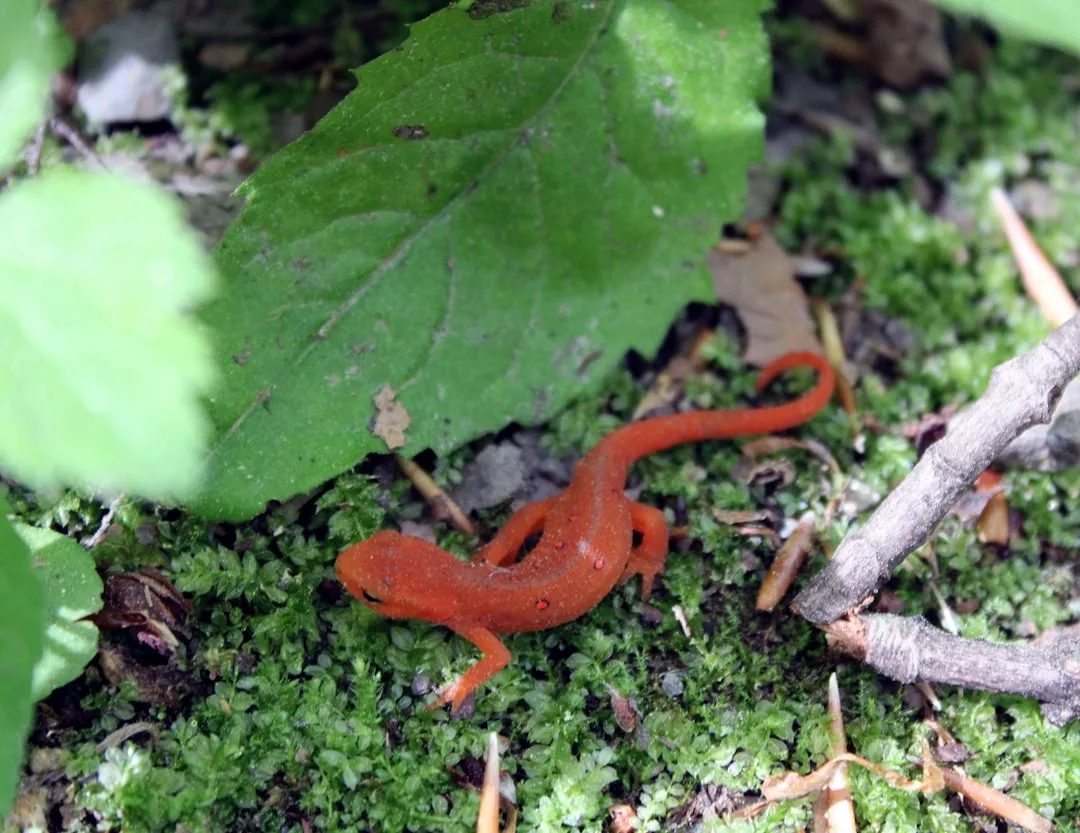
The red-spotted newt (Notophthalmus viridescens) of eastern North America illustrates this pattern dramatically. Its aquatic larvae metamorphose into bright orange-red terrestrial juveniles - red efts - that wander forest floors for two to seven years. Their brilliant coloration advertises their toxicity. After this extended terrestrial phase, they return to ponds and streams, transforming into olive-green aquatic adults for the remainder of their lives.
The Newt-Snake Arms Race
The most extraordinary story in newt biology - and one of the most remarkable examples of coevolution in all of nature - involves the rough-skinned newt (Taricha granulosa) of the Pacific Northwest and the common garter snake (Thamnophis sirtalis) that preys upon it.
Rough-skinned newts produce tetrodotoxin (TTX), the same neurotoxin found in pufferfish, blue-ringed octopuses, and certain species of crabs. TTX blocks sodium channels in nerve and muscle cells, causing paralysis and death. A single rough-skinned newt carries enough tetrodotoxin in its skin to kill several adult humans. In most environments, this chemical defense renders the newt effectively invulnerable to predation.
But in certain populations across Oregon and California, common garter snakes have evolved resistance to TTX through mutations in their sodium channel genes. These resistant snakes can consume rough-skinned newts that would kill virtually any other vertebrate predator. The newts, in response, have evolved to produce even higher concentrations of tetrodotoxin. The snakes, in turn, have evolved even greater resistance.
"What you get is a coevolutionary arms race that has driven both species to extraordinary extremes. Some newt populations produce enough toxin to kill a roomful of people, and some snake populations can shrug off doses that would kill a horse. Neither species benefits from this escalation - the snakes pay a fitness cost in reduced crawl speed, and the newts invest enormous metabolic resources in toxin production. But neither can afford to stop." - Dr. Edmund Brodie III, University of Virginia, evolutionary biologist
This geographic mosaic of coevolution, documented extensively by Edmund Brodie Jr. and Edmund Brodie III over decades of research, has become a cornerstone example in evolutionary biology textbooks. The toxin levels in newts and resistance levels in snakes are tightly correlated on a population-by-population basis - where newts are more toxic, snakes are more resistant, and vice versa. It is an evolutionary ratchet with no apparent endpoint.
Lungless Salamanders: Breathing Through Skin
The family Plethodontidae - the lungless salamanders - is the largest and most diverse family of salamanders, comprising over 470 species, roughly two-thirds of all known salamander diversity. As their name indicates, these animals possess no lungs whatsoever. They breathe entirely through cutaneous and buccopharyngeal respiration: oxygen diffuses through their moist skin and the mucous membranes lining their mouths directly into the bloodstream.
This respiratory strategy imposes strict ecological constraints. Lungless salamanders must keep their skin perpetually moist. They are therefore found almost exclusively in humid microhabitats: beneath rotting logs, in leaf litter, under rocks along stream banks, in the crevices of wet rock faces, and within caves. Many species are active primarily at night or during rain events when ambient humidity is highest.
Despite these constraints, plethodontids have radiated spectacularly. In the Appalachian Mountains of eastern North America - the global epicenter of salamander diversity - more than 50 species of lungless salamanders can be found within a single mountain range.
Plethodon salamanders, the genus that includes the ubiquitous red-backed salamander (Plethodon cinereus), reach biomass densities in some Appalachian forests that exceed the combined biomass of all birds and mammals in the same area. They are among the most numerous vertebrates in temperate forest ecosystems, though their secretive habits make them invisible to most human observers.
Cave Salamanders and the Olm: Life in Eternal Darkness
Several salamander lineages have invaded cave environments and evolved extraordinary adaptations to permanent darkness. The most remarkable of these is the olm (Proteus anguinus), a fully aquatic, cave-dwelling salamander found in the limestone karst systems of southeastern Europe, primarily in Slovenia, Croatia, and Bosnia-Herzegovina.
The olm is Europe's only obligate cave-dwelling vertebrate. It has vestigial eyes covered by skin, having lost functional vision over millions of years of subterranean evolution. Its skin is unpigmented, giving it a pale, pinkish-white appearance that earned it the folk name "human fish" in Slovenian tradition. It navigates its lightless environment using a highly developed lateral line system, electroreception, and acute chemical senses.
But the olm's most astonishing adaptation is its metabolism. Living in nutrient-poor cave environments where food appears unpredictably and infrequently, the olm has evolved the ability to dramatically slow its metabolic rate. Research has demonstrated that olms can survive without any food for up to 10 years by reducing activity to near zero and metabolizing stored lipids at an extraordinarily low rate.
They can live for over 100 years, making the olm one of the longest-lived amphibians known to science. A captive breeding colony in Postojna Cave, Slovenia, has been monitored for decades and has provided invaluable data on the species' biology.
The Science of Regeneration: From Blastema to Bedside
Salamander regeneration is not merely a biological curiosity. It is a field of active, intensive biomedical research with potential applications that could transform human medicine.
The central question is straightforward: if a salamander can rebuild a perfect limb from a stump, why can we not? Mammals share the vast majority of their genes with salamanders. The molecular pathways involved in limb development during embryogenesis - FGF signaling, Wnt signaling, Shh patterning - are conserved across vertebrates.
The raw genetic machinery for building a limb exists in every human cell. Yet when a human loses a finger, the wound heals with scar tissue. No blastema forms. No regeneration occurs.
Researchers have identified several key differences. First, the immune response in salamanders following injury is fundamentally different from that in mammals. Salamanders mount a less inflammatory immune response that favors tissue remodeling over fibrotic scarring.
Second, salamander cells retain the ability to dedifferentiate - to abandon their mature, specialized identity and revert to a progenitor state capable of forming new tissues. Mammalian cells have largely lost this plasticity. Third, the wound epidermis that forms over a salamander amputation site sends specific molecular signals that initiate blastema formation. Mammalian wound healing does not produce equivalent signals.
Recent breakthroughs have been encouraging. In 2019, researchers at Tufts University and Harvard demonstrated that a brief application of a five-drug cocktail delivered via a wearable bioreactor could trigger significant limb regeneration in adult African clawed frogs - an animal that does not normally regenerate limbs. The treated frogs regrew limbs with bone, nerve tissue, and functional movement over 18 months.
While frogs are far closer to salamanders than to humans, the result demonstrated that regenerative potential can be unlocked in animals that have lost it.
The axolotl genome was fully sequenced in 2018 by a team at the Research Institute of Molecular Pathology in Vienna. At approximately 32 billion base pairs, it is roughly 10 times the size of the human genome, making it one of the largest genomes ever sequenced. This achievement has accelerated the identification of genes specifically involved in regeneration and opened new avenues for targeted research.
Conservation Threats: Bsal and the Fungal Apocalypse
As if habitat loss, pollution, and overexploitation were not enough, salamanders now face a devastating emerging infectious disease. Batrachochytrium salamandrivorans (Bsal), a chytrid fungus closely related to the Batrachochytrium dendrobatidis (Bd) that has devastated frog populations worldwide, was first identified in 2013 after it caused the near-complete collapse of fire salamander populations in the Netherlands.
Bsal appears to have originated in East Asia, where native salamander species have coevolved with the fungus and show resistance to its effects. When Bsal arrives in populations with no evolutionary history of exposure - as in Europe and potentially North America - the results are catastrophic. Mortality rates in susceptible species can exceed 90%.
The fungus produces enzymes that digest keratin in salamander skin, causing deep, erosive lesions that compromise the animal's ability to breathe, osmoregulate, and resist secondary infections.
The threat to North American salamanders is particularly alarming because the continent harbors the greatest salamander diversity on Earth, with nearly 200 species concentrated in the Appalachian region. If Bsal were to become established in North America - potentially through the international pet trade in Asian newts and salamanders - the ecological consequences could be devastating.
The United States Fish and Wildlife Service took the precautionary step in 2016 of listing 201 salamander species under the Lacey Act, effectively banning their import and interstate transport to reduce the risk of Bsal introduction.
Habitat loss remains the most pervasive threat to salamanders globally. Deforestation, stream channelization, wetland drainage, and urban development eliminate the moist microhabitats that most salamanders require. Climate change compounds these threats by altering temperature and precipitation patterns, shifting the elevational ranges of suitable habitat, and increasing the frequency of droughts that desiccate the forest floors where terrestrial salamanders live.
A Future Worth Regenerating
Salamanders have survived mass extinctions, continental drift, and the rise and fall of countless ecosystems over 200 million years. Their regenerative abilities represent perhaps the single most medically valuable biological trait in the animal kingdom - a trait that could one day allow humans to regrow damaged tissues, heal spinal cord injuries, and repair failing organs. Their ecological roles as both predators and prey in forest and stream ecosystems are irreplaceable.
Yet we are losing them. We are losing the Chinese giant salamander to luxury dining. We are losing hellbenders to dirty water. We are losing axolotls to urban sprawl. We are losing European fire salamanders to a fungus that human commerce has spread across the globe.
The science of salamander regeneration holds extraordinary promise. But that science depends on the continued existence of the animals themselves - not just as laboratory specimens, but as wild populations embedded in functioning ecosystems. Preserving salamander diversity is not merely an ethical obligation. It is a medical imperative and an ecological necessity.
The masters of regeneration need us to return the favor.
References
Voss, S.R., et al. (2018). "The genome of the axolotl, Ambystoma mexicanum." Nature, 554(7690), 50-55.
Yan, F., et al. (2018). "The Chinese giant salamander exemplifies the hidden extinction of cryptic species." Current Biology, 28(10), R590-R592.
Martel, A., et al. (2013). "Batrachochytrium salamandrivorans sp. nov. causes lethal chytridiomycosis in salamanders." Proceedings of the National Academy of Sciences, 110(38), 15325-15329.
Brodie, E.D. III, & Brodie, E.D. Jr. (1999). "Predator-prey arms races: Asymmetrical selection on predators and prey may be reduced when prey are dangerous." BioScience, 49(7), 557-568.
Muneoka, K., Han, M., & Gardiner, D.M. (2009). "Regrowing human limbs." Scientific American, 298(4), 56-63.
Zambrano, L., et al. (2020). "Long-term population assessment of the axolotl in the remnants of Lake Xochimilco." Hydrobiologia, 847, 2895-2907.
Voyles, J., et al. (2019). "Shifts in disease dynamics in a tropical amphibian assemblage are not due to pathogen attenuation." Science, 359(6383), 1517-1519.
Frequently Asked Questions
Can axolotls really regenerate their brains and other organs?
Yes, axolotls possess the most extensive regenerative abilities of any vertebrate. They can regrow entire limbs complete with bones, muscles, nerves, and blood vessels. They can also regenerate portions of their brain, their spinal cord, heart tissue, and even their eyes.
Unlike mammals, which heal injuries with scar tissue, axolotls form a structure called a blastema at the wound site - a mass of dedifferentiated cells that can redevelop into any tissue type needed. An axolotl can regenerate the same limb repeatedly throughout its life with no loss of function or fidelity. This extraordinary ability has made the axolotl one of the most studied animals in regenerative medicine research.
How do salamanders breathe without lungs?
The family Plethodontidae, known as lungless salamanders, is the largest salamander family with over 470 species, and none of them possess lungs. They breathe entirely through their skin and the lining of their mouths in a process called cutaneous respiration. Oxygen dissolves into the thin, moist mucus layer coating their skin and diffuses directly into capillaries beneath the surface. Carbon dioxide exits the same way.
This method of breathing requires their skin to remain constantly moist, which is why lungless salamanders are typically found in damp forest floors, stream banks, and cave environments. Some species also have nasolabial grooves - tiny channels running from the nostril to the upper lip - that help with chemoreception rather than breathing.
How large can giant salamanders get, and are they endangered?
The Chinese giant salamander (Andrias davidianus) is the largest living amphibian on Earth, historically reaching lengths of up to 1.8 meters (nearly 6 feet) and weights exceeding 50 kilograms. However, individuals of this size are now essentially nonexistent in the wild. The species is critically endangered, driven to near-extinction primarily by overharvesting for the luxury food trade and habitat destruction.
Although China operates thousands of giant salamander farms, conservation geneticists have found that farm operations actually threaten wild populations by releasing commercially bred hybrids that dilute the genetics of distinct wild lineages.
The closely related Japanese giant salamander (Andrias japonicus) reaches about 1.5 meters and faces similar habitat pressures, though it has received stronger legal protection in Japan, where it is designated a national natural monument.