
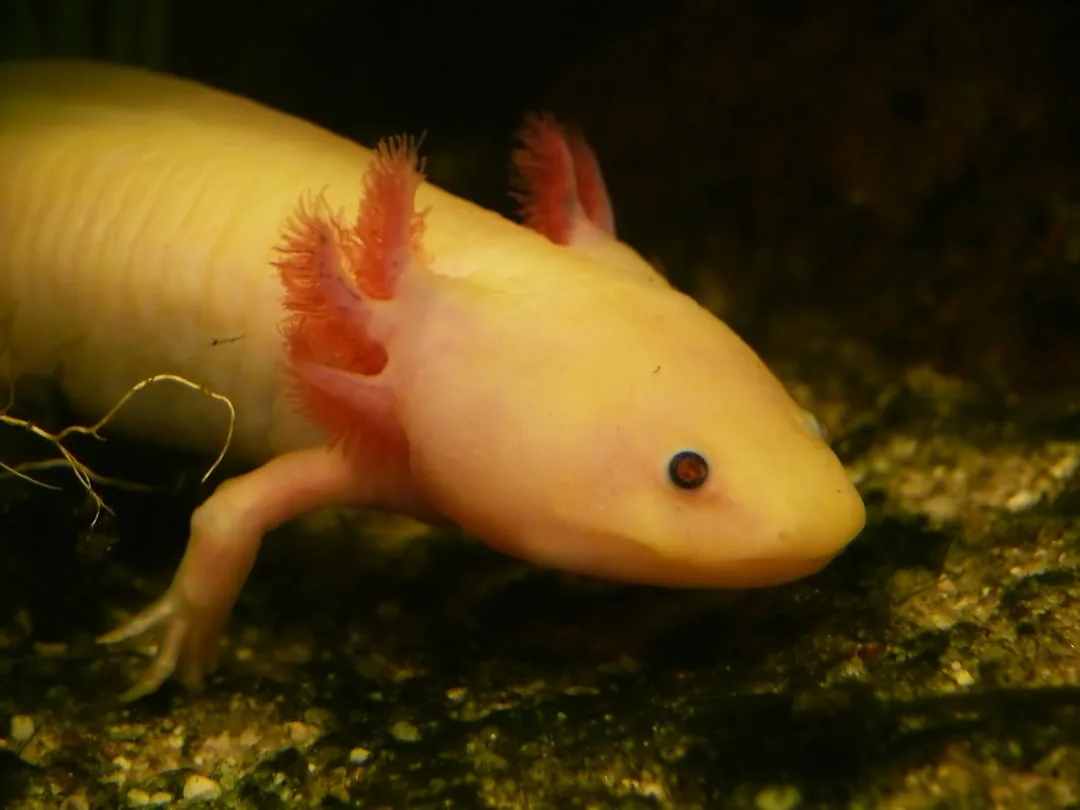
What can axolotls regenerate?
Axolotls can regenerate entire limbs including bones, muscles, nerves, and blood vessels - with no scarring and full function restored. They also regenerate heart tissue, spinal cord sections, parts of their brain (including complex optic structures), sections of their jaw, gills, tail, and even reproductive organs.
The Biology That Seems Impossible
Cut off an axolotl's arm and in three months it grows back - not just a copy, but an entire new arm with bones, muscles, blood vessels, and nerves arranged exactly as they were. Cut off both arms and both regrow. Cut out a section of the heart - it regenerates. Damage part of the spinal cord - it rebuilds. Remove parts of the brain and, remarkably, the brain grows back.
The axolotl does all this without scarring. The new limb looks and functions identical to the original. You cannot tell, after regeneration is complete, that anything was ever amputated.
No other vertebrate can do this. Humans heal wounds by scarring. Most lizards can drop a tail that regrows into something simpler than the original. A few other salamanders have partial regeneration abilities. Only the axolotl regenerates at this level, with this consistency, for all body parts including the most complex structures.
This biology has made the axolotl one of the most important research animals in biomedical science. Understanding how it regenerates could eventually transform human medicine.
What Can Be Regenerated
Axolotls have been experimentally tested to regrow:
Entire limbs. Both arms and legs, including all tissue types. Regeneration time: 40-90 days depending on limb size.
Tail. Including spinal cord extension, musculature, and skin.
Jaw sections. Both upper and lower jaw can regrow bone, teeth, muscles, and associated structures.
Heart tissue. Damaged heart sections regenerate with full function restored.
Spinal cord. Complete severance followed by regrowth, with nerve function restored.
Eyes. Including retina, lens, cornea, and optic nerve in some cases.
Brain sections. Significant portions of the brain can regenerate. Complex brain structures including the optic tectum (visual processing region) rebuild with functional connections.
Gills. The external gills that characterize axolotls regrow fully if damaged.
Reproductive organs. Reproductive tissue regenerates, though fertility after severe damage is not always preserved.
Skin and external tissue. Standard tissue replacement without scarring.
The breadth of regenerative capability is unmatched in any other vertebrate. Axolotls can essentially rebuild any lost body part given time.
How Regeneration Actually Works
The process of axolotl regeneration has been studied extensively. The basic sequence is understood even if the molecular details are still being worked out.
The stages of limb regeneration:
Stage 1: Wound healing
When a limb is amputated, cells near the wound rapidly migrate to cover the exposed tissue. This initial wound covering takes hours to days. Unlike human healing, no scar tissue forms - the wound cover is minimal and temporary.
Stage 2: Dedifferentiation
The specialized cells beneath the wound covering - muscle cells, bone cells, nerve cells, skin cells - begin to dedifferentiate. This means they revert from their specialized functions back to a more primitive, stem-cell-like state.
This is extraordinary. In most animals, once cells specialize, they stay specialized. A human muscle cell remains a muscle cell forever. In axolotls, cells can literally reverse their developmental path, becoming pluripotent progenitor cells capable of becoming anything.
Stage 3: Blastema formation
The dedifferentiated cells accumulate at the amputation site, forming a structure called a blastema. This is a mass of proliferating progenitor cells that looks almost like an embryonic limb bud.
The blastema grows rapidly, doubling in size every few days during peak regeneration.
Stage 4: Redifferentiation
Cells within the blastema begin to differentiate into the tissues of the new limb. Some become bone cells, others become muscle cells, others become blood vessels, nerves, and skin. The pattern of differentiation matches the original limb structure precisely.
This pattern matching is one of the most puzzling aspects of axolotl regeneration. The blastema "knows" what kind of limb to build based on where it is on the body. A blastema at the shoulder builds an entire arm; a blastema on the hand builds only a hand.
Stage 5: Pattern formation and growth
The new limb grows outward from the amputation site, with tissues organizing into the correct anatomical arrangement. Muscle fibers align properly. Bone forms in the right positions. Nerves grow toward the right targets. Blood vessels connect correctly.
Stage 6: Completion
After 40-90 days, the new limb is complete. Size, proportions, and function match the original. Movement, sensation, and all normal limb functions are restored.
The Genetic Machinery
Research over the past two decades has identified many of the genes involved in axolotl regeneration.
Key genes:
- AMBLOX. Specific to axolotls, involved in blastema formation
- Meis genes. Regulate limb development, reactivated during regeneration
- Wnt signaling. Controls cell proliferation during regeneration
- BMP signaling. Orchestrates pattern formation in new tissues
- Fgf8. Critical for establishing the basic limb pattern
The axolotl genome is enormous - approximately 10 times the size of the human genome at 32 billion base pairs. Many genes exist in multiple copies, and the regenerative genes have been duplicated and modified in ways that enabled this extraordinary capability.
Sequencing the axolotl genome was a major scientific undertaking completed in 2018. The large genome size had delayed sequencing efforts for years. With the full genome available, researchers can now identify specific genetic differences between axolotls and non-regenerative vertebrates.
What we have learned:
Most regeneration-relevant genes exist in humans too. The difference is not primarily in the genes themselves but in their regulation - which genes activate when, in which cells, at what levels.
Humans have essentially the same genetic toolkit as axolotls but different operating instructions. This is actually encouraging for medical applications - we do not need to insert new genes, we need to change how existing genes are regulated.
Why Can't Humans Regenerate?
If axolotls and humans share much of the same regeneration machinery, why can't humans regenerate?
Evolutionary divergence:
Humans and axolotls last shared common ancestors approximately 360 million years ago. Since then, the mammalian lineage has lost complex regeneration capabilities that the salamander lineage retained.
Why mammals might have lost regeneration:
Several hypotheses:
Faster wound healing. Mammals heal wounds quickly through scarring, which reduces infection risk. In the time it takes an axolotl to regenerate a limb (40-90 days), a mammal with a similar injury could die from infection before regeneration completed.
Cancer prevention. The processes involved in regeneration - cell dedifferentiation, rapid proliferation - resemble processes in cancer. Mammalian evolution may have suppressed regeneration partly as cancer prevention.
Warm-blooded physiology. Mammals maintain high body temperatures, making us more vulnerable to infection and less tolerant of slow healing processes. Axolotls are cold-blooded and metabolically slower.
Size difference. Regenerating a human limb would require massive amounts of cellular material and years of time. Smaller animals can regenerate smaller structures faster.
The scarring default:
Humans retain some regenerative capability. The liver can regrow after partial removal. Bone heals through new bone formation. Skin renews continuously. These are limited, specialized regeneration processes - not comparable to what axolotls do.
When humans have serious injuries to limbs, the body's default response is scarring rather than regeneration. Scarring is essentially "quick fix" healing that prioritizes speed over perfection.
Medical Research Applications
Axolotl research has direct implications for human medicine, though practical applications remain distant.
Potential research outcomes:
Spinal cord injury treatment. If axolotl spinal cord regeneration can be replicated in humans, paralysis from spinal cord injuries might become treatable. This is a major research focus.
Heart attack recovery. Axolotl heart regeneration provides a template for potentially regrowing human heart tissue damaged by heart attacks.
Limb regeneration. Long-term goal of regrowing human limbs after amputation. Still very distant but conceptually possible.
Diabetic wound healing. People with diabetes often heal wounds poorly. Understanding better regeneration mechanisms could provide treatment approaches.
Organ regeneration. Regrowing damaged organs would eliminate the need for transplants.
Scar reduction. Even if full regeneration is not achieved, reducing scarring after surgery or injury would improve many medical outcomes.
Ongoing research programs:
Major research centers working on axolotl-inspired regeneration include:
- University of Kentucky's Ambystoma Genetic Stock Center
- University College London
- Max Planck Institute for Cell Biology and Genetics (Dresden)
- MDIBL (Mount Desert Island Biological Laboratory)
- Various U.S. academic medical centers
Most research is basic science currently. Practical applications to humans face significant challenges because human biology differs from axolotl biology in ways that matter for regeneration.
Neoteny: The Permanent Child
One of the strangest aspects of axolotl biology is that they never grow up.
Most salamanders:
Most salamander species have two distinct life stages. Larvae live in water, breathing through gills and having a tadpole-like body shape. Adults undergo metamorphosis - they lose their gills, develop lungs, and move onto land with a different body plan.
Axolotls skip metamorphosis:
Axolotls remain in larval form for their entire lives. They keep their external gills. They remain aquatic. They never develop the terrestrial adult body plan typical of other salamanders. This is called neoteny or paedomorphosis.
They do reach sexual maturity and can reproduce, but they do so in what is essentially an oversized juvenile body.
The hormonal basis:
Normal salamander metamorphosis is triggered by thyroid hormone. Axolotls have reduced thyroid hormone production, so metamorphosis never occurs.
Injecting axolotls with thyroid hormone actually induces metamorphosis - they can undergo the transformation other salamanders naturally experience. However:
- The induced metamorphosis shortens their lifespan dramatically (from 15 years to about 5 years)
- The transformed adults are less healthy than naturally neotenic individuals
- They lose their regenerative capabilities
This suggests neoteny is essential to axolotl regeneration. The capacity to regrow complex structures may require the specific hormonal and developmental state of permanent larvae.
Evolutionary context:
Axolotls evolved neoteny as an adaptation to their specific environment. Their native Lake Xochimilco (and other Mexican lakes historically) provided abundant aquatic resources with limited need for terrestrial movement. The species could thrive entirely in water, so the metamorphosis stage was evolutionarily disadvantageous - it required energy and produced less well-suited body forms.
The species essentially accepted permanent juvenile form in exchange for optimizing their aquatic lifestyle. This evolutionary trade-off unexpectedly preserved the regenerative abilities that make axolotls so scientifically valuable.
Native Habitat
Axolotls are native to just a few lakes in the Mexico City area - Lake Xochimilco and, historically, Lake Chalco. Both lakes were part of the ancient lake system that covered the Mexico Valley before Spanish colonization.
The lake system:
The pre-Columbian Mexico Valley had five interconnected lakes:
- Lake Xochimilco (south)
- Lake Chalco (south)
- Lake Texcoco (central)
- Lake Xaltocán (north)
- Lake Zumpango (north)
Aztec civilization built Tenochtitlan (the ancient city that became Mexico City) on Lake Texcoco, eventually draining it in Spanish times. Lake Chalco was drained in the 19th century. Today only Lake Xochimilco remains, and it has been dramatically reduced from its original size.
Axolotl populations:
Axolotls once inhabited Lake Xochimilco and Lake Chalco in enormous numbers. They were an important food source for Aztec civilization and continued to be eaten in Mexico through the 20th century.
With Lake Chalco drained and Lake Xochimilco severely degraded, axolotls have nearly disappeared from the wild. Current wild population estimates are below 1,000 individuals.
Current conservation status:
Classified as Critically Endangered by the IUCN since 2009. Many researchers believe the wild population may be functionally extinct - too few individuals remaining to sustain reproduction without active intervention.
Wild recovery obstacles:
- Lake Xochimilco water quality is severely polluted
- Introduced fish species (tilapia, carp) eat axolotl eggs and young
- Urban encroachment from Mexico City continues reducing available habitat
- Climate change affects water temperatures and levels
Conservation efforts focus on:
- Creating protected micro-habitats (called chinampas) where water quality can be managed
- Breeding captive axolotls for potential future reintroduction
- Public education about the species' cultural and scientific importance
- Water quality restoration in remaining habitat
Captive Populations
While wild axolotls are nearly extinct, millions live in captivity worldwide.
Research populations:
Major research institutions maintain axolotl colonies for scientific study. The largest captive population is at the Ambystoma Genetic Stock Center at the University of Kentucky, which houses approximately 3,000 axolotls and maintains genetic diversity through coordinated breeding.
Other major research colonies exist at institutions in Germany, the United Kingdom, China, and Japan. Total research population globally exceeds 10,000 axolotls.
Pet trade populations:
Axolotls have become popular exotic pets, particularly in the past decade as they gained internet fame. Estimates suggest 1-2 million axolotls live in pet trade populations in the United States, Europe, and Asia.
Pet axolotls are relatively easy to care for compared to many aquatic species. They require:
- Cool water (15-20°C)
- Filtered aquariums
- Specific diet (primarily pellets, bloodworms, and small aquatic invertebrates)
- Minimal handling (their skin is delicate)
- Adequate space (20+ gallon tanks for adults)
Pet populations preserve the species in terms of total numbers, but the genetic diversity of pet populations is limited. Most pet axolotls descend from a small number of laboratory lines brought into the pet trade in the 1980s.
Genetic bottleneck:
All captive axolotls - research and pet - trace their ancestry to small founding populations. Genetic diversity is significantly reduced compared to the historical wild population.
This poses long-term concerns for the species. If wild populations go extinct and all axolotls descend from limited captive genetics, the species may face future problems from inbreeding, including increased disease susceptibility and reduced fertility.
The Colors
Most pet axolotls do not look like wild axolotls. Captive breeding has produced multiple color varieties:
Wild type: Dark olive green to brown with dark spots. Resembles the actual color of wild axolotls in Lake Xochimilco.
Leucistic: Pink-tinged white body with dark eyes. The most famous pet axolotl variant.
Albino: White body with red eyes, no melanin production.
Golden albino: Yellow-orange coloration with golden eyes.
Melanoid: Solid black with no lighter spots.
Copper: Reddish-brown body.
GFP (Green Fluorescent Protein): Axolotls genetically modified to glow green under UV light. Originally created for research purposes, some have entered the pet trade.
Chimera: Axolotls with multiple color patterns, sometimes created through embryonic manipulation.
The variety of colors has made axolotls visually distinctive pets. Wild axolotls are much more subdued in appearance than the famous leucistic pet variety.
Cultural Significance
Axolotls have had cultural significance in Mexico for thousands of years.
In Aztec mythology:
The axolotl is associated with Xolotl, the Aztec god of lightning, fire, and the underworld. According to Aztec mythology, the gods were to be sacrificed to bring forth the new sun. Xolotl refused this fate and transformed himself into various creatures to escape, eventually becoming an axolotl in Lake Xochimilco.
The word "axolotl" comes from Nahuatl (Aztec language) and means "water monster" or "water dog."
In modern Mexican culture:
Axolotls appear in Mexican literature, art, and popular culture. The poet Octavio Paz wrote about them. Contemporary Mexican artists frequently feature axolotls in paintings, sculptures, and crafts.
Mexico City features axolotl imagery on buildings, murals, and public art. The species has become a cultural symbol of Mexico's biological and historical heritage.
Internet fame:
Since the 2010s, axolotls have become globally recognized through internet culture. Their distinctive appearance - external gills waving like hair ornaments, tiny smile-like mouth shape, bright colors - has made them popular subjects of social media content.
Minecraft added axolotls as an in-game creature in 2021, introducing the species to millions of young people worldwide. This has likely increased both pet ownership and conservation awareness.
The Research Value
Understanding axolotl biology has generated scientific insights that extend beyond the species.
Regeneration research:
Axolotl regeneration is being studied for direct medical applications. Active research programs aim to:
- Identify specific genes and pathways controlling regeneration
- Develop methods to activate equivalent pathways in human cells
- Apply regenerative principles to wound healing
- Inform tissue engineering approaches
Developmental biology:
Axolotl embryonic development provides a natural experiment in vertebrate development. Studying how axolotl embryos form limbs informs understanding of how limbs form in all vertebrates, including humans.
Genomics:
The axolotl genome contains unusual features - massive size, extensive duplicated regions, specific regulatory elements. Studying this genome informs broader understanding of vertebrate genetics and evolution.
Comparative biology:
Comparing axolotl biology to human biology reveals which features are universal to all vertebrates versus which are specific to regeneration capability. This comparative approach helps identify targets for medical intervention.
Conservation genomics:
Understanding axolotl genetics informs conservation strategies for the wild population. Genetic diversity analyses guide breeding programs and help maintain species viability.
The Future
The axolotl's future is uncertain in the wild but secure in captivity.
Wild population prospects:
Complete extinction of wild axolotls appears likely within decades barring major conservation breakthroughs. Lake Xochimilco continues degrading, invasive species persist, and urban pressure continues.
Some researchers argue the wild axolotl is already functionally extinct - the remaining handful of wild individuals cannot sustain a viable population. Future efforts may focus on restoration of the species through captive-bred reintroductions.
Captive population prospects:
Millions of axolotls will continue living in research laboratories, breeding facilities, and as pets for the foreseeable future. The species cannot go extinct as long as captive populations are maintained.
However, captive populations face their own challenges - genetic bottlenecks, disease outbreaks, and changing regulations. Long-term preservation requires active management.
Scientific contribution:
Regardless of wild status, axolotl research will continue producing insights that benefit medicine and biology. The species' contributions to scientific knowledge are already substantial and will likely grow in coming decades.
The paradox:
Axolotls may become one of the first species to go extinct in the wild while flourishing in captivity and contributing essential knowledge to human medicine. The species essential to our understanding of regeneration itself may be lost from nature before we fully understand what it can teach us.
Why Axolotls Matter
The axolotl is not just an unusual salamander. It represents a biological possibility that exists nowhere else in the vertebrate world. Their regenerative capacity was once shared by a broader group of ancient amphibians, but we have lost it. They preserve an ancient biological gift.
If we lose wild axolotls, we do not just lose a species - we lose the last reminder that the regenerative abilities latent in our own genome were once more fully expressed in our evolutionary ancestors. We lose the connection to a biology that could still, potentially, be recovered if we understand it well enough.
And we lose something even more fundamental: the only vertebrate that can regrow its own brain. That specific biological achievement exists in just this one species. Nothing else in the vertebrate world regenerates brain tissue to the extent axolotls do.
The axolotl is a living library of biology we cannot replicate. Every axolotl in Lake Xochimilco that survives another year is a continuation of 350+ million years of evolution producing a specific set of biological capabilities we have only begun to understand.
The medical implications of axolotl research could transform how we treat spinal cord injuries, heart attacks, traumatic injuries, diabetes complications, and many other conditions. Complete practical applications remain distant. But the research is advancing, and every insight brings us closer to capabilities that would have seemed impossible a generation ago.
Somewhere in a small protected area of Lake Xochimilco, an axolotl is swimming tonight. Her species is on the edge of extinction. Her genes contain biological secrets that could someday help humans recover from paralysis, regrow damaged hearts, and heal without scarring.
Her continued existence may matter more than we currently recognize.
What Animals Can Regenerate a Limb?
The axolotl (Ambystoma mexicanum) is the gold standard - it regrows entire limbs in 40-90 days, complete with bones, muscles, blood vessels, and nerves, with no scarring. Other urodele amphibians including newts and adult salamanders can regenerate limbs, though often less completely. Starfish regrow lost arms and can even regenerate from a single arm fragment containing part of the central disc.
Some lizards drop and regrow tails (though the regenerated tail is cartilaginous rather than bony). Crabs and lobsters regrow lost claws and legs through successive molts. Planaria flatworms regenerate entire bodies from tiny fragments. Hydra and some sea cucumbers regrow everything.
Among vertebrates, the axolotl's regenerative breadth - limbs, heart, spinal cord, jaw, optic tectum, even brain sections - remains unmatched.
What Animals Can Regenerate Their Body?
The axolotl regenerates essentially every body part, including limbs (40-90 days), tail with spinal cord, jaw sections with teeth, heart tissue, severed spinal cord, eye components, brain structures like the optic tectum, gills, and reproductive organs - all without scarring.
Planaria flatworms regrow complete bodies from fragments as small as 1/279th of the original, thanks to pluripotent stem cells called neoblasts. Hydra can reassemble from disaggregated cell populations. Some sea cucumbers eviscerate their internal organs as defense and regrow them. Starfish of genus Linckia can regenerate from a single arm.
Among vertebrates only the axolotl approaches such whole-body regenerative breadth, which is why the species has become one of the most important research animals in regenerative medicine.
What Are Three Types of Animals That Can Regenerate?
Three major regeneration champions represent different strategies. First, amphibians - the axolotl (Ambystoma mexicanum) regrows limbs, heart tissue, spinal cord, jaw sections, and brain regions like the optic tectum without scarring, in 40-90 days depending on limb size.
Second, echinoderms - starfish regrow lost arms and species like Linckia guildingii can regenerate an entire body from a single arm with part of the central disc. Third, flatworms - planarians regenerate complete animals from fragments as small as 1/279th of the original body using neoblast stem cells.
Beyond these, hydra, sea cucumbers, crabs, lobsters, and some lizards demonstrate partial regeneration. The axolotl stands alone among vertebrates for the breadth and fidelity of its regenerative capacity.
Related Articles
- Salamanders and Newts: The Masters of Regeneration
- Frogs and Toads: The Amphibians Vanishing Before Our Eyes
- Immortal Jellyfish: How Turritopsis Dohrnii Cheats Death
Frequently Asked Questions
What can axolotls regenerate?
Axolotls can regenerate entire limbs including bones, muscles, nerves, and blood vessels - with no scarring and full function restored. They also regenerate heart tissue, spinal cord sections, parts of their brain (including complex optic structures), sections of their jaw, gills, tail, and even reproductive organs.
An amputated axolotl limb regrows completely in approximately 40-90 days, producing a new limb that is structurally and functionally identical to the original. The regenerated limb is not a repair or a scar - it is an entirely new limb that develops through a process resembling embryonic growth. No other vertebrate can regenerate at this level. Humans heal wounds by forming scar tissue; axolotls rebuild missing body parts from scratch.
How do axolotls actually regenerate limbs?
Axolotl regeneration works through a process called dedifferentiation. When an axolotl loses a limb, cells at the amputation site first form a wound covering, then the underlying cells ‘dedifferentiate’ - they revert from being specialized cells (muscle, skin, etc.) back to unspecialized progenitor cells. These progenitor cells multiply rapidly, forming a mass called a blastema.
The blastema then differentiates into all the tissues needed for the new limb - bone, muscle, nerves, blood vessels, skin - in the correct proportions and positions. The entire process takes 40-90 days depending on the limb complexity. This is essentially the opposite of how human wound healing works. We build scar tissue by rapidly covering wounds with different cell types.
Axolotls dissolve the specialization barriers between cell types and rebuild from scratch.
Why can't humans regenerate limbs like axolotls?
Humans and axolotls diverged from common ancestors approximately 360 million years ago. During this time, mammalian ancestors lost the regeneration capabilities that were preserved in salamanders. The evolutionary trade-off appears to have favored faster wound healing through scarring (which reduces infection risk) over the slower, more complex regeneration process.
Humans have some regenerative capabilities - we regrow liver tissue, repair bone fractures, and replace skin cells continuously - but we cannot regrow complete complex structures like limbs. Research suggests the genes for regeneration still exist in human DNA but are regulated differently. Some labs are working to activate these pathways in human cells experimentally.
Success remains distant, but understanding axolotl regeneration is slowly revealing which genes control the process and how they might eventually be activated therapeutically in humans.
Why do axolotls never mature into adults like other salamanders?
Axolotls exhibit a condition called neoteny - they retain juvenile features (external gills, aquatic lifestyle, tadpole-like body shape) throughout their adult lives. Most salamanders metamorphose from aquatic larvae into terrestrial adults, but axolotls skip this transformation entirely. They reach sexual maturity while still in their larval body plan. This is caused by inadequate production of thyroid hormone, which normally triggers metamorphosis.
Axolotls can actually be induced to metamorphose through hormone injection, but it shortens their lifespan dramatically (from 15 years to approximately 5 years) and produces a less healthy animal. Their natural neoteny appears to be an evolutionary adaptation to their specific environment - the cold, high-altitude lakes of Mexico where terrestrial life would be inhospitable.
The permanent juvenile state is part of what enables their extraordinary regenerative abilities.
Are axolotls extinct in the wild?
Axolotls are on the brink of extinction in the wild. Fewer than 1,000 individuals remain in their native Lake Xochimilco ecosystem near Mexico City. The species was formally classified as Critically Endangered by the IUCN in 2009, and most current experts believe the wild population may already be functionally extinct.
Threats include water pollution, habitat destruction, invasive fish species (tilapia and carp that eat axolotl eggs and young), and urban encroachment. Mexico City now surrounds Lake Xochimilco and continues expanding. Ironically, millions of axolotls live in captivity worldwide - in research laboratories, pet trade populations, and specialized breeding facilities.
The captive populations are genetically homogeneous descendants of a small founding group, but they preserve the species. If wild populations go completely extinct, reintroduction from captive stocks may eventually be attempted, though restoring the lake ecosystem they need is the greater challenge.