
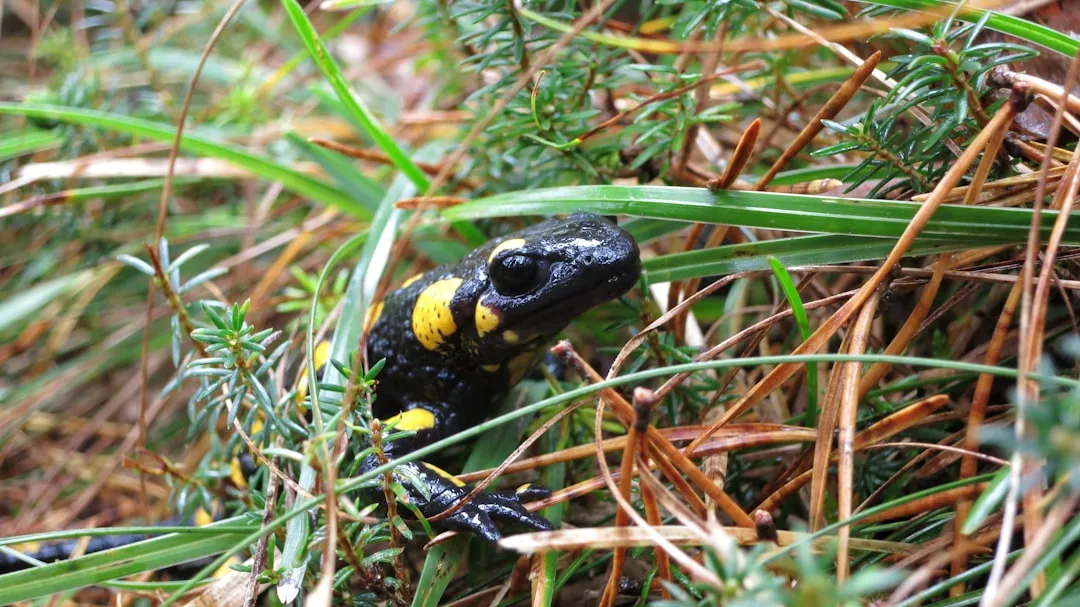
The fire salamander is the most famous amphibian in European folklore and one of the most biologically unusual salamanders in the world. Unlike the vast majority of its relatives, Salamandra salamandra does not lay eggs in still water and watch them drift off to become someone else's problem.
Several of its populations are live-bearing, producing fully formed miniature adults that never experience a free-swimming larval stage. Its skin secretes one of the most potent steroidal alkaloid toxins in the amphibian world. It can regenerate lost limbs and even sections of heart tissue. It can live half a century in captivity. And its name is the root of a myth so persistent that the animal became a medieval symbol for the element fire itself.
This guide covers every major aspect of fire salamander biology and ecology: size, colouration, habitat, diet, reproduction, the samandarin toxin, regenerative biology, subspecies, conservation status, and the relationship between fire salamanders and humans. It is a reference entry, not a summary - so expect specifics: centimetres, grams, subspecies, toxicology, and verified records.
Etymology and Classification
The scientific name Salamandra salamandra is a tautonym - genus and species use the same word - and both descend from the Greek salamandra, meaning simply "salamander". The animal known to Aristotle and Pliny under that name was almost certainly this species, since S. salamandra is the only large, conspicuous, forest-dwelling salamander across most of the Greco-Roman world.
The entire order Urodela, the family Salamandridae, and the genus Salamandra all trace their modern taxonomic names to this one animal.
Fire salamanders sit inside a well-studied branch of the salamander family tree.
- Kingdom: Animalia
- Phylum: Chordata
- Class: Amphibia
- Order: Urodela (tailed amphibians)
- Family: Salamandridae (true salamanders and newts)
- Genus: Salamandra
- Species: S. salamandra
The genus Salamandra contains only six species, all of them terrestrial, all of them toxic, and all of them restricted to the Western Palaearctic. The fire salamander's closest relatives include the alpine salamander (Salamandra atra), which is fully viviparous, and the Corsican fire salamander (Salamandra corsica), which was split from S. salamandra on genetic grounds in the last two decades.
Current taxonomy recognises 13 subspecies of S. salamandra, though several of these are under active debate and some herpetologists argue they deserve full species status.
Size and Physical Description
Fire salamanders are among the largest salamanders in Europe. Adults are easy to identify on sight because of the unmistakable glossy black body marked with bright yellow or orange patches.
Typical adult dimensions:
- Length: 15-25 cm from snout to tail tip
- Weight: 30-40 g, up to 50 g in well-fed animals
- Body: stocky, with a broad head and short limbs
- Tail: round in cross-section, roughly as long as the body
Larger subspecies in Iberia and the Balkans occasionally exceed 30 cm, while certain isolated island and mountain forms are noticeably smaller. Females are slightly larger and heavier on average, particularly when carrying developing larvae inside the body.
The skin is smooth, moist, and very glossy, covered in microscopic mucous glands that keep the animal from drying out. Larger, concentrated venom-producing glands form two obvious swellings on the head just behind the eyes - the paired parotoid glands - and smaller glands run in two parallel rows down the back.
The pattern of yellow on black varies so widely that field researchers use it as an individual identifier. Some animals are almost all black with small golden dots. Others have long yellow stripes running from head to tail. A few populations, such as S. s. alfredschmidti, have so much yellow that the black is reduced to thin lines.
Every healthy adult carries a unique pattern, and the pattern does not change significantly through adult life, so a single good photograph is enough to re-identify a wild fire salamander years later.
Colouration, Aposematism, and Visual Ecology
The bright yellow-on-black pattern is aposematic - a warning signal honestly advertising the animal's toxicity. Predators with colour vision, especially birds, learn after one bad experience to avoid anything that looks like a fire salamander. This is an expensive strategy to evolve because it requires the toxin and the bright pattern to work together, but it pays off by making the salamander effectively invisible to experienced predators even in broad daylight on a wet forest path.
Aposematism only works if the animal stands out. Fire salamanders do nothing to blend in. They move slowly, often in the open, and make no attempt to hide their colours when disturbed. Several other European amphibians, including the alpine newt and various frog species, mimic similar warning patterns, though fire salamanders appear to be the original model.
Fire salamander vision is unremarkable - the animals rely far more on scent, vibration, and tactile cues than on sight - but their own pattern evolution is driven by the vision of their predators. Populations in shaded Mediterranean oak forests tend to have more yellow than populations in darker central European beech forests, presumably because the warning pattern needs to be visible against the local background.
Skin Toxins: Samandarin
The defining chemical weapon of the fire salamander is samandarin. This is a complex steroidal alkaloid - a nitrogen-containing compound built on the same carbon skeleton as cholesterol but heavily modified into a neurotoxin. Samandarin and several related molecules (samandarone, samanine, cycloneosamandione) are produced in the skin glands, stored, and released in a milky secretion when the animal is attacked or handled roughly.
Effects of samandarin exposure:
| Exposure route | Typical effect on small mammals | Effect on humans |
|---|---|---|
| Skin contact | Mild irritation, salivation | Local burning, redness, mild swelling |
| Eye contact | Severe inflammation, temporary blindness | Intense pain, tearing, brief blurring |
| Oral ingestion | Muscle spasms, high blood pressure, convulsions | Nausea, cramps, rarely severe symptoms |
| Bloodstream entry | Paralysis, respiratory arrest, death | Hospital-level emergency, potentially fatal |
The toxin is potent enough to kill a dog that bites down on an adult fire salamander hard enough to rupture the skin glands. Cats that mouth a salamander typically vomit and salivate heavily for hours. Small predators such as weasels and stoats are occasionally killed outright.
For humans the risk is usually mild, but handling requires care. The toxin crosses mucous membranes easily. Touching the eyes, mouth, or an open cut after handling a fire salamander is a bad idea, and washing hands thoroughly with soap after any contact is essential. Fire salamanders can also eject a thin stream of secretion toward a threat, reaching as far as a metre, usually aimed at the face.
The ejected droplets do not always fly in a straight line, so simply holding the animal "safely" is no guarantee of avoiding the toxin.
The steroidal alkaloids are also a rare example of a vertebrate producing its own defensive toxin from scratch. Most poisonous amphibians - poison dart frogs are the most famous example - acquire their toxins from diet. Fire salamanders biosynthesise samandarin in the glands themselves, which is why captive-bred animals on insect diets remain fully toxic.
Habitat and Range
Fire salamanders need three features of a landscape simultaneously. Remove any one and the population fails.
- Dense deciduous or mixed woodland. Leaf litter, rotting logs, and thick moss provide daytime shelter, humidity, and the invertebrate prey that supports the adult.
- Constant high humidity. Fire salamanders breathe partly through the skin and rehydrate through the belly skin. They cannot survive in dry open habitats.
- Clean, cool, slow-flowing water nearby. For ovoviviparous populations the larvae need a stream, pond, or forest pool. For fully viviparous populations this requirement is relaxed.
Geographic range:
- Europe from northern Portugal east to Ukraine and Greece
- North Africa: Morocco, northern Algeria
- Middle East: northwestern Iran, northern and southern Turkey, the Levant
- Elevation: sea level up to about 2,500 metres (Pyrenees, Atlas, Caucasus)
Fire salamanders are absent from the British Isles, Ireland, Scandinavia north of southern Sweden, the southern Iberian plateau's driest zones, and most Mediterranean islands. Several of these absences reflect post-glacial recolonisation failures rather than unsuitable current climate.
Behaviour and Activity
Fire salamanders are strictly nocturnal and crepuscular except during heavy daytime rain. On a wet spring night after warm rain, a single hectare of good European beech forest can produce dozens of active adults within an hour. On a dry summer day the same hectare reveals no sign of salamanders at all - every animal is deep inside a log, stone cavity, or mammal burrow, breathing slowly, waiting for humidity to rise.
Activity triggers:
- Air temperature between 5 and 18 degrees Celsius
- Relative humidity above 85 per cent, ideally close to 100
- Recent rainfall within the previous 24 hours
- Low wind
- Night or deep overcast
Fire salamanders are solitary outside the breeding season but tolerate each other well. Individuals maintain small home ranges of just a few dozen to a few hundred square metres, often using the same daytime refuge for years at a time. Males become briefly territorial during courtship, but actual fights are rare - serious injuries would be difficult to survive in an animal that relies on intact skin to breathe.
When threatened, a fire salamander has a predictable sequence: freeze, arch the back to present the bright pattern, release toxin from the skin, and if that fails ejaculate the secretion toward the attacker. Flight is a last resort because the animal cannot outrun anything.
Reproduction: Ovoviviparity and Viviparity
Most salamanders reproduce by laying eggs in water. Fire salamanders do not. This is one of the most striking biological features of the species and separates it from the great majority of its relatives.
Mating:
Mating takes place on land, usually in spring or early summer. The male grips the female from below, walks forward with her on his back, and deposits a gelatinous sperm packet (the spermatophore) onto the ground. The female picks up the spermatophore with her cloaca, and fertilisation happens internally. Females can store sperm for months or years before using it.
Two reproductive strategies:
- Ovoviviparity - the standard strategy across most subspecies. Fertilised eggs develop inside the female into larvae, which are released into a clean stream or pool. A typical female releases 10-60 larvae over a few nights. Larvae have external gills, swim freely, feed on small invertebrates, and metamorphose after two to four months.
- Viviparity - the strategy of a few high-altitude and isolated subspecies, notably S. s. bernardezi and S. s. fastuosa in northern Spain. Larvae complete development entirely inside the mother, absorbing nutrients through a placenta-like connection to the uterine lining and often cannibalising less-developed siblings. The female eventually gives birth to 1-15 fully formed miniature adults, which never experience a free-swimming larval stage.
Viviparity allows fire salamanders to reproduce in places with no reliable streams - a major advantage in rocky mountain valleys or isolated karst systems where pools dry out unpredictably. The evolutionary transition from ovoviviparity to viviparity appears to have happened independently several times within the species, which is one reason some biologists argue that the "species" is actually a complex of several closely related species.
Larvae and Metamorphosis
Ovoviviparous larvae are easy to spot. They are 2-3 cm long at release, with prominent external feathery gills, a laterally compressed tail fin, and the already-visible adult black-and-yellow pattern faintly marked along the body. A characteristic bright yellow spot sits at the base of each limb, which helps distinguish fire salamander larvae from newt larvae in the same water.
Larvae hunt small aquatic invertebrates - cyclops, water fleas, mosquito larvae, caddisfly larvae - by lunging and swallowing. They are cannibalistic in crowded conditions. Metamorphosis takes two to four months, occasionally longer in cold water. At metamorphosis the gills reabsorb, the tail fin shrinks, the lungs and terrestrial skin develop, and the juvenile salamander leaves the water. From that moment on the animal is strictly terrestrial.
Juveniles take four to five years to reach sexual maturity, and many do not reach it at all. Mortality is high for the first several months out of water, mostly from predators and desiccation.
Regeneration
Fire salamanders, like most salamanders, can regenerate lost body parts to a degree unmatched by any other vertebrate of comparable size. A lost limb, tail, or section of the lower jaw grows back over several months, complete with functional muscle, nerve, bone, and skin. Parts of the heart and sections of the spinal cord can also regrow after injury.
The cellular mechanism involves specialised cells at the wound site dedifferentiating back into a pluripotent state, forming a structure called a blastema, and then redifferentiating into whatever tissues the missing part needs. This is the same process that attracts so much biomedical research interest in the closely related axolotl.
Fire salamanders are harder to work with in laboratory settings because they mature slowly and do not breed as easily as axolotls, but they share the same regenerative machinery and have been used in regeneration studies since the nineteenth century.
Regeneration is energetically expensive. A fire salamander that loses its tail redirects a substantial fraction of its food intake into rebuilding the missing tissue for several months afterward. Wild animals with regrown limbs usually show slightly smaller, less symmetrical replacements than the original.
Subspecies and Regional Variation
Thirteen subspecies are currently recognised, distributed across the species' range:
| Subspecies | Region | Notable feature |
|---|---|---|
| S. s. salamandra | Central and eastern Europe | Nominate form, black with yellow spots |
| S. s. terrestris | Western Europe | Stripes rather than spots |
| S. s. gallaica | Northwestern Iberia | Reddish or orange markings |
| S. s. bernardezi | Asturias, Spain | Fully viviparous, striped pattern |
| S. s. fastuosa | Navarre, Spain | Fully viviparous, bright yellow striping |
| S. s. bejarae | Central Spain | Spotted, smaller size |
| S. s. morenica | Southern Spain | Restricted range, distinct genetics |
| S. s. crespoi | Portugal | Slender body, long tail |
| S. s. gigliolii | Southern Italy | Heavy yellow patterning |
| S. s. werneri | Greece | Variable pattern, small size |
| S. s. infraimmaculata | Levant, Turkey, Iran | Sometimes split into own species |
| S. s. alfredschmidti | Northern Spain (small range) | Largely yellow with thin black lines |
| S. s. longirostris | Southern Spain | Elongated snout |
Several of these taxa are under active taxonomic debate. Genetic work in the last twenty years has repeatedly suggested that S. s. infraimmaculata and some Iberian subspecies are distinct enough to be elevated to full species, and future revisions are likely.
Conservation Status and Threats
The IUCN Red List classifies the fire salamander as Vulnerable with a decreasing population trend, though regional status varies dramatically. Some Iberian subspecies remain locally abundant. Others, particularly in the Low Countries and parts of Germany, have collapsed to the edge of extinction in less than two decades.
Primary threats:
- Batrachochytrium salamandrivorans (Bsal). The emerging chytrid fungus first recognised in the Netherlands in 2013 kills fire salamanders with devastating efficiency. In the Dutch epicentre the population fell by more than 99 per cent within a few years. Bsal has since been detected in Belgium, Germany, Spain, and the United Kingdom (in captive collections). It appears to have entered Europe through the pet trade from Asia, where native salamanders have coexisted with the fungus for long enough to evolve resistance.
- Habitat loss and fragmentation. Intensive forestry, conversion of deciduous woodland to conifer plantations, drainage of forest streams, and general urbanisation all reduce available habitat. Fire salamanders are slow to disperse and poor at crossing open ground, so even modest fragmentation can isolate populations.
- Road mortality. Fire salamanders migrate on wet nights and often cross roads at predictable points. In a single night's rain, dozens of adults can be killed on a single road in central Europe. Amphibian tunnels, fencing, and volunteer carry-over programmes reduce the toll.
- Water pollution. Pesticides, fertiliser runoff, and acidification damage larval habitat. Even populations that reproduce on land are affected indirectly when their prey base collapses.
- Climate change. Hotter, drier summers shorten the activity season and dry out breeding pools. Milder winters disrupt hibernation rhythms. Long-term shifts in rainfall patterns are expected to reduce available habitat across the Mediterranean edge of the range.
- Illegal collection. Fire salamanders are still collected for the pet trade, sometimes in large numbers, particularly the brightly patterned subspecies.
Conservation measures include national protection laws across most of the range, Bsal-specific biosecurity protocols for field researchers, captive-assurance colonies in several European zoos, bans on the import of live salamanders in several EU countries, and amphibian-crossing infrastructure along major migration roads. Research into antifungal treatments and natural Bsal resistance is ongoing. Without effective Bsal management, the medium-term outlook for several subspecies is bleak.
Fire Salamanders and Humans
No other European amphibian has shaped human culture the way the fire salamander has. The myth that the animal lives inside fire goes back to Aristotle and Pliny, persisted through the Middle Ages, and was still being debated by naturalists in the seventeenth century. The explanation is physical - salamanders shelter inside damp logs, the logs go on the fire, the heat drives the animal out, and witnesses conclude the creature was born of flame - but the legend outgrew the biology.
Medieval alchemists adopted the fire salamander as a symbol of the element fire itself. The image appeared on chimney breasts, heraldic shields, insurance company logos, and countless printed books on natural magic. King Francis I of France took the fire salamander as his personal emblem. The name "salamander" has been applied to everything from a hand-held metal plate used to brown food to an early class of British warship. The Salamander range of cast-iron stoves is still sold today.
Modern relationships are more ambivalent. Fire salamanders are protected under national law in almost every country they inhabit. Volunteer amphibian patrols carry salamanders across roads on rainy spring nights across Germany, the Netherlands, Switzerland, and Austria. Field herpetologists photograph individual patterns to track long-term population trends. Zoos maintain captive colonies as insurance against Bsal.
Educational programmes teach children to look without touching - handling wild animals is discouraged both because of the toxin and because human skin oils and transferred fungi can harm the salamander.
The fire salamander remains one of the most recognisable, most scientifically studied, and most culturally freighted amphibians in the world. Its survival through the next fifty years will depend less on the animal itself, which has weathered ice ages, empires, and centuries of folklore, than on whether Europe can contain Bsal and keep its forests wet.
Related Reading
- Salamanders and Newts: The Masters of Regeneration
- Axolotl: The Eternal Larva
- Axolotl Regeneration: Limbs, Spinal Cord, and Brain
References
Relevant peer-reviewed and governmental sources consulted for this entry include IUCN Red List assessments for Salamandra salamandra, the European Commission Habitats Directive species accounts, the 2013 and 2014 publications in Proceedings of the National Academy of Sciences describing Bsal, reviews of salamander alkaloid chemistry in Natural Product Reports, and long-term field studies in Herpetological Journal and Amphibia-Reptilia.
Subspecies numbers follow the most recent consolidated taxonomy as of 2024 with active debate noted in the text.
Frequently Asked Questions
How big are fire salamanders?
Adult fire salamanders (Salamandra salamandra) measure 15-25 cm from snout to tail tip, with larger subspecies occasionally reaching 30 cm. They weigh 30-40 grams on average, with well-fed captive animals sometimes topping 50 grams. Females tend to be slightly larger and stockier than males, especially when carrying developing young. Newly born larvae measure 2-3 cm and already show the black-and-yellow body pattern.
Growth is slow - fire salamanders typically take four to five years to reach sexual maturity and continue adding length throughout life, though growth slows sharply after year ten.
What do fire salamanders eat?
Fire salamanders are opportunistic carnivores that feed on almost any soft-bodied invertebrate small enough to swallow whole. Staple prey includes earthworms, slugs, snails, spiders, millipedes, woodlice, beetle larvae, crickets, and soft-bodied insects. Larger adults occasionally take tiny newts, frogs, or even juveniles of their own species.
They hunt primarily at night and on rainy days, when humidity keeps their skin moist and prey animals are active on the forest floor. A fire salamander uses scent, motion detection, and faint substrate vibrations to locate prey, then strikes with a short lunge and a sticky tongue. They do not drink in the conventional sense - water is absorbed directly through the skin of the lower belly and vent.
Where do fire salamanders live?
Fire salamanders inhabit humid deciduous and mixed forests across most of Europe, parts of North Africa (Morocco, northern Algeria), and into parts of the Middle East (northwestern Iran, southern Turkey, the Levant). They require three habitat elements simultaneously: dense shade and leaf litter for daytime hiding, moist ground to keep the skin hydrated, and nearby clean, cool, slow-flowing streams or pools for larval development.
Elevations range from sea level in cool regions up to about 2,500 metres in the Pyrenees and Atlas Mountains. Fire salamanders are absent from the British Isles, Scandinavia north of southern Sweden, and most of the Mediterranean islands, where either climate or colonisation history excluded them. Daytime refuges include hollow logs, stone cavities, mammal burrows, and thick moss.
Are fire salamanders poisonous?
Yes. The skin of Salamandra salamandra contains paired parotoid glands on the head and rows of smaller glands running down the back that secrete a milky fluid rich in samandarin and related steroidal alkaloids. Samandarin is a neurotoxin that causes muscle spasms, high blood pressure, and respiratory distress. The secretion is potent enough to kill dogs, cats, and small predators that bite down hard enough to rupture the glands.
For humans the risk is usually mild - skin contact can cause burning and irritation, and getting the toxin in the eyes or mouth produces severe pain and temporary swelling. Washing hands thoroughly after contact is essential. Fire salamanders can also spray the toxin short distances when strongly provoked, so keeping the animal well away from the face is sensible if an encounter happens.
Do fire salamanders really give birth to live young?
Yes, and this is one of the most biologically unusual features of the species. Most salamanders lay eggs in water. Fire salamanders instead retain fertilised eggs inside the female’s body where they develop into larvae, which are then released into a stream or pool when mature enough to swim and feed. This strategy is called ovoviviparity.
Several high-altitude and isolated subspecies have gone one step further - in Salamandra salamandra bernardezi and S. s. fastuosa, larvae complete metamorphosis entirely inside the mother, absorbing nutrients through a placenta-like structure, and emerge as fully formed miniature adults that never touch water as larvae. This is called true viviparity and is exceedingly rare among amphibians.
The difference allows populations in areas with no reliable streams to reproduce anyway.
Why were fire salamanders thought to live in fire?
The myth stretches back at least to Aristotle and Pliny the Elder and persisted into the Renaissance. Fire salamanders spend the day hiding inside damp, rotting logs. When people gathered logs for firewood and threw them on a hearth, the heat drove the sheltering salamander out of the wood - appearing, to a witness, to have been born from the flames themselves.
The name salamander comes from the Greek salamandra, and the modern genus, family, and order names all descend from this single animal. Medieval alchemists considered the fire salamander a symbol of the element fire itself, and images of the animal appeared on heraldic shields, alchemical texts, and on chimneys of houses that claimed mystical protection.
Modern biology is less romantic - the animals do not survive fire at all - but the name and the legend have stuck.
How long do fire salamanders live?
Wild fire salamanders typically live 15-20 years, with a small fraction of individuals reaching older ages in undisturbed forests. Captive animals routinely live much longer thanks to stable temperature, constant food, and freedom from predators and disease. The record-holder was a fire salamander kept at Artis Zoo in Amsterdam that survived 50 years. Several other captive individuals have reached 30-40 years.
Factors that shorten wild lifespan include road mortality (fire salamanders migrate in wet weather and cross roads at predictable spots), predation of larvae by fish and insects, desiccation of breeding pools during dry years, and increasingly the Bsal chytrid fungus. Because the species matures slowly and produces few young per year, long adult life is essential for population stability.
What is Bsal and why is it killing fire salamanders?
Batrachochytrium salamandrivorans, usually abbreviated Bsal, is a chytrid fungus discovered in 2013 after fire salamander populations in the Netherlands collapsed with unprecedented speed. Bsal is closely related to the better-known chytrid fungus Bd, which has devastated frog populations worldwide, but Bsal specifically targets salamander skin.
Infected animals develop deep ulcerating lesions, lose the ability to regulate water and electrolytes through their skin, and die within weeks. Mortality rates in naive wild populations approach 99 per cent. The fungus appears to have entered Europe through the international pet trade from East Asia, where native salamanders have evolved resistance. European salamander populations have no such resistance.
Efforts to slow the spread include bans on salamander imports, biosecurity protocols at field sites, captive-assurance colonies, and experimental antifungal treatments. Conservation biologists consider Bsal the single largest short-term threat to fire salamanders and to European salamanders more broadly.