
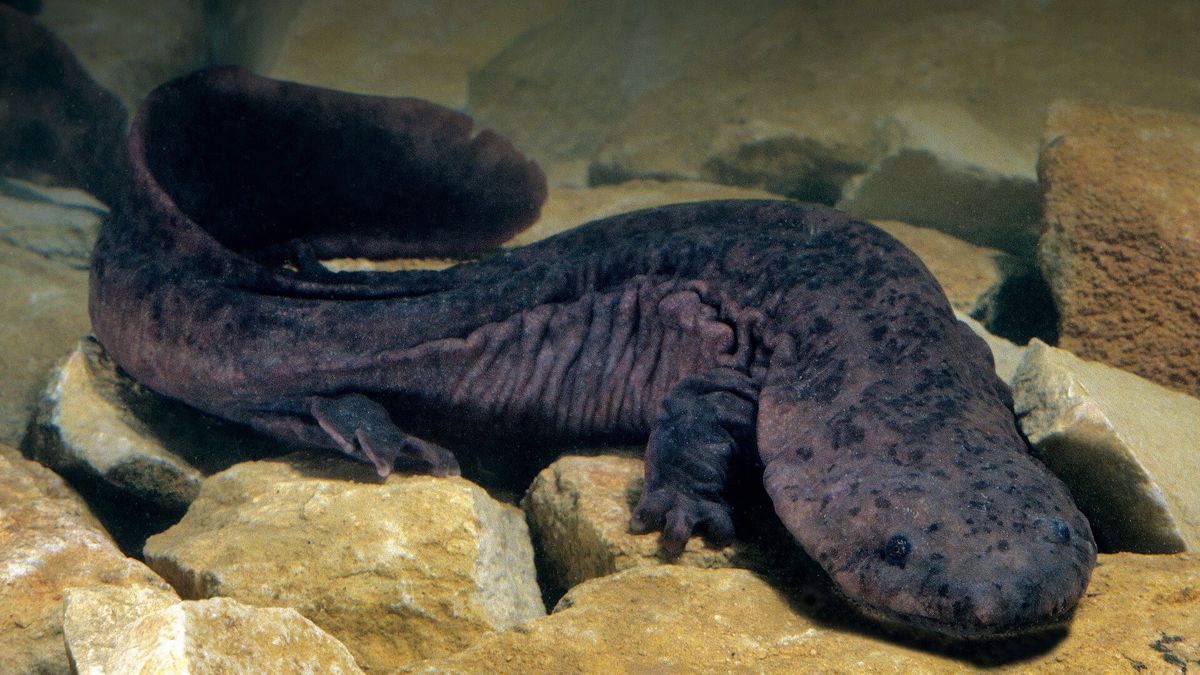
The Chinese giant salamander is the largest living amphibian on Earth. Verified adults reach 1.5 metres in length, record individuals have exceeded 1.8 metres, and nineteenth-century reports describe animals approaching 2 metres and weighing more than 65 kilograms.
It is an aquatic, cold-water, mountain-stream predator from central and southern China, and its closest living relatives are the Japanese giant salamander and the North American hellbender - all three remnants of an ancient lineage that has persisted essentially unchanged for more than 170 million years.
It is also, by almost every measure that matters, in catastrophic decline. Wild populations are estimated at around one per cent of their historical abundance. A 2018 genetic study concluded that the animal once called Andrias davidianus is actually at least five - and possibly as many as eight - distinct cryptic species, several of which are probably already extinct in the wild.
A commercial farming industry producing millions of animals per year for the luxury banquet trade has muddled those species through hybridisation, and well-intentioned releases have contaminated the few surviving relict populations.
This entry covers Chinese giant salamander biology in detail: size, taxonomy, the cutaneous respiration that ties the species to clean cold water, the eerie "baby cry" vocalisations that give the animal its Chinese common name, reproduction and male-guarded nests, the recent cryptic-species discovery, the Shaanxi-centred aquaculture industry, and the long conservation story that has reduced wild populations by more than ninety-nine per cent.
Etymology and Common Names
The scientific name Andrias davidianus combines the genus Andrias, which means roughly "image of a man" in Greek and was originally applied to a fossil cryptobranchid mistakenly described as a human skeleton, with the species epithet davidianus, honouring the French missionary-naturalist Armand David, who sent the first specimens known to Western science from central China in the 1870s.
The Chinese common name is far more evocative. It is wa wa yu (娃娃鱼), which translates literally as "baby fish" or "child fish". The name refers not to appearance but to sound. When distressed or handled, a Chinese giant salamander emits a series of high-pitched vocalisations that are eerily similar to the cry of a human infant.
Multiple historical and modern accounts describe fishermen and farmers being disturbed or outright frightened by the calls, and the resemblance is close enough that a person encountering one for the first time may initially mistake it for an abandoned child.
Other regional names in Chinese include da ni (big salamander) and local variants tied to particular river basins. In English the animal is most often referred to simply as the Chinese giant salamander.
Classification and Evolutionary Context
Chinese giant salamanders belong to the order Urodela (tailed amphibians) and the family Cryptobranchidae. The family contains two extant genera: Andrias, which includes the Chinese and Japanese giant salamanders, and Cryptobranchus, the North American hellbender.
The cryptobranchid lineage is one of the oldest vertebrate lineages still alive. Fossils attributable to the family date from the Middle Jurassic, roughly 170 million years ago. A celebrated European Miocene fossil, Andrias scheuchzeri, was mistakenly described in 1726 as the skeleton of a human drowned in Noah's Flood - and that misidentification is the reason the living Asian giants carry the genus name Andrias.
Modern cryptobranchids retain the flat head, wrinkled lateral skin, reduced eyes, and fully aquatic adult stage characteristic of the family throughout its fossil record. Because the morphological change between Jurassic fossils and living animals is so small, cryptobranchids are often described as living fossils.
The split between the North American Cryptobranchus and the Asian Andrias appears to have occurred around 70 million years ago, and the split between the Chinese and Japanese Andrias lineages is somewhat more recent.
The 2018 Cryptic-Species Discovery
Until 2018 Andrias davidianus was treated as a single widespread species. A genetic study led by researchers at the Kunming Institute of Zoology and the Zoological Society of London, published in Current Biology, changed that picture dramatically. Using DNA sampled from wild, museum, and farmed animals across China, the team showed that animals from different major river basins were deeply divergent - divergent enough to represent separate species under almost any reasonable species concept.
The conclusion was that Andrias davidianus as traditionally defined is actually a complex of at least five, and quite possibly as many as eight, distinct cryptic species, corresponding roughly to the major river basins of central and southern China. Some of these lineages appear to have been lost from the wild already. The remaining wild animals belong to a handful of genuine lineages scattered across the range, often in heavily disturbed habitats.
The conservation implications are severe. Farm animals, which form the bulk of the "Chinese giant salamander" population on Earth, are hybrids of several distinct lineages. Releases of farm-sourced animals - whether for formal reintroduction or informal Buddhist mercy-release ceremonies - introduce hybrid genetics into wherever they end up, eroding the integrity of the few surviving genuine wild populations.
In effect, efforts presented as conservation have probably accelerated the extinction of the genuine species they were supposed to save.
Size and Physical Description
Chinese giant salamanders are the largest amphibians on Earth. Only their close relatives the Japanese giant salamanders rival them in size, and the North American hellbender, while similar in overall plan, is far smaller.
Adults:
- Total length: 1.0-1.5 m in typical mature individuals
- Record length: up to 1.8 m in verified modern specimens; historical reports up to 2 m
- Weight: 25-50 kg in typical adults; record individuals heavier
- Body shape: dorsoventrally flattened, broad-headed, short-limbed, paddle-tailed
- Skin: loose, heavily wrinkled along the sides, mucus-coated
Hatchlings and larvae:
- Length at hatching: roughly 30 mm
- External gills retained for the first two to three years, then partially resorbed
- Sexual maturity reached at around 5-6 years in captivity; later in the wild
The most distinctive external feature is the heavy lateral skin fold running along each side of the body. These folds dramatically increase the skin's surface area, which is essential because adults breathe almost entirely through the skin rather than through lungs or gills. The folds are densely supplied with capillaries and can expand outward when oxygen demand rises.
The head is broad, flat, and wedge-shaped - an adaptation for anchoring under large flat rocks in swift current. The jaws are lined with small sharp teeth arranged in two rows on the upper jaw and one on the lower, ideal for gripping wriggling prey.
The eyes are tiny, lidless, and set far apart on top of the head; they provide only limited vision, and adults rely primarily on chemoreception and lateral-line pressure sensing rather than sight. The tail is long, laterally compressed, and strongly muscled, providing propulsion in short bursts when the animal strikes at prey or flees a disturbance.
Colouration is variable and generally cryptic - mottled dark brown, grey, or olive with irregular patches or blotches that blend into gravel-and-cobble streambeds. Some individuals show reddish or yellowish tones, particularly in populations from certain river basins.
Cutaneous Respiration and the Need for Clean Cold Water
The most ecologically important feature of the Chinese giant salamander is its respiratory system. Adults have only vestigial lungs, reduced gill function, and a very slow metabolism. Between ninety and ninety-five per cent of all gas exchange happens through the skin, a mechanism called cutaneous respiration.
This arrangement only works under a narrow set of environmental conditions.
| Requirement | Typical value |
|---|---|
| Water temperature | Below about 20 degrees Celsius (optimal 10-18 C) |
| Dissolved oxygen | Above 6 mg/L (optimal 8-10 mg/L) |
| Flow regime | Fast, turbulent, continuously oxygenating |
| Substrate | Clean gravel and cobble with deep crevices and overhangs |
| Silt load | Minimal - sediment clogs skin capillaries |
Warm water holds less dissolved oxygen than cold water, so any increase in stream temperature reduces the oxygen available for skin respiration. Slow water likewise fails to refresh oxygen at the animal's surface.
When a Chinese giant salamander is short of oxygen it extends the skin folds, increasing surface area, and begins a slow rocking motion similar to the "swaying" behaviour well documented in the North American hellbender. Swaying moves fresh oxygenated water across the skin and, under moderate oxygen stress, is often sufficient to compensate. Under severe oxygen stress the animal suffocates.
Silt is the silent killer. Fine sediment particles coat the skin and clog the capillary-rich folds, reducing gas-exchange capacity and producing chronic hypoxia. Because of this, land-use changes in a watershed - deforestation, agricultural runoff, mining, road construction, dam-related sediment trapping and release - translate rapidly into population declines even when the stream itself appears otherwise intact.
In ecological terms the Chinese giant salamander is an indicator species at the very top of its water-quality bracket. The presence of a reproducing population is strong evidence that the stream system is clean, cold, well-oxygenated, and structurally intact. Its disappearance from most of its historical range is an early and unusually clear signal that the freshwater ecosystems of central and southern China have been profoundly degraded.
Vocalisations: The "Baby Cry"
One of the most unusual features of the species - and one of the few amphibian traits most likely to make a human uncomfortable - is its vocal repertoire. Chinese giant salamanders produce a variety of calls, including low-frequency grunts, hisses, and, most strikingly, a high-pitched cry that sounds remarkably like a human infant.
The "baby cry" is the sound that gave rise to the name wa wa yu. It is most reliably elicited when an animal is handled or distressed, but it has also been recorded from undisturbed animals at night and in breeding contexts. The calls include harmonic structure and frequency modulation reminiscent of mammalian infant vocalisations, which is part of why the perceptual similarity is so strong.
The biological function is not fully understood. Hypotheses include:
- Defensive warning - the calls may startle predators, particularly those that have learned to avoid distressed young of other species.
- Social signalling - the calls may convey position or condition to conspecifics in dark, turbulent water where visual cues are useless.
- Distress display - a general-purpose stress vocalisation that has been co-opted by observers into the perception of a "baby".
What is clear is that the calls are unusual for salamanders. Most species in the order Urodela are effectively silent, relying on chemical and visual cues rather than sound. Chinese giant salamanders - along with their close relatives - are an exception, and the "baby cry" is one of the few cases in which a salamander vocalisation has passed into widespread folk description.
Habitat and Range
Historically, Chinese giant salamanders occupied cold, fast-flowing, highly oxygenated mountain streams across central and southern China, including parts of the Yangtze, Yellow, and Pearl River basins across roughly seventeen provinces.
The distribution spanned a range of elevations and stream types, with local populations adapted to the specific conditions of each major river basin - a geographical structure that is now understood to reflect the underlying cryptic-species structure uncovered in 2018.
Current distribution is drastically reduced. Large-scale field surveys in the 2010s, most notably a multi-year project that visited more than two hundred historical sites, recorded wild animals at only a handful of locations. Most of those records are believed to represent recent escapees or releases from farms rather than persisting relict populations. Genuine wild populations of genetically coherent cryptic species are now extremely rare.
Microhabitat requirements remain strict wherever the species persists. Suitable streams show:
- Water temperatures below about 20 degrees Celsius
- Dissolved oxygen above 6 mg/L
- Swift, turbulent flow with alternating riffle-and-pool structure
- Clean gravel and cobble substrate with deep crevices and rock overhangs
- Minimal silt deposition and low nutrient loading
- Intact riparian vegetation
Individual animals are site-faithful, sheltering in specific crevices for long periods and moving within small home ranges. Movements of more than a few hundred metres are unusual outside of flood displacement or anthropogenic disturbance.
Diet and Hunting Behaviour
Chinese giant salamanders are opportunistic carnivores. Their size allows them to take a wider range of prey than smaller cryptobranchids, but the general pattern of ambush predation on whatever is locally abundant is similar across the family.
Typical prey, ranked roughly by frequency:
- Fish (a wide range of native freshwater species, plus carp and loaches in modified habitats)
- Crustaceans (especially freshwater crabs and shrimp)
- Amphibians (frogs and other salamanders, including conspecifics)
- Aquatic insect larvae and worms
- Small mammals washed into the stream
- Their own eggs (nest predation by non-guarding adults)
Hunting is predominantly nocturnal. By day, the animal rests under a shelter rock or in a crevice; shortly after sunset it emerges and begins a slow, patient search of the streambed. Prey is detected primarily through chemoreception and through a sensitive lateral-line system that senses pressure changes in the surrounding water. When prey comes within reach, the salamander strikes with a rapid sideways snap of the broad jaws and swallows it whole.
Because the metabolism is slow and the environment cold, Chinese giant salamanders do not need to feed frequently. A healthy adult can go weeks between substantial meals, and nest-guarding males may eat almost nothing during the two-month brood period.
Reproduction and Male Parental Care
Chinese giant salamander reproduction, like that of the hellbender, is external and male-guarded - a pattern unusual among salamanders, most of which use internal fertilisation and either lay unguarded eggs or, in some lineages, retain the eggs internally.
Breeding cycle:
- Late summer to early autumn: mature males excavate or claim a nest cavity under a large flat rock or inside a bank crevice, defending it aggressively against rival males.
- Courtship: a female enters the nest and is courted by the resident male. A single male may accept egg strings from more than one female across the breeding window.
- Spawning: the female deposits a paired string of roughly 400-500 eggs. The male fertilises them externally as they are laid.
- Guarding: the male remains in the nest for approximately 50 to 60 days, defending the clutch against predators - including other adults - and circulating oxygenated water across the eggs with periodic body movements.
- Hatching: larvae emerge at about 30 millimetres. They carry external gills and a yolk sac for several weeks.
- Metamorphosis: external gills are partially resorbed during the first few years, though vestigial gill slits persist into adulthood.
- Sexual maturity: reached at 5-6 years of age in captivity and probably somewhat later in the wild.
Extended male parental care is a striking feature of the family. Nest-guarding males lose substantial body condition during the brood period and are particularly vulnerable to disturbance. Given the fragmentation of the remaining wild habitat, even casual disturbance of a known nest rock can have disproportionate population consequences, because the total number of actively reproducing wild nests in some river basins may now be very small.
Lifespan and Population Biology
Chinese giant salamanders are remarkably long-lived amphibians. Verified lifespans in captivity extend to 50 to 80 years. Some state media reports have claimed individual animals 130 years or even 200 years old, but those figures have no peer-reviewed support and rely on age-estimation methods that do not stand up to scrutiny.
A realistic upper bound is probably around 80 years, which is nevertheless extraordinary for an amphibian and consistent with the long lifespans documented in the related North American hellbender.
The combination of late sexual maturity, long lifespan, large clutches with low larval survival, and extreme habitat specificity produces a population structure that can look superficially stable while in fact quietly ageing toward collapse.
| Life-history metric | Typical value |
|---|---|
| Age at sexual maturity | 5-6 years (captive); later in wild |
| Generation time | 15-20 years |
| Verified maximum age | 50-80 years |
| Disputed "maximum" claims | 130-200+ years (unverified) |
| Eggs per clutch | 400-500 |
| Larval survival to age 1 | Very low in disturbed systems |
| Adult annual survival (intact populations) | High, but historical data are limited |
Several of the cryptic species identified in 2018 probably consist of only small numbers of ageing adults with little or no successful reproduction - the textbook signature of a population drifting toward extinction even while individual animals remain alive.
Conservation Status and Threats
The IUCN Red List classifies the Chinese giant salamander (treated as a single species for historical reasons) as Critically Endangered, with a strongly decreasing population trend. In practical terms the wild population is estimated to be around one per cent of its historical abundance, and many of the distinct cryptic species identified in 2018 are likely functionally extinct in the wild.
The drivers of decline are well documented.
Primary threats:
- Direct harvest for food. Chinese giant salamander meat has been regarded as a luxury banquet delicacy for centuries. Commercial exploitation intensified sharply from the mid-twentieth century, and demand has been the single most important driver of wild decline.
- Habitat loss and degradation. Dams, river-channel modification, water abstraction, pollution, mining runoff, sedimentation from deforestation, and rising stream temperatures have degraded or destroyed most historical habitat.
- Hybridisation from farmed stock. Releases of hybrid farmed animals into wild streams - both formal reintroductions and informal Buddhist mercy releases - have introduced mixed genetics from multiple cryptic species into surviving populations, eroding genetic integrity and probably accelerating the extinction of genuine local lineages.
- Disease. Farmed animals carry ranaviruses and other pathogens that have been documented in wild die-offs following releases.
- Poaching for the farm trade. Wild-caught founders remain a valuable input to farms despite legal protection, and small persisting wild populations remain vulnerable to targeted collection.
- Climate change. Warming stream temperatures directly threaten cutaneous respiration, and more intense rainfall events increase sediment delivery to remaining habitat.
The Shaanxi aquaculture industry. Commercial farming of Chinese giant salamanders expanded rapidly in China from the 1990s onward, and by the 2010s Shaanxi province had become the centre of the industry, with thousands of farms producing millions of animals per year for the restaurant trade.
Farming was promoted in part as a conservation strategy on the argument that commercially supplied meat would relieve pressure on wild populations. In practice, farming has produced several additional problems:
- Farmed stock draws on wild-caught founders from multiple river basins, mixing distinct cryptic species into hybrid broodstock.
- Animals are routinely moved between provinces, spreading disease and further muddling genetics.
- Farmed meat has not clearly reduced demand for wild-caught animals, because wild-caught meat retains a cultural premium.
- Releases of farm animals into rivers have introduced hybrid genetics and pathogens into whatever wild populations remain.
Conservation responses include legal protection under Chinese wildlife law, listing under CITES Appendix I, captive-breeding programmes at research institutions, stricter regulation of release events, pilot projects to develop genetically screened and locality-matched stock for any future reintroduction, and protected-area designation for a small number of streams with persisting genuine wild populations.
Several Chinese research groups are working to formally describe and protect the cryptic species identified in 2018.
Long-term recovery will depend on formally recognising the cryptic-species structure, suspending general-purpose releases of hybrid farm animals, protecting the specific stream systems where genuine wild lineages persist, and reducing commercial demand for wild-caught animals.
Chinese Giant Salamanders and Humans
Chinese giant salamanders have shared central and southern Chinese waterways with humans for thousands of years, and the cultural record is long. The animal appears in classical Chinese natural-history texts, local folklore, and regional cuisine across much of its historical range. The very name wa wa yu, with its reference to the infant-like cry, reflects the strong impression the species has made on people who encountered it in the field.
Consumption as a luxury food - rather than ordinary subsistence use - is the cultural factor that has mattered most for conservation. The status of the species as an expensive banquet dish intensified commercial harvest in the twentieth century and continues to drive demand into the twenty-first.
Conservation messaging in China is increasingly clear that sustainable consumption of wild-caught animals is not possible given current population levels, and that even farmed consumption carries conservation costs because of hybridisation and release effects.
Awareness has improved in recent decades. The species is formally protected in Chinese wildlife law, is listed under CITES Appendix I (prohibiting most international commercial trade), and features in Chinese conservation education materials. A handful of protected-area designations now cover stream systems believed to hold surviving wild populations. Foreign scientific collaboration - including the 2018 cryptic-species study - has been central to the modern understanding of the species complex.
For freshwater ecosystems of central and southern China, the Chinese giant salamander is a keystone indicator: when wild populations persist, the stream system is broadly functional. Their disappearance from most of their range is a stark signal that the ecological integrity of those watersheds has been deeply compromised over the past century.
Related Reading
- Hellbender Salamander: North America's Giant
- Axolotl: The Mexican Walking Fish
- Fire Salamander: Europe's Most Striking Amphibian
- Salamanders and Newts: The Masters of Regeneration
- Axolotl: Regenerate Limbs and Brain
References
Sources consulted for this entry include the IUCN Red List assessment for Andrias davidianus, the 2018 cryptic-species study by Yan and colleagues published in Current Biology, large-scale field-survey reports by the Kunming Institute of Zoology and the Zoological Society of London, CITES listing documentation for Andrias davidianus, peer-reviewed research published in Biological Conservation, Oryx, Herpetologica, and PLoS ONE, and Chinese wildlife authority status reviews addressing the Shaanxi aquaculture industry and the conservation implications of farmed-animal release.
Population and trend figures reflect the most recent consolidated assessments available through 2024.
Frequently Asked Questions
How big does a Chinese giant salamander get?
Adult Chinese giant salamanders (Andrias davidianus) typically reach 1.0 to 1.5 metres in total length and weigh 25 to 50 kilograms. Verified record individuals have exceeded 1.8 metres, and nineteenth-century and early twentieth-century reports describe animals approaching 2 metres and more than 65 kilograms - figures that are plausible but cannot now be confirmed because animals of that size no longer exist in the wild.
That size makes the species the largest amphibian on Earth, slightly larger than its close relative the Japanese giant salamander and several times the mass of the North American hellbender. Hatchlings emerge at roughly 30 millimetres, so they grow through roughly a thirty-fold increase in length and many thousand-fold increase in mass over the course of a long life.
Why is it called the 'baby fish' salamander?
The Chinese common name is wa wa yu, which translates literally as ‘baby fish’ or ‘child fish’. The name refers to the animal’s vocalisations. When distressed or handled, a Chinese giant salamander produces a series of high-pitched calls that sound remarkably like a human infant crying. The resemblance is close enough that fishermen and farmers report being startled by it.
The calls are thought to have a defensive or contact-signalling function, though the exact behavioural context is still poorly understood. The species is one of the few amphibians known to produce such clearly articulated vocal signals, which is unusual because most salamanders are essentially silent.
Where does the Chinese giant salamander live?
Historically, Chinese giant salamanders occupied cold, fast-flowing, highly oxygenated mountain streams across central and southern China, including parts of the Yangtze, Yellow, and Pearl River basins, across roughly seventeen provinces. Today the distribution is drastically fragmented.
Field surveys across more than two hundred historical sites in the 2010s found wild animals at only a handful of locations, and most of those are believed to be recent escapees or releases from farms rather than genuine relict wild populations. Habitat requirements are strict - water temperatures below about 20 degrees Celsius, dissolved oxygen above 6 mg/L, clean gravel and cobble substrate, deep shelter crevices and rock overhangs, and minimal silt load.
Most streams that once supported populations have been altered by damming, pollution, or sediment input.
How many species of Chinese giant salamander are there really?
A 2018 study in the journal Current Biology, led by researchers at the Kunming Institute of Zoology and the Zoological Society of London, used genetic data from wild, museum, and farmed animals to show that Andrias davidianus as traditionally defined is actually a complex of at least five - and possibly as many as eight - deeply divergent, reproductively isolated species.
These cryptic species correspond roughly to the major river basins of central and southern China. Some of these lineages appear to be already functionally extinct in the wild, surviving only as contaminated genetic fragments in farmed stock.
The finding has major conservation implications because the animals being farmed and released across China are hybrids of multiple cryptic species, and those releases are themselves eroding whatever genuine wild lineages remain.
Why is the Chinese giant salamander endangered?
The IUCN lists the Chinese giant salamander as Critically Endangered, and the wild population is estimated to be around one per cent of its historical level. The dominant driver of decline is direct harvest for human consumption. The animal has been regarded as a luxury banquet delicacy in several parts of China for centuries, and commercial exploitation intensified sharply from the mid-twentieth century onward.
Habitat loss and degradation are important secondary drivers - dams, river-channel modification, water pollution, mining runoff, sedimentation from deforestation, and rising stream temperatures all reduce available habitat.
More recently, well-intentioned release programmes that put farmed animals into wild streams have introduced hybrid genetics and disease into surviving populations, further threatening the genuine cryptic species identified by genetic work. The combination of slow maturation, low recruitment, and strong commercial demand makes recovery extremely difficult.
What is the Shaanxi salamander-farming industry, and why does it matter?
Chinese giant salamander farming expanded rapidly in China from the 1990s onward, and by the 2010s Shaanxi province had become the commercial centre of the industry, with thousands of farms producing millions of animals per year for the luxury food market. Farming was promoted in part as a conservation measure on the argument that commercially supplied meat would reduce pressure on wild populations.
In practice, the industry relies on wild-caught founders, stocks of uncertain provenance, and routine movement of animals across provinces. The 2018 cryptic-species study showed that farmed populations are typically hybrids of several distinct evolutionary lineages. Farm animals also carry ranaviruses and other pathogens that have been linked to wild-population die-offs.
Releases of farmed animals into rivers, whether as formal reintroductions or informal Buddhist mercy releases, have introduced hybrid genes and disease into the few surviving wild populations. Reforms to require genetically screened, locality-matched stock for any release are now being advocated.
How do Chinese giant salamanders breathe?
Adult Chinese giant salamanders breathe almost entirely through the skin, a process called cutaneous respiration. Their heavy lateral skin folds greatly increase the surface area exposed to water, and the skin is richly supplied with capillaries just below the surface. Lungs are reduced and gills are largely vestigial in adults.
Because oxygen uptake through skin depends on dissolved oxygen concentration, the animals require cold, fast-flowing, highly oxygenated water - warm or stagnant water simply cannot supply enough oxygen for the metabolism of a 20-to-50-kilogram amphibian relying on skin respiration.
When oxygen is limited, the animal extends its skin folds and may perform a slow rocking motion, similar to the ‘swaying’ behaviour documented in its close relative the North American hellbender, to refresh oxygenated water across the skin surface.
How long do Chinese giant salamanders live?
Verified lifespans for Chinese giant salamanders are in the range of 50 to 80 years under good captive conditions, and probably somewhat shorter in the wild because of predation and environmental stress. Claims occasionally circulate that wild individuals can live more than 200 years, and some Chinese state media outlets have reported 200-year-old specimens found in caves.
Those claims have no peer-reviewed support and are dismissed by amphibian biologists; the age-estimation methods behind them are not rigorous. A realistic upper bound is probably around 80 years, which is nevertheless extraordinary for an amphibian and is consistent with the long lifespans documented in other cryptobranchids such as the hellbender, which has reached 55 years in captivity.