
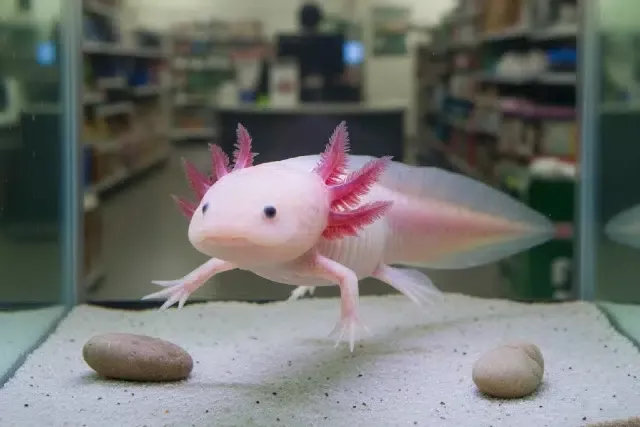
The axolotl is one of the strangest vertebrates alive. It is a salamander that refuses to grow up, a freshwater predator that still carries the frilly external gills of its hatchling form into old age, and a laboratory celebrity that has arguably taught biologists more about tissue regeneration than any other species on Earth.
Ambystoma mexicanum is endemic to a single shrinking canal system in the middle of Mexico City, yet it is also one of the most widely kept amphibians in the world - present in research labs, aquariums, and living rooms on six continents. The contrast between its wild rarity and its captive abundance is part of what makes this animal so peculiar.
This guide covers every major aspect of axolotl biology: size and anatomy, habitat and ecology, diet and hunting, reproduction, regeneration, metamorphosis, conservation status, laboratory importance, and the deep cultural history that gives the species its Nahuatl name. It is a reference entry, not a summary - expect specifics: centimetres, grams, chromosome counts, population figures, and verifiable records.
Etymology and Classification
The word axolotl comes from the Nahuatl language of the Aztec people. It is usually interpreted as combining atl (water) with xolotl (monster, dog-like creature, or trickster), yielding something close to "water monster" or "water dog". The species is deeply tied to the Aztec deity Xolotl, twin of the feathered serpent Quetzalcoatl.
In one version of the myth, Xolotl refused to be sacrificed to sustain the sun and transformed himself into an axolotl to hide in the water of Lake Xochimilco. The biological name Xolotl gave the animal remains in use five centuries later.
The scientific name Ambystoma mexicanum was formalised by French naturalist Auguste Dumeril in 1865, after the French expedition to Mexico shipped 34 live axolotls to Paris the previous year. Those 34 animals became the breeding stock for almost every captive axolotl alive today.
The genus Ambystoma belongs to the family Ambystomatidae, the mole salamanders, and contains more than thirty species across North America. Most members of the genus metamorphose into terrestrial adults; the axolotl is famous for not doing so.
Taxonomy reflects anatomy rather than lifestyle. The axolotl sits squarely in class Amphibia, order Urodela (tailed amphibians), and is closely related to the tiger salamander (Ambystoma tigrinum). Molecular data support rare hybridisation between the two species, which is one reason the state of California bans the keeping of axolotls - escaped pets could genetically contaminate local tiger salamander populations.
Size and Physical Description
Axolotls are medium-sized salamanders with a distinctive body plan that looks almost prehistoric.
Adult measurements:
- Length: 15-45 cm from snout to tail tip
- Typical adult length: around 23 cm
- Weight: 60-230 g
- Head width: 3-5 cm
- Gill stalks: 3 pairs of branched external gills, each up to 5 cm long
Anatomical features that never disappear:
- External gills with feathery filaments for oxygen uptake
- Dorsal and caudal tail fin running from the back of the head to the tail tip
- Lateral line system along the body for detecting water vibration
- Laterally flattened tail adapted for swimming
- Small, weak limbs with four toes on the front feet and five on the back
The axolotl has four working respiratory systems simultaneously: external gills, skin, a pair of simple lungs, and pharyngeal respiration through the mouth lining. This redundancy lets it survive in water with low or fluctuating oxygen, which is exactly the kind of water found in the canals of Xochimilco.
Colour in wild-type animals is a mottled dark olive-brown to greenish-black, dotted with gold speckles that help camouflage the animal against the substrate. Captive breeding has produced several colour morphs that are almost never seen in the wild:
- Leucistic - pale pink body with dark eyes, the most iconic aquarium morph
- Albino - cream to white body with pink eyes and pink gills
- Melanoid - solid dark brown or black, without the gold flecks
- Golden albino - yellow body with pink eyes and peach-coloured gills
- Copper - soft coppery brown, a recessive variant
- GFP - transgenic line expressing green fluorescent protein that glows under blue light
These morphs are products of captive selection and transgenic engineering, and most would not survive in Lake Xochimilco. Leucistic animals in particular would be highly visible to the introduced tilapia and carp that now dominate the canals.
Habitat: Lake Xochimilco and the Valley of Mexico
The axolotl is endemic to a single system: the freshwater canals of Lake Xochimilco, in the south of Mexico City. Historically it also lived in the adjacent Lake Chalco, but that lake was artificially drained during the nineteenth century to control flooding and to expand farmland. Today, wild axolotls live only in Xochimilco, and even there they are thin on the ground.
Xochimilco is not a conventional lake. It is a five-hundred-year-old network of canals cut by the Aztecs around artificial islands called chinampas - floating-garden plots built up from lake sediment for intensive agriculture. The system was once one of the largest food-producing regions in pre-Columbian North America. Today many chinampas are still farmed, but the canal network has shrunk, silted, and been badly contaminated by Mexico City's growth.
Axolotls prefer:
- Water temperature: 14-20 degrees Celsius
- pH: 7.4-8.0 (slightly alkaline)
- Hardness: moderate, with plenty of dissolved calcium
- Depth: 1-3 metres typical, up to 5 metres in deeper sections
- Substrate: fine silt overlaid with submerged macrophytes and leaf litter
- Vegetation: emergent and submerged plants for cover and egg attachment
They tolerate low oxygen and moderate turbidity but do poorly in warm water, which accelerates metabolism, promotes fungal infection, and reduces dissolved oxygen. Xochimilco's progressive warming and nutrient pollution have pushed conditions toward the edge of what axolotls can physiologically handle.
Diet and Hunting
Axolotls are obligate carnivores with an ambush hunting style and a surprisingly effective suction-feeding strike.
Wild diet:
- Aquatic insect larvae (midge, mayfly, dragonfly)
- Amphipods, isopods, and other small crustaceans
- Aquatic worms (tubifex, blackworm)
- Small molluscs
- Small fish, including juveniles of their own species when food is scarce
Hunting method:
- The axolotl hovers low in the water column or rests on the substrate, often with gills fluttering and body motionless.
- Prey is detected by a combination of vision, the lateral line vibration sense, and chemoreception through the skin and mouth.
- The axolotl orients its head toward the target and approaches slowly.
- At striking distance it opens its jaw explosively, generating negative pressure that sucks water and prey together into the mouth cavity.
- Prey is swallowed whole. Axolotls have only small vomerine teeth and cannot bite meaningfully.
Studies show that a healthy adult axolotl in the wild eats the equivalent of 1-3% of its body mass per day, mostly at night. Captive animals are typically fed bloodworms, earthworms, brine shrimp, blackworms, small shrimp, and specialised commercial pellets. Feeding schedules vary from daily for juveniles to two or three times a week for full-grown adults.
Reproduction and Life Cycle
Axolotl reproduction is fully aquatic and uses the external-fertilisation strategy characteristic of mole salamanders.
Courtship and mating:
- A sexually mature male performs a waving dance, swaying his tail and waving scent toward the female.
- If receptive, she follows him across the substrate.
- The male deposits small conical packets of sperm called spermatophores on the lake bed.
- The female walks over the spermatophores and collects them with the lips of her cloaca.
- Fertilisation is internal from that point, but takes place after sperm transfer on the substrate.
Eggs and larvae:
- Clutch size: 300-1,100 eggs, attached to plants and objects individually or in small clumps
- Incubation: 10-14 days at 20 degrees Celsius
- Larval length at hatching: ~11 mm
- Yolk sac supplies nutrition for the first 48-72 hours
- Sexual maturity: 6-18 months in captivity, somewhat slower in the wild
Axolotls reach full size around age 2 and remain reproductively active across most of their 10- to 20-year lifespan. Males can be distinguished from females by a swollen cloaca and generally slimmer body, while females tend to be stockier and wider when carrying eggs.
Neoteny: The Eternal Larva
Every other Ambystoma salamander is an obligate metamorph - it hatches as an aquatic larva and eventually transforms into a terrestrial adult. The axolotl is an obligate neotenic: it reaches sexual maturity while still in its larval form and almost never completes metamorphosis on its own. This is the single most important fact about axolotl biology.
The mechanism is hormonal. Thyroid hormone is the signal that drives metamorphosis in all amphibians. In axolotls, the thyroid gland is structurally present and produces the hormone, but the target tissues respond weakly. Several genes in the pituitary and hypothalamus keep circulating thyroid hormone low across the animal's life.
This has two dramatic consequences:
- The axolotl keeps traits that other salamanders shed - external gills, tail fin, lateral line, fully aquatic lifestyle - throughout adulthood.
- The developmental programme that would normally bury regeneration under metamorphosis stays active. An adult axolotl regenerates like an embryo does.
Under specific laboratory conditions, metamorphosis can be forced. The standard method is injection of thyroxine. Under exposure, the axolotl reabsorbs its gills, loses its tail fin, develops eyelids, thickens its skin, and transforms into something that closely resembles a tiger salamander. The change is permanent. Metamorphosed axolotls are poor swimmers, vulnerable to dehydration, and usually live roughly half the normal lifespan.
Regeneration: The Most Studied Feature
If axolotls had only one claim to fame it would be regeneration. No other vertebrate can rebuild this much of its body this well.
What the axolotl can regenerate:
- Entire limbs (legs, arms), including bones, muscles, nerves, blood vessels, skin
- Full tail and tail fin
- Jaw tissue, including the lower jaw
- Lens of the eye
- Retina
- Spinal cord segments
- Portions of the heart ventricle
- Parts of the brain (telencephalon tissue)
- Portions of the lungs
- Ovarian and testicular tissue
How it works:
- Wound closure. Within minutes to hours, epithelial cells migrate across the wound to form a thin wound epidermis. No blood clot forms in the usual mammalian way.
- Apical epithelial cap. The wound epidermis thickens into a specialised signalling structure that releases growth factors into the underlying tissue.
- Dedifferentiation. Adult cells below the wound lose their specialised identity, divide, and form a bud-like mass called a blastema.
- Patterning. The blastema receives positional cues (from Hox genes and others) that tell it what to rebuild.
- Redifferentiation. Cells of the blastema mature into bone, cartilage, muscle, skin, and nerves in the correct pattern.
- Integration. The new structure wires into the nervous and circulatory systems and becomes functionally indistinguishable from the original.
Crucially, the process leaves no scar tissue. In mammals, fibrosis seals a wound permanently and blocks further regrowth. In axolotls the immune response is tuned to suppress scar-forming inflammation and permit blastema formation instead.
A single axolotl can regenerate the same limb over a hundred times across its life. Limb regeneration time is typically 40-90 days depending on age, temperature, and size of the missing part. Older and larger animals regenerate more slowly.
Axolotls in Science
The axolotl has been central to developmental biology for over 150 years. Its role can be summarised in a few numbers and labs.
| Research centre | Focus |
|---|---|
| Ambystoma Genetic Stock Center, Kentucky | Captive colony, genome, distribution |
| Max Planck Institute, Dresden | Blastema biology, cell lineage |
| Harvard Medical School | Cardiac and spinal cord regrowth |
| Cold Spring Harbor Laboratory | Genomics, transcriptomics |
| CINVESTAV and UNAM, Mexico | Conservation genetics, field ecology |
The axolotl genome was published in full in 2018. At roughly 32 billion base pairs it is about ten times larger than the human genome, making it one of the largest vertebrate genomes ever sequenced. The sequencing and assembly took years because long repetitive regions made the data extremely difficult to resolve. The final genome has enabled comparative studies of regeneration across vertebrates and is a foundation for understanding why mammals cannot do what axolotls can.
Transgenic axolotl lines expressing fluorescent proteins such as GFP are now standard laboratory tools. Researchers can track individual cell lineages in real time as they participate in regeneration, which was not possible in any vertebrate before.
A consequence of the laboratory legacy is severe inbreeding. Most captive axolotls trace to the 34 animals imported to Paris in 1864, plus a handful of later introductions. Inbreeding has subtly altered captive axolotls and makes them genetically distinct from the wild population. This matters for conservation: lab axolotls are not suitable as a source to restock Lake Xochimilco.
Conservation: Population in Crisis
The IUCN Red List classifies Ambystoma mexicanum as Critically Endangered - the category immediately before Extinct in the Wild. Every credible survey over the last three decades shows the wild population crashing.
Population estimates across time:
| Year | Density (per km^2) | Notes |
|---|---|---|
| 1998 | ~6,000 | Early systematic survey |
| 2004 | ~1,000 | Steep decline apparent |
| 2008 | ~100 | National Autonomous University of Mexico survey |
| 2014 | ~35 | Fewer than 50 individuals per km^2 |
| 2023-2024 | ~35 (stable locally) | Partial recovery in refuge zones only |
Total wild adult axolotls now number in the low hundreds to under a thousand across Xochimilco as a whole. The principal threats are:
- Urban pollution. Mexico City has sprawled into the wetlands, dumping untreated and partially treated sewage into the canal system. Nitrates, phosphates, heavy metals, and pharmaceutical residues all appear in Xochimilco water.
- Invasive species. Tilapia (Oreochromis) and common carp (Cyprinus carpio) were stocked in the 1970s and 1980s for local fisheries. Both species eat axolotl eggs and larvae and compete for food. Populations are now self-sustaining and pervasive.
- Water management. Natural spring flow has been diverted for the city's water supply. Canals are replenished with treated water of very different chemistry from the original springs.
- Agriculture. Pesticides and fertilisers from the surrounding chinampa plots leach directly into canal water.
- Habitat fragmentation. Individual axolotls are cut off in isolated canal segments by silting, construction, and water gates, reducing gene flow and breeding.
- Unregulated trade. Illegal local harvest for food and medicine was once significant; most recent legal pressure appears controlled, but enforcement is limited.
Conservation responses include the UNAM-led refuge programme, which has walled off sections of canal to exclude tilapia, replanted native vegetation, and reintroduced monitored axolotls from captive stock matched to local genetics. Some refuges show small population rebounds. International Union for the Conservation of Nature continues to classify the species as Critically Endangered and the long-term outlook depends entirely on restoring Xochimilco itself.
Cultural History
Axolotls have been culturally significant for at least a thousand years. The Aztec people regularly harvested them for food and for ritual use, especially during religious ceremonies tied to Xolotl. Early Spanish chronicles describe axolotls sold in Tenochtitlan markets. The amphibian appears in colonial-era herbal medicine and in nineteenth-century Mexican folk remedies for respiratory illness.
The species became scientifically famous in 1864 when French soldiers returning from the Franco-Mexican war brought living specimens to Paris.
Auguste Dumeril in the Museum National d'Histoire Naturelle bred them successfully and startled European naturalists when some of the offspring metamorphosed spontaneously - the first direct evidence that a neotenic population could be turned, under certain conditions, into a fully terrestrial salamander. That single observation launched the modern study of amphibian metamorphosis.
In Mexican popular culture today, the axolotl is a national symbol. It appears on the 50-peso banknote (issued 2021), in murals, in Pokemon-style character designs, and in major museum exhibits. Short stories by Julio Cortazar ("Axolotl", 1956) and paintings by Diego Rivera feature the species. Conservation non-profits now lean on the animal's cultural weight to push for stronger protection of Xochimilco.
Related Reading
- Salamanders of the World: An Illustrated Overview
- Regeneration in Nature: From Lizards to Axolotls
- Lake Xochimilco: Last Home of the Axolotl
- Metamorphosis: Why Some Amphibians Change and Some Don't
References
Relevant peer-reviewed and governmental sources consulted for this entry include IUCN Red List assessments for Ambystoma mexicanum, publications from the Ambystoma Genetic Stock Center at the University of Kentucky, the axolotl genome paper in Nature (Nowoshilow et al., 2018), field surveys from the Universidad Nacional Autonoma de Mexico (UNAM) and CINVESTAV, and articles in Development, Developmental Biology, and Science.
Population estimates reflect the most recent consolidated surveys available through the UNAM axolotl conservation programme.
Frequently Asked Questions
What is an axolotl and why is it called a 'walking fish'?
The axolotl (Ambystoma mexicanum) is a fully aquatic salamander native to the freshwater canals of Lake Xochimilco near Mexico City. Early European observers mistook it for a fish because of its external gills, tail fin, and permanent underwater lifestyle - but it is a true amphibian in the same family as the tiger salamanders of North America. Unlike its relatives, the axolotl never leaves the water and never loses its larval features.
Adults reach 15-45 cm, with most around 23 cm, and weigh 60-230 g. They breathe through gills, skin, and simple lungs simultaneously.
How does axolotl regeneration work?
Axolotls regrow lost body parts by forming a structure called a blastema at the wound site - a mass of cells that dedifferentiate, losing their specialised identity, then redifferentiate to rebuild the exact tissue that was lost. They can regenerate limbs, tails, jaws, lenses of the eye, spinal cord, portions of the heart, parts of the brain, and even parts of the lungs.
Regeneration happens without scar tissue and produces a structure anatomically identical to the original. A single axolotl can regrow the same limb more than a hundred times without losing fidelity. This is why laboratories from Harvard to the Max Planck Institute in Dresden maintain large axolotl colonies for regeneration research.
Where do axolotls live in the wild?
Wild axolotls are endemic to the Valley of Mexico, specifically the canal network of Lake Xochimilco in the south of Mexico City. Historically they also inhabited nearby Lake Chalco, which was drained in the nineteenth century to prevent flooding. The species exists nowhere else on Earth. Xochimilco is not a single open lake but a complex of ancient canals (chinampas) cut by the Aztecs for agriculture more than five hundred years ago.
Axolotls live among submerged vegetation at depths of 1-3 metres, where water temperatures sit at 14-20 degrees Celsius. The wild population has declined drastically, with recent surveys estimating fewer than 1,000 adult axolotls remaining across the entire system.
Why are axolotls endangered?
The IUCN lists axolotls as Critically Endangered with a decreasing population trend. Three pressures combine to threaten the species. First, Mexico City has expanded directly into historical axolotl habitat - untreated wastewater, agricultural runoff, and urban pollution contaminate the canals. Second, the water supply has been diverted for human use and treated water pumped in, altering salinity and nutrient balance.
Third, non-native tilapia and carp, introduced into Xochimilco during aquaculture programmes in the 1970s and 1980s, outcompete and eat juvenile axolotls. Densities that were 6,000 per square kilometre in the 1990s fell to below 100 by 2008 and continue to drop. Local conservation groups and university teams are restoring refuges, but the wild species remains at very high extinction risk.
How long do axolotls live?
Wild axolotls typically live 10 to 15 years. Captive animals kept in cool, clean water with regular feeding routinely reach 20, and verified individuals have exceeded that. Longevity is shaped more by water quality and diet than by genetics.
Metamorphosed axolotls - those that have been forced through the transformation to a terrestrial salamander by thyroid hormone - usually live only half as long, around 5 to 8 years, because metamorphosis is metabolically costly and the resulting terrestrial form is poorly adapted. Sexual maturity is reached at 6-18 months and axolotls can breed throughout their adult lives, with females laying 300-1,100 eggs per clutch.
What do axolotls eat?
Axolotls are obligate carnivores. In the wild they consume aquatic invertebrates, small crustaceans, insect larvae, worms, snails, and the occasional small fish. Hunting is ambush-based: the axolotl hovers near the substrate, detects prey through a combination of vision and lateral line vibration sensing, and strikes by opening its wide mouth rapidly to generate suction. There are no teeth worth biting with, so prey is swallowed whole.
Captive animals are typically fed bloodworms, earthworms, brine shrimp, blackworms, and specialised pellets. Axolotls are prone to obesity when overfed and to impaction if they ingest gravel, so keepers generally use bare-bottom tanks or fine sand.
Can axolotls turn into adult salamanders?
Yes, but it is rare and almost never happens in the wild. Axolotls are what biologists call obligate neotenic - they reach sexual maturity while keeping all their larval features. The underlying cause is a muted response to thyroid hormone; the thyroid gland is present and functional, but the target tissues do not transform.
Inject thyroid hormone directly, or severely alter iodine levels, and the axolotl metamorphoses into a lung-breathing terrestrial salamander resembling its close relative the tiger salamander. The gills retract, the fin is reabsorbed, and the skin thickens. Metamorphosed axolotls usually have shorter lifespans, reduced fertility, and poor terrestrial adaptation, which is why researchers and hobbyists rarely induce the change on purpose.
Are axolotls good pets, and is it legal to keep them?
Captive-bred axolotls have been kept as pets for more than a century and are legal in most countries, but with significant exceptions. The state of California bans them outright because of concerns about hybridisation with native tiger salamanders if they were to escape. New Jersey, Maine, Virginia, and parts of Canada have similar or stricter rules.
Where legal, they need a chilled, filtered aquarium at 14-20 degrees Celsius, no gravel substrate, low flow, and a carnivorous diet. They must never be released to the wild and must never come into contact with wild amphibian populations. Importantly, captive-bred does not mean from Lake Xochimilco - the pet trade is supplied by generations of laboratory and hobbyist lineages, and no pet purchase helps the wild species.