
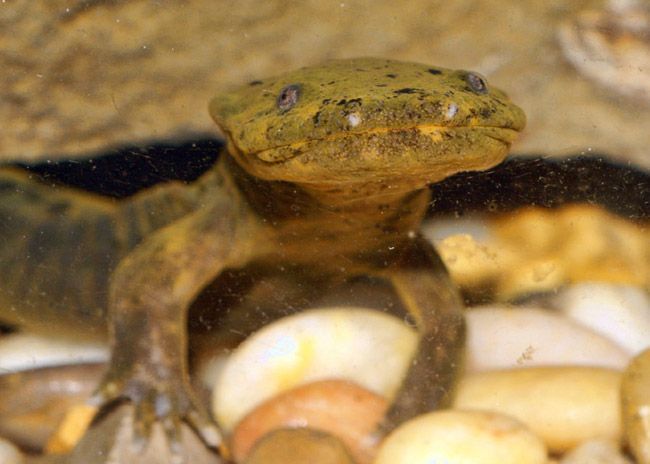
The hellbender is the largest salamander on the North American continent and one of only three surviving species in the ancient family Cryptobranchidae - a lineage so evolutionarily conservative that modern members look nearly identical to fossils from the Jurassic.
Adult hellbenders reach 30 to 74 centimetres from snout to tail tip, weigh up to three kilograms, and spend their entire lives submerged in cold, fast-flowing streams of the eastern United States. They are fully aquatic amphibians, breathing almost entirely through wrinkled folds of skin rather than through lungs or gills. They are also, by most measures, in serious trouble.
This entry covers hellbender biology in detail: size, taxonomy, the peculiar skin-based respiration that ties the species to clean cold water, hunting behaviour, the unusual male-guarded reproductive cycle, their relationship to the Chinese and Japanese giant salamanders, and the long conservation story that has reduced wild populations by more than seventy per cent in many drainages since the 1970s.
Etymology and Folk Names
The scientific name Cryptobranchus alleganiensis comes from the Greek krypto (hidden) and branchia (gills) and the Appalachian place name. It translates roughly to 'hidden-gilled salamander of the Alleghenies'. The reference is to the reduced, mostly internal gill slits retained in adulthood, which are barely visible under the animal's heavy skin folds.
The common names are more colourful. Across Appalachia and the Ozarks the hellbender has picked up a collection of nicknames that reveal more about human perception than about the animal itself.
- Hellbender - the origin is uncertain. One frequently repeated folk etymology claims early settlers thought the animal looked like 'a creature from Hell, bent on returning'. More sober linguists suggest it is simply a dialect word describing a wrinkly or twisted shape.
- Snot otter - a reference to the slippery, mucus-heavy coat that coats the skin and makes the animal almost impossible to hold.
- Devil dog - the large head, small eyes, and defensive bite gave it a reputation as something dangerous.
- Allegheny alligator - a comparison to the only other large, flat-headed vertebrate most settlers had seen.
- Lasagna lizard and mud devil - regional variants referring to the skin folds and the muddy environments where hellbenders sometimes rest.
None of these names reflect hellbender biology accurately. It is not a lizard, not a dog, not venomous, and not an 'alligator' in any sense. Regardless, the names have stuck, and the negative folklore around the species has contributed directly to its decline through centuries of unnecessary killing by anglers who believed a bite was poisonous.
Classification and Evolutionary Context
Hellbenders belong to the order Urodela (tailed amphibians, i.e. salamanders and newts) and to the family Cryptobranchidae. The family contains only two genera: Cryptobranchus, represented by the North American hellbender, and Andrias, which contains the Chinese and Japanese giant salamanders.
Two hellbender subspecies are recognised:
- Eastern hellbender (C. a. alleganiensis) - widespread across Appalachian drainages, the more common of the two.
- Ozark hellbender (C. a. bishopi) - restricted to the White River system of southern Missouri and northern Arkansas, and federally Endangered in the United States.
The cryptobranchids are a startlingly old lineage. Fossils attributable to the family date from the Middle Jurassic, roughly 170 million years ago, and one specimen from the Miocene of Europe - Andrias scheuchzeri - is famous for having been mistakenly described in 1726 as the skeleton of a human drowned in Noah's Flood.
Modern cryptobranchids retain the flat head, wrinkled lateral skin, reduced eyes, and fully aquatic adult stage characteristic of the family throughout its fossil record. For that reason they are often described as living fossils.
The split between the North American Cryptobranchus and the Asian Andrias appears to have occurred around 70 million years ago, coinciding with the final breakup of the Laurasian supercontinent.
Size and Physical Description
Hellbenders are the largest salamanders in North America by a wide margin. Only the Asian giant salamanders - their closest living relatives - exceed them in size globally.
Adults:
- Total length: 30-74 cm (typical mature individuals 40-60 cm)
- Weight: 1.5-3 kg in healthy adults
- Body shape: dorsoventrally flattened, broad-headed, short-limbed
- Skin: loose, highly wrinkled along the sides, heavily mucus-coated
Hatchlings and larvae:
- Length at hatching: 25-33 mm
- External gills retained for 18-24 months, then resorbed
- Reach sexual maturity at 5-8 years of age
The hellbender's most distinctive physical features are the heavy lateral skin folds running along each side of the body. These folds dramatically increase the surface area of the skin, which is essential because adults breathe almost entirely through the skin rather than through lungs or gills. The folds are densely supplied with capillaries, and the animal can expand them outward when oxygen demand rises.
The head is broad and flattened, an adaptation for wedging under the large flat rocks that form the core of hellbender habitat. A hellbender can anchor itself beneath a rock in strong current by spreading its limbs slightly and flattening against the substrate. The eyes are tiny, lidless, and provide only limited image resolution; most sensory input comes from chemoreception and from a sensitive lateral-line system that detects pressure changes in the surrounding water.
Colouration is usually a mottled grey-brown, sometimes with reddish or yellow patches, providing effective camouflage against gravel-and-cobble streambeds. Individuals in different drainages vary considerably, which has led to continuing taxonomic debate about whether additional subspecies deserve recognition.
Cutaneous Respiration and the Need for Clean Cold Water
The most ecologically important feature of the hellbender is its respiratory system. Adult hellbenders have only vestigial lungs, largely non-functional gills, and a very slow metabolism. Between ninety and ninety-five per cent of all gas exchange happens through the skin, a mechanism called cutaneous respiration.
This arrangement only works under a narrow set of environmental conditions.
| Requirement | Typical value |
|---|---|
| Water temperature | Below about 20 degrees Celsius (optimal 10-15 C) |
| Dissolved oxygen | Above 6 mg/L (optimal 8-10 mg/L) |
| Flow regime | Fast, turbulent, continuously oxygenating |
| Substrate | Clean gravel and cobble with large flat rocks |
| Silt load | Minimal - sediment clogs skin capillaries and gill slits |
Warm water holds less dissolved oxygen than cold water, so any increase in stream temperature reduces the oxygen available for skin respiration. Slow water likewise fails to refresh oxygen at the animal's surface. When a hellbender is short of oxygen it increases its surface area by extending the skin folds and begins a distinctive side-to-side rocking motion known as swaying.
Swaying moves fresh water across the skin and, under moderate oxygen stress, is sufficient to compensate. Under severe oxygen stress the animal suffocates.
Silt is the silent killer. Fine sediment particles coat the skin and clog the capillary-rich folds, reducing gas-exchange capacity and leading to chronic hypoxia. This is why land-use changes in a watershed - clear-cut logging, agricultural runoff, road construction, unpaved ATV trails - translate so rapidly into hellbender declines even if the stream itself is not directly contaminated.
In ecological terms the hellbender is an indicator species. The presence of a reproducing hellbender population is strong evidence that a stream system is clean, cold, well-oxygenated, and structurally intact. The disappearance of a hellbender population is usually an early signal that something has gone wrong upstream - often years before changes become visible in water-chemistry monitoring.
Habitat and Range
Hellbenders are restricted to two broad regions of the eastern United States: the Appalachian drainage system and the Ozark drainages. Historical records include parts of southern New York, Pennsylvania, West Virginia, Virginia, Ohio, Kentucky, Tennessee, North Carolina, Georgia, Alabama, southern Illinois, southern Indiana, Missouri, and Arkansas. Current distribution is far more fragmented; many populations persist only in isolated headwater reaches where they once occupied entire watersheds.
Microhabitat requirements are strict. Hellbenders prefer streams and small rivers with:
- Large flat rocks - typically 40 cm or greater across - on clean gravel or cobble substrate
- Continuous swift current with well-oxygenated riffle-and-pool structure
- Minimal silt deposition and low nutrient load
- Intact riparian vegetation that shades the water and stabilises banks
- Strong crayfish populations
Adult hellbenders are site-faithful to an extreme degree. Mark-recapture studies in Appalachian streams have documented individuals returning to the same shelter rock for more than a decade. Home ranges are small, often only a few dozen square metres, and movements of more than a few hundred metres are unusual outside of flood displacement.
Diet and Hunting Behaviour
Hellbenders are opportunistic carnivores, but they specialise heavily on crayfish. Stomach-content and prey-availability studies across their range report crayfish as roughly eighty to ninety per cent of adult diet by volume, with the balance made up of aquatic insects, small fish, tadpoles, other salamanders, worms, and occasionally their own eggs.
Typical prey, ranked by frequency:
- Crayfish (many genera, most commonly Cambarus and Orconectes)
- Small fish (sculpins, darters, juvenile minnows)
- Aquatic insect larvae (especially large stonefly and hellgrammite larvae)
- Tadpoles and other amphibian larvae
- Earthworms washed into the stream
- Conspecific eggs (nest predation by non-guarding adults)
Hellbenders are predominantly nocturnal. They spend daylight hours under a shelter rock and emerge shortly after sunset to hunt. Hunting style is a slow, patient search rather than active pursuit: the animal walks along the streambed, probing under rocks and into crevices, detecting prey through chemical cues and lateral-line sensing rather than vision. When prey is located, the hellbender strikes with a rapid sideways lunge of the broad jaws and swallows the catch whole.
Because their metabolism is slow and their environment cold, hellbenders do not need to eat frequently. A healthy adult can go weeks between substantial meals, especially during the nest-guarding season when males may eat almost nothing for two to three months.
Reproduction and Male Parental Care
Hellbender reproduction is unusual among salamanders in two respects: fertilisation is external, and the male provides the parental care. This is a reversal of the pattern seen in most other salamander families.
Breeding cycle:
- Late summer to early autumn: mature males excavate nest cavities under large flat rocks, often digging out gravel from beneath the shelter to create a chamber with a single entrance.
- Pre-breeding aggregations: up to five to seven males may gather around particularly high-quality nest sites. These gatherings are themselves unusual, because adult hellbenders are normally solitary and territorial.
- Spawning: a female enters the nest and deposits a paired string of 150-450 eggs. The male fertilises the eggs externally as they are laid, then encourages or forces the female to leave. A single male may receive eggs from two or more females in the same nest across the breeding window.
- Guarding: the male remains in the nest cavity for roughly two to three months, defending the clutch against predators - including other hellbenders - and swaying rhythmically to circulate oxygenated water over the eggs.
- Hatching: larvae emerge in late autumn or early winter at 25-33 mm in length. They carry external gills and a yolk sac for several weeks.
- Metamorphosis: external gills are resorbed between 18 and 24 months of age. The animal assumes adult morphology but retains vestigial gill slits.
- Sexual maturity: reached at 5-8 years of age, sometimes later in colder drainages.
The extended male parental care is striking. Nest-guarding males lose substantial body condition during the brood period and are vulnerable to disturbance - turning over a nest rock for casual observation can cause the male to abandon or cannibalise the clutch. This is a significant concern for well-meaning recreational users of hellbender streams.
Lifespan and Population Biology
Hellbenders are remarkably long-lived amphibians. Wild individuals are documented at ages beyond 29 years, and captive animals have surpassed 55 years, which is approaching the maximum known lifespan for any amphibian. The combination of late sexual maturity, long lifespan, small clutch-to-recruitment ratios, and extreme habitat specificity produces a population structure that is slow to decline - but even slower to recover.
| Life-history metric | Typical value |
|---|---|
| Age at sexual maturity | 5-8 years |
| Generation time | 15-20 years |
| Wild maximum age | 29+ years |
| Captive maximum age | 55+ years |
| Eggs per clutch | 150-450 |
| Larval survival to age 1 | Under 5% in many populations |
| Adult annual survival | 90-95% in intact populations |
A long-lived animal with high adult survival but low larval recruitment is typical of species adapted to stable environments. In disturbed systems, low recruitment means that remaining adult populations can look healthy for years while quietly ageing toward collapse. Several hellbender populations in the eastern United States are in exactly this state - demographically ageing adult populations with little evidence of successful reproduction.
Conservation Status and Threats
The IUCN Red List classifies the hellbender as Vulnerable with a decreasing population trend. In the United States the Ozark subspecies Cryptobranchus alleganiensis bishopi is federally Endangered under the Endangered Species Act, with a total wild population estimated at fewer than 600 mature adults across its restricted range in Missouri and Arkansas.
Several state agencies - notably Missouri, Tennessee, North Carolina, Ohio, and Pennsylvania - list hellbenders as state-endangered or species of special concern.
Overall trend data are sobering. Many long-monitored streams have seen hellbender populations decline by more than seventy per cent since the 1970s, and several drainages that once supported dense populations now hold no reproducing hellbenders at all.
Primary threats:
- Sedimentation. Fine sediment from clear-cut logging, agriculture, road construction, unpaved trails, and stream-bank erosion clogs skin folds and smothers nest rocks. This is the single most important driver of decline.
- Water pollution. Agricultural runoff, mine drainage, sewage discharges, and persistent organic contaminants degrade water chemistry. Hellbenders accumulate heavy metals and PCBs in fat and liver tissue.
- Habitat fragmentation. Dams, low-head weirs, and impoundments warm water, trap sediment, and cut populations off from one another. Hellbenders cannot cross reservoirs.
- Illegal collection. Hellbenders have appeared in the international pet trade despite being protected across their range. Even small levels of collection from slow-growing populations can have long-term consequences.
- Angler persecution. Folklore claims of poisonous bites lead some anglers to kill hellbenders caught by accident. This pressure has been documented to contribute to local extirpations.
- Disease. The amphibian chytrid fungus Batrachochytrium dendrobatidis has been detected in hellbender populations, as have several ranaviruses. The interaction with other stressors is not fully understood.
- Climate change. Warming stream temperatures directly threaten cutaneous respiration. More intense rainfall events increase sediment delivery and scour nest habitat.
Conservation responses include captive breeding and headstarting programmes at zoos and universities (the Saint Louis Zoo's Ron Goellner Center for Hellbender Conservation has released more than 10,000 Ozark hellbenders since the early 2000s), targeted nest-box installations, state-level legal protection, and watershed restoration projects focused on reducing sediment delivery.
Long-term recovery will depend on durable improvements in land use across entire catchments, not on single-species interventions in isolated stream reaches.
Hellbenders and Humans
Hellbenders have shared eastern North American waterways with humans for thousands of years, and the cultural record is mixed. Cherokee and Shawnee traditions include respectful references to the large river salamander. European settlers, by contrast, rapidly developed a body of folklore that treated the animal as dangerous, supernatural, or simply disgusting.
The false belief that hellbender bites are venomous has been unusually persistent. Trout anglers who hook hellbenders by accident have historically killed them on the assumption that they are dangerous or that they compete with game fish. Neither assumption is correct - hellbenders have no venom, and studies of stomach contents show that they rarely eat trout or trout eggs.
Awareness has improved in recent decades. Hellbenders are now official state amphibians of Pennsylvania and are featured in educational programmes across their range. Citizen-science projects ask river users to report hellbender sightings, which has produced valuable distribution data. Regulations in most states now prohibit collecting, killing, or possessing hellbenders without a research permit.
Recreational stream users can help protect hellbender populations by avoiding turning over large flat rocks (which can expose nest cavities and kill clutches), reducing sediment delivery from trails and crossings, and reporting any hellbender sightings - living or dead - to state wildlife agencies.
Related Reading
- Axolotl: The Mexican Walking Fish
- Fire Salamander: Europe's Most Striking Amphibian
- Salamanders and Newts: The Masters of Regeneration
- Axolotl: Regenerate Limbs and Brain
References
Sources consulted for this entry include the IUCN Red List assessment for Cryptobranchus alleganiensis, US Fish and Wildlife Service Ozark Hellbender Recovery Plan documents, the Saint Louis Zoo Ron Goellner Center for Hellbender Conservation annual reports, peer-reviewed research published in Herpetologica, Copeia, Journal of Herpetology, and Biological Conservation, and state wildlife agency status reviews from Missouri, Tennessee, North Carolina, Pennsylvania, and Ohio.
Population and trend figures reflect the most recent consolidated assessments available through 2024.
Frequently Asked Questions
How big does a hellbender get?
Adult hellbenders (Cryptobranchus alleganiensis) typically measure 40-60 cm in total length and weigh 1.5-3 kg, though exceptional individuals reach 74 cm. That makes them the largest salamanders in North America and the third largest in the world, behind only the Chinese giant salamander (up to 1.8 m) and the Japanese giant salamander (up to 1.5 m). Hatchlings emerge from the egg at just 25-33 mm but grow rapidly during their first five years.
Adult body shape is distinctive - broad, flat head, stout trunk, short limbs, paddle-like tail, and heavy lateral skin folds.
Where do hellbenders live?
Hellbenders are restricted to the cold, fast-flowing, highly oxygenated streams and rivers of the eastern United States. Their range covers Appalachian drainages from southern New York west to Missouri and south to northern Georgia and Alabama, plus the separate Ozark drainages of southern Missouri and northern Arkansas.
Within those rivers they require specific microhabitat - large flat rocks on clean gravel or cobble substrate, water temperatures below about 20 degrees Celsius, and dissolved oxygen levels above 6 mg/L. Hellbenders are non-migratory and extremely site-faithful. Individuals have been recaptured under the same rock year after year for more than a decade.
What do hellbenders eat?
Hellbenders are opportunistic carnivores, but crayfish typically make up 80-90% of their diet by volume. They also eat small fish, aquatic insects, tadpoles, other salamanders, worms, and occasionally their own eggs. They hunt at night, ambushing prey from beneath rocks or stalking slowly along the streambed. Hellbenders detect prey primarily through chemoreception and lateral-line pressure sensing rather than vision.
Feeding rates drop sharply during the breeding season, when nest-guarding males may go weeks without eating while defending their clutches.
Why do hellbenders have such wrinkly skin?
The loose, wrinkled skin folds along a hellbender’s sides are a respiratory adaptation. Hellbenders have only vestigial lungs and reduced gill function in adulthood, so more than 90% of their gas exchange happens through the skin - a process called cutaneous respiration. The folds dramatically increase surface area exposed to water and are capillary-rich.
To maximise oxygen uptake they often ‘rock’ from side to side, a behaviour called swaying, which moves fresh oxygenated water over the skin. This is also why hellbenders require extremely cold, fast-flowing, well-oxygenated streams: warm or stagnant water simply does not carry enough dissolved oxygen to meet their metabolic demand through skin alone.
Are hellbenders dangerous or venomous?
No. The names ‘devil dog’ and ‘hellbender’ suggest danger but are entirely undeserved. Hellbenders have no venom, no fangs, and no inclination to attack humans. The mucus on their skin contains mild antimicrobial compounds but is not toxic. A cornered or handled hellbender may bite defensively, and the bite can break skin because of the size of the jaws, but there is no medical risk beyond normal wound care.
Folk beliefs that a hellbender bite is poisonous - common in parts of Appalachia - are false and have contributed to the species’ decline through unnecessary persecution by anglers.
How do hellbenders reproduce?
Hellbender reproduction is external and male-guarded. In late summer and early autumn a mature male excavates a nest cavity under a large, flat rock. Several females may visit the nest over a short breeding window, each depositing 150-450 eggs in a paired string. The male fertilises the eggs as they are laid, then remains in the nest for two to three months guarding them against predators, including other hellbenders.
Pre-breeding aggregations of five to seven males around prime nest sites have been documented. Eggs hatch in late autumn or early winter. Larvae have external gills that are resorbed at about eighteen months to two years, after which the animal takes on adult morphology. Sexual maturity arrives at five to eight years of age.
Are hellbenders endangered?
The IUCN lists the hellbender as Vulnerable with a decreasing population trend, and many subpopulations have declined by more than 70% since the 1970s. The Ozark subspecies (C. a. bishopi) is federally Endangered under the US Endangered Species Act, with a wild population estimated below 600 mature adults.
Primary threats include stream sedimentation from logging, agriculture, and road construction; water pollution and acidification; dam construction and impoundments that warm water and trap sediment; illegal collection for the pet trade; and persecution by anglers. Secondary pressures include the amphibian chytrid fungus (Batrachochytrium dendrobatidis), ranaviruses, and increased water temperature linked to climate change.
Several state wildlife agencies run captive-breeding and release programmes, but recovery depends fundamentally on restoring clean, cold, free-flowing streams.
How is the hellbender related to the Chinese and Japanese giant salamanders?
The hellbender is the only New World member of the family Cryptobranchidae. Its only close living relatives are the Chinese giant salamander (Andrias davidianus and several recently recognised species) and the Japanese giant salamander (Andrias japonicus). All three share features - fully aquatic life, skin-based respiration, flattened heads, and exceptional longevity - inherited from a common ancestor that lived more than 160 million years ago.
The Asian giants can exceed 1.5 metres and are the largest amphibians on Earth; the hellbender is noticeably smaller but ecologically equivalent in North American streams. Fossil cryptobranchids are remarkably similar to modern forms, which is why the family is often described as a lineage of living fossils.