
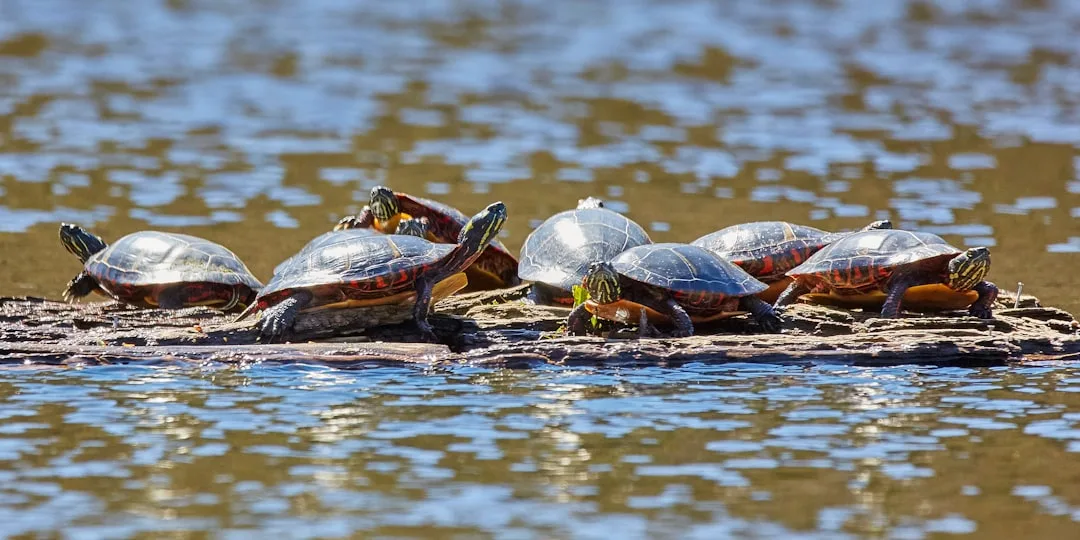
The painted turtle is the most widespread native turtle in North America and one of the most thoroughly studied reptiles on Earth. Chrysemys picta ranges from Nova Scotia to British Columbia, from the Gulf Coast to southern Canada, and from sea level to more than 1,800 metres of elevation.
It is the turtle most people in the United States and southern Canada meet first - the basking silhouette on a half-submerged log, the red-edged shell glimpsed through duckweed, the tiny hatchling found crossing a road in spring.
This guide covers the full biology and ecology of the painted turtle: size and markings, the four subspecies, habitat and range, diet and how it changes with age, reproduction and temperature-dependent sex determination, the extraordinary cold tolerance of hatchlings, lifespan, conservation status, and the handful of genuinely strange facts that set this small freshwater reptile apart from every other turtle on the continent.
Etymology and Classification
The genus name Chrysemys comes from Greek roots meaning 'gold turtle' - a reference to the yellow markings on the head, neck, and limbs. The species epithet picta is Latin for 'painted', describing the bright red, orange, and yellow markings that trace the margins of the shell and run along the legs and head. Early European naturalists who encountered the animal were struck by how decorated it looked compared with the drab turtles of Europe, and the name has held for more than two centuries.
Chrysemys picta sits within the family Emydidae, the pond and marsh turtles, a diverse family that includes sliders, map turtles, cooters, and box turtles. Within Emydidae the genus Chrysemys is currently treated as monotypic, containing only the painted turtle and its four subspecies, though recent molecular work suggests that the southern painted turtle may deserve full species status as Chrysemys dorsalis.
Fossil evidence places the genus as one of the oldest continuously recognisable turtle lineages still alive. Chrysemys-type turtles appear in the fossil record roughly 55 million years ago, in Eocene deposits across North America. Modern painted turtles are anatomically almost indistinguishable from those early forms. That continuity makes Chrysemys picta the oldest extant turtle species by lineage and one of the longest-lived vertebrate morphologies on the planet.
Size and Physical Description
Painted turtles are modestly sized freshwater turtles. Adults are compact, smooth, and strongly flattened compared with snapping or musk turtles.
Adults:
- Carapace length: 10-25 cm, varying by subspecies and latitude
- Weight: typically 300-500 g, with large western females approaching 1 kg
- Shell profile: low, smooth, oval, slightly keeled in some subspecies
Sexual dimorphism:
- Females: larger overall, heavier, shorter tails, shorter front claws
- Males: smaller, slimmer, long foreclaws used in courtship, longer thicker tails with the cloaca positioned well past the shell margin
Hatchlings:
- Carapace: roughly 2-3 cm at emergence
- Weight: 3-6 g
- Proportionally rounder and more colourful than adults
The carapace is typically dark olive to black with red or orange markings along the edge of the marginal scutes. The plastron, or lower shell, ranges from pale yellow with minimal marking in the eastern subspecies to an elaborate dark pattern on a red or orange background in the western form. The head, neck, and limbs are dark with fine yellow stripes and scattered red dashes.
The combination of bold red shell edges and yellow head stripes is one of the most distinctive patterns in any North American reptile.
Biologists have long debated the function of these markings. The patterns are not obviously cryptic - a basking painted turtle is unambiguously visible from a distance. Current evidence suggests the colours function partly as warning signals to potential predators: painted turtles are surprisingly quick into the water, difficult to grip, and capable of delivering sharp bites and deep scratches, and bright markings may advertise the cost of pursuit.
The Four Subspecies
One of the most unusual features of Chrysemys picta is that it is a single species fractured into four well-defined, geographically separated subspecies. Each has a distinct range, a distinct shell pattern, and measurable genetic differences.
| Subspecies | Scientific name | Range | Distinguishing marks |
|---|---|---|---|
| Eastern painted | C. p. picta | Atlantic coast from Nova Scotia to Georgia | Carapace scutes aligned in neat rows; plastron plain yellow |
| Midland painted | C. p. marginata | Great Lakes, Ohio Valley, St. Lawrence | Dark central plastron blotch |
| Southern painted | C. p. dorsalis | Mississippi Valley south to Louisiana | Bold red or orange dorsal stripe |
| Western painted | C. p. bellii | Great Plains, Rockies, Pacific Northwest | Largest; intricately patterned red plastron |
Where subspecies ranges meet, hybrid zones exist and intergrades are common. Genetic analyses consistently show that the southern painted turtle is the most divergent form, to the point that several taxonomic authorities now treat it as a separate species. The western and midland forms are less cleanly separated from each other. The eastern form is the most isolated, confined to the Atlantic slope by the Appalachian mountain barrier.
The existence of four distinct subspecies within one of the most widespread turtles in the world is a signature of the Pleistocene glaciations. Each form represents a lineage that survived in a separate ice-age refugium and expanded north as glaciers retreated. The patchwork of shell patterns we see today is essentially a map of postglacial recolonisation frozen into turtle biology.
Habitat and Range
Painted turtles are the most widely distributed native turtle in North America. Their range extends from Nova Scotia across southern Canada to Vancouver Island, south through nearly all of the continental United States, and into parts of northern Mexico. They are absent from the driest desert interiors and from the highest mountain plateaus but otherwise close to ubiquitous wherever fresh water stands still.
The species is tied to slow-moving or still freshwater habitats. Ideal habitat includes:
- Shallow ponds with soft muddy bottoms
- Marshes and wet meadows
- Oxbow lakes and slow river backwaters
- Drainage ditches and farm ponds
- Quiet lake margins with emergent vegetation
- Beaver impoundments
Painted turtles require four habitat elements simultaneously: soft bottom sediment for overwintering, abundant aquatic plants for food and cover, exposed basking structures such as logs or rocks, and nearby open soil or sand for nesting. Populations persist surprisingly well in modestly urbanised landscapes as long as all four requirements are present.
The species tolerates a broader latitudinal range than almost any other turtle. Painted turtle populations flourish where winter ice covers ponds for five months a year - conditions that eliminate most other reptiles entirely.
Diet and the Age-Related Shift
Painted turtles are omnivores, but their diet is not static. Across the life of an individual it undergoes one of the most dramatic diet shifts documented in any North American reptile: young turtles are predominantly carnivorous, adults are predominantly herbivorous.
Hatchling and juvenile diet:
- Aquatic insect larvae (mayflies, dragonflies, midges)
- Small crustaceans and amphipods
- Tadpoles and small fish
- Leeches, snails, worms
- Carrion when available
Adult diet:
- Duckweed, pondweed, water lily fragments
- Filamentous algae
- Submerged aquatic plants
- Insects, tadpoles, small fish when encountered
- Carrion, including fish and amphibian carcasses
The shift is gradual and tracks growth rate. Protein-rich animal prey drives the rapid growth required during the first years of life, when survival depends on reaching a size that is too large for most aquatic predators to swallow. Once adult size is reached, energy needs drop and plant material becomes an efficient, locally abundant food source.
In practical terms, a pond full of painted turtles functions as both a community of young predators and a community of older grazers occupying the same water at the same time.
Painted turtles are active foragers. They swim slowly through vegetation, probe the bottom, and inspect drifting debris for food. Unlike snapping turtles, they are not ambush predators. Feeding happens almost entirely in the water.
Reproduction and Temperature-Dependent Sex Determination
Painted turtle reproduction is strictly seasonal and coupled to environmental temperature at every stage. Mating takes place in spring, shortly after emergence from overwintering. Males court females with an elaborate display involving the long foreclaws, fluttering them rapidly alongside the female's face in a sustained underwater ritual that can last many minutes.
Nesting happens in late spring and early summer, typically May through July. Females leave the water during warm afternoons or evenings and travel up to several hundred metres to find suitable open soil. They dig a flask-shaped nest chamber roughly 10-12 cm deep with alternating hind feet, lay 4-15 eggs, and cover the nest before returning to water.
Clutch data:
| Metric | Value |
|---|---|
| Clutches per year | 1-3 depending on latitude |
| Eggs per clutch | 4-15 (subspecies and body size dependent) |
| Incubation period | 72-80 days typical |
| Hatching month | Late August to September |
| Age at first reproduction | 4-10 years (females later than males) |
Incubation is where the species becomes biologically strange. Painted turtles have no sex chromosomes. Sex is decided entirely by nest temperature during the middle third of incubation. Cool nests, around 23-27 degrees Celsius, produce overwhelmingly male hatchlings. Warmer nests, above roughly 29 degrees Celsius, produce overwhelmingly females. The pivotal temperature - the one at which both sexes are produced in equal numbers - is narrow, generally around 28 degrees Celsius.
This system is elegant but brittle. Climate warming has already shifted sex ratios toward females in many monitored populations across the United States. In some warm years some northern sites produce no males at all. If the trend continues without compensation through nesting behaviour shifts or range movement, some local populations could become reproductively unsustainable on a timescale of decades.
Hatchling Overwintering and Extreme Cold Tolerance
The single most extraordinary feature of the painted turtle is what its hatchlings do with their first winter. In most turtle species hatchlings emerge from the nest in late summer, walk to water, and overwinter submerged in mud. Painted turtle hatchlings do something else entirely.
They hatch from the egg in late summer or early autumn inside the underground nest chamber, absorb the remaining yolk, and then stay put. They do not dig their way out. They remain in the nest through the entire winter, above ground, in a chamber that freezes solid along with the surrounding soil.
Painted turtle hatchlings survive being frozen. Ice crystals form in the fluid between their cells. Their tissues accumulate glucose and other cryoprotectants that prevent lethal intracellular ice formation. Body temperatures of minus 10 degrees Celsius or lower have been measured in hatchlings that subsequently thawed and walked to water unharmed. This is the best cold tolerance documented in any reptile.
The strategy seems to pair with the species' general approach to cold: adults overwinter in pond-bottom mud where oxygen may run out entirely for weeks, surviving by switching to anaerobic metabolism and buffering the acidic byproducts with calcium released from their own shells and bones. No other group of vertebrates combines quite this set of tolerances - freezing, oxygen starvation, and acid buffering through skeletal chemistry.
The evolutionary origin of hatchling freeze tolerance is debated. One hypothesis is that it allows the species to nest in spring while avoiding fragile late-autumn hatchling migrations. Another is that it simply reflects the extreme northern reach of the species: painted turtles nest far further north than any other North American turtle, and freeze tolerance is the only strategy that works at those latitudes.
Basking, Behaviour, and Social Life
Painted turtles are famous baskers. Their thermoregulation depends on direct sunlight: a turtle that does not bask cannot digest efficiently, cannot fight off infections, and cannot synthesise the vitamin D needed for healthy shell growth.
Preferred basking substrates include partially submerged logs, emergent rocks, mats of floating vegetation, and beaver lodges. Painted turtles frequently bask communally, and at favoured logs in mid-summer one can see five, ten, or more individuals sharing space. When logs run out they stack, sometimes three or four deep, with smaller turtles perched on the shells of larger ones.
Despite this tolerance for proximity, painted turtles are not truly social animals in the way mammals or birds can be. There is no cooperation, no communal defence, no shared parental care. Communal basking reflects shared demand for a limited resource - warm, dry, safe perches above water - rather than any social bond.
Painted turtles are intensely wary in the wild. A basking group will drop into the water at the smallest disturbance from thirty metres away, sometimes with an audible splash. Underwater, they swim confidently but rely heavily on vegetation and bottom debris for cover from predators including raccoons, herons, mink, otters, large fish, and snapping turtles.
Lifespan and Aging
Painted turtles are long-lived by the standards of their size. Wild individuals commonly live 30-40 years. Northern populations, where growth is slowest and maturity comes latest, produce the oldest individuals. Captive painted turtles regularly exceed 50 years with appropriate care.
Long-term mark-recapture studies in Michigan, Ontario, and Illinois have tracked individually recognised females across decades and recovered breeding animals well into their fourth and fifth decades. Clutch size in these older females is often larger than in younger breeders, and hatch rates do not consistently decline with age - the painted turtle shows something close to negligible reproductive senescence.
This extended reproductive lifespan is ecologically significant. Painted turtle populations depend on decades of accumulated adult female output to compensate for very high hatchling and juvenile mortality. Management actions that reduce adult female survival - road mortality at nesting migrations, for example - can destabilise populations that appear superficially healthy.
Conservation Status and Threats
The IUCN lists Chrysemys picta as Least Concern. The species is still abundant, still widespread, and still capable of persisting in moderately disturbed habitat. That status is accurate at the global scale but conceals serious local pressures.
Primary threats:
- Road mortality. Nesting females travel long distances on land and cross roads in significant numbers. Adult female loss is especially damaging given slow reproductive replacement.
- Habitat loss. Wetland drainage for agriculture and development continues to remove prime habitat across the range.
- Nest predation. Subsidised predators - raccoons, skunks, coyotes - thriving on human food sources destroy extraordinary proportions of painted turtle nests, commonly 70-90% at monitored sites.
- Climate-driven sex ratio skew. Warming nest temperatures are pushing hatchling sex ratios strongly toward females and may produce reproductively unsustainable populations in some areas over coming decades.
- Collection for the pet trade. Painted turtles are popular in the pet trade, and illegal wild collection remains a concern in certain regions.
- Invasive competitors. Released red-eared sliders, originally native only to parts of the species' southern range, now compete with painted turtles across much of North America and in wild populations overseas.
- Painted turtles as invasive. Escaped or released painted turtles from the North American pet trade have become established in parts of Europe, where they outcompete native pond turtles such as Emys orbicularis.
Conservation tools include nest protection cages, roadway mortality signage and wildlife underpasses, wetland protection, and nest-site management that targets the warmest microhabitats for shading trials. None of these directly addresses climate-linked feminisation; that problem will require longer-term range and phenology shifts.
Painted Turtles and Humans
The painted turtle is the most frequently encountered turtle across most of its range. It appears on state emblems - Michigan, Illinois, Colorado, and Vermont have all named some version of the painted turtle their state reptile - and is a common subject of nature education programmes. Because it tolerates modest habitat disturbance and is comfortable in urban ponds, it is often the first wildlife species children handle.
The species has become a major model organism in physiology. Research on painted turtle hatchlings underlies much of what science knows about vertebrate freeze tolerance, anoxia tolerance, and cryoprotection. Work on adult overwintering has illuminated skeletal buffering of lactic acidosis and the limits of vertebrate anaerobic metabolism. Wildlife veterinarians routinely cite painted turtle studies when designing cold-stunning recovery protocols for other reptile species.
Legally protected across most of its range, the painted turtle nonetheless occupies an ambiguous position in North American culture - common enough to be ignored, visible enough to be treasured, and strange enough that researchers keep finding new things to study in an animal that has looked essentially unchanged for more than 50 million years.
Related Reading
- Alligator Snapping Turtle: Prehistoric Ambush Predator
- Green Sea Turtle: Ocean Migrations and Grazing Life
- Galapagos Tortoise: Island Giants
- Turtles and Tortoises: Ancient Survivors in a Shell
- Sea Turtles and Magnetic Field Navigation
References
Sources consulted for this entry include the IUCN Red List assessment for Chrysemys picta, the Turtle Taxonomy Working Group's Conservation Biology of Freshwater Turtles and Tortoises (multiple editions), long-term demographic studies from the E.S.
George Reserve in Michigan, and peer-reviewed work on painted turtle freeze tolerance and anoxia tolerance in Journal of Experimental Biology, Physiological and Biochemical Zoology, and Copeia. Subspecies genetic analyses draw on work published in Molecular Phylogenetics and Evolution. Climate-linked sex ratio skew data reflect multi-site monitoring reported in Ecology and Biological Conservation.
Frequently Asked Questions
How big do painted turtles get?
Painted turtles (Chrysemys picta) are modestly sized freshwater turtles. Adult carapace length runs from 10 to 25 centimetres, and adult mass typically falls between 300 and 500 grams. Females are consistently larger than males - the largest verified western painted turtles exceed 25 cm and approach 1 kg. Males are slimmer, with longer front claws and longer tails. Hatchlings emerge from the egg at roughly 2-3 cm carapace length and weigh only a few grams.
Growth is fastest in the first five years and slows dramatically once sexual maturity is reached, which can take 4-10 years depending on latitude and food availability.
Where do painted turtles live?
The painted turtle is the most widely distributed native turtle in North America. Its range stretches from southern Canada - Nova Scotia across to British Columbia - down through nearly the entire United States and into northern Mexico. The species is absent only from the driest parts of the southwest and the highest mountain regions.
Painted turtles strongly prefer slow-moving or still fresh water: ponds, marshes, lake margins, oxbows, drainage ditches, and the backwaters of slow rivers. They need soft muddy bottoms for overwintering, abundant aquatic vegetation for food and cover, and exposed logs, rocks, or mats of vegetation for basking.
What do painted turtles eat?
Painted turtles are omnivores, but their diet shifts with age. Hatchlings and juveniles are strongly carnivorous. They pursue aquatic insects, small crustaceans, tadpoles, leeches, small fish, and carrion - high-protein foods needed for rapid shell and body growth. As painted turtles mature the diet gradually tips toward plant material.
Adult painted turtles consume large quantities of submerged vegetation - duckweed, algae, water lilies, and pondweed - supplemented with whatever invertebrates, small vertebrates, or carcasses they encounter. They are active foragers rather than ambush predators, swimming through vegetation and probing the bottom with their snouts.
How long do painted turtles live?
In the wild, painted turtles commonly reach 30-40 years, and individuals in the northern parts of the range frequently exceed those numbers thanks to slow growth and delayed maturity. In captivity, with consistent diet, stable temperatures, and veterinary care, lifespans above 50 years are well documented.
Long-term mark-recapture studies in Michigan and Ontario have recovered individually identified females still reproducing in their fourth and fifth decades. Like many long-lived turtles, painted turtles show negligible reproductive senescence - older females often produce larger clutches with higher hatch rates than younger ones.
How do painted turtles survive winter?
Adult painted turtles overwinter underwater, buried in mud at the bottom of their pond or marsh. Their metabolism drops so low that they can survive without breathing for up to four months by absorbing small amounts of oxygen through the skin of the cloaca, throat, and neck. When dissolved oxygen runs out entirely, they switch to anaerobic metabolism, buffering the resulting lactic acid with calcium released from their shells.
Hatchlings use a completely different strategy: they remain in the nest chamber above ground, and their tissues tolerate freezing. Their bodies allow extracellular ice to form while protecting cells with high concentrations of cryoprotectants, then thaw intact in spring. This combination gives the painted turtle the best cold tolerance of any reptile.
How does temperature determine painted turtle sex?
Painted turtles have temperature-dependent sex determination (TSD). The sex of each egg is decided by the temperature of the nest during a middle portion of incubation - roughly the second third of development. Cooler nests, around 23-27 degrees Celsius, produce mostly or entirely males. Warmer nests, above about 29 degrees Celsius, produce mostly or entirely females.
There is no sex chromosome - a single nest at a pivotal temperature can produce both sexes depending on tiny variations. This system leaves the painted turtle directly vulnerable to climate change. Studies across the United States have already documented significant feminisation of wild clutches, and some northern populations are producing almost no males in warm years.
Are painted turtles endangered?
The IUCN lists the painted turtle as Least Concern at the species level. The species is abundant, widespread, and tolerant of modestly degraded habitats. That global status hides meaningful regional concerns, however. Road mortality during nesting migrations is a major cause of adult female loss in many populations, and because turtle population growth depends heavily on adult survival, this alone can cause local declines.
Habitat loss, wetland drainage, pollution, introduced predators, and illegal collection for the pet trade all contribute to pressure on individual populations. Climate-driven sex ratio skew is a slower, more insidious threat that has only recently been recognised as potentially serious.
What are the four subspecies of painted turtle?
The painted turtle is divided into four subspecies that are geographically and genetically distinct. The eastern painted turtle (C. p. picta) is found from Nova Scotia down the Atlantic coast; its carapace scutes line up in neat rows. The midland painted turtle (C. p. marginata) occupies the Great Lakes region and middle Mississippi drainage, with a dark blotch on the plastron.
The southern painted turtle (C. p. dorsalis) of the Mississippi Valley is smaller and carries a bold red or orange stripe down the middle of the carapace. The western painted turtle (C. p. bellii) is the largest subspecies and ranges across the Great Plains to British Columbia; it has an intricately patterned plastron. Genetic evidence has led some scientists to propose splitting them into separate species, particularly the southern form.