
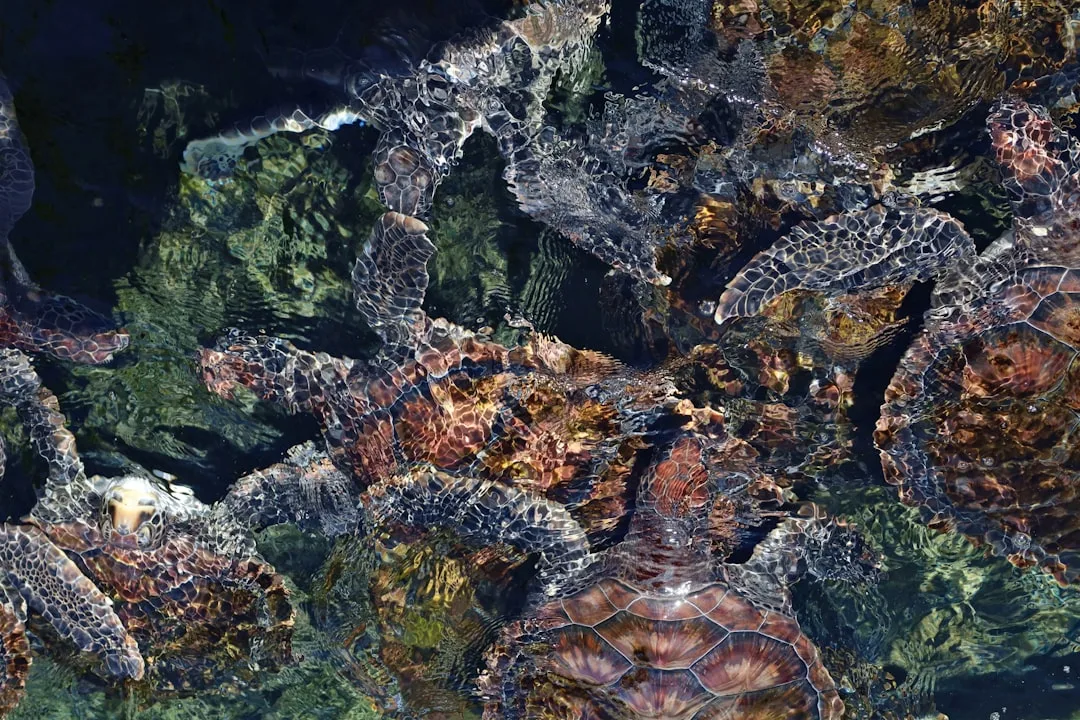
How do sea turtles find their birth beach?
Sea turtles navigate back to their birth beaches using Earth's magnetic field as a biological GPS. Each beach on Earth has a unique magnetic signature based on its specific latitude, longitude, and geological composition. When female sea turtles hatch and enter the ocean, they memorize their birth beach's magnetic signature.
The Most Remarkable Navigation in the Animal Kingdom
Twenty years after she hatched on a specific stretch of sand in Florida, a loggerhead sea turtle swims back toward that exact beach. She has spent two decades in the open Atlantic, traveling thousands of kilometers across feeding grounds extending from Africa to the Caribbean. She has never seen this beach as an adult. She has not seen any beach at all since she was a hatchling the size of a cookie.
And yet somehow, navigating through 13,000 kilometers of featureless open ocean, she finds the right beach. Not just the right general area - the specific beach. Within a few kilometers of where she hatched. She crawls ashore on the same sand her mother crawled across, and her grandmother, and her great-grandmother, back through lineages that have been returning to this beach for millions of years.
Sea turtle navigation is one of the most remarkable achievements in the animal kingdom. It involves magnetic field detection, memory encoded during the first hours of life, and a precision that would impress any human engineer trying to build an equivalent GPS system.
The Basic Phenomenon
Female sea turtles exhibit natal homing or philopatry - returning to their birth beaches to lay their own eggs. This is not general migration to some breeding area; it is specific navigation to a particular beach, often measured in hundreds of meters rather than kilometers.
The evidence:
Genetic analysis confirms that female sea turtles on specific beaches share maternal DNA lineages distinct from females on neighboring beaches even just kilometers away. This is only possible if females are returning to their specific birth beaches and breeding with local conditions rather than mixing with other populations.
Accuracy of homing:
Approximately 90 percent of nesting females return to within a few kilometers of their birth beach. Some return to within meters of their birth site.
For which species:
Natal homing has been documented in:
- Green sea turtles
- Loggerhead sea turtles
- Leatherback sea turtles
- Olive ridley sea turtles
- Hawksbill sea turtles
- Kemp's ridley sea turtles
- Flatback sea turtles
Essentially all sea turtle species show strong natal homing, though the precision varies. Leatherbacks have slightly looser homing than loggerheads, but all sea turtle populations show clear maternal genetic clustering tied to specific beaches.
The Migration Scale
Before understanding how turtles navigate, consider what they are navigating.
Leatherback sea turtles:
- Largest living turtles (up to 2 meters long, 700 kg)
- Annual migrations up to 20,000 kilometers
- Feed on jellyfish in Arctic and Antarctic waters
- Nest on tropical beaches
- Return route must span multiple ocean basins
Loggerhead sea turtles:
- Tagged individuals tracked traveling 13,000 kilometers from Japan to Mexico and back
- Individual turtles may occupy multiple feeding grounds during their lives
- Nesting females can travel 3,000+ km from feeding areas to nesting beaches
- Some populations cross the Pacific Ocean repeatedly
Green sea turtles:
- Hawaii populations nest at French Frigate Shoals, 1,300+ km from feeding grounds
- Atlantic populations migrate between Brazil and Ascension Island, 2,250 km into open ocean
- Some populations show remarkable site fidelity to tiny remote islands
Olive ridleys:
- Synchronized mass nesting events called arribadas bring thousands of females ashore simultaneously
- Individual turtles travel thousands of kilometers between feeding areas and arribada beaches
- Mass nesting ensures at least some eggs survive even high predation rates
Every sea turtle species migrates extensively, often across open ocean with no visual landmarks for guidance. The navigation problem is among the most difficult any animal attempts.
The Magnetic GPS
Sea turtles navigate primarily using Earth's magnetic field. This has been proven through a combination of behavioral experiments and physiological research.
The evidence:
Experiments by Dr. Kenneth Lohmann at the University of North Carolina have demonstrated that sea turtles can:
- Detect Earth's magnetic field intensity (which varies by latitude)
- Detect Earth's magnetic field inclination (angle of the field relative to the surface)
- Use this information to determine their location on Earth
- Remember specific magnetic signatures from their hatching location
- Navigate back to those signatures later in life
The experimental setup:
Lohmann tested sea turtle hatchlings in controlled laboratories by placing them in water-filled arenas surrounded by magnetic coils. The coils simulated the magnetic fields of different locations on Earth.
When hatchlings were placed in magnetic conditions matching the ocean off North Carolina (where they had hatched), they swam in directions that would take them into the Atlantic currents. When the magnetic field was shifted to simulate a location off West Africa, the same hatchlings reoriented and swam in different directions - directions appropriate for navigating from West Africa rather than from North Carolina.
This proves sea turtles process magnetic information and translate it into navigation behavior. They have a biological GPS that tells them where they are on Earth.
How they detect magnetic fields:
Sea turtles have specialized cells containing magnetite - a naturally magnetic iron oxide compound. These cells are located in specific brain regions and respond to magnetic field variations. When magnetic fields change around the turtle, magnetite cells signal the nervous system, providing the turtle with information about location and direction.
This biological compass is not the same as a human compass. Humans with compasses know only direction. Sea turtles can determine both direction AND latitude from magnetic fields, giving them two-dimensional location information.
The Memory Formation
How do sea turtles remember their birth beach's magnetic signature decades later?
The imprinting hypothesis:
When hatchlings emerge from eggs and crawl to the ocean, they pass through a brief period (probably hours to days) during which their brains encode the magnetic signature of the surrounding area. This encoding is essentially permanent - it persists through decades of open-ocean life and is accessible decades later when the turtle needs to return.
Evidence for imprinting:
Females tagged as hatchlings at specific beaches have been observed returning to those beaches 20-30 years later to lay their own eggs. The timing and specificity of these returns is inconsistent with learning - turtles do not return to areas they have visited during their adult lives but specifically to their hatching location.
The imprinting mechanism is analogous to how salmon imprint on natal streams' chemical signatures. Different sensory systems (chemical for salmon, magnetic for turtles), same general strategy: encode critical location information during brief developmental windows.
Neural basis:
The specific brain structures involved in magnetic imprinting are still being investigated. Research at several laboratories is working to identify:
- Where magnetite cells cluster in the turtle brain
- How imprinting encodes magnetic information in neural structure
- How retrieval of imprinted memories occurs decades later
- Why the imprinting window is restricted to early life
This is active cutting-edge research in animal navigation. The neuroscience is not fully understood, but the behavioral evidence for magnetic imprinting is strong.
Supplementary Navigation Systems
While magnetic fields provide the primary navigation mechanism, sea turtles use multiple sensory inputs to refine their navigation.
Ocean currents:
Sea turtles appear to sense ocean current direction and speed, using this information to calculate their drift and adjust their heading. This is particularly important because open-ocean currents can push a swimming turtle significantly off course - compensating for current drift is essential for long-distance navigation.
Water temperature:
Turtles detect water temperature gradients that correlate with specific ocean regions. Warm water indicates tropical regions; cold water indicates polar regions. This is not precise location information but provides general regional cues.
Light patterns:
Polarized light patterns in the sky may provide directional information, particularly near the surface during daylight hours. Turtles spend much of their time near the surface breathing, giving them exposure to sky conditions.
Star patterns:
Some evidence suggests sea turtles can orient using star positions during nighttime near the surface. This has been harder to verify experimentally because turtle behavior at night is difficult to observe.
Chemical cues near beaches:
As turtles approach nesting beaches after their magnetic navigation brings them to the correct region, chemical cues in the water help them locate the specific beach. These include:
- Minerals and organic compounds unique to the specific coastline
- Freshwater runoff patterns (though sea turtles live in salt water, freshwater signatures near beaches provide landmarks)
- Specific plant and algal compounds associated with particular shorelines
The combination of magnetic navigation (for general location) and chemical navigation (for final approach) allows the remarkable precision of sea turtle natal homing.
The Life Cycle
Sea turtle life histories are among the most dramatic in the animal kingdom.
Hatching:
Female sea turtles lay 80-200 eggs in beach nests, typically at night. Eggs incubate for 45-75 days depending on species and sand temperature. Hatchlings emerge collectively in a "boil" - hundreds of small turtles erupting from the sand simultaneously and scrambling toward the ocean.
Beach-to-ocean journey:
This first journey is incredibly dangerous. Predators - raccoons, foxes, crabs, shorebirds - converge on beach nests. Probably half of hatchlings die before reaching the water. Those that make it to the ocean face shark and fish predation in the shallows.
The lost years:
After reaching the ocean, sea turtles enter a phase historically called "the lost years" because biologists could not track where they went or what they did. Satellite tagging and genetic research in recent decades has revealed that young sea turtles drift with ocean currents, feeding in open ocean on jellyfish, small fish, and plankton.
Juvenile sea turtles spend 5-15 years in this open-ocean drifting phase. They navigate using their magnetic sense, using ocean currents as transportation, and gradually growing from palm-sized hatchlings to dinner-plate-sized juveniles.
Adulthood:
After reaching approximately juvenile size, sea turtles transition to coastal feeding grounds. Specific adult turtles occupy specific feeding areas, returning to the same underwater locations year after year. Some individual turtles have been observed at the same feeding sites for 30+ years.
Breeding:
Female sea turtles reach breeding maturity at 15-30 years old depending on species. Every 2-3 years during breeding season, they leave their feeding grounds and navigate to their birth beaches. They may lay 3-7 clutches per breeding season, then return to feeding grounds for the next 2-3 years.
Male sea turtles do not return to beaches at all. They remain near the offshore coastal waters during breeding seasons, waiting for females and mating with receptive turtles before the females come ashore.
Longevity:
Sea turtles live 80-100+ years, with some individuals estimated at 150+ years old. They may reproduce for decades, contributing eggs to multiple generations during their reproductive lifetimes.
The Temperature-Sex Problem
Sea turtle offspring gender depends on incubation temperature, not genetics - a system called temperature-dependent sex determination (TSD).
How TSD works:
During the middle third of embryonic development, the egg's temperature determines the developing turtle's sex:
- Cooler sand (below 28°C): produces males
- Warmer sand (above 30°C): produces females
- Around 29°C (species-specific): produces mixed sex ratios
The exact threshold varies slightly by species, but the pattern holds across all sea turtles.
The climate change problem:
Sand temperatures at nesting beaches have risen measurably due to climate change. Beaches that historically produced mixed male-female hatchling ratios now produce predominantly female hatchlings.
Extreme cases:
- Queensland Australia green sea turtles: 99.1 percent female hatchlings in recent surveys
- Florida loggerhead turtles: 70-80 percent female at many beaches
- Raine Island Great Barrier Reef turtles: 99+ percent female
Why this is dangerous:
Sex ratios skewed dramatically toward females threaten long-term population viability. Without enough males, populations cannot sustain reproduction. A population producing 1 male per 100 females may appear healthy during breeding seasons (females lay eggs normally), but cannot sustain itself across decades as existing males age out of reproductive function.
Conservation responses:
Beach management programs now include:
Shade structures. Shade cloth placed over nests during incubation can lower sand temperature enough to produce more male hatchlings.
Nest relocation. Moving eggs to cooler beach areas or hatchery facilities with controlled temperature management.
Sand cooling. Sprinkler systems wetting nest sand to reduce temperature.
Hatchery programs. In some regions, eggs are excavated and transferred to controlled hatchery environments where temperature can be managed.
These interventions work at small scales but cannot realistically protect entire populations. The underlying climate change remains the primary threat.
The Conservation Crisis
Sea turtles are among the most threatened vertebrate groups on Earth. Six of seven species are classified as Threatened, Endangered, or Critically Endangered by the IUCN.
Threat categories:
Fishing bycatch. Sea turtles drown in commercial fishing gear. Longline fishing, bottom trawling, and gillnet fishing all kill substantial numbers of turtles. Estimated turtle deaths from fishing bycatch: 250,000+ per year globally.
Poaching. Eggs are harvested for food in many regions despite legal protection. Adult turtles are killed for meat (culturally important in some communities) and for shells (hawksbill turtles particularly valued for tortoiseshell jewelry).
Coastal development. Beach construction, artificial lighting, and shoreline modification disrupt nesting beaches. Artificial lights near beaches disorient hatchlings, leading them away from the ocean and toward roads where they die.
Plastic consumption. Sea turtles frequently mistake plastic bags and other debris for jellyfish (their primary prey). Consumed plastic blocks digestive systems and can cause death from starvation or internal injury.
Boat strikes. Turtles surfacing to breathe are struck by boat propellers, causing severe injuries or immediate death.
Climate change. Beyond temperature-based sex ratio problems, rising sea levels threaten nesting beaches with inundation, and shifting ocean patterns disrupt traditional migration routes.
Oil spills. Major spills directly poison turtles and destroy habitat.
Population status:
Some sea turtle populations are actually recovering due to decades of conservation work. Kemp's ridley turtles, once nearly extinct, have rebounded from fewer than 200 breeding females in 1985 to approximately 10,000 nests annually. Green turtle populations in Hawaii and the Caribbean have increased significantly. Loggerhead populations in Florida and Japan have stabilized.
Other populations continue declining. Leatherback populations in the Pacific have collapsed by over 90 percent. Hawksbill turtles remain critically endangered globally. Olive ridley nesting colonies have been lost or severely reduced in several countries.
The conservation outlook is mixed. Active management works when resources are available and political will exists. The question is whether conservation efforts can scale fast enough to match accelerating threats.
Why Sea Turtle Navigation Matters Beyond Turtles
Research on sea turtle navigation has implications extending beyond the species.
Understanding magnetic sense:
Sea turtles provide one of the clearest behavioral demonstrations of magnetic sensing in vertebrates. Research on their navigation has informed understanding of magnetic sense in:
- Migratory birds (which show similar capabilities)
- Salmon (using magnetic imprinting on natal streams)
- Lobsters and crustaceans (using magnetic fields for navigation)
- Possibly humans (weak magnetic sensing has been proposed but remains controversial)
Biomimicry potential:
Understanding how biological systems detect and process magnetic information could inform new technologies:
- Enhanced GPS alternatives
- Navigation systems for environments where GPS fails (underwater, underground)
- Biological sensors for magnetic field applications
Climate change science:
Sea turtle responses to changing conditions provide natural indicators of climate impact on marine ecosystems. Sex ratio changes, migration timing shifts, and population responses all contribute to understanding how marine environments are changing.
Conservation methodology:
Sea turtle conservation programs have pioneered techniques applicable to other species:
- Community-based protection of nesting sites
- International cooperation across migratory ranges
- Ecotourism as conservation funding
- Incorporating traditional ecological knowledge
These approaches have influenced conservation work for marine mammals, migratory birds, and other wide-ranging species.
The Ancient Navigators
Sea turtles have been performing this navigation routine for approximately 110 million years. The basic life cycle - hatching on beaches, oceanic juvenile phase, adult feeding grounds, natal homing for reproduction - has been refined over 100+ million years of evolution.
The specific beaches where modern sea turtles nest are, in many cases, thousands or millions of years old as nesting locations. Some beaches show archaeological evidence of sea turtle nesting going back to before human civilization existed.
When a female sea turtle crawls onto a beach in Costa Rica, Greece, Florida, or Australia to lay her eggs, she is continuing a lineage of beach visits stretching back to the dinosaur age. Her great-great-etc-grandmothers were doing the same thing on the same or nearby beaches when T. rex walked the Earth.
The magnetic signatures she follows have shifted slightly over millions of years as continents drifted and Earth's magnetic field varied. But the basic navigation system - encoding a magnetic signature at hatching, storing it for decades, and using it to return for reproduction - has persisted through every geological and ecological change.
Sea turtles are living connections to an ancient planet. Each successful nesting event continues a chain of continuity extending back before mammals became dominant, before flowering plants reached full diversity, before many modern ocean species existed.
Losing sea turtles would break that chain permanently. No species that exists today could replace them in their ecological and evolutionary role. Their specific navigation capabilities, refined over 100+ million years, are unique achievements in the history of life on Earth.
This is what is at stake when we talk about sea turtle conservation. Not just a species, but an ancient evolutionary experiment in long-distance navigation that has been running continuously since before our own ancestors existed.
Related Articles
- Sea Turtles: Ancient Navigators of the Ocean
- Turtles and Tortoises: Ancient Survivors in a Shell
- Monarch Butterfly Migration
Frequently Asked Questions
How do sea turtles find their birth beach?
Sea turtles navigate back to their birth beaches using Earth’s magnetic field as a biological GPS. Each beach on Earth has a unique magnetic signature based on its specific latitude, longitude, and geological composition. When female sea turtles hatch and enter the ocean, they memorize their birth beach’s magnetic signature.
Decades later (sea turtles reach breeding age at 15-30 years), females use this remembered signature to navigate back to the same beach to lay their own eggs. This behavior, called natal homing or philopatry, is so precise that approximately 90 percent of nesting females return to within a few kilometers of their birth beach.
The magnetic sense is detected through specialized proteins called magnetite in the turtle’s brain tissue that respond to Earth’s magnetic field variations.
How far do sea turtles migrate?
Sea turtles make some of the longest migrations in the animal kingdom. Leatherback sea turtles can migrate over 20,000 kilometers annually between feeding grounds in the Pacific and nesting beaches in Southeast Asia or the Americas. Loggerhead sea turtles tagged in Japan have been tracked traveling 13,000 kilometers to feeding grounds off Mexico and returning. Green sea turtles in Hawaii migrate 1,300+ km to French Frigate Shoals to nest.
Olive ridley turtles migrate thousands of kilometers between feeding and nesting areas in synchronized mass nesting events called arribadas. These migrations span open ocean with no visual landmarks for guidance - turtles navigate entirely using magnetic sensing, ocean currents, temperature gradients, and possibly star patterns.
Young sea turtles learn the correct routes during their initial oceanic phase, encoding the information for later adult migrations.
How old can sea turtles get?
Sea turtles can live 80-100+ years, with some leatherback and green sea turtles estimated at over 150 years old. Exact ages are difficult to determine because sea turtles do not show visible aging signs after reaching maturity. Scientists age older turtles through skeletochronology (counting growth rings in bone samples), which requires either deceased specimens or invasive procedures.
Green sea turtles have particularly long lifespans - individuals tagged in the 1970s are still being observed actively nesting, making them at least 50-60 years old with many decades of potential remaining. Female sea turtles can continue reproducing throughout most of their adult lives, though reproductive rates decline gradually after age 50-60.
The oldest documented green sea turtle was estimated at 152 years old based on skeletal analysis after her death. Sea turtles represent one of the longest-lived vertebrate groups alive today.
Why do sea turtles lay so many eggs?
Sea turtles lay 80-200 eggs per nest and often produce 3-7 nests per breeding season because survival rates from egg to adult are extremely low. Studies estimate only 1 in 1,000 to 1 in 10,000 sea turtle eggs produces a turtle that reaches breeding maturity.
Primary threats include egg predation by raccoons, foxes, dogs, birds, and humans; hatchling mortality from crabs, shore birds, and fish; juvenile mortality from sharks and other predators; human-caused deaths from fishing gear entanglement, boat strikes, plastic consumption, and habitat destruction. A single female sea turtle typically produces 3,000-8,000 eggs over her lifetime to replace herself with two breeding adults (one replacement per parent).
The strategy of producing many offspring with minimal parental investment is called r-strategy reproduction and characterizes most reptiles, fish, and invertebrates. It works only when each offspring has a small probability of surviving - which is precisely why human threats (which kill turtles at higher rates than natural predation) are so dangerous to sea turtle populations.
How does the temperature of sand affect sea turtle babies?
The temperature of sand during incubation determines sea turtle offspring gender - a process called temperature-dependent sex determination (TSD). Warmer sand produces female turtles; cooler sand produces males. The exact temperature threshold varies by species but typically falls around 29°C. Nests incubating at 30°C+ produce nearly 100 percent female hatchlings; nests at 28°C or below produce predominantly males.
Climate change is disrupting this system dramatically. As beach temperatures rise globally, some populations now produce 99+ percent female hatchlings. Research in Australia found loggerhead turtle populations producing as much as 99.1 percent female offspring at certain beaches. This sex ratio skew threatens long-term population viability - without enough males, populations cannot sustain themselves.
Conservation efforts now include cooling nests with shade structures and sprinkler systems, though these interventions cannot scale to protect all nesting beaches globally.