
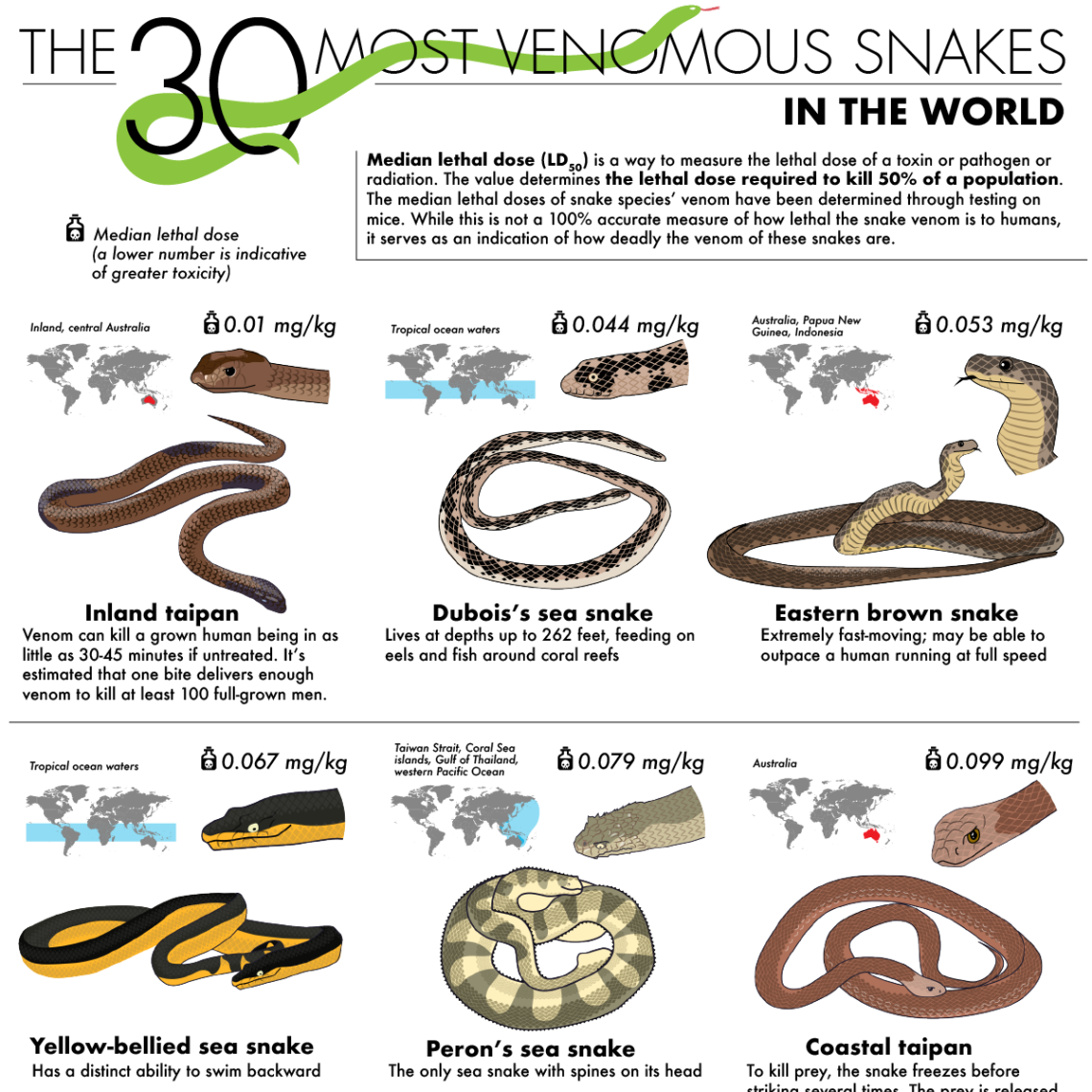
What is the most venomous snake in the world by LD50?
The inland taipan (Oxyuranus microlepidotus) holds the record for the lowest subcutaneous LD50 of any terrestrial snake at 0. 025 mg/kg, making its venom the most potent. A single bite delivers enough venom to theoretically kill over 200 adult humans.
The question of which snake is the "most venomous" has produced decades of debate among herpetologists, toxicologists, and emergency physicians - debate that often confuses venom potency with clinical danger. These are not the same thing. A snake with extraordinarily potent venom may cause relatively few human deaths because it lives in remote habitat, delivers small doses, or has a docile temperament.
Conversely, a species with comparatively moderate venom may kill thousands annually because it is aggressive, abundant, and coexists with dense human populations.
The standard laboratory measure of venom potency is the LD50 - the lethal dose required to kill 50 percent of a test population of mice, expressed in milligrams of venom per kilogram of body weight. A lower LD50 indicates more potent venom. While this metric has well-documented limitations (mouse physiology is not human physiology; subcutaneous, intravenous, and intramuscular injection routes produce different values), it remains the most widely cited comparative standard in toxinology.
"The LD50 tells you how toxic a venom is to mice. It does not tell you how dangerous a snake is to humans. Danger is a function of toxicity, venom yield, fang length, temperament, geographic overlap with people, and access to antivenom." - Dr. Bryan Grieg Fry, venom researcher, University of Queensland [1]
This ranking draws on subcutaneous LD50 data - the most clinically relevant injection route, as most snakebites deliver venom into subcutaneous tissue rather than directly into veins. Where available, intravenous values are noted for comparison.
Understanding LD50 Methodology
The LD50 assay was developed by British pharmacologist J.W. Trevan in 1927, originally for standardizing drug dosages. Its application to snake venom research became widespread in the mid-20th century as antivenom production required quantitative measures of venom potency. The test involves injecting groups of laboratory mice with graded doses of venom and observing mortality over 24 to 48 hours. The dose at which 50 percent of subjects die is calculated through probit analysis.
Several variables affect LD50 values significantly:
- Injection route: Intravenous (IV) LD50 values are always lower (more potent) than subcutaneous (SC) values, because venom enters the bloodstream immediately. SC values better approximate natural snakebite scenarios.
- Mouse strain: Different mouse strains show different susceptibilities to the same venom.
- Venom source: Venom composition varies between individuals, populations, age classes, and seasons within the same species. A single LD50 value for a species is necessarily an approximation.
- Venom preparation: Lyophilized (freeze-dried) venom produces different results than fresh liquid venom.
For unit conversions relevant to toxicology data - such as converting between mg/kg, micrograms per gram, or other dose-weight relationships - unit conversion tools can simplify the arithmetic involved in comparing data from different studies.
The Top 10 Most Venomous Snakes by Subcutaneous LD50
| Rank | Species | Common Name | SC LD50 (mg/kg) | IV LD50 (mg/kg) | Average Venom Yield (mg dry) | Primary Venom Type |
|---|---|---|---|---|---|---|
| 1 | Oxyuranus microlepidotus | Inland Taipan | 0.025 | 0.01 | 44 - 110 | Neurotoxic + myotoxic |
| 2 | Pseudonaja textilis | Eastern Brown Snake | 0.041 | 0.012 | 5 - 67 | Procoagulant + neurotoxic |
| 3 | Oxyuranus scutellatus | Coastal Taipan | 0.064 | 0.013 | 120 - 400 | Neurotoxic + procoagulant |
| 4 | Bungarus candidus | Malayan Krait | 0.108 | 0.047 | 10 - 25 | Neurotoxic (presynaptic) |
| 5 | Notechis scutatus | Mainland Tiger Snake | 0.118 | 0.04 | 35 - 180 | Neurotoxic + procoagulant + myotoxic |
| 6 | Bungarus caeruleus | Common/Blue Krait | 0.151 | 0.043 | 20 - 114 | Neurotoxic (presynaptic) |
| 7 | Pseudechis australis | King Brown/Mulga Snake | 0.18 | - | 150 - 600 | Myotoxic + anticoagulant |
| 8 | Enhydrina schistosa | Beaked Sea Snake | 0.164 | 0.067 | 8 - 20 | Neurotoxic + myotoxic |
| 9 | Acanthophis antarcticus | Common Death Adder | 0.338 | 0.079 | 70 - 236 | Neurotoxic (postsynaptic) |
| 10 | Dendroaspis polylepis | Black Mamba | 0.32 | 0.05 | 100 - 400 | Neurotoxic (dendrotoxins) |
Data compiled from Broad et al. 1979, Mebs 2002, and the Australian Venom Research Unit databases [2].
Two species that dominate public perception - the King Cobra (Ophiophagus hannah) and the Russell's Viper (Daboia russelii) - do not appear in the top 10 by LD50, despite being among the most medically significant snakes on Earth. The King Cobra's SC LD50 is approximately 1.31 mg/kg, placing it well outside the most potent venoms. Its danger derives instead from the enormous volume of venom it delivers per bite - up to 7 ml of liquid venom, enough to kill an elephant.
Species Profiles
Inland Taipan (Oxyuranus microlepidotus) - The Most Potent Venom on Earth
The inland taipan holds the undisputed record for the lowest LD50 of any terrestrial snake: 0.025 mg/kg subcutaneous. A single bite from an adult inland taipan delivers an average of 44 mg of venom - enough, in theory, to kill over 200 adult humans or approximately 250,000 mice.
This staggering potency evolved not for defense against humans but for rapid immobilization of its primary prey: the long-haired rat (Rattus villosissimus), a fast-moving rodent that could inflict serious injury on the snake if not subdued almost instantly.
The venom contains a complex cocktail of at least 14 identified toxins, including:
- Oxylepitoxin-1 - a potent presynaptic neurotoxin (paradoxin-like phospholipase A2)
- Oxylepitoxin-2 - postsynaptic alpha-neurotoxin
- Protease activators - trigger disseminated intravascular coagulation (DIC)
- Myotoxins - cause rhabdomyolysis (skeletal muscle destruction)
- Hyaluronidase - a "spreading factor" that accelerates venom distribution through tissue
"The inland taipan's venom is a masterpiece of biochemical engineering. Every component works synergistically - the neurotoxins paralyze, the procoagulants trigger clotting cascades that consume clotting factors, and then the victim bleeds internally once those factors are exhausted. It attacks multiple physiological systems simultaneously." - Professor David Warrell, Oxford University, tropical medicine specialist [3]
Despite its unmatched venom potency, the inland taipan is responsible for zero confirmed human fatalities in recorded history. This paradox is explained by its geographic isolation: it inhabits the remote, sparsely populated black soil plains of central Australia, particularly the Channel Country of western Queensland and northeastern South Australia. Its temperament is also comparatively shy; when encountered, it typically flees rather than strikes.
Geographic range: Restricted to semi-arid regions of central Australia, primarily western Queensland, northeastern South Australia, and a small area of the Northern Territory. Population density is low, and encounters with humans are exceptionally rare.
Eastern Brown Snake (Pseudonaja textilis) - Australia's Deadliest
With an SC LD50 of 0.041 mg/kg, the eastern brown snake possesses the second most potent terrestrial snake venom. Unlike the inland taipan, however, this species is responsible for more snakebite deaths in Australia than any other snake - approximately 60 percent of all fatal snakebites on the continent.
The disparity between the taipan's greater potency and the brown snake's higher kill count illustrates why LD50 alone is an inadequate measure of danger. The eastern brown snake:
- Thrives in agricultural and suburban environments, frequently entering farms, sheds, and gardens
- Is highly alert and defensive, rearing into an S-shaped striking posture when threatened
- Strikes multiple times in rapid succession, delivering venom efficiently through relatively short (3 mm) fangs
- Possesses venom with powerful procoagulant activity, triggering venom-induced consumptive coagulopathy (VICC) that can cause fatal cerebral hemorrhage within hours if untreated
Its venom composition is dominated by prothrombinase complex activators (Group C prothrombin activators) - enzymes that convert prothrombin to thrombin thousands of times faster than the body's natural coagulation cascade. This consumes circulating clotting factors within 30 minutes, leaving the victim in a paradoxical state: initial hypercoagulation followed by complete inability to clot, leading to uncontrolled internal bleeding [4].
Geographic range: Eastern Australia from Cape York to South Australia, extending inland along river systems. Also present in parts of Papua New Guinea and Indonesia.
Blue Krait (Bungarus caeruleus) - The Silent Night Hunter
The blue krait (also called the common Indian krait) possesses one of the most insidious venoms of any snake. Its SC LD50 of 0.151 mg/kg places it firmly among the world's most potent venoms, but the true danger lies in the nature of its neurotoxicity.
Krait venom is dominated by presynaptic beta-bungarotoxins - phospholipase A2 neurotoxins that irreversibly destroy the nerve terminal, preventing acetylcholine release at the neuromuscular junction. Unlike postsynaptic neurotoxins (which block receptors and can potentially be displaced by antivenom), presynaptic toxin damage is permanent.
Once beta-bungarotoxin has destroyed a nerve terminal, recovery requires the growth of entirely new nerve endings - a process that takes days to weeks. This means that even if antivenom is administered, it cannot reverse paralysis already established by presynaptic toxins.
Kraits are nocturnal and often enter homes in rural South Asia, biting people while they sleep on floor mats. The bite itself is often painless - sometimes described as no worse than an ant sting - and many victims do not wake up. They die of respiratory paralysis during the night, discovered only in the morning.
Fatality statistics: The blue krait is responsible for an estimated 10,000 deaths annually across the Indian subcontinent, though exact figures are difficult to establish due to underreporting in rural areas. Case fatality rates for untreated bites range from 70 to 100 percent.
Geographic range: Indian subcontinent from Pakistan through India, Sri Lanka, Bangladesh, and Nepal. Inhabits scrubland, agricultural fields, and the immediate vicinity of rural dwellings.
Black Mamba (Dendroaspis polylepis) - Africa's Most Feared
The black mamba's SC LD50 of approximately 0.32 mg/kg makes it only moderately potent compared to Australian elapids. What makes it the most feared snake in Africa - and arguably the most dangerous snake encounter a human can have anywhere on Earth - is the combination of factors surrounding its envenomation:
- Speed: Capable of moving at speeds up to 20 km/h (12.5 mph), making it one of the fastest snakes in the world
- Venom volume: Delivers 100-400 mg of venom per bite (lethal human dose estimated at 15-20 mg)
- Multiple strikes: Frequently delivers 4-8 bites in a single attack, each injecting venom through 6.5 mm fangs
- Neurotoxin cocktail: Venom contains dendrotoxins (potassium channel blockers), fasciculins (acetylcholinesterase inhibitors), and cardiotoxins, producing a rapid-onset envenomation syndrome that can kill within 30 minutes to 6 hours without treatment
"A black mamba bite without antivenom is essentially a death sentence. The onset of symptoms - metallic taste, blurred vision, difficulty swallowing, respiratory distress - can begin within 10 minutes. By the time most rural African victims reach a medical facility, irreversible damage has occurred." - Dr. Jean-Philippe Chippaux, Institut de Recherche pour le Developpement, Paris [5]
The species derives its common name not from its body color (which is olive to grey-brown) but from the black interior of its mouth, displayed during its characteristic open-mouth threat display.
Fatality statistics: Estimated 20,000+ bites per year across sub-Saharan Africa, with untreated case fatality rates approaching 100 percent. Mortality even with antivenom treatment ranges from 10-20 percent, depending on delay to treatment.
Geographic range: Sub-Saharan Africa from Senegal to Somalia and south to South Africa. Inhabits savanna, woodland, and rocky hillsides, but is also found in sugarcane fields and peridomestic environments.
King Cobra (Ophiophagus hannah) - Volume Over Potency
The king cobra's venom is relatively mild by elapid standards, with an SC LD50 of approximately 1.31 mg/kg. This places it far below the inland taipan, eastern brown, and most kraits in terms of drop-for-drop toxicity. Yet the king cobra kills an estimated 5 people per year in its range and is universally respected by herpetologists as one of the most dangerous snakes alive.
The explanation is simple: the king cobra is the longest venomous snake on Earth, reaching lengths of 5.5 meters (18 feet), and delivers venom in quantities that no other snake can match. A single defensive bite may inject 200-500 mg of venom (dry weight), with a maximum recorded yield of approximately 7 ml of liquid venom from a single extraction.
The estimated lethal dose for a human is only 12 mg (dry weight). A large king cobra can therefore deliver 40 or more lethal human doses in a single bite.
The venom itself is primarily neurotoxic, containing haditoxin (a postsynaptic neurotoxin) and phospholipase A2 enzymes that cause progressive respiratory paralysis, along with cytotoxins that produce significant local tissue destruction.
Geographic range: South and Southeast Asia from India through China, the Philippines, and Indonesia. Inhabits dense tropical forests, bamboo thickets, and agricultural plantations.
Venom Composition: Neurotoxins vs. Hemotoxins
Snake venoms are broadly classified by their dominant mechanism of action, though most venoms contain components from multiple categories. Understanding these mechanisms is critical for emergency medicine and antivenom development.
| Venom Category | Mechanism | Primary Target | Onset Speed | Species Examples |
|---|---|---|---|---|
| Presynaptic neurotoxins | Destroy nerve terminals; block acetylcholine release | Neuromuscular junction | 1-6 hours | Kraits, taipans, tiger snakes |
| Postsynaptic neurotoxins | Block nicotinic acetylcholine receptors | Neuromuscular junction | 30 min - 3 hours | Cobras, mambas, death adders |
| Procoagulant toxins | Activate clotting cascade; consume clotting factors | Blood coagulation system | 30 min - 2 hours | Brown snakes, taipans |
| Hemotoxins/Hemorrhagins | Destroy blood vessel walls; cause internal bleeding | Vascular endothelium | 2-12 hours | Vipers, pit vipers, boomslang |
| Myotoxins | Destroy skeletal muscle (rhabdomyolysis) | Skeletal muscle fibers | 2-24 hours | Sea snakes, mulga snake, tiger snake |
| Cytotoxins | Cause local tissue necrosis and inflammation | Cell membranes | 1-6 hours | Spitting cobras, puff adder |
The distinction between "neurotoxic" and "hemotoxic" venoms, while useful for general classification, is an oversimplification. Many of the most dangerous species possess multicomponent venoms that attack several physiological systems simultaneously. The coastal taipan, for example, contains a powerful presynaptic neurotoxin (taipoxin), a procoagulant (oscutarin C), and myotoxins - effectively disabling the nervous system, the clotting cascade, and skeletal muscle in parallel.
Communicating these complex biochemical mechanisms to the public and to non-specialist medical professionals remains a significant challenge. Scientific writing in toxinology has evolved its own specialized vocabulary and conventions - a topic explored in depth at Evolang, which examines how technical knowledge is communicated across disciplines.
Geographic Distribution and Human Risk
The global burden of snakebite is staggering in scale. The World Health Organization classifies snakebite as a Neglected Tropical Disease, estimating:
- 5.4 million snakebites per year worldwide
- 1.8 - 2.7 million envenomations (not all bites deliver venom)
- 81,000 - 138,000 deaths per year
- 400,000+ permanent disabilities annually, including amputations, chronic pain, and psychological trauma
The vast majority of snakebite mortality occurs in sub-Saharan Africa, South Asia, and Southeast Asia - regions where venomous snakes overlap with rural populations that have limited access to healthcare and antivenom.
Regional Fatality Leaders
Africa's most medically important snake is not the black mamba but the saw-scaled viper (Echis carinatus species complex), which kills more people in Africa and Asia combined than any other genus. Its venom is hemotoxic, causing disseminated intravascular coagulation and hemorrhage, with an SC LD50 of approximately 2.3 mg/kg - far less potent than the snakes discussed above.
Yet its abundance, aggressive temperament, and proximity to farming communities make it the world's leading snake killer by total body count.
In Australia, which harbors the majority of the world's most venomous species by LD50 measurement, snakebite deaths average only 2-4 per year - a testament to effective first aid education, rapid access to antivenom, and a well-funded healthcare system. The contrast with South Asia, where 46,000 people die annually from snakebite (many from species with far less potent venom), demonstrates that venom potency is only one variable in the complex equation of snakebite mortality.
Making rapid decisions under pressure - such as administering correct first aid after a snakebite - is a skill that involves pattern recognition, calm assessment, and procedural recall. These cognitive abilities can be explored and benchmarked through tools like IQ and cognitive assessments, which measure problem-solving capacity under time constraints.
Delivery Mechanisms: Fangs, Pressure, and Venom Control
Not all venomous snakes deliver venom with equal efficiency. Fang morphology, musculature, and bite behavior vary enormously and directly affect clinical outcomes.
Elapids (cobras, kraits, mambas, taipans, coral snakes) possess proteroglyphous fangs - short, fixed fangs at the front of the upper jaw. These fangs are typically 3-8 mm long (though the black mamba reaches 6.5 mm and the king cobra approximately 10 mm). Because the fangs are short and fixed, elapids often need to chew or hold onto their prey to deliver a full dose of venom. Dry bite rates (bites without venom injection) for elapids range from 10-50 percent depending on species.
Viperids (vipers, pit vipers, rattlesnakes) possess solenoglyphous fangs - long, hinged fangs that fold against the roof of the mouth when not in use and rotate forward to an erect position during a strike. These fangs can be 20-40 mm long in large species, allowing deep intramuscular venom injection. The Gaboon viper (Bitis gabonica) holds the record for the longest fangs of any snake at 50 mm (2 inches), and possesses the highest venom yield of any viper at 450-600 mg per extraction.
Rear-fanged snakes (Colubridae: various genera) possess opisthoglyphous fangs - grooved teeth at the back of the upper jaw that deliver venom through capillary action rather than injection. Most rear-fanged species are harmless to humans, but notable exceptions include the boomslang (Dispholidus typus) and the twig snake (Thelotornis), whose hemorrhagic venoms have caused human fatalities.
Antivenom: The Only Definitive Treatment
Antivenom remains the only specific treatment for snake envenomation. Developed through a process fundamentally unchanged since Albert Calmette produced the first antivenom in 1895, antivenom production involves injecting sub-lethal doses of venom into large animals (typically horses, but also sheep, goats, and camels), harvesting the resulting antibodies from serum, and purifying them for human use.
The global antivenom supply chain is in crisis. Effective polyvalent antivenoms for sub-Saharan Africa have been discontinued by manufacturers due to low profitability. The WHO estimated in 2018 that global antivenom production meets less than half of the actual need. India alone requires an estimated 2.8 million vials per year but produces antivenoms of variable quality, with clinical efficacy that varies dramatically between manufacturers.
"We have a treatment that works. The problem is that the people who need it most cannot access it. Antivenom is too expensive, too scarce, and too often of poor quality in the regions where snakebite kills the most people." - Dr. David Williams, Australian Venom Research Unit, on the global antivenom crisis [6]
Recent research has focused on recombinant antivenoms - synthetic antibodies produced through biotechnology rather than animal immunization. Oligoclonal mixtures of human monoclonal antibodies targeting key venom toxins have shown promising results in preclinical trials, potentially offering antivenoms that are cheaper, more consistent, and do not cause serum sickness.
Evolutionary Arms Races and Venom Variation
Venom is not a static property of a species. It is a dynamic, evolving weapon shaped by millions of years of predator-prey coevolution. Several important patterns have emerged from comparative venom research:
Geographic venom variation: The Mojave rattlesnake (Crotalus scutulatus) exhibits two distinct venom phenotypes - Type A (neurotoxic, containing Mojave toxin) and Type B (hemorrhagic, lacking Mojave toxin) - distributed geographically across its range. Populations in central Arizona possess predominantly Type A venom, while populations in other regions possess Type B.
Some populations show intermediate venom profiles. The SC LD50 for Type A venom is 0.18 mg/kg; for Type B, approximately 2.4 mg/kg - a 13-fold difference within the same species.
Ontogenetic shifts: Many pit viper species show dramatic changes in venom composition as they mature. Juvenile Bothrops jararaca possess venom dominated by hemorrhagic metalloproteinases, while adults shift toward a venom enriched in procoagulant serine proteases. This shift correlates with dietary changes: juveniles eat frogs and lizards, while adults prey on rodents and birds [7].
Resistance evolution: Prey species under intense selection pressure from venomous snakes have evolved remarkable biochemical defenses. The California ground squirrel (Otospermophilus beecheyi) possesses serum proteins that neutralize northern Pacific rattlesnake venom.
The honey badger (Mellivora capensis) shows resistance to cobra and mamba neurotoxins through mutations in its nicotinic acetylcholine receptor that reduce toxin binding affinity. These adaptations drive reciprocal selection on the snake's venom, creating an ongoing evolutionary arms race.
Beyond LD50: A More Complete Danger Assessment
The LD50 provides a useful starting point for comparing venoms, but a comprehensive danger assessment must integrate multiple factors. The following framework is used by clinical toxinologists to evaluate overall snakebite risk:
- Venom potency (LD50) - how toxic is each milligram of venom?
- Venom yield - how much venom does the snake deliver per bite?
- Fang length and delivery efficiency - can the fangs penetrate clothing and reach vasculature?
- Temperament - how readily does the snake bite when encountered?
- Geographic overlap with humans - does the species live near human habitation?
- Nocturnal/diurnal activity - does it bite when people are sleeping or awake?
- Antivenom availability - is specific antivenom accessible in the region?
- Healthcare access - how quickly can victims reach a facility with mechanical ventilation and antivenom?
By this multifactorial assessment, the most dangerous snake in the world is arguably not the inland taipan (which has never killed anyone) but the saw-scaled viper or the Russell's viper - species with moderate venom potency but catastrophically high human contact rates, aggressive defensive behavior, and limited antivenom access in their range.
The study of snake venom continues to yield insights not only into evolutionary biology and ecology but also into pharmacology: compounds derived from snake venoms are used in drugs for hypertension (Captopril, from Bothrops jararaca), blood clotting disorders, and pain management. What evolution designed as a weapon, biomedical science is repurposing as medicine.
References
Fry, B.G. et al. (2009). A central role for venom in predation by Varanus komodoensis (Komodo Dragon) and the extinct giant Varanus (Megalania) priscus. Proceedings of the National Academy of Sciences, 106(22), 8969-8974. doi:10.1073/pnas.0810883106
Broad, A.J., Sutherland, S.K., & Coulter, A.R. (1979). The lethality in mice of dangerous Australian and other snake venom. Toxicon, 17(6), 661-664. doi:10.1016/0041-0101(79)90245-9
Warrell, D.A. (2010). Snake bite. The Lancet, 375(9708), 77-88. doi:10.1016/S0140-6736(09)61754-2
Isbister, G.K., Scorgie, F.E., O'Leary, M.A., Seldon, M., Brown, S.G.A., & Lincz, L.F. (2010). Factor deficiencies in venom-induced consumption coagulopathy resulting from Australian elapid envenomation. Journal of Thrombosis and Haemostasis, 8(11), 2504-2513. doi:10.1111/j.1538-7836.2010.04050.x
Chippaux, J.-P. (2011). Estimate of the burden of snakebites in sub-Saharan Africa: A meta-analytic approach. Toxicon, 57(4), 586-599. doi:10.1016/j.toxicon.2010.12.022
Williams, D.J. et al. (2019). Strategy for a globally coordinated response to a priority neglected tropical disease: Snakebite envenoming. PLoS Neglected Tropical Diseases, 13(2), e0007059. doi:10.1371/journal.pntd.0007059
Zelanis, A., Tashima, A.K., Pinto, A.F.M., Leme, A.F.P., Gruber, D.R., & Serrano, S.M.T. (2014). Bothrops jararaca venom proteome rearrangement upon neonate to adult transition. Proteomics, 14(15-16), 1810-1822. doi:10.1002/pmic.201300524
Tasoulis, T. & Isbister, G.K. (2017). A review and database of snake venom proteomes. Toxins, 9(9), 290. doi:10.3390/toxins9090290
Frequently Asked Questions
What is the most venomous snake in the world by LD50?
The inland taipan (Oxyuranus microlepidotus) holds the record for the lowest subcutaneous LD50 of any terrestrial snake at 0.025 mg/kg, making its venom the most potent. A single bite delivers enough venom to theoretically kill over 200 adult humans. Despite this, it has never caused a confirmed human fatality due to its remote habitat in central Australia and relatively shy temperament.
Why does the eastern brown snake kill more people than the inland taipan?
Although the inland taipan has more potent venom, the eastern brown snake causes approximately 60 percent of snakebite deaths in Australia because it thrives in agricultural and suburban environments where it frequently encounters humans. It is also highly alert and defensive, strikes multiple times in rapid succession, and possesses venom with powerful procoagulant activity that can cause fatal cerebral hemorrhage within hours.
What is the difference between neurotoxic and hemotoxic snake venom?
Neurotoxic venoms attack the nervous system by blocking neuromuscular transmission, causing progressive paralysis and respiratory failure. Hemotoxic venoms disrupt blood clotting and damage blood vessel walls, causing internal hemorrhage and organ failure. Many dangerous snakes possess multicomponent venoms that attack several physiological systems simultaneously, making the neurotoxic-hemotoxic distinction an oversimplification.