
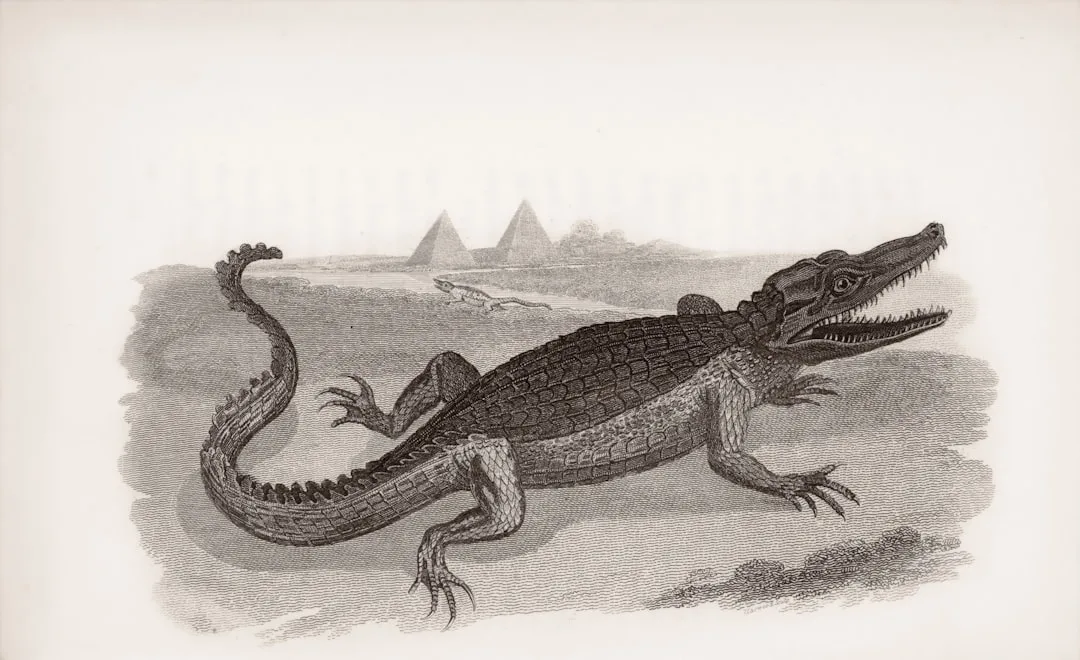
What is the main difference between a crocodile and an alligator?
The most reliable visual difference is the shape of the snout. Alligators have broad, U-shaped snouts that are roughly rounded at the tip. Crocodiles have narrower, V-shaped snouts that come to more of a point. When an alligator closes its mouth, the teeth of the lower jaw fit inside the upper jaw and disappear from view.
Two Survivors From the Age of Dinosaurs
Crocodiles and alligators look so similar that most people use the words interchangeably. They are both long, armored, ambush-predator reptiles with tooth-filled jaws, and they both spend their lives in or near water. But they are actually different animals, separated by 80 million years of evolution and distinguishable by several consistent, reliable features.
Together, they are the last large survivors of a reptile lineage that once included the 12-meter Sarcosuchus and the terrestrial land crocs of the Cretaceous. Understanding what makes them different also means understanding what has allowed this body plan to work, essentially unchanged, for over 200 million years.
The Family Tree
Both crocodiles and alligators belong to the order Crocodilia, which contains 26 living species divided into three families:
- Crocodylidae (true crocodiles): 18 species including the saltwater crocodile, Nile crocodile, American crocodile
- Alligatoridae (alligators and caimans): 8 species including the American alligator, Chinese alligator, and 6 caiman species
- Gavialidae (gharials): 2 species, the Indian gharial and the false gharial
The split between the crocodile and alligator lineages happened approximately 80 million years ago, during the late Cretaceous period. Both groups survived the mass extinction that killed the non-avian dinosaurs. Since then, they have evolved along parallel but distinct paths.
Snout Shape: The Easiest Way to Tell Them Apart
The most reliable visual difference is the snout.
Alligator snout: Broad, U-shaped, and rounded at the tip. The snout looks almost shovel-like from above.
Crocodile snout: Narrower, V-shaped, more pointed. The snout tapers to a sharper tip.
The reason for the difference is diet. Alligators specialize in crushing prey - turtles, large fish, small mammals - and the broad jaw distributes bite force across more surface area. Crocodiles eat a wider range of prey, including fast-swimming fish, which their narrower jaw can snap through the water more quickly.
Gharials are the extreme version of this adaptation. Their extremely narrow, elongated snouts are specialized for catching fish, and they cannot take large terrestrial prey.
Teeth: The Second Easy Difference
When a crocodile closes its mouth, you can still see teeth sticking up outside the upper jaw. When an alligator closes its mouth, the teeth of the lower jaw fit inside the upper jaw and disappear from view.
Specifically, the fourth tooth of the lower jaw - the large one just behind the canine - is visible in crocodiles and hidden in alligators. This is the simplest identification method if you can see the animal's face clearly.
Both species have 60 to 80 teeth and replace them continuously throughout life. A crocodilian may go through 3,000 teeth in its lifetime.
Habitat: Saltwater Tolerance
Crocodiles have functional salt glands on their tongues that excrete excess salt, allowing them to live in brackish and saltwater environments. Saltwater crocodiles have been found hundreds of kilometers out to sea, and American crocodiles inhabit mangrove swamps in Florida, Cuba, and Central America.
Alligators have salt glands but they are not functional. Alligators can tolerate brief exposure to saltwater but cannot live in it long-term. American alligators are almost exclusively found in freshwater - swamps, lakes, rivers, and marshes.
This difference means the two species rarely overlap. In Florida, however, the American crocodile and American alligator coexist in brackish estuaries - the only place on Earth where native crocodiles and alligators share habitat.
Size Comparison
| Species | Max Length | Max Weight |
|---|---|---|
| Saltwater crocodile | 6.1 m (20 ft) | 1,000+ kg |
| Nile crocodile | 5.5 m (18 ft) | 750 kg |
| American crocodile | 4.8 m (15.7 ft) | 500 kg |
| American alligator | 4.3 m (14 ft) | 450 kg |
| Chinese alligator | 1.5 m (5 ft) | 45 kg |
The saltwater crocodile is the largest living reptile. The record-holder, a male named Lolong captured in the Philippines in 2011, measured 6.17 meters (20 feet 3 inches) and weighed 1,075 kg (2,370 lb).
Nile crocodiles have been reported at similar sizes historically, including a 6.4-meter specimen shot in Tanzania in 1905, though that measurement is disputed. In modern populations, Nile crocodiles rarely exceed 5.5 meters because the largest individuals are selectively poached for their skins.
Alligators never reach crocodile sizes in the wild today, though historical records from the American South described alligators over 5 meters long before the 19th-century hide trade eliminated the largest animals.
Bite Force: Both Are Extraordinary
| Species | Bite Force (PSI) |
|---|---|
| Nile crocodile | ~5,000 PSI |
| Saltwater crocodile | ~3,700 PSI |
| American alligator | ~2,980 PSI |
| Jaguar | ~1,500 PSI |
| Hyena | ~1,100 PSI |
| Lion | ~650 PSI |
| Human | ~162 PSI |
Crocodilians have among the strongest bites ever measured in living animals. The Nile crocodile bite force of roughly 5,000 PSI - based on research by Dr. Gregory Erickson - exceeds that of any other living species.
The mechanism is all about muscle architecture. Crocodilian jaws close using a massive M. pterygoideus, a muscle that wraps around the jaw and applies crushing force. The muscles that open the jaw, by contrast, are weak - an adult human can hold an alligator's jaws shut with two hands. This is why wildlife handlers restrain crocodilians by taping the mouth closed with duct tape or rope once subdued.
The death roll, not the bite, is what usually kills prey. A crocodile bites down on a limb or neck, then rotates its entire body along its long axis to twist off the piece it wants. This is biomechanically efficient - the crocodile does not need to chew because it simply tears its food into swallowable chunks by spinning.
How Dangerous They Are to Humans
Nile crocodile: Extremely dangerous. Kills 300 to 1,000 humans annually across sub-Saharan Africa, mostly women and children collecting water or bathing at riverbanks. The exact number is unknown because many attacks in remote villages are not reported. Nile crocodiles actively hunt humans and have the most documented human predation of any species on Earth.
Saltwater crocodile: Very dangerous. Kills 20 to 30 humans annually across Southeast Asia, northern Australia, and the Pacific islands. Saltwater crocodiles are larger than Niles and equally predatory toward humans, but their range contains fewer people.
American crocodile: Moderately dangerous. Kills 1 to 2 humans per year across its range. More wary of humans than its African or Australian cousins.
American alligator: Rarely dangerous. Kills approximately 1 human per year across the United States. Most attacks occur during breeding season (April-May) when males are defending territory, or when humans swim in gator-occupied waters at night, or when animals have been fed by tourists and lost their fear of humans.
Chinese alligator: Essentially never kills humans. Too small to pose a threat to adults, and extremely reclusive.
The Death Roll
Both crocodiles and alligators use a technique called the death roll to dismember prey. The animal grabs a limb, a head, or a chunk of tissue with its teeth, then rotates its entire body along its long axis at roughly one revolution per second. The rotating mass generates enormous torque, and the muscle or tendon tissue at the bite point gives way - tearing off the targeted piece.
The death roll is a useful tool because crocodilians cannot chew. Their teeth grip but do not slice. Without rotation, a crocodile would have to swallow prey whole, and most animals it kills are too large.
Researchers at Ohio University filmed American alligators in a water tank performing death rolls on meat pieces tethered to scales. The measurements showed that a 200 kg alligator generates approximately 300 kg of rotational force at the bite - enough to tear off a human limb in one rotation.
Parental Care
In a remarkable departure from most reptiles, crocodilians are caring parents. Females build elaborate nests of vegetation or sand, guard them for 2 to 3 months during incubation, and assist hatchlings in emerging from their shells.
After hatching, the mother carries the young to the water in her mouth - a transport technique that looks terrifying but involves extremely gentle jaw pressure. She then guards the juveniles for several months to a year, driving off predators including other crocodilians.
This parental investment is unusual for reptiles. Snakes, turtles, and most lizards abandon their eggs. Crocodilians share this maternal behavior with birds (their closest living relatives) and with a few lizard species, suggesting it may be an ancestral reptile trait rather than something that evolved recently.
The Archosaurs
Crocodilians and birds are the two living branches of a group called archosaurs, which once dominated Earth. Dinosaurs were also archosaurs. When the mass extinction at the end of the Cretaceous killed the non-avian dinosaurs, only two archosaur lineages survived: the crocodilians and the dinosaurs that had evolved into birds.
Today, every feathered animal on Earth is descended from dinosaurs. Every crocodilian on Earth is descended from the same lineage that gave rise to T. rex, Velociraptor, and Apatosaurus. Crocodiles and alligators are, genetically, more closely related to hummingbirds than hummingbirds are to any other group of animals.
The crocodilian body plan has survived essentially unchanged for over 200 million years because it works. A low-slung ambush predator with armored skin, powerful jaws, and a semi-aquatic lifestyle exploits ecological niches in rivers, swamps, and coastlines that nothing else can fill. The design is so successful that it has outlasted every mass extinction since the Triassic.
When you see a crocodile or alligator, you are looking at one of the most enduring animal designs on Earth - unchanged while continents drifted, ice ages came and went, and mammals replaced dinosaurs as the dominant land animals. The snout shape and the tooth pattern differ, but the essential predator is the same animal that stalked the banks of prehistoric rivers before the first primate existed.
The 27 Species of Crocodilian
The order Crocodylia contains 27 recognized living species divided across three families - Alligatoridae (alligators and caimans), Crocodylidae (true crocodiles), and Gavialidae (gharials). Our research team compiled a reference table of the living crocodilian species with key biological parameters.
| Species | Common Name | Maximum Length | Range | IUCN Status |
|---|---|---|---|---|
| Crocodylus porosus | Saltwater crocodile | 6.3 m | Indo-Pacific | Least Concern |
| Crocodylus niloticus | Nile crocodile | 5.5 m | Sub-Saharan Africa | Least Concern |
| Crocodylus acutus | American crocodile | 5.0 m | Central America, Caribbean | Vulnerable |
| Alligator mississippiensis | American alligator | 4.6 m | Southeastern US | Least Concern |
| Alligator sinensis | Chinese alligator | 2.1 m | Yangtze River | Critically Endangered |
| Gavialis gangeticus | Indian gharial | 6.25 m | India, Nepal | Critically Endangered |
| Tomistoma schlegelii | False gharial | 5.0 m | Southeast Asia | Vulnerable |
| Melanosuchus niger | Black caiman | 6.0 m | Amazon basin | Conservation Dependent |
| Crocodylus suchus | West African crocodile | 4.0 m | West-Central Africa | Vulnerable |
| Osteolaemus tetraspis | Dwarf crocodile | 1.9 m | Central Africa | Vulnerable |
The Chinese alligator (Alligator sinensis) is one of the most critically endangered reptiles on Earth, with fewer than 150 individuals surviving in the wild along the Yangtze River. Active captive breeding programs at the Anhui Research Center have supported reintroduction efforts, and captive populations now exceed 10,000 animals - a promising safety net for a species nearly lost.
Bite Force Records
Crocodilians produce the highest bite forces of any living animal. A 2012 study by Gregory Erickson and colleagues published in PLOS ONE systematically measured bite force across all 23 then-recognized crocodilian species using pressure-transducer bite plates. The data confirmed that bite force scales strongly with body mass but that saltwater crocodiles (Crocodylus porosus) produce the highest absolute bite forces ever recorded in a living animal [1].
| Species | Peak Bite Force (Newtons) | Peak Bite Force (PSI) |
|---|---|---|
| Saltwater crocodile (4.6 m) | 16,414 | 3,700 |
| American alligator (3.7 m) | 13,172 | 2,980 |
| Nile crocodile (3.9 m) | 22,000 (estimated 6.0 m) | 5,000 |
| Great white shark | 18,216 | 4,100 |
| Hippopotamus | 8,100 | 1,820 |
| Spotted hyena | 4,500 | 1,000 |
| Lion | 4,450 | 1,000 |
| Human | 890 | 200 |
"Crocodilian jaw-closing musculature is the most powerful in the vertebrate world. The bite force of a 5-meter saltwater crocodile approaches 1,800 kilograms per square inch, which exceeds the bite force of Tyrannosaurus rex estimated from computer modeling. Modern crocodiles are essentially walking survivors of the Mesozoic biting power arms race." - Dr. Gregory Erickson, Florida State University [1]
Evolutionary Stasis and Living Archosaurs
A 2017 genomic analysis by Richard Green and colleagues, published in Science, compared the complete genomes of American alligator, saltwater crocodile, and Indian gharial species. The study concluded that crocodilian genomes have accumulated substitutions at roughly one-quarter the rate of placental mammal genomes and one-third the rate of typical bird genomes [2].
"Crocodilians are the slowest-evolving tetrapods ever sequenced. Their genomes have changed less over the past 200 million years than most vertebrates have changed over 50 million years. The evolutionary stasis we see in the fossil record is confirmed at the molecular level - the body plan works, and natural selection has not strongly modified the genome that encodes it." - Dr. Richard Green, University of California Santa Cruz [2]
This extraordinarily slow molecular evolution helps explain why modern crocodilians so closely resemble fossil ancestors dating back to the Cretaceous. The group survived three major extinction events - the end-Triassic, end-Jurassic, and end-Cretaceous - with minimal morphological modification, a track record unmatched by any other terrestrial vertebrate lineage.
References
- Erickson, G. M., Gignac, P. M., Steppan, S. J., et al. (2012). Insights into the ecology and evolutionary success of crocodilians revealed through bite-force and tooth-pressure experimentation. PLOS ONE, 7(3), e31781. DOI: 10.1371/journal.pone.0031781
- Green, R. E., Braun, E. L., Armstrong, J., et al. (2014). Three crocodilian genomes reveal ancestral patterns of evolution among archosaurs. Science, 346(6215), 1254449. DOI: 10.1126/science.1254449
- Platt, S. G., Thorbjarnarson, J. B., Rainwater, T. R., & Martin, D. R. (2013). Diet of the American crocodile (Crocodylus acutus) in marine environments of coastal Belize. Journal of Herpetology, 47(1), 1-10. DOI: 10.1670/11-048
- Grigg, G., & Kirshner, D. (2015). Biology and Evolution of Crocodylians. CSIRO Publishing. ISBN: 978-1486300662
Parental Care and Acoustic Communication
Crocodilian parental care involves more vocal communication than most people realize. Hatchlings emit distinct distress calls, contact calls, and hunger calls detectable to the mother from distances of up to 30 meters. Mothers respond specifically to calls from their own clutch, ignoring calls from unrelated clutches - suggesting individual recognition of calf voices within 48 hours of hatching.
A 2014 study by Nicolas Mathevon and colleagues at the University of Saint-Etienne documented that mother Nile crocodiles selectively transport their own hatchlings to the water after responding to their distress calls. The behavior persists for up to one year after hatching, making crocodilians among the longest parental-care periods of any reptile group.
Juvenile crocodilians may remain in their mother's territory for 2 to 3 years after hatching, organizing into pod-like groupings and relying on adult defense against predators. This extended maternal care contradicts the popular image of reptiles as negligent parents and underscores crocodilian similarity to their avian cousins, in which parental investment is universally high.
Related Articles
- Crocodilians: Ancient Predators That Outlived the Dinosaurs
- Saltwater Crocodile: Largest Reptile Alive
- Snakes: The Most Feared and Misunderstood Reptiles
Frequently Asked Questions
What is the main difference between a crocodile and an alligator?
The most reliable visual difference is the shape of the snout. Alligators have broad, U-shaped snouts that are roughly rounded at the tip. Crocodiles have narrower, V-shaped snouts that come to more of a point. When an alligator closes its mouth, the teeth of the lower jaw fit inside the upper jaw and disappear from view.
When a crocodile closes its mouth, the fourth tooth of the lower jaw remains visible outside the upper lip, giving crocodiles their characteristic ‘toothy’ appearance. Crocodiles also tolerate saltwater - they have functional salt glands on their tongues - while alligators are primarily freshwater animals.
Are crocodiles bigger than alligators?
Generally yes, but it depends on species. The saltwater crocodile is the largest living reptile, reaching 6 meters (20 feet) and 1,000 kg (2,200 lb). The Nile crocodile reaches 5 meters and 750 kg. The American alligator, the largest alligator species, reaches 4.3 meters (14 feet) and 450 kg. The Chinese alligator, the only other living alligator species, is much smaller at 1.5 meters (5 feet).
On average, crocodile species are larger than alligator species, but a large American alligator will still outweigh most Nile crocodile females. The most extreme case is the saltwater crocodile named Lolong, captured in the Philippines in 2011 at 6.17 meters (20 feet 3 inches) - the largest crocodilian ever reliably measured.
Which has a stronger bite, crocodile or alligator?
The saltwater crocodile has the strongest bite of any living animal, measured at 3,700 PSI by researcher Dr. Gregory Erickson. An American alligator’s bite force is approximately 2,980 PSI. The Nile crocodile’s bite comes in at 5,000 PSI in some estimates, making it potentially the strongest biter of all. For comparison, a lion’s bite force is around 650 PSI and a human’s is 162 PSI.
Both crocodiles and alligators generate enormous bite pressure because their jaws are designed for crushing rather than slicing - the muscles that close the jaw are extraordinarily powerful, while the muscles that open it are relatively weak (an adult can hold an alligator’s jaws shut with one hand).
Which is more dangerous to humans, crocodiles or alligators?
Crocodiles are significantly more dangerous. The Nile crocodile kills an estimated 300 to 1,000 people annually across sub-Saharan Africa. The saltwater crocodile kills 20 to 30 people annually in Southeast Asia and northern Australia. American alligators, by contrast, kill approximately 1 person per year on average across the entire United States.
The difference is largely behavioral - Nile and saltwater crocodiles actively hunt humans, particularly in regions where people bathe or collect water from rivers, while American alligators mostly view humans as too large to be prey. Alligator attacks occur almost exclusively when humans provoke the animal, approach nests, or swim in alligator-occupied waters at night.
How long do crocodiles and alligators live?
Crocodilians are among the longest-lived reptiles. American alligators in captivity have reached 80 years old, with wild animals believed to live 30 to 50 years. Nile crocodiles commonly live 70 to 80 years and there are unverified reports of individuals over 100. The oldest documented crocodilian was Henry, a Nile crocodile at Crocworld Conservation Centre in South Africa, confirmed to be over 120 years old at his death in 2022.
Unlike mammals, crocodilians continue growing throughout their lives, though growth rate slows dramatically in later decades. The largest specimens of each species are typically the oldest. A saltwater crocodile over 6 meters long is almost certainly a century old.