
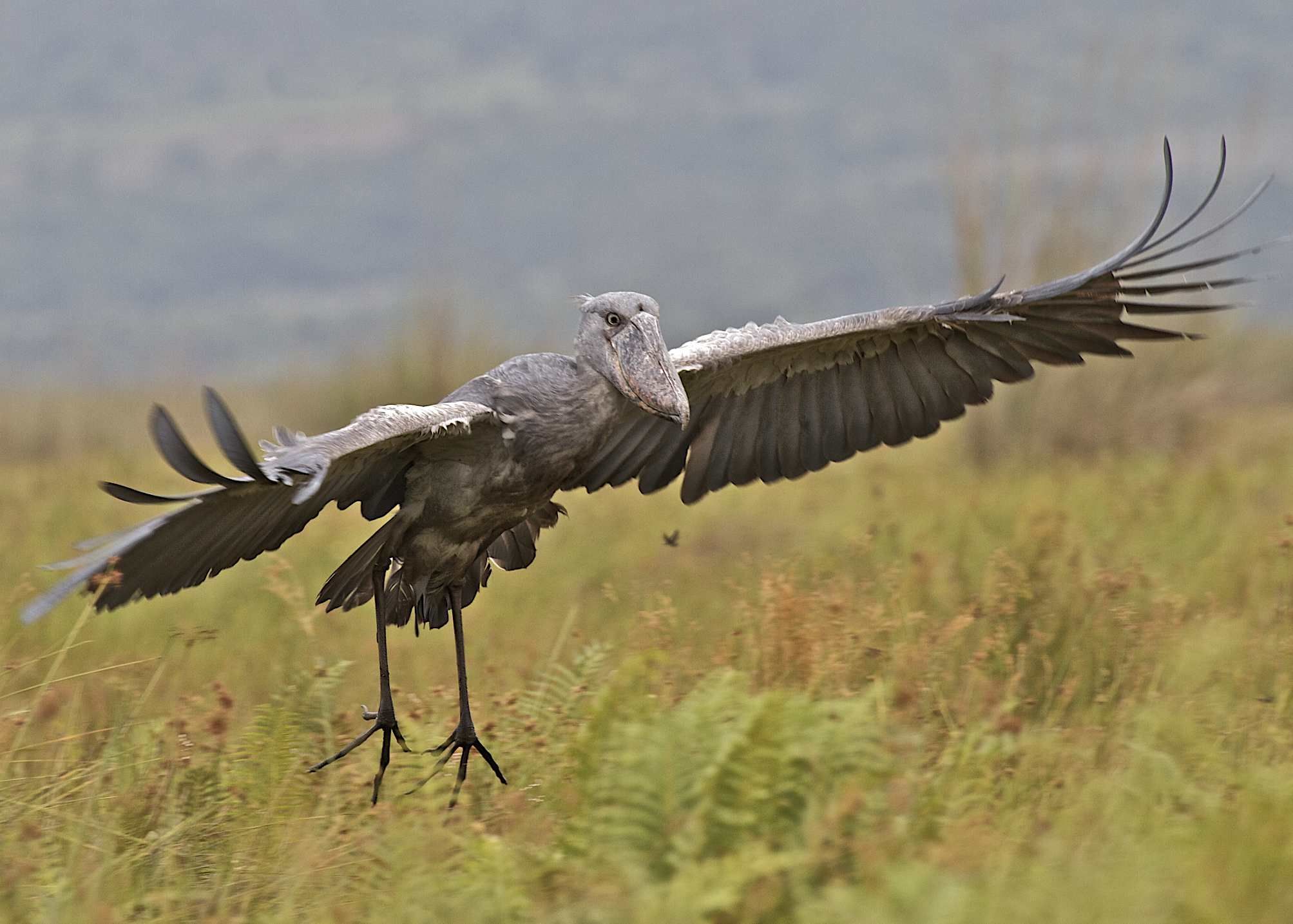
In the vast papyrus swamps of the Sudd, Africa’s largest tropical wetland, a bird the height of a ten-year-old child stands motionless for thirty minutes or more beside a channel of dark water, staring downward with yellow eyes through the tangle of reeds.
When a lungfish surfaces to breathe, as it must, regularly, being a fish that breathes air through functional lungs, the bird lurches forward in a collapse-and-strike that is less graceful than violent, toppling into the vegetation and closing a bill the size and shape of a Dutch clog over the fish in a single explosive movement. It is Balaeniceps rex: the shoebill, the whalehead, the shoe-billed stork. The scientific name translates as “whale-head king.”
The shoebill stands up to 1.5 metres and spreads wings of 2.6 metres. It is largely silent, almost exclusively solitary outside the breeding season, and maintains individual territories in prime papyrus swamp that may span 3 square kilometres. It decapitates lungfish with the hooked tip of its massive bill, discarding the head and gut, consuming only the body.
It has been documented eating young Nile crocodiles up to 60 cm long. It produces, outside the nest, essentially no vocalisations.
It was known to science as an unusual specimen for decades before its taxonomic position relative to storks, herons, and pelicans was resolved, and the answer, when molecular analysis arrived, placed it with the pelicans rather than the storks, which surprised most of the scientific community.
There are an estimated 5,000 to 8,000 shoebills remaining in the world.
Etymology and Classification
The genus name Balaeniceps was established by Gould in 1850, combining the Latin balaena (whale) and caput (head) to produce “whale-head,” a reference to the extraordinary proportional width of the bill. The species name rex is the Latin word for king, an acknowledgement of the bird’s imposing stature.
The French common name ‘bec-en-sabot’ and the Afrikaans ‘skoenbekooievaar’ both translate variants of “shoe-beak” or “shoe-billed stork.” In Arabic, the bird is known as ‘abu markub’, “father of a slipper.” All these names describe the bill.
The shoebill’s classification has been contentious since its formal description. Early taxonomists placed it with storks (Ciconiidae) because of its large size, wading habits, and overall gestalt. Subsequent authorities moved it between several positions, including a separate family (Balaenicipitidae) of uncertain affinities.
The advent of molecular phylogenetics resolved the question in favour of the order Pelecaniformes: multiple independent analyses from the early 2000s onward consistently placed Balaeniceps rex within this order, most closely related to the hamerkop (Scopus umbretta) and then to the pelicans (Pelecanidae).
This placement has now been adopted by all major taxonomic authorities, including the IUCN, BirdLife International, and the American Ornithological Society.
The family Balaenicipitidae contains only the single species Balaeniceps rex, with no known close living relatives. The fossil record for the shoebill is sparse; a possible fossil relative from the Oligocene of Egypt has been described, but its relationship to the modern family is uncertain.
Physical Description
The shoebill is one of the most unmistakable birds in the world. Adults stand 1.2 to 1.5 metres in height at the crown, with total body length of 100 to 140 cm and wingspan of 230 to 260 cm. Weight ranges from 4 to 7 kg, with males averaging slightly larger than females. The size range overlaps broadly between the sexes, making field sexing unreliable.
Plumage is uniformly blue-grey with a slight greenish iridescence on the back and wing coverts in fresh plumage. The underparts are slightly paler. Juveniles are brownish-grey, gradually acquiring the adult blue-grey colouration over the first three to four years. The legs are dark grey-black.
The eyes are pale yellow, almost silver in some individuals, and positioned to look forward and slightly downward, a convergence with predatory birds that require binocular depth perception for precise strikes, though the shoebill’s hunting method depends more on patience than precision of aim.
The bill is the defining feature. It measures 18.8 to 24 cm in length, up to 10 cm in width, and is pale yellow-grey with variable irregular brown-grey streaking or blotching. The upper mandible has a strongly hooked tip projecting over the lower mandible, creating the cutting and gripping surface used in prey manipulation. The sides of the bill taper to sharp edges.
The total surface area of the bill is proportionally extraordinary relative to the bird’s head, creating the distinctive shape that all common names reference.
The neck is long and thick for a pelecaniform, held retracted in an S-curve at rest rather than extended as in storks and cranes. The feet are very large, with unwebbed toes designed for walking across floating vegetation rather than swimming. The middle toe measures approximately 16 to 18 cm, providing a broad base that distributes the bird’s weight across papyrus stems and floating grass mats.
Habitat and Range
The shoebill’s distribution is centred on the freshwater wetlands of East and Central Africa, with the greatest population density in South Sudan’s Sudd, one of the world’s largest tropical wetland complexes. From South Sudan, the range extends south through Uganda, the Democratic Republic of Congo, Rwanda, Burundi, Tanzania, and Zambia, with occasional records from Ethiopia, Central African Republic, and Botswana.
The total range is roughly 3,000 kilometres north to south, but the species is locally restricted to specific wetland types within this broad area and is absent from most of the region.
The defining habitat is extensive papyrus (Cyperus papyrus) swamp with permanent or semi-permanent water and abundant large fish, particularly lungfish. Papyrus swamps are among the world’s most difficult wetland types to enter and survey, characterised by dense mats of aquatic vegetation, shallow murky water, and nearly impenetrable stands of papyrus reaching 4 to 5 metres in height.
This inaccessibility has historically provided the shoebill with a degree of protection from human disturbance. However, the same characteristics make population monitoring difficult, and shoebill abundance in the least accessible parts of the Sudd and the DRC swamps is poorly quantified.
Water level dynamics are important for shoebill habitat quality. The birds forage most effectively in areas where fish are concentrated by receding or static water: as swamp margins dry out seasonally or during drought years, fish crowd into remaining channels where the shoebill can exploit high prey density.
Flooded grassland adjacent to papyrus swamps may be used for foraging but is not the primary habitat. The species shows fidelity to specific territories and nest sites across multiple years.
Diet and Feeding Behaviour
The shoebill’s dietary specialisation is extraordinary: it focuses almost entirely on large, difficult prey items in one of the most challenging hunting environments on Earth. The primary prey are lungfish (Protopterus spp.), which can reach over a metre in length and which the shoebill targets as they surface to breathe.
The shallow, poorly oxygenated water of papyrus swamps creates conditions where lungfish must surface regularly, making them predictably available to a patient surface-watching predator.
The hunting sequence involves three phases. First, position: the shoebill wades or stands at the margin of a channel or pool, choosing a location where the water is shallow enough for fish to surface but deep enough to conceal the bill-tip during approach. The bird stands facing the water with the bill angled downward.
Second, wait: the shoebill remains motionless, often for 30 minutes or more, scanning the water surface for the movement or shadow of a surfacing fish. This patience is apparently genuine immobility rather than slow-motion approach; video analysis has confirmed that the bird does not creep forward during the waiting phase.
Third, strike: when a fish surfaces or moves within range, the shoebill drops forward onto the prey in a collapse-lunge, immersing the head and often the entire anterior body into the vegetation and water.
The strike ends with the bill closed around the fish and, typically, around a mass of vegetation and water that must be discarded. The shoebill raises its head, holds the bill slightly open at the sides while retaining the fish at the tip, and shakes the bill to expel water and plant material.
If the prey is a large lungfish, the bird uses the hooked bill tip to sever the fish’s head and gut before swallowing; this decapitation prevents the fish’s air bladder from expanding during ingestion. Lungfish up to 1 m long have been recorded as prey, consumed after this processing step.
Supplementary prey includes large eels, catfish, tilapia, Nile monitors, frogs, water snakes, and young Nile crocodiles. The crocodile predation is particularly notable; documented cases involve crocodilians up to approximately 60 cm in total length, which the shoebill kills by severe compression with the bill and then swallows whole or in sections. This makes the shoebill one of very few bird species to regularly consume crocodilians.
Behaviour and Intelligence
The shoebill is an asocial species outside the breeding season. Individual birds maintain large exclusive territories in papyrus swamp habitat and avoid conspecifics aggressively. Territory size varies with habitat quality but has been estimated at 1 to 3 square kilometres per individual in productive Uganda swamps, making it one of the largest individual territories of any non-raptor waterbird.
This territoriality, combined with habitat specialisation, limits the population density that even protected papyrus swamps can support.
The primary social vocalisation of the shoebill is the bill-clattering display performed at the nest. Both members of a breeding pair engage in mutual clattering, rapidly opening and closing the bill to produce a rapid-fire rattling sound compared to a machine gun, during nest greeting when one bird relieves the other at the nest. This display is thought to function in pair bond maintenance.
Outside the nest, shoebills are essentially silent: they produce no territorial calls, no alarm calls, and no contact calls during foraging or flight. This silence is extreme even by wading bird standards and may be an adaptation to the passive hunting strategy, where any sound might disturb surfacing fish.
Movement between territories and to and from the nest typically occurs in early morning or late afternoon, with the bird soaring on thermals to gain altitude before gliding to the destination. The flight silhouette is remarkable, the heavy bill and retracted neck held forward, the broad wings with their visible fingered primary feathers, and the long trailing legs, and is distinctive in the field.
Reproduction and Life Cycle
The shoebill’s breeding season varies across its range: in Uganda it is concentrated in the dry season from October to January, while in the Sudd it occurs primarily between October and December. Pairs are monogamous and appear to maintain long-term pair bonds, returning to the same nest territory in successive seasons.
Nests are enormous structures built on islands of floating vegetation, papyrus platforms, or compact papyrus beds. The foundation is a mass of aquatic vegetation up to 1.7 m in diameter, with a central depression lined with drier plant material. The same nest site may be used for many consecutive years with additions each season. Nest construction and maintenance are shared by both pair members.
Clutch size is 1 to 3 eggs, most commonly 2. Eggs are white or pale blue-white, measuring approximately 90 by 62 mm. Incubation lasts approximately 30 days and is shared, with adults taking turns of 2 to 6 hours at the nest. The incubating adult regularly brings water to the eggs by wetting the belly feathers and pressing against the eggs, a thermoregulatory behaviour that prevents overheating in the direct tropical sun that occasionally reaches the nest during periods of low wind.
Hatching of the two eggs is asynchronous, with a gap of 3 to 5 days corresponding to the laying interval. This asynchrony ensures that the first chick is already several days old and physiologically advanced when the second hatches, creating an inherent size and competitive advantage for the first chick.
Shoebills practise obligate brood reduction: both parents invest feeding effort overwhelmingly in the first chick, and the second chick, even if apparently healthy, receives little food and typically dies of starvation within 1 to 2 weeks. This is not neglect or oversight but a consistent pattern documented across multiple breeding seasons and populations.
The second egg serves as actuarial insurance: if the first egg or chick fails early, the second provides an alternative. Once the first chick is sufficiently developed that its survival is likely, the second is effectively abandoned.
The surviving chick fledges at approximately 95 days. The juvenile plumage, a duller brownish-grey, persists through the first several years as the bird gradually assumes adult colouration. Age at first breeding is estimated at 3 to 4 years. Longevity in the wild is estimated at 35 to 40 years, consistent with other large waterbirds; a captive individual at Frankfurt Zoo lived to 36 years.
Conservation Status
Balaeniceps rex is classified as Vulnerable on the IUCN Red List with a declining population trend. The global population estimate of 5,000 to 8,000 individuals, while uncertain, indicates one of the smallest populations of any large waterbird in Africa.
The primary driver of decline is habitat destruction and degradation. Papyrus swamp drainage for agriculture, particularly for rice and sugar cultivation in Uganda and the DRC, has eliminated substantial areas of core habitat. The burning of papyrus swamp margins for cattle grazing is widespread and eliminates the transitional habitat zones the shoebill uses for foraging.
Oil exploration and extraction in the Sudd represents a threat with the potential to affect the single largest population. Increased human settlement along swamp margins increases disturbance at nest sites, causing nest abandonment.
Illegal collection for the live bird trade is documented but poorly quantified. Shoebills command very high prices in private collections and in zoo acquisition; individual birds have reportedly sold for over US$10,000 on the black market. South Sudan, Uganda, and Tanzania are countries where illegal collection has been detected.
Conservation measures include legal protection across most of the range, management of key wetland protected areas (including the Mabamba Ramsar site in Uganda, one of the most accessible shoebill locations in Africa), and ecotourism development that provides communities with economic incentives to protect shoebill habitat.
Community-based conservation in Uganda has shown that local fishermen who guide tourists to shoebill sites receive sufficient income to reduce the incentive for illegal egg collection and disturbance. Formal population monitoring using systematic counts in accessible portions of the range provides trend data that underpins IUCN assessments.
Related Reading
- Secretary Bird (Sagittarius serpentarius)
- Parrots That Understand Language: Alex the African Grey
- Saltwater Crocodile: Largest Reptile Alive
- Crocodilians: Ancient Predators That Outlived the Dinosaurs
References
Collar, N. J., & Kirwan, G. M. (2020). Shoebill (Balaeniceps rex), version 1.0. In J. del Hoyo, A. Elliott, J. Sargatal, D. A. Christie, & E. de Juana (Eds.), Birds of the World. Cornell Lab of Ornithology. https://doi.org/10.2173/bow.shoebil1.01
Hackett, S. J., Kimball, R. T., Reddy, S., Bowie, R. C. K., Braun, E. L., Braun, M. J., & Yuri, T. (2008). A phylogenomic study of birds reveals their evolutionary history. Science, 320(5884), 1763–1768. https://doi.org/10.1126/science.1157704
Carswell, M., Pomeroy, D., Reynolds, J., & Tushabe, H. (2005). The Bird Atlas of Uganda. British Ornithologists’ Club and British Ornithologists’ Union. ISBN: 9780907446354
Guillet, A., & Crowe, T. M. (1981). The morphology of the shoebill (Balaeniceps rex). Ostrich, 52(1), 42–49. https://doi.org/10.1080/00306525.1981.9639702
Wynn-Grant, R., & Masarik, M. (2021). Community-based conservation of the shoebill in Uganda’s wetlands. Oryx, 55(2), 218–225. https://doi.org/10.1017/S0030605319000528
Bildstein, K. L., Schelsky, W., Zalles, J., & Ellis, S. (1998). Conservation status of tropical raptors. Journal of Raptor Research, 32(1), 3–18.
Frequently Asked Questions
Is the shoebill a stork?
Despite its common name ‘shoe-billed stork’ and its superficial resemblance to storks in posture and habitat, the shoebill is not a stork. Modern molecular phylogenetics places it firmly within the order Pelecaniformes, alongside pelicans, herons, egrets, and ibises. It was long classified with storks (order Ciconiiformes) on morphological grounds, and the resemblance in general body plan is real but convergent rather than indicating close ancestry.
The shoebill’s placement in Pelecaniformes is well supported by multiple independent molecular analyses and is now the taxonomic consensus. It remains the sole species in the family Balaenicipitidae, with no close living relatives.
What does the shoebill eat?
The shoebill’s diet is dominated by large freshwater fish, particularly lungfish (Protopterus spp.), which are highly abundant in the poorly oxygenated papyrus swamps the shoebill inhabits. Lungfish are obligate air-breathers that must surface periodically, making them vulnerable to the shoebill’s wait-and-strike strategy.
The shoebill also takes large eels, catfish, tilapia, frogs, water snakes, monitor lizards, and, notably, young Nile crocodiles up to approximately 60 cm long. The hook-tipped bill is used to grip prey and, in the case of large lungfish, to slice through the fish’s body to remove the head and gut, which are then discarded, before swallowing the remaining body whole.
This decapitation behaviour prevents the lungfish’s lung from inflating and making swallowing difficult.
How does the shoebill hunt?
The shoebill hunts by a method called ‘stand-and-wait’ or ‘ambush’ foraging. It wades slowly into papyrus swamp or stands at the margin of dense vegetation beside open water channels, then remains absolutely motionless for minutes to hours, scanning the water surface with its downward-tilted eyes.
When a lungfish surfaces to breathe or a large fish moves within range, the shoebill lunges forward with its entire body, often toppling into the vegetation, and closes the bill around the prey in a strike that lasts approximately 0.2 to 0.5 seconds. The large bill acts as a scoop, taking in both the fish and a mass of water and vegetation.
The shoebill then raises its head, lets water drain from the sides of the bill while retaining the fish, and proceeds to manipulate the catch before swallowing.
How big is the shoebill's bill?
The shoebill’s bill measures 18.8 to 24 cm in length and up to 10 cm in width at the broadest point, making it one of the widest bills relative to body size of any bird. It is compressed laterally to a sharp edge at the sides and terminates in a strongly hooked tip used for gripping and cutting prey. The bill is pale grey-yellow with irregular brown-grey blotches.
Its large surface area relative to the bird’s head gives the animal its characteristic prehistoric profile. The bill’s breadth functions as a scoop during the lunge, increasing the probability of capturing fish that attempt to dodge sideways. The hook is strong enough to sever the spine of a large lungfish or hold a struggling young crocodile.
Where does the shoebill live?
The shoebill is restricted to freshwater wetlands in East and Central Africa, ranging from South Sudan (where the largest population occurs, centred on the Sudd swamp system) through Uganda, Rwanda, the Democratic Republic of Congo, Tanzania, and south to Zambia and Botswana. Its core habitat requirement is dense, extensive papyrus (Cyperus papyrus) swamp with permanent or semi-permanent water and high lungfish density.
The species is not migratory but may move locally between seasons in response to water level changes. The Sudd swamp of South Sudan holds perhaps the largest contiguous area of suitable habitat in Africa and supports a disproportionate share of the global population.
How many shoebills are left in the world?
Current estimates from BirdLife International and IUCN analyses suggest a global population of 5,000 to 8,000 mature individuals, though the true number is uncertain due to the difficulty of surveying remote papyrus swamps. The species is classified as Vulnerable on the IUCN Red List, with a declining population trend.
South Sudan’s Sudd may hold 700 to 1,500 birds; Uganda, where the species has received the most intensive monitoring, holds an estimated 600 to 1,000. The population is fragmented across multiple countries, with small isolated populations in Tanzania, Rwanda, and Zambia particularly vulnerable to localised habitat loss and disturbance.
Why is the shoebill endangered?
The shoebill is classified as Vulnerable (not yet Endangered) but is declining. Primary threats are habitat loss and degradation of papyrus swamp wetlands through drainage for agriculture, burning for cattle grazing, and conversion of surrounding buffer land. The species is also vulnerable to disturbance at nest sites by fishing communities.
Nest disturbance in Uganda, where nesting occurs near human settlements, causes a significant proportion of nest failures. Illegal capture for the live bird trade, primarily to supply Middle Eastern private collections and zoos, is a documented but poorly quantified additional pressure. The species’ very low reproductive rate, typically only one chick successfully fledged per pair per year at best, makes recovery from population decline very slow.
How does the shoebill reproduce?
Shoebills nest on large platform nests built on islands of floating vegetation or on papyrus beds. The nest is up to 3 m in diameter, constructed of aquatic plants, and may be reused across seasons. Clutch size is typically 2 eggs, laid 3 to 5 days apart. Incubation lasts approximately 30 days and is shared by both parents.
Both eggs typically hatch, but shoebills practise obligate brood reduction: the first-hatched chick receives almost all parental attention and food, while the second chick weakens and dies within 1 to 2 weeks in the great majority of cases. The second egg functions as insurance against early failure of the first egg or chick. The surviving chick fledges at approximately 95 days and remains dependent on the parents for several more weeks.
Successful pairs typically raise only one chick per season.