
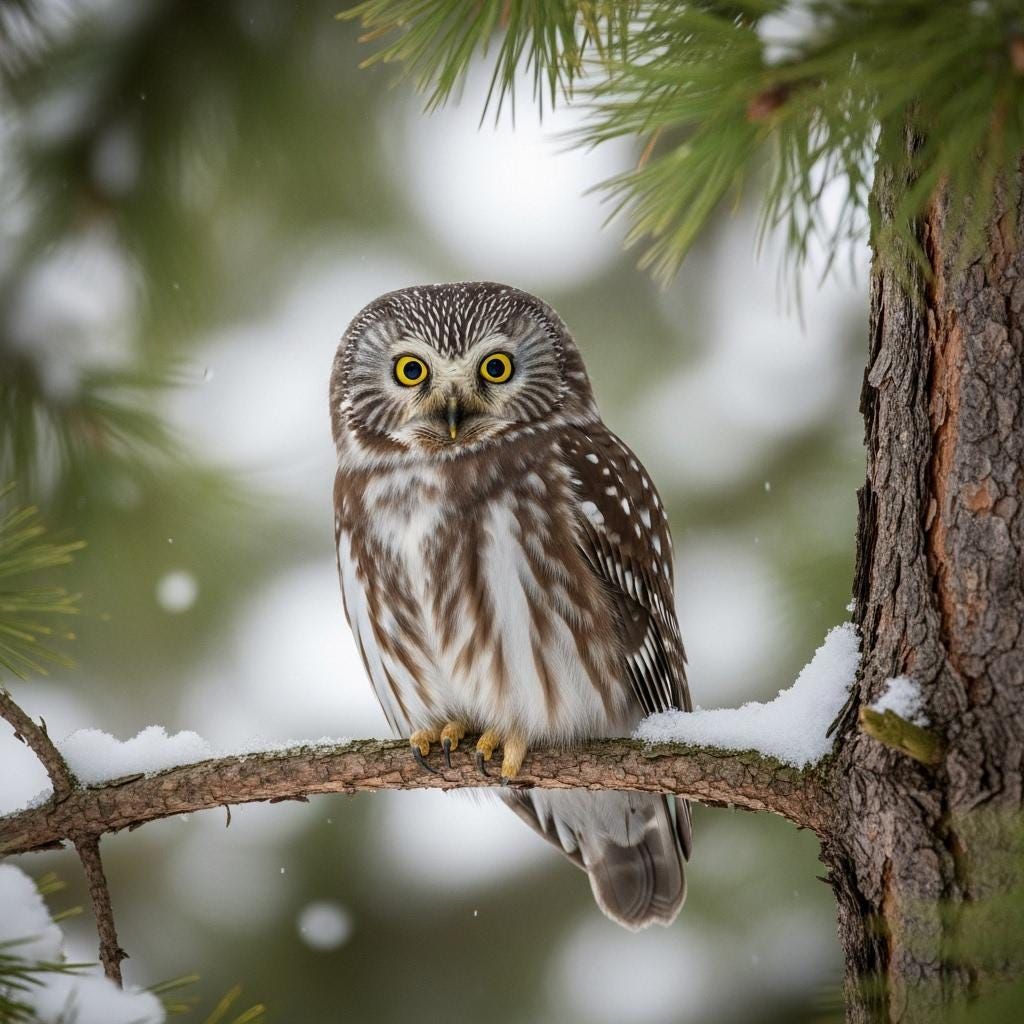
The barn owl is the most widely distributed owl species on Earth and one of the most widely distributed birds of any kind. Unlike the tufted, hooting owls of storybook tradition, the barn owl has a smooth heart-shaped face, screams rather than hoots, and specialises in hunting small rodents across open country on every continent except Antarctica.
Forty-six recognised subspecies of Tyto alba occupy habitats from tropical savanna to cold temperate farmland, making the species a textbook example of ecological flexibility within a single evolutionary lineage.
This entry covers every major aspect of barn owl biology: taxonomy, size, sensory adaptations, silent flight, diet, reproduction, conservation status, and the long relationship between barn owls and human farms. The barn owl has been studied more intensively than almost any other owl, because its willingness to nest in boxes on working farms puts it within reach of both researchers and children.
It is also the species behind much of what modern science knows about auditory localisation, and the species that has inspired an entire subfield of quiet aerodynamics.
Etymology and Classification
The scientific name Tyto alba comes from the Ancient Greek tyto, meaning 'night owl', and the Latin alba, meaning 'white'. Italian naturalist Giovanni Antonio Scopoli described the species formally in 1769, though European farmers had associated the bird with barns, granaries, and ghost stories for many centuries before that.
Common names in other languages reflect the same association with farmyards and pale plumage: the German Schleiereule ('veiled owl'), French effraie des clochers ('church-tower screamer'), and Spanish lechuza comun ('common owl') all testify to how tightly the species is linked to human settlements.
Taxonomically, barn owls belong to the family Tytonidae, one of only two living owl families. The other family, Strigidae, contains almost every other owl species - including snowy owls, great horned owls, and tawny owls. The two families diverged tens of millions of years ago and differ in skeletal anatomy, breastbone structure, and facial disc shape. Tytonid owls share the heart-shaped face; strigid owls do not.
Within Tyto alba, 46 subspecies have been described based on plumage, size, and geography. Modern molecular work has split several of these into full species: the American barn owl (Tyto furcata) of the Americas and the eastern barn owl (Tyto javanica) of south-east Asia and Australasia are now treated as distinct in most modern treatments.
This guide follows the traditional broad concept of Tyto alba that includes all these forms, because the biology and ecology remain almost identical across the group.
Size and Physical Description
Barn owls are medium-sized owls - smaller than a great horned owl, larger than a screech owl. Size varies across subspecies but falls within a predictable range.
Adult dimensions:
- Length: 32-40 cm from head to tail
- Wingspan: 80-95 cm
- Weight: 430-620 g, with females typically heavier than males
- Tarsus (lower leg): 55-65 mm, unusually long for the species' weight
Plumage and colour:
- Upperparts: golden-buff, heavily patterned with fine grey and white speckles
- Underparts: white to cream, variably spotted in black
- Facial disc: white, heart-shaped, sharply bordered
- Eyes: large, black, forward-facing
The barn owl's most distinctive feature is the heart-shaped facial disc, a tight arrangement of stiff feathers that encircles the face and meets beneath the beak in a characteristic notch. In most other owls the facial disc is circular. The heart shape is unique to tytonid owls and is not merely decorative: as explained below, it works as a sound-focusing structure that funnels auditory information toward the ears.
Unlike horned owls or eagle owls, barn owls have no ear tufts. The tufts on those other species are purely display feathers and have nothing to do with hearing. A barn owl's actual ear openings are hidden beneath feathers on either side of the facial disc. Crucially, these openings are asymmetrically positioned - one sits higher than the other - which is the foundation of the species' legendary hearing. More on that below.
Regional subspecies differ in size and colouration. European forms tend to be pale, almost pure white underneath. North American forms are typically larger and more heavily spotted. Island forms, such as those in the Galapagos and the Canary Islands, are often smaller and darker. Wherever the species occurs, however, the general body plan is immediately recognisable.
The Heart-Shaped Face and Legendary Hearing
The barn owl has the most sensitive directional hearing of any animal ever tested under laboratory conditions, and its head and face are a carefully engineered sound-processing apparatus. Three structural features combine to achieve this.
1. The facial disc as a parabolic reflector. The heart-shaped disc is a tight arc of stiff feathers arranged like the dish of a satellite antenna. Sound waves coming from any direction in front of the owl are reflected inward and funnelled toward the hidden ear openings. The disc provides roughly 10 decibels of gain - a doubling of perceived loudness - before the sound ever reaches the ear canal.
2. Asymmetrical ears. Barn owls are among the very few animals with vertically offset ears. The right ear opening is set higher on the skull than the left, and the two openings point in slightly different directions. A sound originating below and to the front will arrive at the two ears at slightly different times and slightly different intensities.
The owl's brain resolves these tiny differences into a three-dimensional location of the sound source, with vertical precision that almost no other animal achieves through hearing alone.
3. A specialised auditory brain. The barn owl's auditory midbrain contains an unusually large nucleus, the inferior colliculus, densely packed with neurons tuned to specific arrival-time differences. Neuroscientists including Mark Konishi and Eric Knudsen demonstrated during the 1970s and 1980s that barn owls could strike live mice in total darkness using sound alone, with vertical accuracy better than one degree.
These experiments rewrote the textbook understanding of sensory neuroscience and made the barn owl one of the most studied non-mammalian brains in science.
The evolutionary value of this system is straightforward: barn owls hunt at night over grass and rough country, where prey is often completely hidden from sight. A foraging barn owl flies low, listens for scurrying or squeaking, and strikes when the sound is precisely located. Vision plays a role in good light, but the hearing system functions independently and keeps the owl fed even on the darkest moonless nights.
Silent Flight
Barn owl flight is close to acoustically silent at the range at which mice and voles can hear. This serves two purposes. First, prey cannot detect the owl closing in. Second - and often overlooked - the owl can keep listening for faint sounds from its prey without being deafened by its own wing noise.
Three feather adaptations deliver silent flight:
- Serrated leading edges. The front edges of the primary wing feathers are not smooth but combed into tiny stiff teeth. As the owl flies forward, air passes through these teeth and breaks up into many small streams rather than forming the single turbulent airflow that produces audible whoosh.
- Fringed trailing edges. The back edges of the flight feathers carry a soft, flexible fringe. Any remaining turbulence dissipates gently through this fringe rather than shedding loudly off a hard edge.
- Velvety wing surfaces. The upper surface of each wing is covered in a soft, velvet-like pile of fine filaments that absorbs high-frequency sound rather than reflecting it.
The net result: measured sound output from a barn owl in level flight is more than 20 decibels quieter than that of a similarly sized diurnal bird of prey. The trade-off is a slight loss of flight efficiency - barn owls cannot fly as fast or as far as many diurnal raptors. For a night-hunting rodent specialist, the trade is worth it. These adaptations have been studied extensively by aerospace engineers looking to reduce noise from aircraft, wind turbines, and computer cooling fans.
Hunting and Diet
Barn owls are specialist small-mammal hunters. Across their vast range, small rodents make up the overwhelming majority of their diet.
Primary prey:
- Voles (various species) - the staple across temperate regions
- Mice (wood mice, deer mice, house mice)
- Rats (particularly young brown and black rats)
- Shrews (often rejected by other owls but eaten freely by barn owls)
- Young rabbits and hares
Secondary and opportunistic prey:
- Bats, taken at roost entrances or on the wing
- Small birds, mostly sparrows and finches caught at roost
- Frogs and large insects in tropical ranges
- Fish, very rarely, scooped from shallow water
A single adult barn owl eats roughly three to four rodents per night, or about 1,000 rodents per year. A breeding pair feeding a full brood of chicks can double that figure, pushing annual consumption to approximately 2,000 rodents per pair per year.
This extraordinary predation rate is the reason farmers across Europe, North America, the Middle East, Africa, and Australasia install barn owl nest boxes as a biological alternative to rodenticide spraying. Vineyards in California, wheat farms in Israel, and rice paddies in Malaysia have documented substantial reductions in rodent damage after establishing breeding barn owl populations.
Hunting technique:
- Quartering flight. The owl flies low and slow across open ground, head angled downward, wings held in a shallow V.
- Hover. On detecting prey, the owl momentarily pauses in mid-air, tracking the sound.
- Strike. The owl drops legs-first onto the prey, extending its long toes and driving its talons through the animal at the moment of contact.
- Swallow whole. Small prey are swallowed head-first on the spot. Larger prey are carried to a perch.
Indigestible bone, teeth, and fur are compressed in the gizzard and regurgitated later as compact cylindrical pellets. Barn owl pellets are a favourite tool of ecologists and school science teachers because they preserve identifiable skulls and jaws, allowing accurate reconstructions of small-mammal communities in an area.
Reproduction and Life Cycle
Barn owls breed opportunistically. Unlike Arctic owls, they do not run on a strict seasonal calendar; instead they respond to local prey abundance. In good rodent years a pair may raise two full broods; in poor years they may not breed at all.
Courtship:
- Males perform display flights around potential nest sites at dusk, calling loudly.
- Males bring the female food gifts - typically voles or mice - presented repeatedly over several weeks.
- Females often refuse to mate until their crops are regularly full, which functions as a test of male hunting ability.
- The pair often mates for life, reusing the same nest site year after year.
Nesting:
Barn owls do not construct nests. Eggs are laid directly on whatever flat surface the chosen cavity provides - a barn rafter, a church ledge, a hollow tree, a cliff niche, or the floor of a nest box. Pellets accumulate over seasons, building up a debris layer that effectively lines the nest without any weaving.
Clutch and incubation:
- Clutch size: 2-12 eggs, linked directly to local rodent abundance
- Eggs laid at roughly 2-day intervals
- Incubation: 29-34 days, by the female alone
- Hatching is staggered - first-laid eggs hatch first
Hatching asynchrony creates a pronounced size hierarchy among chicks. In good years, all chicks thrive. In lean years, older and stronger chicks get fed first, while younger siblings may die of starvation or, more rarely, be cannibalised. This grim-sounding system is adaptive: it allows the pair to match family size to actual prey supply, rather than losing an entire brood when food runs short.
Fledging and dispersal:
- Chicks open eyes at roughly 9 days
- Fully feathered by 6 weeks
- First flight at 55-65 days
- Independent of parents by 3-4 months
- Disperse 10-30 km from natal site, with occasional records past 1,500 km
Young barn owls reach breeding age by the end of their first year, and in areas with abundant rodents many attempt to breed immediately.
Lifespan
Wild barn owls live an average of around 4 years. Many individuals die in their first winter, when a combination of thin insulation, high metabolic rate, inexperience, and poor hunting conditions leaves juveniles vulnerable to starvation. Adult mortality is driven largely by:
- Cold and wet weather. Barn owls cannot accumulate large fat reserves; several consecutive snowy nights can kill a bird that cannot hunt.
- Vehicle collisions. Road verges are excellent rough-grassland hunting habitat, and thousands of barn owls are struck by vehicles each year in countries with dense road networks.
- Secondary rodenticide poisoning. Barn owls accumulate second-generation anticoagulant rodenticides from rats and mice that have eaten poisoned bait.
- Collisions with fences and power lines.
- Predation by larger owls, especially tawny owls and eagle owls.
In captivity, with consistent food, shelter, and veterinary care, barn owls have lived past 21 years. One documented captive bird reached 25. The enormous gap between wild and captive lifespans reflects how much of wild barn owl mortality is about harsh weather and accidents rather than biological ageing.
The species compensates for short individual lives with high reproductive output. A single pair in prime habitat can produce more than 20 chicks across their breeding career even though most of the adults involved will die young.
Global Distribution and Subspecies
Tyto alba occupies an astonishing range - every continent except Antarctica, along with most inhabited islands. This distribution is unmatched by any other owl and among the widest of any single bird species.
Key regional forms:
| Region | Subspecies (example) | Notable traits |
|---|---|---|
| Western Europe | T. a. alba | Pale, almost pure white underneath |
| Central Europe | T. a. guttata | Darker, heavily spotted below |
| North America | T. a. pratincola | Larger body, heavier build |
| Sub-Saharan Africa | T. a. affinis | Medium size, savanna and farmland |
| Indian subcontinent | T. a. stertens | Smaller, pale |
| Australia | T. a. delicatula | Open country and grassland |
| Galapagos Islands | T. a. punctatissima | Small, darkly spotted |
Across this range the barn owl has followed human agriculture. Granaries, barns, and the rodents they attract provide near-perfect habitat, and the species has expanded into new regions as settled farming has spread. Conversely, abandonment of old farm buildings and loss of rough pasture have caused local declines in parts of western Europe.
Conservation Status and Threats
The IUCN Red List classifies the barn owl as Least Concern, reflecting both its massive range and its overall large global population. The species is nowhere close to extinction and is not threatened at the species level. Local and regional declines are well documented, however, and have been the focus of extensive conservation work.
Main threats:
- Habitat loss. Intensive monoculture farming replaces the rough grassland, hedgerows, and field margins that support high rodent densities. Without rough habitat, breeding fails.
- Loss of nest sites. Modern steel-and-concrete farm buildings offer no cavities. Demolition of old barns and removal of hollow trees has eliminated many traditional nest sites.
- Rodenticides. Second-generation anticoagulants - bromadiolone, brodifacoum, difenacoum - are highly lethal to barn owls that eat poisoned rats and mice. Residue studies in Europe and North America regularly detect these compounds in more than 80% of dead barn owls tested.
- Vehicle collisions. Roadsides provide excellent barn owl hunting habitat, and roadkill is a leading cause of death in many developed countries.
- Severe weather. Prolonged snow cover and cold rain can starve local populations within weeks.
- Climate change. Range shifts and altered precipitation patterns are expected to affect barn owl populations, especially at the northern and southern edges of the range.
Successful conservation measures:
- Nest box installation. Tens of thousands of purpose-built nest boxes have been installed across Britain, continental Europe, Israel, the United States, and Australia. Where installed in suitable habitat, boxes are typically occupied within three years.
- Rough field margins. Leaving strips of rough tussocky grass around cultivated fields dramatically increases rodent populations and thus barn owl productivity.
- Rodenticide restrictions. Regulatory restrictions on second-generation anticoagulants have measurably reduced residues in barn owls in several European countries.
- Road design. Raised verge screens, tall hedges adjacent to highways, and reduced mowing of roadsides have been trialled to reduce vehicle strikes.
Barn owls are a rare case in conservation: a globally common species whose local populations respond very quickly to targeted management. Where people plant rough field margins, install nest boxes, and stop using strong rodenticides, barn owls usually return within a few breeding seasons.
Barn Owls and Humans
Barn owls have lived alongside humans for as long as people have stored grain. A barn full of wheat attracts rats and mice; rats and mice attract barn owls; and the owls, in turn, control the rodents. The species name itself records this relationship: farmers across Europe, Africa, and Asia have long recognised the white-faced owl in the rafters as a friend of the harvest.
Folklore has been more mixed. The barn owl's nocturnal habits, white ghostly face, and loud screeching call have made it a fixture of superstition. In parts of Britain, a barn owl calling near a house was said to foretell a death. In Roman augury the bird was a bad omen.
In Ancient Egypt, by contrast, the hieroglyph for the letter 'm' was a stylised barn owl, and the bird was associated with the night and the afterlife without strong negative connotations. Modern folklore often uses the barn owl as a shorthand for haunted buildings, in large part because the species really does occupy abandoned farms and church towers and really does scream in the night.
In the modern era, the relationship has become more deliberate. California vineyards, Israeli kibbutzim, Malaysian oil-palm estates, and United Kingdom farms all use barn owl nest boxes as a biological pest-control tool. The idea is simple: a breeding pair of barn owls will kill around 2,000 rodents a year at zero cost and with no residue to worry about. Studies across all these regions have measured meaningful reductions in rodent damage in fields or orchards that support resident barn owls.
The barn owl also appears extensively in science education. Its pellets are a standard school biology resource, its nest boxes often host live-streamed cameras used in classrooms, and its hearing system is one of the most widely cited examples in neuroscience textbooks. Few wild animals can claim such a broad and positive relationship with human culture.
Related Reading
- Barn Owl: Silent Flight and Extraordinary Hearing
- Owls: Silent Hunters of the Night
- Why Owls Can Turn Their Heads 270 Degrees
- Snowy Owl: Arctic Hunter
- Great Horned Owl
References
Relevant peer-reviewed and governmental sources consulted for this entry include the IUCN Red List assessment for Tyto alba (2019), the Barn Owl Trust population reports, the British Trust for Ornithology (BTO) long-term ringing and nest-box datasets, published neuroscience research by Mark Konishi and Eric Knudsen on auditory localisation, and silent-flight aerodynamics studies in the Journal of the Royal Society Interface.
Regional population estimates follow the most recent national monitoring schemes in the United Kingdom, United States, Israel, and Australia.
Frequently Asked Questions
How big is a barn owl?
Adult barn owls (Tyto alba) measure 32-40 cm from head to tail and have a wingspan of 80-95 cm. Despite looking large in flight, they weigh only 430-620 grams - roughly the same as a grapefruit. Females are typically heavier and more heavily spotted than males, a pattern called reverse sexual dimorphism that is common across owls.
Newly hatched chicks weigh around 12-15 grams but grow fast on a diet of whole rodents, reaching adult size within eight to nine weeks. Regional subspecies vary in size: island forms such as those in the Galapagos are smaller, while North American and European forms sit at the larger end of the range.
What do barn owls eat?
Barn owls are specialist small-mammal hunters. Their diet is dominated by voles, mice, rats, shrews, and young rabbits, with regional variations depending on what rodents are locally abundant. A single adult eats roughly 3-4 rodents per night, and a breeding pair feeding chicks can kill up to 2,000 small mammals in a single year.
When rodents are scarce they will take bats, small birds, frogs, and large insects, but these are fallback foods and rarely sustain a breeding effort. Prey is usually swallowed whole. Indigestible bone, fur, and teeth are compressed in the gizzard and regurgitated later as compact pellets, which biologists collect to reconstruct local small-mammal communities.
Where do barn owls live?
Barn owls occupy open country on every continent except Antarctica, making Tyto alba the most widely distributed owl species on Earth. Favoured habitats include rough grassland, farmland hedgerows, marshes, reed beds, savanna, and the edges of deserts. They avoid dense forest and high mountains.
Nest sites are typically cavities - in barns (hence the name), church towers, hollow trees, cliff ledges, and increasingly in purpose-built nest boxes erected by farmers and conservation groups. Across the species’ vast range, 46 subspecies have been described, varying in size, colour, and voice.
Some island forms are now treated as separate species by modern taxonomists, including the American barn owl (Tyto furcata) and the eastern barn owl (Tyto javanica).
How can barn owls hear so well?
Barn owls have the most sensitive hearing of any animal ever tested under laboratory conditions. Three features work together. First, the heart-shaped facial disc acts as a parabolic reflector, focusing sound waves toward the ear openings hidden beneath the feathers. Second, their ear openings are vertically asymmetrical - one sits higher than the other - so a sound from below reaches the two ears at slightly different times and intensities.
The owl’s brain resolves these differences into a three-dimensional fix on the prey. Third, the auditory centre of the barn owl’s brain is unusually large and densely packed with neurons specialised for timing sound arrival. In lightless laboratory trials, barn owls have struck live mice accurately using sound alone.
Why is barn owl flight silent?
Barn owl flight is almost perfectly silent, which gives the bird both a hunting advantage - prey cannot hear it approaching - and an auditory advantage - the owl itself can keep listening while in motion. Three feather adaptations achieve this. The leading edges of the primary wing feathers are serrated like a comb, breaking up the turbulent airflow that causes whooshing noise.
The trailing edges of the wing feathers carry a soft fringe that muffles residual sound. The entire upper surface of the wing is covered in a velvety pile that absorbs rather than reflects sound. These adaptations make mechanical engineers take interest: barn owl wing geometry has inspired quieter fan blades, drone propellers, and wind turbine designs.
How long do barn owls live?
Wild barn owls have a short life expectancy - on average only about 4 years, with many individuals dying in their first winter. Starvation during cold, wet, or snowy weather is the leading cause of death, because their thin insulation and high metabolic rate leave them unable to store significant fat reserves. Vehicle collisions are the second major killer in developed countries, where roadsides often provide ideal hunting habitat.
In captivity, with consistent food and shelter, barn owls have lived past 21 years. Annual productivity is high enough to offset short wild lifespans: a single breeding pair can produce 4-7 chicks per year across several broods when rodents are abundant.
Are barn owls endangered?
The IUCN Red List classifies the barn owl as Least Concern, reflecting its enormous global range and overall large population. However, local and regional declines are well documented. In Britain, barn owl numbers fell sharply during the twentieth century due to loss of rough grassland, intensification of agriculture, and secondary poisoning from rodenticides. Similar declines have been recorded in parts of continental Europe and North America.
Conservation measures that work include installing nest boxes, retaining rough field margins, restricting use of second-generation anticoagulant rodenticides, and reducing vehicle strikes through highway design. Where these measures have been applied, barn owl populations have recovered quickly, demonstrating the species’ resilience when habitat and prey are available.
Do barn owls really hoot?
No - the familiar ‘hoo hoo’ hoot belongs to species such as the tawny owl, great horned owl, and eagle owl. The barn owl’s vocal repertoire is built around a long, rasping screech or scream, often delivered in flight and carrying across open country at night. This screech is the source of many ‘haunted barn’ and banshee legends, because the call is startlingly human-like in tone.
Barn owls also hiss, bill-snap, chitter, and make a distinctive snoring begging call that chicks use when demanding food. Males advertise territory by screeching during display flights; females respond with a lower-pitched version. Regional subspecies show slight vocal differences, but the screech is unmistakable wherever the species occurs.