
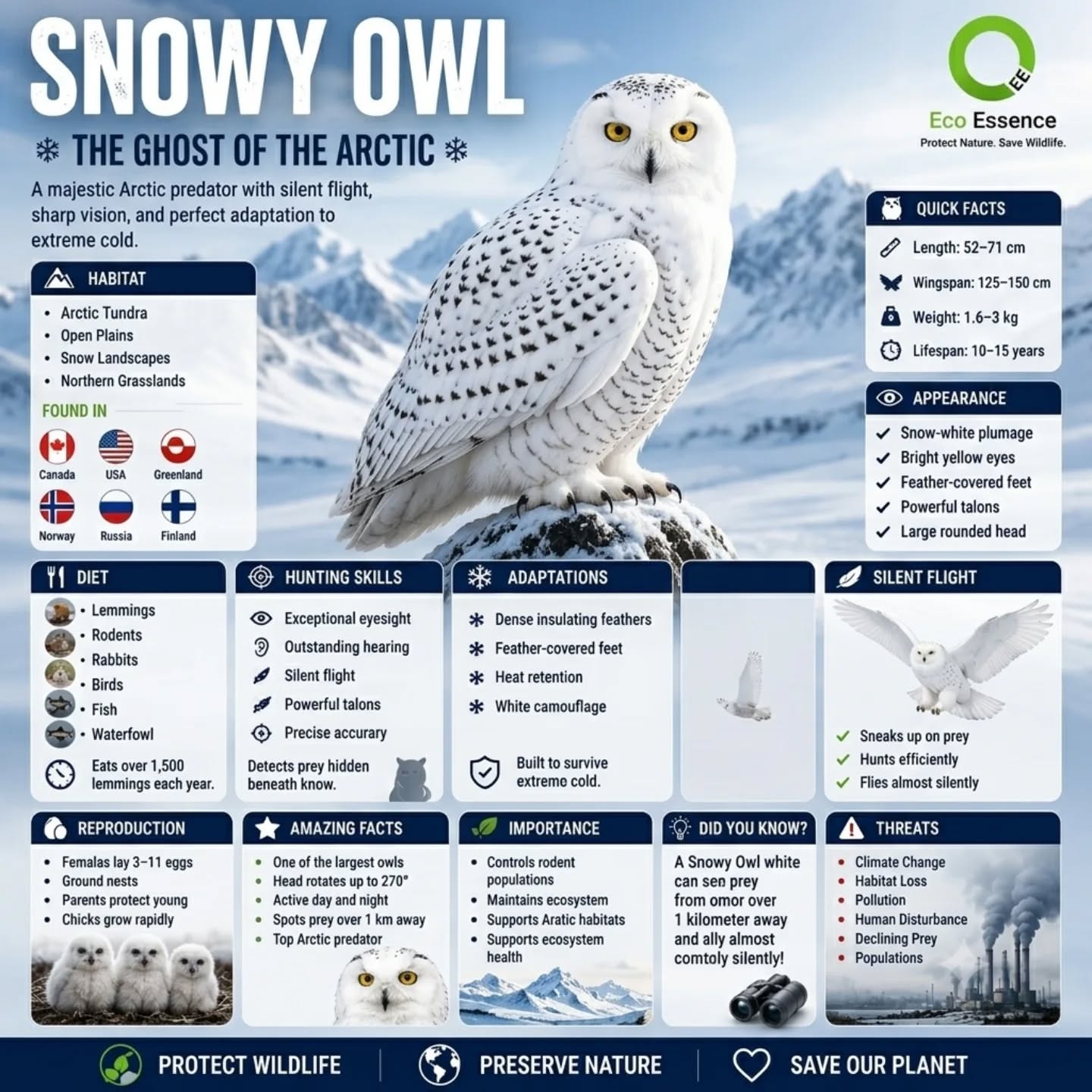
The snowy owl is one of the most instantly recognisable birds on Earth. A large, round, ghost-white raptor of the circumpolar Arctic, Bubo scandiacus lives where almost nothing else with feathers can survive year-round. Unlike most owls, which hunt by night from forest perches, the snowy owl hunts in broad daylight across open tundra and pack ice, and it nests directly on the frozen ground.
By weight it is the largest owl in North America, edging out both the great horned owl and the great grey owl. Its biology is built around one thing: small Arctic rodents, and the wild boom-bust cycles those rodents follow.
This guide covers every aspect of snowy owl biology and ecology - size, plumage, vision, diet, hunting, reproduction, lemming-driven population cycles, southward irruptions, conservation status, and the complicated relationship between the species and global popular culture. It is a reference entry, not a summary, so expect specifics: grams, centimetres, temperatures, clutch sizes, and verified records.
Etymology and Classification
The scientific name Bubo scandiacus places the snowy owl firmly inside the genus of eagle-owls, alongside Eurasian eagle-owls and great horned owls. The species epithet scandiacus means 'of Scandinavia', reflecting where the first specimens described by Linnaeus in 1758 were collected.
For most of the twentieth century the bird was placed in its own genus Nyctea, but molecular work in the early 2000s consolidated the large eagle-owls into a single genus. The snowy owl's closest living relative is now recognised to be the great horned owl (Bubo virginianus).
In the Inuit language the species is called ukpik, a name that also lends itself to landmarks, schools, and sports teams across the North American Arctic. In Russian and Scandinavian languages the bird is known by variants meaning 'white owl' or 'polar owl'. The modern English name 'snowy owl' is straightforward and fits a bird whose appearance is overwhelmingly pale.
Taxonomically, snowy owls belong to the typical owl family Strigidae rather than the barn owl family Tytonidae. The full hierarchy is: Animalia, Chordata, Aves, Strigiformes, Strigidae, Bubo, B. scandiacus.
Size and Physical Description
Snowy owls are large, heavy-bodied owls with a rounded head, a short stubby tail, and immense wings. Size is noteworthy in two directions: they are big overall, and females are consistently and visibly larger than males.
Females:
- Length: 60-71 cm
- Wingspan: 135-150 cm
- Weight: typically 1.7-2.9 kg
Males:
- Length: 52-64 cm
- Wingspan: 125-140 cm
- Weight: typically 1.6-2.5 kg
Hatchlings:
- Weight at hatching: roughly 45 grams
- Nest departure (called 'branching', though there are no branches): about 25 days
- First flight: about 50-60 days
By weight, the snowy owl is the largest owl in North America. Females of the heaviest Arctic subpopulations regularly exceed 2.7 kg, and exceptional individuals approach 3 kg. Males average considerably lighter. This reverse sexual dimorphism - females larger than males - is a pattern seen across many raptors and is thought to relate to division of labour during breeding, with females focused on incubation and nest defence while males hunt.
The head is large, round, and lacks the prominent 'ear tufts' that give great horned owls and eagle-owls their distinctive silhouettes. Snowy owls do have feather tufts, but they are short and usually flattened. The eyes are enormous, bright lemon-yellow, and set forward for binocular vision - a configuration shared with all owls but taken to an extreme here.
Plumage and Camouflage
Plumage is the feature most people recognise first, and it is more complex than the pure-white stereotype suggests. Adult males are nearly solid white, sometimes with scattered small dark flecks. Adult females are white with heavy dark brown or black barring across the back, wings, flanks, and crown. Juvenile birds of both sexes are heavily barred, with fledglings appearing almost grey from a distance.
As males age they lose barring progressively; very old males can look essentially pure white. Females retain heavy markings throughout life, and some older females develop even more extensive barring rather than less.
The colour difference is functional. A white male is highly cryptic against Arctic snow in winter and during the long period when he makes aerial display flights during courtship. A heavily barred female blends with the patchwork of tundra, lichen, dark rocks, and patchy snow that characterises Arctic summer - exactly the conditions under which she incubates on an open ground nest for more than a month.
Snowy owl feathers are unusually dense. The body, legs, and even the toes are fully feathered, producing a shaggy, thickly insulated look. The feet in particular appear almost like furry boots. Total plumage mass can exceed 20% of the bird's body weight, providing insulation against routine air temperatures of minus 40 degrees Celsius and severe wind chill.
Vision and Hearing
Snowy owls have two of the most acute sensory systems in any bird. Their vision is built around enormous eyes with densely packed retinal cells. Each eyeball is nearly the size of a human eyeball - by mass, an adult snowy owl's eyes weigh roughly as much as its brain. Because the eyes are so large they cannot rotate in their sockets, a limitation compensated by extraordinary neck mobility.
Snowy owls can rotate their heads approximately 270 degrees thanks to 14 cervical vertebrae (humans have 7) and specialised blood vessel arrangements that prevent neck rotation from cutting off blood flow to the brain.
Unlike most owls, snowy owl eyes contain a relatively high proportion of cone cells. This gives them strong day vision and meaningful colour perception in the bright, glare-filled conditions of Arctic daylight and snow. Their eyes still contain many rod cells for low-light conditions, but the balance is tilted toward daylight performance. This matches their diurnal lifestyle.
Hearing is equally precise. The ear openings are slightly asymmetrically placed on the skull - one higher than the other - which allows the owl to triangulate sound in vertical as well as horizontal space. The facial disc of stiff feathers channels sound toward the ears. In practice, a hunting snowy owl can locate a lemming moving under 30 centimetres of compacted snow, and it will strike through the snow surface with its feet extended and its eyes closed at the moment of impact.
Diet and Hunting
The snowy owl's diet is dominated by small rodents. In normal Arctic summers, brown lemmings (Lemmus trimucronatus) and collared lemmings (Dicrostonyx spp.) make up the bulk of food intake. An adult owl eats 3 to 5 lemmings per day to maintain body condition. A breeding pair rearing a large brood can consume up to 1,600 lemmings across a single breeding season.
Primary prey:
- Brown lemming (Lemmus trimucronatus)
- Collared lemming (Dicrostonyx spp.)
- Tundra vole (Microtus oeconomus)
Secondary and opportunistic prey:
- Arctic hare and snowshoe hare
- Ground squirrels
- Ptarmigan and grouse
- Ducks, geese, and shorebirds
- Seabirds and their chicks
- Small passerines
- Fish snatched from shallow water
- Carrion when available
Hunting techniques:
- Perch-and-pounce. The owl sits motionless on a raised tundra mound, a rock, a driftwood log, or a utility pole, scanning open ground. When prey moves, the owl drops into a fast, low glide and seizes it with the feet.
- Hovering. In open country with few perches, snowy owls will hover facing into the wind at 5-15 metres up, relocating over prey before stooping.
- Ground coursing. They regularly walk on the ground, hopping and flapping to flush prey from grass or low vegetation.
- Snow strikes. When prey is beneath snow cover, the owl listens, takes off, flies to the exact spot, and punches through the snow with its feet.
- Aerial pursuit. During irruptions in temperate wintering areas, snowy owls have been recorded pursuing ducks and gulls on the wing.
Prey is typically swallowed whole. Lemmings and voles slide down head-first. Larger prey like ducks, hares, or ptarmigan are torn into smaller pieces. Indigestible material - fur, feathers, bones, teeth - is compacted in the gizzard and later coughed up as a pellet. Pellet analysis is one of the main ways biologists study snowy owl diet.
Lemming Cycles and Reproduction
Snowy owl reproduction is inseparable from lemming ecology. Lemming populations in any given area of Arctic tundra cycle through 3-5 year peaks and crashes. In peak years, lemming density can exceed 200 animals per hectare; in crash years, the same hectare may hold almost none. Snowy owls track this abundance with extreme precision.
In a lemming peak year:
- Pairs form on territory in late April
- Females lay 7-11 eggs, sometimes more
- Males hunt almost continuously to feed the incubating female and growing chicks
- Fledging success can exceed 80%
- Young disperse widely the following winter
In a lemming crash year:
- Many females do not breed at all
- Those that do lay small clutches of 3-5 eggs
- Clutches may be abandoned partway through incubation
- Adults themselves may migrate south rather than breed
Typical breeding schedule:
- Courtship and pairing: late April to mid-May
- Egg laying: mid-May to early June, eggs laid 2 days apart
- Incubation: 32-34 days per egg
- Chicks in nest: 14-25 days
- Post-fledging dependence: 2-3 months
Nests are simple ground scrapes on raised mounds or rocky outcrops, lined with a little down and vegetation. Sites are chosen for visibility rather than concealment - an incubating female needs to watch for Arctic foxes, skuas, wolves, and other snowy owls approaching across open country. Males patrol a large territory around the nest and drive off intruders with low flights and loud hooting displays.
Because eggs are laid at 2-day intervals but incubation starts with the first egg, chicks hatch at different ages. The oldest chick in a clutch of 11 may be over three weeks older than the youngest. In good years all chicks may survive. In mediocre years, the youngest are often starved out by their older nestmates, or eaten by them.
Population Cycles and Irruptions
Because snowy owl breeding is so tightly coupled to lemming abundance, the species swings between very different states. In boom years across a large region of tundra, thousands of young birds may fledge. In bust years the same region may produce essentially no young at all. These swings drive one of the most dramatic movements in the bird world: the snowy owl irruption.
An irruption is a large, irregular southward movement of snowy owls beyond their normal winter range. Irruptions follow boom breeding years. When too many young birds meet a collapsing lemming population in their first winter, large numbers fly south looking for food. Irrupting owls may appear in the northern United States, southern Canada, Britain, mainland Europe, and occasionally much further. Recorded irruptive sightings include Texas, Florida, Bermuda, and Hawaii.
The winter of 2013-2014 produced one of the largest snowy owl irruptions ever documented in North America, with over 7,000 reports logged by citizen scientists across the eastern United States. Large irruptions also occurred in 2011-2012 and 2017-2018. Survival of irrupting birds is low - many die from collisions with vehicles and aircraft, starvation in unfamiliar habitat, or shooting.
This migratory behaviour makes population estimation difficult. A 'counted' owl on wintering grounds may simply be a breeding bird displaced, not an additional individual. Modern estimates that correct for double-counting put the global population at roughly 30,000 mature individuals, well below earlier figures that approached 300,000.
Range and Habitat
Snowy owls are circumpolar breeders across the Arctic tundra zone. Their breeding range wraps the top of the globe, covering northern Canada, Alaska, Greenland, Scandinavia, and the Russian Arctic from the Kola Peninsula to the Chukotka coast. They do not breed south of the tree line and do not breed inside forested country.
Breeding habitat:
- Open, treeless tundra
- Raised ground with good sight lines
- Low vegetation and scattered rock
- Proximity to lemming and vole colonies
Wintering habitat:
- Arctic sea ice edges and coastal tundra (some birds)
- Prairie, farmland, and airfields in temperate latitudes (others)
- Coastal marshes and beaches
- Great Lakes shores and frozen wetlands
Winter distribution is highly variable. Some birds stay on breeding territory year-round, hunting ptarmigan and hares during the dark winter months. Others move a few hundred kilometres south to the edge of the boreal forest. In irruption years large numbers may push thousands of kilometres south into the middle of North America or Europe. Individual owls have been tracked spending one winter in Texas and the next in Saskatchewan.
Travel and Movement
Snowy owls are strong fliers and capable long-distance travellers. Satellite telemetry studies have revealed movements that were almost unknown before 2000.
| Metric | Value |
|---|---|
| Typical flight speed | 40-65 km/h |
| Maximum sustained flight | over 1,000 km in 5 days |
| Longest recorded movement | 5,000+ km in a single winter |
| Hunting flight altitude | 2-15 m above ground |
| Migration altitude | up to 1,000 m |
Some tagged birds have crossed the Arctic Ocean between Canada and Russia during single seasons. Others alternate between winter ranges thousands of kilometres apart in consecutive years. This means the 'home range' concept used for many birds does not apply cleanly to snowy owls; many individuals are effectively nomads that follow prey across continents.
Conservation Status and Threats
The IUCN Red List classifies the snowy owl as Vulnerable, following a 2017 uplisting from Least Concern. The population trend is decreasing. The most rigorous recent estimates suggest roughly 30,000 mature individuals globally, though uncertainty remains high.
Primary threats:
- Climate change. The central driver. Warming is disrupting Arctic lemming cycles; several long-studied sites have seen amplitude reduction or disappearance of their 3-5 year cycles. Without reliable lemming peaks, snowy owls produce fewer young across their lifetimes. Changing snow conditions also affect winter lemming survival beneath the snowpack.
- Collisions. Vehicle strikes, power line collisions, and airport strikes kill large numbers of wintering owls in temperate latitudes. Airports are particularly attractive because they resemble open tundra.
- Pesticides and rodenticides. Secondary poisoning from anticoagulant rodenticides used in agricultural areas affects wintering birds.
- Illegal shooting. Despite legal protection across the range, some owls are still shot, particularly during irruptions when unfamiliar humans see them as trophies or as threats to poultry.
- Disturbance. Nest disturbance by hikers, photographers, and vehicles reduces breeding success. The Harry Potter phenomenon that began in the late 1990s produced a documented spike in interest in snowy owls as pets, with knock-on effects on illegal trade.
- Pollution. As long-lived top predators, snowy owls accumulate mercury and persistent organic pollutants in their tissues, with measurable effects on reproduction.
Conservation measures include legal protection across all range states, protected breeding areas in parts of the high Arctic, and monitoring programmes that rely heavily on citizen science. Organisations such as Project SNOWstorm in North America have tagged hundreds of wintering snowy owls, producing the movement data used to estimate global population. None of these efforts address the primary driver - Arctic climate change - which depends on global greenhouse gas emissions.
Snowy Owls and Humans
Snowy owls have been part of Arctic human culture for as long as people have lived on the tundra. Inuit hunters traditionally took snowy owls for food, and owl imagery appears in carvings, prints, and regalia across the circumpolar North. The species is the official bird of the Canadian province of Quebec.
In temperate cultures the snowy owl was largely a curiosity until the late twentieth century. The species was well known to birdwatchers, especially during irruption winters, but did not hold a prominent place in popular culture. That changed abruptly with the publication of the Harry Potter novels beginning in 1997 and the release of the film adaptations from 2001 onward.
Harry Potter's owl Hedwig is depicted as a snowy owl, and the character's popularity produced a measurable increase in public interest in the species.
The effect on actual snowy owls has been mixed. Public awareness translated into donations to conservation and research. But pet-trade demand for snowy owls rose, particularly in parts of Asia and Europe, and animal welfare organisations documented cases of snowy owls kept in unsuitable private collections.
The snowy owl is a poor pet: it requires huge amounts of whole prey, cold temperatures, and enormous flight space that almost no private keeper can provide. Several range-state agencies now cite the 'Hedwig effect' as a secondary conservation concern.
Airport strikes are another important human-owl intersection. During irruption winters, airports in the northern United States and southern Canada regularly host dozens of snowy owls at once. Agencies such as Boston's Logan Airport have worked with researchers to live-trap and relocate owls rather than shoot them, an approach that has become standard practice at many northern airports.
Related Reading
- Owls of the World: The Silent Hunters
- How Owls Hear: Asymmetric Ears and Silent Flight
- Great Horned Owl: North America's Tiger of the Sky
- Arctic Animals: Survival at the Top of the World
References
Relevant peer-reviewed and governmental sources consulted for this entry include the IUCN Red List assessment for Bubo scandiacus (2017 uplist and subsequent updates), the Birds of the World account maintained by the Cornell Lab of Ornithology, Project SNOWstorm tracking data (2013-present), and published research in The Auk, Journal of Raptor Research, Arctic, and Ibis.
Population figures reflect the most recent consolidated estimates as of the 2024 IUCN review. Behavioural and movement data draw on satellite telemetry studies conducted across North America and Fennoscandia from 2013 to 2024.
Frequently Asked Questions
How big is a snowy owl?
Snowy owls (Bubo scandiacus) measure 52-71 cm from head to tail with a wingspan of 125-150 cm. Females weigh 1.7-2.9 kg and males 1.6-2.5 kg, making females consistently the larger sex - a pattern known as reverse sexual dimorphism. By weight the snowy owl is the largest owl in North America, edging out the great horned owl and the great grey owl.
Newly hatched chicks weigh only about 45 grams but grow fast enough to leave the nest mound at 25 days old and fly by 50-60 days.
What do snowy owls eat?
Snowy owls are specialist carnivores whose summer diet on the tundra is dominated by small rodents - especially brown lemmings and collared lemmings. An adult owl eats 3-5 lemmings per day, and a breeding pair with chicks can consume up to 1,600 lemmings across a single breeding season. When lemmings are scarce, snowy owls switch to voles, Arctic hares, ground squirrels, ptarmigan, ducks, seabirds, and even fish scooped from the water.
During winter and on coastal wintering grounds they take waterfowl, shorebirds, and occasional small mammals. Prey is usually swallowed whole, and indigestible bone and fur is coughed up later as pellets.
Where do snowy owls live?
Snowy owls breed across the circumpolar Arctic tundra in Canada, Alaska, Greenland, Fennoscandia, and northern Russia. Breeding habitat is open, treeless tundra with raised mounds or rocky outcrops used as hunting perches and nest sites. They do not breed in forested regions. In winter many birds stay in the Arctic, but a substantial fraction moves south into the northern United States, southern Canada, and temperate Eurasia.
During lemming crashes they undertake dramatic ‘irruptions’ and can appear as far south as Texas, Florida, Bermuda, and parts of southern Europe. They favour open environments year-round - prairie, marsh, beach, airfield, farmland - because their hunting style depends on wide sight lines.
Are snowy owls endangered?
The IUCN Red List classifies the snowy owl as Vulnerable with a decreasing population trend, following a 2017 uplisting from Least Concern. Recent estimates suggest roughly 30,000 mature individuals worldwide, down sharply from earlier figures that may have been inflated by double-counting nomadic birds. The primary threat is climate change, which is disrupting the boom-bust lemming cycles that snowy owls depend on for successful breeding.
Secondary threats include collisions with vehicles and power lines, electrocution, pesticide exposure, illegal shooting, and disturbance at nest sites. The species is not currently threatened by habitat loss on breeding grounds because the high Arctic remains largely undeveloped.
How long do snowy owls live?
Wild snowy owls typically live around 10 years, though many die in their first winter during long southern migrations and most never reach breeding age. Captive birds have reached 28 years thanks to consistent food, veterinary care, and absence of migration stress. Adult mortality is driven by starvation in bust years, collisions with vehicles and structures, shootings, and predation on nests by Arctic foxes and skuas.
Females begin breeding around age 2-3 when conditions allow, and a single productive female may raise dozens of young across her lifetime if she happens to coincide with multiple lemming peaks.
Why are snowy owls active during the day?
Most owls are nocturnal, but snowy owls are diurnal - they hunt during daylight hours. The reason is geography. Snowy owls evolved on Arctic tundra where summer sun never sets and winter darkness lasts for weeks. An owl that hunted only at night would starve during the polar summer and struggle during the polar winter.
Diurnal hunting also suits their main prey: lemmings are active in daylight hours, and open tundra lacks the dense vegetation that would reward nocturnal ambush. Their eyes contain an unusually high proportion of cone cells for an owl, giving them strong colour vision and acuity in bright snow glare.
What is a snowy owl irruption?
An irruption is a periodic, large-scale southward movement of snowy owls beyond their normal winter range. Irruptions follow Arctic lemming population cycles. After a boom summer when pairs raise large broods, the following winter tundra cannot support all those young birds, and many fly south in search of food.
Irruptions bring hundreds or thousands of snowy owls into the northern United States, southern Canada, and occasionally much further - recorded sightings include Texas, Bermuda, and Hawaii. The 2013-2014 irruption was among the largest on record, with over 7,000 reports logged by birders across eastern North America. Irrupting birds often die young, overwhelmed by unfamiliar environments, vehicle strikes, and starvation.
Are male and female snowy owls different?
Yes, and snowy owls display one of the most visible forms of sexual dimorphism among owls. Females are larger and more heavily marked - their white plumage carries extensive dark barring across the back, wings, and belly. Males are smaller and mostly white, with older males sometimes appearing almost pure white with only faint speckling.
This difference is functional as well as visual: the heavier barred female camouflages better while incubating on open ground, while the whiter male blends with snow during winter and during his airborne display flights. Females also do all incubation and brooding, while males do most of the hunting during the breeding season.