
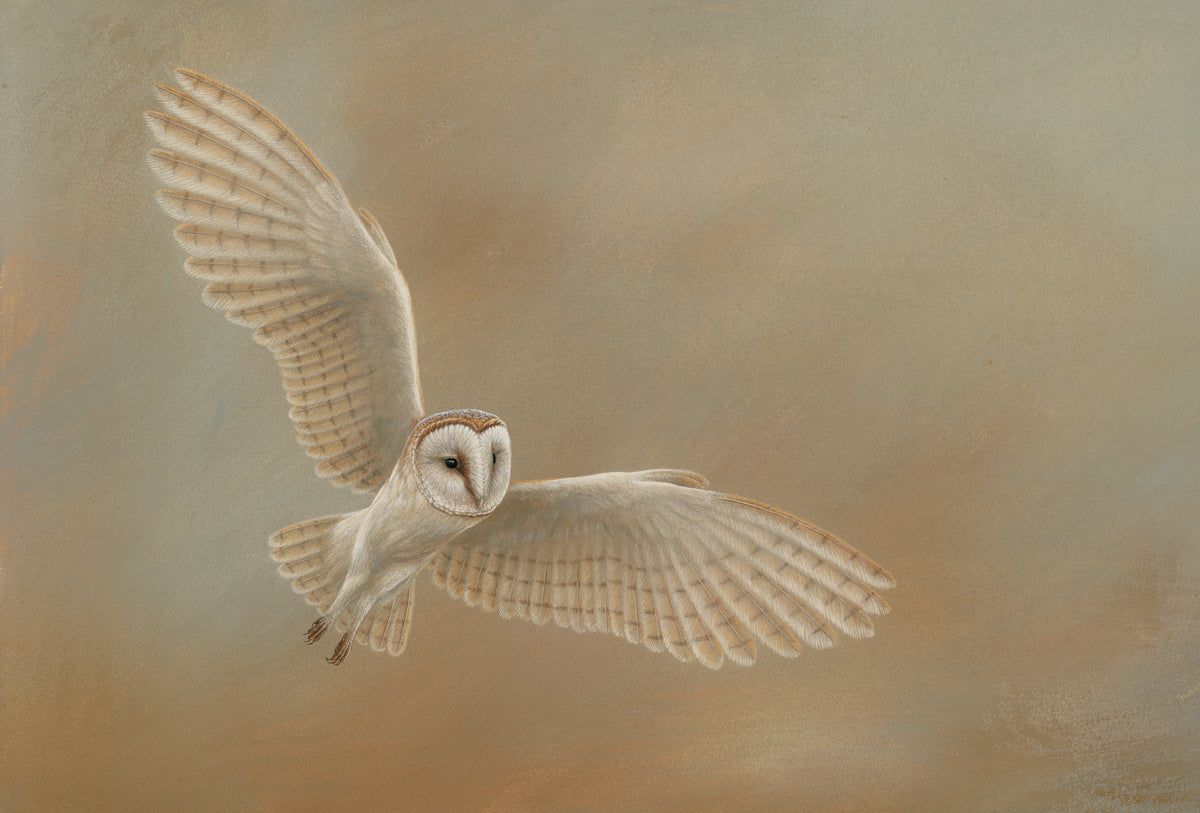
How do barn owls fly silently?
Barn owls fly in near-total silence thanks to specialized feather structures found only in owls. Their flight feathers have three key adaptations: a serrated leading edge that breaks up air turbulence, a soft velvety surface that absorbs sound, and a fringed trailing edge that reduces noise from air flowing off the wingtip.
The Ghost of the Barn
A barn owl emerges from an abandoned barn at dusk. It flies across a moonless field at 3 meters per second. A mouse runs through tall grass 30 meters away. The owl hears the mouse's faint rustling, calculates its exact three-dimensional location from minute sound differences between its asymmetric ears, adjusts course silently, and strikes, killing the mouse on the first attempt.
The mouse never heard the owl. No grass moved in warning. The owl's flight feathers produced zero detectable sound. The entire hunt happened through acoustic calculations in complete darkness.
This is the barn owl (Tyto alba), nature's most refined sonic hunter and one of the most successful bird species on Earth.
The Silent Flight System
Barn owl flight is effectively silent.
The special feathers:
Barn owl flight feathers have three key modifications:
Serrated leading edge:
- Small "teeth" along the forward edge of primary flight feathers
- Breaks up air flow before it creates turbulence
- Eliminates the "whoosh" of normal bird flight
Velvety upper surface:
- Entire wing covered in soft, down-like feathers above the flight feathers
- Absorbs sound vibrations
- Reduces feather-to-feather scraping noises
Fringed trailing edge:
- Soft fringe along the back of primary feathers
- Reduces vortex noise where air leaves the wing
- Smooths airflow turbulence
The result:
A flying barn owl produces less sound than a human breathing. Measured flight noise at 2 meters distance approaches the lower limits of scientific measurement equipment.
Why it matters:
Silent flight serves two purposes:
- Prey cannot hear the owl approaching
- The owl's own flight noise doesn't interfere with its hearing
Most owls have similar adaptations, but barn owls have the most refined silent-flight system of any bird.
Engineering applications:
Owl feather structures have inspired:
- Quieter wind turbines
- Stealth aircraft designs
- Reduced-noise drones
- Jet engine sound reduction
The Hearing System
Barn owls have the most acute directional hearing of any bird.
Asymmetric ears:
Uniquely among birds, barn owl ears are asymmetric:
- Left ear opening: positioned higher
- Right ear opening: positioned lower
- Outside appearance remains symmetrical (ear openings hidden under feathers)
Why asymmetry:
Symmetrical ears only allow horizontal localization (sound reaches left and right ears with slight time differences).
Asymmetric ears allow vertical localization too, sounds from above reach the higher left ear first; sounds from below reach the lower right ear first.
Precision:
Time differences as small as 30 microseconds can be detected. Intensity differences further refine location estimates.
Result: barn owls can pinpoint prey to within 1 centimeter in pitch darkness.
The facial disc:
The distinctive heart-shaped face functions as sound-collection equipment:
- Concave shape acts as a parabolic dish
- Focuses sound toward ear openings
- Amplifies faint sounds by ~10 decibels
- Highly optimized geometry
Hunting Technique
Barn owls hunt by sound in darkness.
The sequence:
- Listening flight: slow, silent flight above open terrain
- Sound detection: rustling prey detected through facial disc and ears
- Triangulation: head rotation pinpoints exact location
- Approach: silent descent toward prey
- Talon extension: grasp prey with specialized feet
- Kill: crushing grip or killing bite
Success rate:
Barn owls have high hunt success, around 75% of strikes succeed, far better than most birds of prey. Their acoustic precision makes misses rare.
Vision still matters:
Though they can hunt purely by sound, barn owls also have excellent low-light vision. In moonlit conditions, they use both senses combined for even better targeting.
Under snow:
Barn owls can detect and catch voles and mice moving under snow cover. The sounds of tunneling prey reach the owl's ears through the snow. The owl plunges talons-first through the snow to the exact location.
Diet
Barn owls are small-mammal specialists.
Typical diet composition:
- Mice (various species): 40-60%
- Voles: 20-30%
- Shrews: 5-10%
- Rats: 5-10%
- Other (birds, bats, insects): 1-5%
Daily consumption:
An adult barn owl eats 2-4 small mammals per night, totaling approximately 150-250 grams. Over a year: 1,000-3,000 rodents.
Regional variation:
Diet varies by location based on available prey:
- UK: primarily short-tailed field voles
- Australia: house mice, native rodents
- Africa: various native rodents
- Americas: deer mice, voles
Agricultural importance:
Barn owls are critical for rodent control:
- Single owl families can control rodents across 100+ hectares
- Reduces need for rodenticides
- Prevents crop losses
- Valuable to organic farming
Nest boxes:
Installing barn owl nest boxes reduces rodent damage by 10-50% on farms. Many agricultural programs promote barn owl conservation as integrated pest management.
Global Distribution
Barn owls are extraordinarily widespread.
Range:
Every continent except Antarctica:
- Americas (from Canada to Argentina)
- Europe
- Africa (sub-Saharan)
- Asia (Middle East through Southeast Asia)
- Australia and New Zealand
- Many islands
Subspecies:
Approximately 46 subspecies exist, adapted to local conditions:
- Color variations (white to dark brown)
- Size differences
- Call variations
- Habitat preferences
Habitat:
- Open grasslands
- Agricultural fields
- Savannas
- Light woodlands
- Desert edges
- Areas near human structures
Not found in:
- Very cold climates (no year-round small mammals)
- Dense rainforests
- High mountains
- Ice-covered regions
Relationship With Humans
Barn owls have lived alongside humans for thousands of years.
Historical context:
- Name from their association with barns
- Roosted in agricultural buildings throughout human history
- Followed agricultural expansion across continents
- Considered useful in most cultures for rodent control
Cultural perceptions:
- Positive: pest controllers, spiritual symbols
- Neutral: common birds in rural areas
- Negative: ghostly appearance led to death omens in some cultures
"Ghost owl":
Their pale face and silent flight inspired many folklore traditions:
- Associated with the supernatural in some European traditions
- Signifying death in various Native American beliefs
- Considered protective spirits elsewhere
Modern significance:
- Symbol of sustainable farming
- Important indicator of ecosystem health
- Popular in wildlife photography
- Frequently featured in nature documentaries
Conservation
Barn owl status varies by region.
Overall status:
IUCN Least Concern globally, but significant regional declines.
UK and Ireland:
- Severely declined in 20th century
- Loss of old barns reduced nesting sites
- Agricultural intensification reduced prey
- Pesticides (rodenticides) poisoned owls indirectly
- Recovery through nest box programs and agricultural reform
Europe:
- Mixed, declines in some countries, stable in others
- Climate change affecting winter survival
- Agricultural reform generally beneficial
North America:
- Generally stable
- Some regional concerns
- Vehicle collisions a significant mortality source
Threats:
- Rodenticides: secondary poisoning from eating poisoned rodents
- Vehicle strikes: hunting owls often fly low across roads
- Loss of hunting habitat: hedgerow removal, field consolidation
- Climate change: altering prey distributions
- Barn demolition: removing traditional nesting sites
Conservation measures:
- Nest boxes in appropriate habitat
- Maintenance of hedgerows and field margins
- Integrated pest management (reducing rodenticide use)
- Protecting mature trees with cavities
- Farmer education
Reproduction
Barn owl breeding is fast and prolific.
Breeding season:
Most regions have spring/summer breeding. Some tropical areas breed year-round.
Pair formation:
Barn owls often pair for life. Pairs stay together in their territory year-round in most regions.
Nesting:
- Use existing cavities (don't build nests)
- Hollow trees, church towers, farm buildings, nest boxes
- 4-7 eggs typical (sometimes more)
- Incubation: 32 days
- Female incubates; male provides food
Chick development:
- Hatching asynchronous (3-day intervals)
- Chicks fed for 7-12 weeks
- Become independent at ~3 months
- Sexual maturity: 1 year
Population dynamics:
- High reproductive rate when prey abundant
- Fast population recovery possible
- Rodent population crashes can cause owl breeding failures
- Typical lifespan: 4 years (some reach 15+)
Species Diversity
The barn owl genus (Tyto) includes multiple related species.
Common barn owl (T. alba):
- Most widespread
- Pale face, lighter underparts
- Global distribution
American barn owl (T. furcata):
- Americas only
- Recent taxonomic separation
- Darker overall
Eastern barn owl (T. javanica):
- Southeast Asia to Australia
- Recently recognized separately
Ashy-faced owl (T. glaucops):
- Caribbean endemic
- Grayer coloration
Other Tyto species:
- Greater sooty owl (Australia)
- Masked owls (Pacific region)
- Bay owls (Africa and Asia)
Research and Study
Barn owls are among the most-studied birds.
Research areas:
Bioacoustics:
- Their hearing and silent flight have generated decades of research
- Applied to engineering, audiology, and acoustics
Pest control biology:
- Model species for studying integrated pest management
- Research into optimizing nest box placement
- Studies of prey-predator dynamics
Conservation biology:
- Indicator species for agricultural health
- Sentinel for pesticide impacts
- Monitor for ecosystem changes
Evolutionary biology:
- Their unique silent flight features provide evolutionary insights
- Asymmetric ears offer rare examples of bilateral asymmetry
- Global subspecies variation informs speciation research
The Perfect Hunter
What makes barn owls remarkable is not any single feature but their integrated design.
Each adaptation supports the others:
- Silent flight enables sound-based hunting
- Asymmetric ears enable precise sound localization
- Facial disc amplifies faint prey sounds
- Specialized feathers reduce self-noise that would interfere with hearing
- Small-mammal diet provides abundant year-round prey
Together, they produce a species that can hunt successfully in near-total darkness, a niche that few other animals can fill effectively.
This integrated design explains their global success. Barn owls aren't the largest owls, the fastest birds, or the most physically impressive predators. They are simply the most refined acoustic hunters of small mammals. In that specific ecological niche, they dominate so completely that related owl species rarely overlap with them.
Every barn owl hunting at night in a barn, field, or forest edge is performing one of nature's most sophisticated sensory integrations, continuously calculating prey positions from acoustic data while moving silently through three-dimensional space.
Their centuries-long association with agricultural humans is not coincidence. Our barns and buildings provided ideal nesting sites. Our agricultural fields produced rodent populations. And barn owls rewarded us by controlling those rodents more effectively than any other predator.
The relationship endures because it has worked, in different forms, across different cultures, for thousands of years - humans growing crops, rodents attacking them, and silent pale ghosts hunting the rodents invisibly in the night.
Acoustic Performance in Numbers
The Kalenux Team has assembled published bioacoustic measurements to put the barn owl's sensory advantage in context. A typical songbird in flight produces peak sound pressure of 65 to 70 dB SPL at 1 meter; a barn owl at the same distance produces less than 5 dB SPL, at or below the noise floor of most field-grade recording equipment.
| Sound Source | Sound Pressure Level at 1 m |
|---|---|
| Normal human conversation | 60-65 dB |
| A crow in flight | 55 dB |
| A pigeon in flight | 50 dB |
| A typical songbird in flight | 40-45 dB |
| A tawny owl in flight | 15-20 dB |
| A barn owl in flight | below 5 dB (near noise floor) |
| Threshold of human hearing | 0 dB |
"The barn owl's hearing is so acute that it can localize a stationary mouse in complete darkness by its breathing alone. We measured precision of approximately one degree in both horizontal and vertical directions, which is roughly equal to a human pointing their finger at a small object across a room. Except the owl does it in the dark, from 30 meters, while gliding silently." - Masakazu Konishi, California Institute of Technology, The Auk, 1973 [1]
The auditory map in the barn owl's midbrain, first characterized by Konishi and Eric Knudsen in the 1970s, consists of an ordered grid of neurons in which each cell responds most strongly to a sound originating from a specific direction in space.
The owl essentially carries a built-in radar display in its brainstem, and the accuracy of that display is within one degree of resolution both horizontally and vertically - the most precise auditory spatial representation ever documented in any vertebrate.
Aerodynamic Design Lessons from Owl Feathers
Engineering interest in barn owl flight has grown steadily since the 1990s, when high-fidelity wind tunnel studies at the German Aerospace Center (DLR) quantified the exact aerodynamic function of the serrated leading edge and trailing-edge fringe. The leading-edge comb breaks an oncoming vortex into many smaller vortices, which combine destructively and cancel most of the sound that a smooth leading edge would produce. The trailing-edge fringe does the same for vortices shed off the wing.
Bio-inspired designs derived from these feather structures have measurably reduced noise in commercial applications:
- Siemens wind turbine blades with serrated trailing edges (modeled on owl feathers) reduce blade noise by 2-3 dB, translating to noticeable reductions in sound at distances of a kilometer or more from a turbine.
- Airbus has tested owl-inspired leading edges on landing-gear fairings to reduce approach noise on commercial aircraft.
- Computer-controlled drone propellers with owl-inspired edge treatments reduce audible signature by 4-5 dB, meaningful for wildlife monitoring drones designed not to disturb the animals they film.
"The barn owl's wing is one of the most beautifully engineered biological structures I have ever studied. It is a reference standard for any aerodynamicist working on low-noise design." - Justin Jaworski, Lehigh University, Journal of Fluid Mechanics, 2013 [2]
Global Population and Conservation
The barn owl is among the most widely distributed landbird species on Earth. BirdLife International estimates a global population of roughly 10 million mature birds, classified as Least Concern by the IUCN. But that reassuring global figure masks severe regional declines.
| Region | Trend | Key Pressure |
|---|---|---|
| North America | Declining in Midwest and Northeast | Rodenticides, vehicle collisions |
| United Kingdom | Recovering from 20th century decline | Nest box programs; prey scarcity in monocultures |
| Continental Europe | Mixed; decline in France and Germany | Intensive agriculture, barn demolition |
| Australia | Irregular, prey-driven population swings | Rodent boom-bust cycles |
| South Africa | Stable, widely used in agricultural IPM | Popular in vineyard pest control |
| Tropical Asia | Declining in some regions | Habitat loss, oil palm expansion |
The South African wine industry provides one of the clearest success stories. Since the early 2000s, Cape wineries have installed thousands of barn owl nest boxes across their vineyards.
Studies by Hugo Meyer and Peter Taylor at the University of Cape Town documented that each nest box supports a breeding pair that removes an average of 3,000 rodents per year, saving the typical estate the equivalent of 2-3 percent of gross revenue in crop protection and pesticide costs [3]. Similar programs in Israeli and Californian agriculture have produced comparable results.
References
- Konishi, M. (1973). How the owl tracks its prey. American Scientist, 61(4), 414-424.
- Jaworski, J. W., and Peake, N. (2013). Aerodynamic noise from a poroelastic edge with implications for the silent flight of owls. Journal of Fluid Mechanics, 723, 456-479.
- Meyer, H., and Taylor, P. J. (2019). The economic value of barn owl (Tyto alba) biological pest control in South African agriculture. African Journal of Ecology, 57(2), 151-158.
- Knudsen, E. I., and Konishi, M. (1978). A neural map of auditory space in the owl. Science, 200(4343), 795-797.
- Payne, R. S. (1971). Acoustic location of prey by barn owls (Tyto alba). Journal of Experimental Biology, 54(3), 535-573.
Related Articles
- Why Owls Can Turn Their Heads 270 Degrees
- Owls: Silent Hunters of the Night
- Peregrine Falcon: The Fastest Animal on Earth
Frequently Asked Questions
How do barn owls fly silently?
Barn owls fly in near-total silence thanks to specialized feather structures found only in owls. Their flight feathers have three key adaptations: a serrated leading edge that breaks up air turbulence, a soft velvety surface that absorbs sound, and a fringed trailing edge that reduces noise from air flowing off the wingtip. Together, these features eliminate the whooshing sound that most bird wings produce.
A barn owl flying 2 meters away from a human is essentially inaudible - measured noise levels approach the lower limits of scientific equipment. This silence serves two purposes: prey cannot hear the owl approaching, and the owl’s own flight noise doesn’t interfere with its acute hearing while hunting. Engineers have studied owl feathers to design quieter aircraft and wind turbines.
The serrated edge principle has been adapted for jet engine components and drone designs to reduce noise pollution.
How do barn owls hunt in total darkness?
Barn owls can hunt successfully in complete darkness using only sound. Their asymmetric ears - the left ear opening is positioned higher than the right - allow them to calculate prey location in three dimensions from tiny differences in when sound reaches each ear. The time difference (as little as 30 microseconds) enables horizontal positioning, while intensity differences provide vertical positioning.
Their distinctive heart-shaped facial disc acts as a parabolic sound collector, channeling sounds to their ears with extraordinary efficiency. Research has shown barn owls can pinpoint a mouse’s location to within a centimeter in pitch darkness. They pivot their heads with precise control while listening, triangulating prey position before attacking.
The strike is calculated entirely from acoustic data - by the time the owl extends talons for the kill, it hasn’t seen the prey at any point in the hunt. This hunting method works equally well in complete darkness, tall grass, and under snow cover.
What do barn owls eat?
Barn owls are among the most specialized small mammal predators on Earth. Their diet is 90-95% mice, voles, rats, and shrews, with occasional small birds, large insects, and rarely bats. A single barn owl consumes 1,000-3,000 rodents per year, making them critical for agricultural pest control. This has made barn owls valuable allies for farmers worldwide - installing barn owl nest boxes has been shown to reduce rodent damage to crops by 10-50%.
Their specialization on small mammals is so complete that they can identify individual species by ear; barn owls distinguish mice from voles by subtle sound differences in rustling vegetation. They hunt primarily at night, flying slowly and silently over fields listening for prey. After a successful hunt, they swallow small rodents whole; larger prey is torn into pieces.
Barn owl pellets (regurgitated bones and fur) are widely used in school biology classes because their prey-specific content makes them perfect for studying food webs.
Where do barn owls live?
Barn owls (Tyto alba) are the most widely distributed owl species on Earth - and among the most widely distributed birds of any kind. They live on every continent except Antarctica, in approximately 46 subspecies adapted to local conditions. They inhabit grasslands, agricultural areas, open woodlands, savannas, and desert edges. They adapted remarkably well to human-modified landscapes, particularly farmland and barns (hence the name).
Their preferred roosting and nesting sites are cavities in old trees, hollow structures, church towers, and agricultural buildings. In the UK and Europe, barn owls declined dramatically due to old barn demolition and modern farming practices. Conservation efforts include providing nest boxes in barns and specific farm buildings, which have helped restore populations in many regions.
They are absent from only the coldest environments where small mammals are not available year-round. Their global success reflects their adaptability and the universal availability of small rodents as prey.
Why are barn owls' faces heart-shaped?
Barn owls’ distinctive heart-shaped facial discs function as sophisticated sound-collection devices. The concave white feathers forming the disc act like parabolic satellite dishes, gathering faint sounds from surrounding space and focusing them toward the owl’s ear openings at the edges of the disc. The shape is highly optimized - decades of biomechanical research have shown that any departure from the specific heart shape reduces acoustic efficiency.
The facial disc amplifies quiet sounds by approximately 10 decibels, giving barn owls acoustic sensitivity comparable to expensive sound recording equipment. The disc also reduces background noise by preferentially collecting sounds from the owl’s facing direction.
Their bright white facial appearance reflects ambient light toward prey, possibly making them look like ghostly apparitions - contributing to their nickname ‘ghost owl.’ Ancient cultures often associated barn owls with supernatural beings because of this appearance. Their silent flight combined with pale faces made them seem otherworldly in pre-industrial rural areas.