
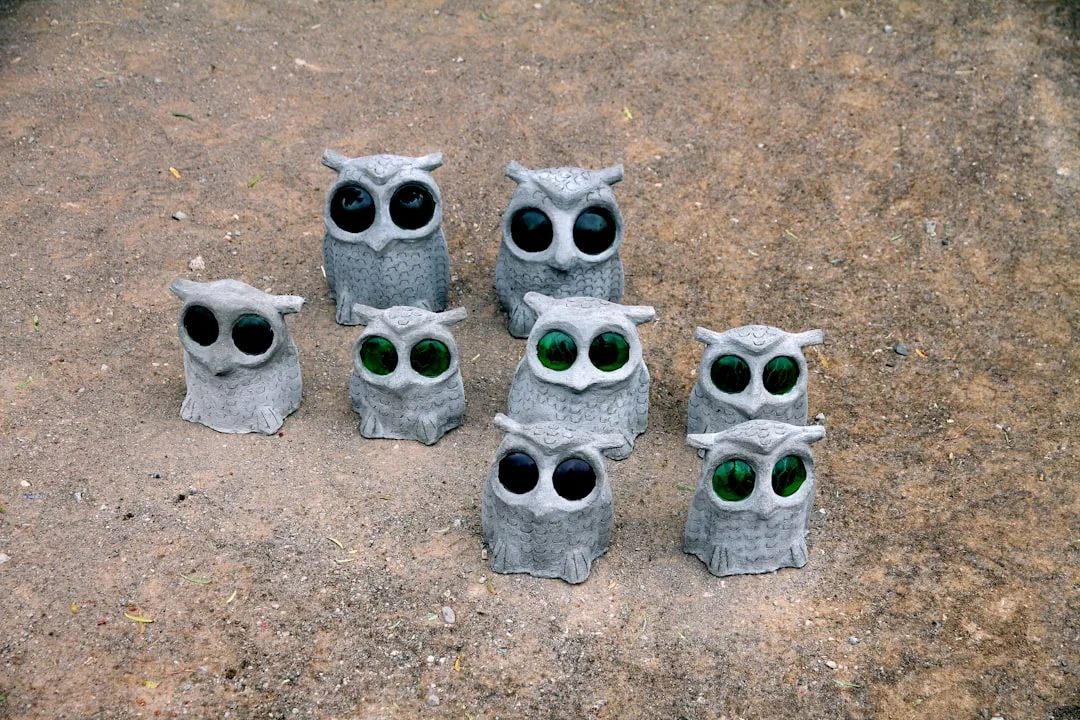
How far can an owl actually turn its head?
Owls can rotate their heads approximately 270 degrees in each direction - not 360 degrees as is sometimes claimed. A 270-degree rotation allows an owl looking forward to turn its head nearly completely to the side, just short of facing directly backward. The impressive range of motion evolved because owl eyes cannot move much within their sockets.
The Biological Engineering Behind Nature's Silent Predator
An owl sits motionless on a branch. Without moving its body a millimeter, it turns its head to look backward over one shoulder. Then it turns the other way, looking backward over the other shoulder. The total arc of motion covers approximately 270 degrees. Any human who attempted this would suffer a fatal stroke.
The owl does this casually, routinely, multiple times per minute during active hunting. The biological engineering that makes this possible is among the most sophisticated anatomical solutions in the bird world. It involves duplicated vertebrae, specialized blood vessels, pressure-buffering cavities in the skull, and a neural architecture that synchronizes all of this in real time.
Understanding owl head rotation is a study in how evolution solves extreme engineering problems when the ecological pressure is strong enough.
The 270 Degrees
First, the myth correction: owls cannot turn their heads 360 degrees. The common claim that they can rotate their heads all the way around is false.
Actual owl head rotation:
- Maximum rotation in each direction: approximately 270 degrees
- Total range: nearly 540 degrees (270 in each direction)
- Transition: owls rotate smoothly to one extreme, pause, then snap back to rotate to the other extreme
The 270-degree range means an owl looking forward can turn its head nearly completely to the side and slightly past. The bird can look directly behind itself, with either side of the head facing forward.
What "360 degrees" really means in popular culture:
The confusion comes from observing an owl rotate its head 270 degrees in one direction, then snap back to rotate 270 degrees in the other direction. If you miss the snap-back motion, it looks like the head rotated all the way around. It is actually two separate rotations in opposite directions.
The Vertebrae
The primary anatomical reason for owl head rotation is the number of vertebrae in the neck.
Comparative vertebrae counts:
| Species | Neck Vertebrae |
|---|---|
| Human | 7 |
| Most mammals | 7 |
| Chicken | 13-14 |
| Owl | 14 |
| Swan | 24-25 |
| Most birds | 10-15 |
Mammals (including humans) have 7 cervical (neck) vertebrae - essentially locked at this number by evolutionary constraints dating back approximately 300+ million years. Even giraffes with their enormous necks have just 7 cervical vertebrae; they just have much longer individual vertebrae.
Birds are not constrained this way. Different bird species have different numbers of neck vertebrae depending on ecological needs. Owls evolved 14 - twice the mammalian number - specifically to enable their extreme head rotation.
Why more vertebrae helps:
Each joint between vertebrae can rotate a small amount. With 7 vertebrae, total rotation is limited to the sum of rotations at 6 joints. With 14 vertebrae, total rotation is the sum of 13 joints.
Additionally, owl vertebrae have different shapes and articulation surfaces than human vertebrae. Each joint permits more rotation individually.
Combined, the increased vertebrae count and improved joint design provide the anatomical capability for extreme rotation.
The Blood Flow Problem
Extreme head rotation creates a blood flow problem. The vertebral arteries that supply blood to the brain pass through small openings in the neck vertebrae. When the neck twists significantly, these arteries can become pinched, potentially cutting off blood supply to the brain.
In humans, head rotation beyond approximately 45-60 degrees can partially compress vertebral arteries. Extreme rotation (beyond 90 degrees) would cause severe compression and potential stroke. This is why we can only turn our heads slightly without moving our whole body.
Owls routinely rotate their heads far beyond what would be survivable for humans. They have evolved multiple anatomical features to prevent blood flow disruption.
Feature 1: Oversized vertebral channels.
In owls, the vertebral artery passes through a much larger channel in each vertebra than it actually needs. This extra space acts as a buffer - the artery has room to move and flex without being compressed by rotation.
Where a human vertebral channel fits the artery snugly (maximizing stability but vulnerable to compression), owl channels are 10+ times larger than the artery diameter, allowing significant movement without constriction.
Feature 2: Extensive arterial networks.
Owl neck anatomy includes multiple redundant pathways for blood to reach the brain. If one vertebral artery becomes compressed during rotation, alternative routes carry blood through other arterial branches.
The human vertebral arterial system has some redundancy but owls have much more. Their brain can tolerate temporary reduction in blood flow from one source because other sources continue supplying oxygen.
Feature 3: Blood-pooling cavities.
At the base of owl skulls, specialized cavities store pooled blood. During normal operation, blood flows through these cavities continuously. During extreme head rotations, blood can be drawn from these reservoirs to maintain brain supply even if inflow is temporarily reduced.
This is like having an emergency reservoir that can supply the brain for the seconds-to-minutes during which head rotation disrupts normal flow.
Feature 4: Flexible artery attachments.
The vertebral arteries connect to the blood vessel network around the skull in ways that permit rotation without tension. Where human arterial connections are fixed and stiffen with rotation, owl connections flex and adjust.
This minimizes mechanical stress on the arteries during rotation.
Why Owls Need This
The extreme head rotation evolved for very specific reasons: owl eye anatomy makes it necessary.
Owl eyes are fixed in place:
Unlike most animals with eyes that can rotate within their sockets, owl eyes are essentially fixed forward. The eyes are actually tube-shaped (not spherical like most vertebrate eyes), and the tube shape is anchored in the skull in ways that prevent rotation.
If you watch an owl carefully, you will see its head turning constantly while its eyes remain locked in the head. An owl cannot glance sideways without moving its entire head.
Why tube-shaped eyes:
Owl eyes are shaped this way because it provides maximum magnification and light-gathering capability in a limited skull size. The tube structure works like a built-in telephoto lens:
- Longer focal length provides magnification
- Larger effective aperture captures more light for low-light vision
- Rigid tube structure maintains optical quality better than flexible sphere
These are enormous advantages for a nocturnal hunter. Owls can see details at great distances and in extremely dim light - much better than any spherical-eyed predator could achieve with a similar-sized skull.
The rotation requirement:
If eyes cannot rotate, but the animal needs to look in different directions to hunt, the entire head must rotate. Small rotations are inadequate for hunting that involves tracking moving prey in three dimensions while remaining stationary.
Hence the 270-degree capability. An owl hunting from a perch can scan its entire surroundings without moving its body at all. The body remains still (preventing detection by prey) while the head rotates to survey the full environment.
This combination of fixed telescope-like eyes plus extremely mobile head gives owls their characteristic appearance and their exceptional hunting capability.
The Silent Flight
Beyond head rotation, owls are famous for their nearly silent flight. This is another specialized adaptation for hunting.
The sound measurements:
Owl flight noise has been measured at under 2 decibels for most species - below the threshold of human hearing at close range. By comparison:
- Most other birds flying: 20-40 dB
- Small songbirds: 10-15 dB
- Normal conversation: 60 dB
- Vacuum cleaner: 70-80 dB
Owls essentially fly without making any audible sound. This is remarkable because flight inherently creates air turbulence and noise. Most animals cannot fly without generating measurable sound.
How silent flight works:
Three feather adaptations combine to eliminate flight noise:
1. Serrated leading edges.
The front edge of owl primary feathers has comb-like serrations called "fimbriae." These small projections break up the airflow hitting the wing, preventing the formation of large turbulent vortices that would generate noise.
Instead of air smoothly compressing against the leading edge (producing the whistling sound of typical bird flight), air is broken into many smaller, quieter vortices by the serrations.
2. Fringed trailing edges.
The back edge of owl feathers has fine fibrous fringes. These dampen the sound of air leaving the feather, reducing the trailing-edge noise that most bird wings produce.
3. Soft upper surface.
Owl feathers have a velvety surface covered with tiny down-like structures. This soft surface absorbs sound energy that would otherwise radiate outward from the wing during flight.
Combined, these three features reduce flight noise by more than 98 percent compared to equivalent-sized birds with conventional feather structures.
The hunting advantage:
Silent flight allows owls to approach prey without acoustic warning. Small mammals - mice, voles, shrews - have excellent hearing but cannot detect approaching owls until the attack is already occurring.
A rustling leaf generates more noise than an owl's flight. By the time prey animals hear anything, the owl's talons are closing on them.
Other Owl Anatomical Features
Beyond head rotation and silent flight, owls have several other specialized features.
Asymmetrical ear placement:
Most owls have ear openings at different heights on their skulls - one ear higher than the other. This asymmetry provides superior sound localization capabilities.
When sound arrives at the two ears, it reaches them at slightly different times (because one ear is closer to the source) and with slightly different intensities. Owls use these differences to calculate the precise 3D location of sounds.
The most specialized species (barn owls particularly) can locate prey through pure hearing alone, even in complete darkness. They can catch a mouse moving through grass using only sound cues.
Facial disk:
Owls have a distinctive facial disk - a concave arrangement of stiff feathers around the eyes. This acts like a satellite dish, collecting sound waves and directing them toward the ears.
The facial disk can be consciously adjusted to focus on sounds from specific directions. An alert owl may be actively "tuning" its facial disk to amplify specific sounds from specific directions.
Sharp talons:
Owl talons are among the sharpest and most powerful for a bird of their size. Great horned owls can generate grip forces of 500 PSI or more, sufficient to kill prey instantly through crushing.
The talons are specifically shaped for the kill-and-carry hunting style owls use: sharp points for penetration, curved geometry for maintaining grip during flight, strong enough to support the prey's weight while carrying.
Species Diversity
Approximately 250 owl species exist worldwide, distributed across every continent except Antarctica. They range enormously in size:
Largest owls:
- Great grey owl (Strix nebulosa): appears largest due to plumage but relatively light at 1-1.7 kg
- Eurasian eagle-owl (Bubo bubo): up to 4 kg, 1.8 m wingspan
- Blakiston's fish owl (Bubo blakistoni): up to 4.6 kg, 2 m wingspan - actually the heaviest owl
Smallest owls:
- Elf owl (Micrathene whitneyi): 40 g, 12.5 cm tall - fits in a hand
- Pygmy owls (various species): 50-90 g
- Boreal owl: moderate small size
Specialized species:
- Snowy owl: lives in Arctic environments, white coloration
- Burrowing owl: lives in underground burrows rather than trees
- Fish owls: specialize in hunting fish from rivers
- Eagle owls: large predators capable of hunting small mammals up to fox-size
Each species has slightly different adaptations, prey preferences, and habitats. The common owl anatomy (large eyes, head rotation, silent flight) is shared, but implementations vary.
Hunting Strategy
Most owls use a "sit and wait" hunting strategy that leverages their specialized anatomy.
The perch-and-pounce:
- Perch selection. Owl chooses a vantage point overlooking open ground where prey may appear.
- Survey. Owl rotates head to scan the entire surroundings using its 270-degree capability.
- Detection. Prey is spotted through visual or auditory cues. Owl locks onto the target.
- Attack. Owl launches into silent flight, gliding directly at the prey.
- Strike. Owl extends talons at the last moment, grabbing the prey.
- Kill. Grip strength crushes the prey's body, usually killing it instantly.
- Return to perch. Owl carries prey back to a safe location for consumption.
Prey preferences:
- Small mammals (mice, voles, rats): most owl species
- Birds: many species take songbirds as opportunistic prey
- Fish: specialized fish owls
- Insects: smaller owl species
- Larger prey: eagle owls can take rabbits, foxes, cats
Owls are cultural symbols partially because their hunting is spectacularly effective. A barn owl hunting with sound-based detection in total darkness appears almost supernatural - the bird can catch prey under conditions where visual hunters would be completely blind.
Cultural Associations
Owls have powerful cultural significance across human civilizations, often associated with wisdom, mystery, or death.
Wisdom symbol:
In Western cultures, owls are associated with wisdom, tracing back to ancient Greek mythology. The goddess Athena (goddess of wisdom) was often depicted with an owl. The phrase "wise old owl" and owl imagery on graduation caps reflect this association.
Death association:
In many other cultures, owls are associated with death or bad omens. Many Native American cultures, various Asian traditions, and some European folklore link owls with mortality. Hearing an owl calling at night was considered a sign of approaching death.
The association with death likely comes from owls' nocturnal habits and haunting calls - combined with their actual role as predators of smaller animals.
Silent hunter:
In various cultures, owls represent stealth, silence, and watchful patience. The phrase "watchful as an owl" reflects this theme. The silent flight capability genuinely is remarkable, making owls seem almost magical in their ability to appear suddenly.
Harry Potter and popular culture:
In recent decades, the Harry Potter series introduced a generation to owls as magical companions. This fictional association has dramatically increased public interest in owls and probably contributed to rising pet owl ownership in some regions.
Unfortunately, this fictional portrayal has caused welfare problems. Owls make poor pets for the vast majority of keepers due to their specialized needs, feeding requirements, and nighttime activity. Many owls acquired as pets are subsequently abandoned or require sanctuary rescue.
Conservation Issues
Owl populations face various threats, with conservation status varying by species.
Common threats:
Habitat loss. Forest cutting, grassland conversion, and urban development reduce available habitat for most species.
Rodenticide poisoning. Rat poisons used for pest control accumulate in the food chain. Owls eating poisoned rodents receive cumulative doses that can be fatal. This is a major problem in agricultural and urban areas.
Vehicle collisions. Owls hunting near roads are frequently struck by cars. Low-flying owls are particularly vulnerable because they are often at windshield height.
Secondary poisoning. Beyond rodenticides, other agricultural chemicals affect owl populations indirectly by reducing prey availability or contaminating food sources.
Climate change. Changing temperatures and precipitation patterns affect prey availability and breeding success.
Status examples:
- Spotted owl: Endangered in Pacific Northwest, center of controversial forest protection efforts
- Barn owl: Declining in parts of Europe
- Blakiston's fish owl: Endangered, fewer than 1,000 individuals remaining
- Snowy owl: Vulnerable, declining from climate change
- Most common species: Stable or declining slightly
- Eagle owls: Recovering in some regions after historical persecution
Specific conservation programs exist for many species. Barn owl nest box programs have been particularly successful in parts of Europe. Forest protection efforts in the Pacific Northwest aim to preserve spotted owl habitat.
The Engineering Marvel
The owl represents one of evolution's most coordinated anatomical design packages. Every feature integrates with others:
Tube-shaped eyes provide exceptional vision but prevent eye movement within sockets.
Head rotation of 270 degrees compensates for fixed eyes, allowing complete surroundings awareness.
Fourteen cervical vertebrae enable the extreme head rotation.
Specialized blood vessel architecture prevents stroke during rotation.
Silent flight feathers allow approaches without prey detection.
Asymmetrical ear placement enables sound localization for hunting in darkness.
Sharp talons and strong grip enable effective kill-and-carry capture.
Remove any of these features and the others work less well. The owl is an integrated system where each capability depends on and enhances the others.
This is why owls have been evolutionarily successful for over 60 million years across virtually every terrestrial environment. The basic design works, and species variations have adapted the common platform for specific ecological niches.
When you see an owl turn its head to watch you, you are seeing a product of extraordinary biological engineering. The movement that seems casual and possibly unsettling is the result of integrated adaptations spanning skeletal structure, blood vessel design, and nervous system control.
Owls are not just good predators. They are examples of how evolution, given enough time and selection pressure, produces anatomical solutions that would seem impossible to engineer from scratch but work reliably in the natural world for millions of generations.
Related Articles
- Owls: Silent Hunters of the Night
- Eagle Vision: 8 Times Better Than Humans
- Raptors: The Apex Predators of the Sky
Frequently Asked Questions
How far can an owl actually turn its head?
Owls can rotate their heads approximately 270 degrees in each direction - not 360 degrees as is sometimes claimed. A 270-degree rotation allows an owl looking forward to turn its head nearly completely to the side, just short of facing directly backward. The impressive range of motion evolved because owl eyes cannot move much within their sockets.
Unlike human eyes which can look in different directions within fixed heads, owl eyes are essentially fixed forward. To look around, owls must turn their heads. The 270-degree capability gives them essentially complete visual coverage of their surroundings without moving their bodies, which is critical for their ambush hunting strategy.
After rotating to one extreme, owls can quickly snap their heads back to the other extreme - a movement that appears as a single complete rotation but actually involves rotation in both directions.
How do owls avoid cutting off their blood supply when rotating?
Owls have several specialized anatomical features that prevent blood supply disruption during extreme head rotations. First, the vertebral artery (which supplies blood to the brain) runs through a large cavity in each vertebra - much larger than the artery itself. This extra space allows the artery to move without being pinched during rotation.
Second, owls have extensive blood vessel networks connecting the two vertebral arteries, so blocking one side of blood flow still allows circulation from the other. Third, owls have blood-pooling cavities at the base of their skulls that store blood during rotations and release it when circulation is disrupted. Fourth, the small blood vessels enter and leave these cavities in ways that minimize disruption from rotation.
Combined, these adaptations ensure brain blood supply remains stable even when the head is twisted in ways that would cause stroke in humans.
Why can't humans turn our heads like owls?
Humans have 7 cervical (neck) vertebrae; owls have 14. This is the primary anatomical reason for the difference. Owls’ double vertebrae count allows them to achieve much greater head rotation than humans can. Each owl vertebra contributes a small amount of rotation, and 14 vertebrae cumulatively rotate much further than 7 vertebrae.
Additionally, owl vertebrae have different shapes and joint structures than human vertebrae, permitting greater range of motion at each joint. The evolutionary reason owls have so many neck vertebrae is that birds in general tend to have more cervical vertebrae than mammals, and owls have evolved even further than other birds in this direction.
Humans evolved with 7 cervical vertebrae approximately 300+ million years ago and this number has been evolutionarily stable for the entire mammalian lineage. Changing vertebrae count is extraordinarily difficult evolutionarily.
Why do owls have such big eyes?
Owl eyes are enormous relative to their skull size - approximately 5 percent of body weight in small owls, compared to 0.02 percent in humans. Their large size provides superior light-gathering capability for low-light hunting. Owls hunt primarily at night, when light levels are thousands of times lower than during daylight. Larger eyes collect more photons and provide better night vision.
Additionally, owl retinas contain very high densities of rod cells (specialized for low-light) and fewer cone cells (specialized for color vision). This means owls see very well in darkness but have relatively limited color vision. Owl eye size is so extreme that their eyes are not round balls like human eyes - they are tube-shaped, with flat corneas and long focal depths. The tube shape provides magnification similar to a telephoto lens.
Because of this shape, owl eyes cannot rotate within their sockets, which is why owls need such extreme head rotation.
Are owls actually silent flyers?
Yes, owls are among the quietest flying animals on Earth. Their flight feathers have specialized structures that virtually eliminate sound during flight. Three key adaptations: first, the leading edge of owl primary feathers has comb-like serrations that break up turbulent airflow into smaller, quieter vortices. Second, the trailing edges have tiny fibrous fringes that dampen noise.
Third, the feather surfaces are covered with soft down-like structures that absorb sound energy. Studies have measured owl flight noise at under 2 decibels - below the threshold of human hearing for mammals of similar size. This silent flight is critical for their hunting strategy. Prey animals (particularly small mammals with excellent hearing) cannot detect approaching owls until the attack is already happening.
The same feather adaptations that provide silent flight also reduce the owl’s ability to hear its own flight sounds, which would otherwise interfere with detecting prey movements.