
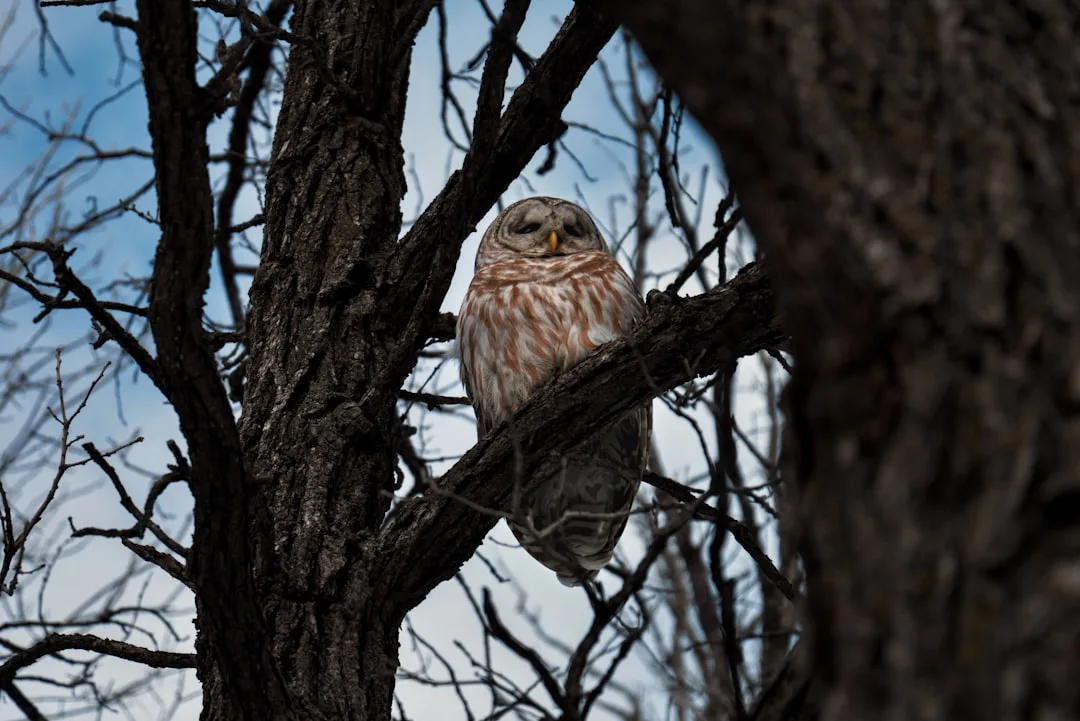
How do owls fly silently?
Owls achieve silent flight through three structural adaptations in their feathers. First, comb-like serrations along the leading edge of the primary flight feathers break incoming air into smaller micro-turbulences. Second, a velvet-like surface of tiny barb extensions across the upper wing absorbs friction noise.
There is no bird quite like an owl. In the gathering dark, when the rest of the avian world has fallen silent and roosted for the night, owls come alive. They launch from perches on wings that produce virtually no sound, navigate through pitch-black forests with pinpoint auditory precision, and strike with talons capable of exerting crushing force per square inch that rivals some raptors twice their size.
Owls are evolution's answer to the question of how to be a perfect nocturnal predator - and the engineering solutions encoded in their anatomy are so refined that aerospace researchers study them to design quieter aircraft.
With more than 250 recognized species distributed across every continent except Antarctica, owls represent one of the most successful radiations of predatory birds on Earth. They range from the elf owl, scarcely larger than a sparrow at 40 grams, to the Blakiston's fish owl, a hulking 4.5-kilogram hunter that plucks salmon from frozen Siberian rivers.
They inhabit deserts, tundra, tropical rainforests, grasslands, and the downtown cores of major cities. Their adaptations span an extraordinary spectrum - from the barn owl's satellite-dish face to the burrowing owl's subterranean lifestyle to the snowy owl's feathered feet that function like snowshoes.
Yet for all their ubiquity, owls remain among the most misunderstood and least studied birds. Their nocturnal habits make field research extraordinarily difficult, and many tropical species are known from only a handful of museum specimens. What we do know reveals animals of remarkable sophistication - and growing vulnerability.
Order Strigiformes: Taxonomy and Diversity
Owls belong to the order Strigiformes, which is divided into two families. The family Tytonidae contains the barn owls and bay owls - approximately 20 species characterized by heart-shaped facial discs and relatively long legs. The family Strigidae, the "typical owls," encompasses the remaining 230-plus species, including everything from eagle-owls to screech-owls to pygmy-owls.
The oldest known owl fossils date to approximately 60 million years ago, placing their origin in the Paleocene epoch, not long after the mass extinction that wiped out the non-avian dinosaurs. This makes owls one of the most ancient lineages of modern birds. Early owl fossils from the Eocene of North America and Europe suggest that the group diversified rapidly to fill the nocturnal predator niche left vacant by the extinction of small theropod dinosaurs [1].
Modern molecular phylogenetics has clarified some long-standing taxonomic puzzles. The owls' closest living relatives are not hawks or eagles, as their predatory lifestyle might suggest, but rather the nightjars (order Caprimulgiformes) and, more distantly, the mousebirds (order Coliiformes). This means that the similarities between owls and diurnal raptors - hooked beaks, taloned feet, forward-facing eyes - are the product of convergent evolution rather than shared ancestry.
Key statistics on owl diversity:
- Total recognized species: approximately 250 (with new species still being described from tropical regions)
- Largest species: Blakiston's fish owl (Bubo blakistoni), wingspan up to 190 cm, weight up to 4.5 kg
- Smallest species: elf owl (Micrathene whitneyi), wingspan 27 cm, weight 40 g
- Most widespread species: barn owl (Tyto alba), found on every continent except Antarctica
- Most recently described species: Principe scops-owl (Otus bikegila), formally described in 2022
The Science of Silent Flight
The defining adaptation of owls - the trait that makes everything else possible - is their capacity for virtually silent flight. A pigeon in flight generates noise measurable at roughly 38 decibels at one meter distance. An owl of comparable size, flying at the same speed, produces noise below the threshold of most standard recording equipment. This silence is not a single trick but a system of three interlocking feather modifications, each addressing a different source of aerodynamic noise.
Adaptation 1: The Comb-Like Leading Edge
The primary flight feathers of owls possess a unique structure along their leading edge: a row of stiff, evenly spaced, hook-like projections called serrations or "comb teeth." These structures, typically 1 to 3 millimeters in length, break incoming airflow into smaller micro-turbulences before it passes over the wing surface.
In conventional aerodynamics, the leading edge of a wing generates significant noise as the boundary layer of air transitions from laminar (smooth) to turbulent flow. The owl's serrations manage this transition gradually, preventing the abrupt turbulence that produces audible sound.
Research at Cambridge University demonstrated that when these serrations were experimentally removed from owl feathers and tested in a wind tunnel, the noise generated by the feather increased by approximately 8 decibels - a difference that would be clearly audible to prey animals [2].
Adaptation 2: The Velvet Upper Surface
The dorsal (upper) surface of owl flight feathers is covered in a layer of extremely fine, hair-like extensions of the feather barbs, creating a texture often described as "velvety." This micro-texture serves an acoustic function analogous to the sound-absorbing foam used in recording studios. As air flows across the wing surface, the velvet layer absorbs the friction noise that would otherwise be generated by the interaction between the air boundary layer and the feather surface.
Electron microscopy studies have revealed that these structures are remarkably uniform in size and spacing - approximately 200 micrometers in length - suggesting strong selective pressure for acoustic performance. No other group of birds possesses this adaptation.
Adaptation 3: The Trailing Edge Fringe
The trailing (rear) edge of owl flight feathers terminates in a soft, flexible fringe of unconnected barb tips, rather than the rigid, interlocking edge found in most birds. This fringe acts as a diffuser, breaking up the trailing-edge vortices that form as air exits the wing. In standard aerodynamics, trailing-edge noise is one of the dominant sources of airfoil noise, particularly at low flight speeds - exactly the speeds at which owls typically hunt.
"The owl is the only flying machine - natural or engineered - that has independently solved all three major sources of aerodynamic noise: leading-edge turbulence, boundary-layer friction, and trailing-edge vortex shedding." - Christopher Clark, Department of Biology, University of California, Riverside
Together, these three adaptations suppress owl flight noise to frequencies below 2 kilohertz. This is significant because the hearing of most small mammals - the primary prey of most owls - is optimally sensitive in the 2 to 8 kHz range. The owl's flight noise falls below its prey's hearing window, rendering the predator effectively inaudible during the final approach.
| Noise-Reduction Adaptation | Location on Feather | Aerodynamic Problem Solved | Noise Reduction |
|---|---|---|---|
| Comb-like serrations | Leading edge of primary feathers | Laminar-to-turbulent boundary layer transition | ~8 dB reduction |
| Velvet micro-texture | Upper (dorsal) surface of flight feathers | Boundary-layer friction noise | ~5 dB reduction |
| Trailing edge fringe | Rear edge of flight feathers | Trailing-edge vortex shedding | ~6 dB reduction |
| Combined system | Entire wing | All three noise sources | Total flight noise below 2 kHz |
Asymmetrical Ears and Auditory Precision
While silent flight delivers owls to their prey undetected, it is their hearing that locates prey in the first place. Owls possess the most sophisticated auditory system of any bird, and in many nocturnal species, hearing is the primary sense used for hunting - surpassing even their famously acute vision.
The key innovation is asymmetrical ear placement. In species such as the barn owl, great grey owl, and boreal owl, the left and right ear openings are positioned at different heights on the skull. The left ear is typically higher and angled slightly downward, while the right ear is lower and angled slightly upward.
This offset means that a sound arriving from below the owl's line of sight reaches the right ear fractionally before the left, while a sound from above reaches the left ear first. By processing the microsecond time differences and intensity variations between the two ears, the owl's brain constructs a three-dimensional sound map of its environment.
The barn owl (Tyto alba) represents the pinnacle of this system. Its heart-shaped facial disc acts as a parabolic reflector, channeling sound toward the ear openings with remarkable efficiency.
Laboratory experiments at the California Institute of Technology demonstrated that barn owls can locate a sound source in total darkness to within 1 to 2 degrees of arc in both the horizontal and vertical planes - an accuracy comparable to a human pointing at a visible target [3]. In practical terms, this means a barn owl can strike a mouse moving beneath a layer of snow or leaf litter without ever seeing it.
The neural architecture supporting this ability is equally impressive. The barn owl's auditory processing centers in the midbrain (the inferior colliculus and its surrounding nuclei) contain specialized space-mapped neurons that fire only when sound originates from a specific point in three-dimensional space. This creates a tonotopic map of auditory space that is continuously updated as the owl moves its head - a biological sonar system that predates human radar technology by millions of years.
The 270-Degree Head: Cervical Engineering
Owls cannot move their eyes. Their eyes are not spherical but tubular - elongated structures locked into bony eye sockets called sclerotic rings. This tubular shape maximizes light-gathering ability (critical for nocturnal vision) but eliminates the eye mobility that most other vertebrates rely on to scan their surroundings. Owls compensate with the most extreme neck rotation of any terrestrial vertebrate.
An owl can rotate its head approximately 270 degrees in either direction from the forward-facing position - meaning it can look almost directly behind itself by turning in either direction. This range of motion, roughly three-quarters of a full circle, is made possible by three anatomical adaptations:
14 cervical vertebrae. Humans and nearly all other mammals have 7 cervical vertebrae. Owls possess twice that number, and each vertebra articulates with the next through a joint that permits a greater individual range of motion than mammalian cervical joints. The cumulative effect is a neck of extraordinary flexibility.
Vertebral arterial slack. In most vertebrates, the vertebral arteries (which supply blood to the brain) pass through channels in the cervical vertebrae that fit tightly around the vessels. In owls, these channels are approximately 10 times wider than the arteries they contain, leaving ample room for the vessels to shift and stretch during extreme rotation without being pinched or occluded.
Carotid contractile reservoirs. Research published in Science by medical illustrator Fabian de Kok-Mercado and colleagues at Johns Hopkins University revealed that owls possess balloon-like reservoirs at the base of their carotid arteries, just below the skull.
When the owl rotates its head far enough to compress one carotid artery, these reservoirs - which have been pre-filled with pooled blood - release their contents to maintain uninterrupted blood flow to the brain [4]. This adaptation prevents the strokes and loss of consciousness that would occur in any mammal attempting the same degree of rotation.
Notable Species: Profiles of Remarkable Owls
Great Horned Owl (Bubo virginianus) - The Apex Nocturnal Predator
The great horned owl is the most powerful owl in the Americas and one of the most formidable nocturnal predators on Earth. Weighing between 1.0 and 2.5 kilograms with a wingspan reaching 1.5 meters, it occupies the top of the nocturnal food chain across virtually all of North and South America, from Arctic treeline to Patagonian steppe.
What distinguishes the great horned owl is the extraordinary breadth of its diet. It routinely takes prey that other predators avoid entirely. It is one of the only consistent predators of skunks - apparently unbothered by the spray that deters nearly every other carnivore. It attacks and kills porcupines, somehow managing to flip the animal and strike at the unprotected belly.
It has been documented taking domestic cats, young foxes, opossums, and even other raptors, including red-tailed hawks and smaller owl species. Its grip strength has been measured at approximately 300 pounds per square inch (roughly 13.6 kg/cm2), comparable to the bite force of a large dog.
Great horned owls are among the earliest nesting birds in North America, often laying eggs in January or February when snow still blankets the ground. They do not build their own nests, instead appropriating the stick nests of red-tailed hawks, crows, or herons. The female incubates in subfreezing temperatures, her densely feathered body insulating the eggs while her mate delivers food.
Snowy Owl (Bubo scandiacus) - Arctic Specialist and Cultural Icon
The snowy owl is the heaviest owl in North America, with females reaching 2.9 kilograms - heavier even than great horned owls. It is one of the few owls that hunts primarily during the day, an adaptation to the continuous daylight of the Arctic summer. Its primary prey is lemmings, and a single snowy owl may consume 1,600 lemmings per year.
In years of lemming abundance, snowy owls breed prolifically, producing clutches of up to 11 eggs; in lean years, they may not breed at all, instead undertaking long-distance irruptions southward into the northern United States and southern Canada.
The snowy owl became a global cultural phenomenon through its portrayal as Hedwig, Harry Potter's companion in J.K. Rowling's book series and the subsequent film franchise (2001-2011). Hedwig was depicted as a loyal, intelligent messenger owl, and the character's popularity triggered a measurable surge in demand for pet owls worldwide.
In India, where the Harry Potter films were enormously popular, conservation organizations documented a significant increase in the illegal capture and sale of owls following each film release. A 2010 report by the wildlife trade monitoring network TRAFFIC estimated that the Indian owl trade involved thousands of birds annually, with many buyers explicitly citing Harry Potter as their inspiration [5].
The phenomenon prompted J.K.
Rowling herself to issue a public statement in 2012 discouraging the purchase of pet owls, noting that "if anybody has been influenced by my books to think an owl would be happiest shut in a small cage and kept in a house, I would like to take this opportunity to say as forcefully as I can: you are wrong." Wildlife organizations including the World Owl Trust and the International Owl Center have since used the franchise as an educational platform, redirecting Potter-inspired interest toward conservation rather than ownership.
Barn Owl (Tyto alba) - The World's Most Widespread Land Bird
The barn owl holds a distinction that no other land bird can claim: it is found on every continent except Antarctica, and on most major oceanic island groups. Its range encompasses the Americas, Europe, Africa, the Middle East, South and Southeast Asia, and Australasia.
This extraordinary distribution is partly a function of its association with human agriculture - barn owls thrive in the mosaic of fields, hedgerows, and old buildings that farming creates - and partly a testament to its adaptability as a predator.
The barn owl's most recognizable feature is its heart-shaped facial disc, a concave arrangement of stiff, densely packed feathers that functions as a parabolic sound collector. The disc is not merely decorative; each side can be adjusted independently by muscles beneath the skin, allowing the owl to fine-tune the direction and focus of incoming sound waves. Combined with its asymmetrical ears, this gives the barn owl auditory acuity unmatched in the animal kingdom.
A single barn owl family consumes an estimated 3,000 rodents per year, making the species an invaluable ally to farmers. In Israel, a government-backed program has installed thousands of barn owl nest boxes in agricultural areas as a biological pest control measure, reducing rodenticide use and its associated ecological damage.
The program, which began in 2008, has been so successful that it has been replicated in Jordan, creating a rare example of cross-border conservation cooperation in the Middle East.
Burrowing Owl (Athene cunicularia) - The Underground Owl
The burrowing owl defies nearly every expectation people hold about owls. It is active during the day. It lives underground. It stands on long, stilt-like legs at the entrance to its burrow, looking for all the world like a small, indignant sentinel guarding a prairie dog town. It is one of the most charismatic and behaviorally unusual raptors in the Western Hemisphere.
Burrowing owls nest in underground tunnels, typically appropriating burrows dug by prairie dogs, ground squirrels, or tortoises, though they will excavate their own when necessary. They line the entrance and interior of the burrow with animal dung - usually cattle or horse manure - a behavior that long puzzled researchers.
The answer, it turns out, is elegant: the dung attracts dung beetles and other coprophagous insects, which the owls then eat. The dung serves as bait, luring a reliable food source directly to the owl's doorstep. Studies have shown that burrowing owls with dung-baited nest entrances consume ten times more beetles than those without [6].
Burrowing owls face significant conservation challenges. Their dependence on prairie dog and ground squirrel colonies links their fate to those species, which have been decimated by poisoning campaigns, habitat conversion, and sylvatic plague. In Canada, the burrowing owl is listed as endangered, and populations have declined by more than 90 percent since the 1990s.
Elf Owl (Micrathene whitneyi) - The World's Smallest Owl
At just 40 grams and roughly 13 centimeters in length, the elf owl is the smallest owl on Earth - lighter than many songbirds and scarcely larger than a house sparrow. It inhabits the deserts and dry woodlands of the southwestern United States and Mexico, where it nests almost exclusively in cavities excavated by woodpeckers in saguaro cacti and other large columnar cacti.
Despite its diminutive size, the elf owl is an effective insectivore, feeding on moths, beetles, crickets, scorpions, and small spiders. It has been observed catching scorpions and carefully removing the stinger before consuming them - a behavior that suggests a degree of learned or instinctive caution. Elf owls are migratory, spending winters in southern Mexico, and they are one of the only owl species in North America that undertake true seasonal migration.
The elf owl's reliance on saguaro cacti links its fate to the health of the Sonoran Desert ecosystem. Saguaros take 50 to 75 years to grow their first arm and up to 200 years to reach full size, making them exceptionally vulnerable to habitat destruction. Climate change, urban expansion, and the increasing frequency of wildfires in the Sonoran Desert all threaten the saguaro stands on which elf owls depend.
Owl Pellets: Windows Into Ecosystems
Owls swallow their prey whole or in large chunks, and their digestive systems separate the nutritious soft tissues from the indigestible hard parts - bones, teeth, fur, feathers, chitin, and claws. These indigestible remnants are compacted in the gizzard into dense, oblong masses called pellets, which the owl regurgitates roughly 6 to 10 hours after feeding.
Owl pellets are not feces. They exit through the mouth, not the cloaca, and they contain no digested material. Because owls generate minimal stomach acid compared to diurnal raptors (which dissolve bones almost entirely), owl pellets preserve skeletal remains in remarkably intact condition. A single barn owl pellet may contain the complete skulls and skeletal elements of two or three voles, identifiable to species by dental morphology.
"Owl pellets are perhaps the single most informative natural artifact available to field ecologists studying small mammal communities. No trapping program, no matter how intensive, can match the dietary sampling that a resident owl performs every night of the year." - David Marti, The Ecology of Owl Pellets (1987)
This preservation quality has made owl pellet analysis one of the most powerful tools in vertebrate ecology. By collecting pellets beneath known owl roost sites and identifying the prey remains within them, researchers can reconstruct detailed pictures of local small mammal communities - including species composition, relative abundance, and seasonal variation - without ever trapping a single animal.
Barn owl pellet studies have been used to document the presence of rare shrews, confirm the range expansions of invasive rodents, and even discover species previously unknown to science in remote regions.
In education, owl pellet dissection has become one of the most widely used hands-on biology exercises in schools worldwide. Commercial suppliers sterilize and package barn owl pellets for classroom use, and the exercise teaches students about food webs, skeletal anatomy, predator-prey relationships, and scientific classification - all from a single small object.
Owls in Culture and Mythology
No group of birds has accumulated a richer or more contradictory body of mythology than the owls. Across cultures and centuries, owls have been simultaneously revered as symbols of wisdom and feared as harbingers of death.
The roots of both associations are easy to understand: an owl's large, forward-facing eyes give it an expression that humans instinctively read as thoughtful or intelligent, while its eerie nocturnal calls, ghostly pale plumage (in species like the barn owl), and association with darkness have made it a natural symbol of the supernatural.
In ancient Greece, the little owl (Athene noctua) was the sacred companion of Athena, goddess of wisdom and strategic warfare. The owl appeared on Athenian silver tetradrachm coins from the 5th century BCE onward, and the phrase "bringing owls to Athens" became a proverb equivalent to "carrying coals to Newcastle" - meaning to do something unnecessarily, since Athens was already full of owls.
The association between owls and wisdom persists in Western culture to this day, visible in everything from university crests to children's literature.
In Roman culture, however, the owl's reputation took a darker turn. Pliny the Elder described the owl as "the very monster of the night" and wrote that the appearance of an owl was an omen of death and disaster. Roman historians recorded that owls were seen before the deaths of Julius Caesar, Augustus, and several other prominent figures - though these accounts were almost certainly written after the fact to retroactively assign supernatural significance to the events.
Across much of Asia and Africa, owls carry similar associations with death, witchcraft, and bad fortune. In India, owls are associated with Lakshmi, the goddess of wealth, but are also widely considered omens of death - a dual symbolism that has complicated conservation efforts. In many African traditions, owls are believed to be the familiars of witches or the embodiment of restless spirits, and their presence near a home is considered deeply inauspicious.
The Ainu people of Japan, by contrast, revere the Blakiston's fish owl as a divine guardian spirit (kotan kor kamuy - "god that protects the village"). Traditional Ainu belief holds that the fish owl watches over human communities from the forest and warns them of danger. This reverence has contributed to the cultural significance of fish owl conservation in Hokkaido, where the species survives in small but protected populations.
In Mesoamerican cultures, the owl held a complex and often fearsome position. The Aztecs associated the owl with Mictlantecuhtli, the god of the dead and the underworld. The Maya regarded the owl as a messenger of the lords of Xibalba, the underworld realm. The Spanish phrase lechuza (barn owl) retains supernatural connotations in parts of Mexico and Central America to this day, where the bird is sometimes regarded as a shape-shifting witch.
Conservation and Threats
Owls face a constellation of threats that mirror the broader crisis confronting global biodiversity. Habitat loss is the primary driver: deforestation eliminates nesting sites and hunting grounds, while the conversion of grasslands to intensive agriculture removes the rodent-rich edge habitats on which many species depend.
Rodenticides (particularly second-generation anticoagulants) pose a severe and insidious threat, as owls that consume poisoned rodents accumulate sublethal doses that impair reproduction, immune function, and survival. Studies in the United Kingdom found anticoagulant residues in 87 percent of barn owls tested post-mortem.
Vehicle collisions are a major cause of owl mortality in developed countries. Barn owls, which hunt along road verges where rodent densities are high, are especially vulnerable. In the United Kingdom alone, an estimated 5,000 barn owls are killed by vehicles annually - a significant proportion of the national population of roughly 10,000 breeding pairs.
Climate change is altering the distribution and abundance of prey species, with cascading effects on owl populations. Snowy owls depend on predictable lemming cycles, which are being disrupted by warming Arctic temperatures. Species adapted to old-growth forests - such as the northern spotted owl of western North America - face compounding threats from both logging and the northward expansion of the more aggressive barred owl into their range.
References
[1] Mayr, G. "Paleogene Fossil Birds." Springer-Verlag, 2009. Analysis of Paleocene and Eocene owl fossils and the early radiation of Strigiformes.
[2] Clark, C.J., LePiane, K., and Liu, L. "The Leading Edge Comb of Owl Wings Reduces Noise." Journal of the Royal Society Interface, vol. 17, no. 168, 2020.
[3] Knudsen, E.I. "The Hearing of the Barn Owl." Scientific American, vol. 245, no. 6, 1981, pp. 113-125.
[4] de Kok-Mercado, F., Habib, M., Phelps, T., Gregg, L., and Bhatt, D.H. "Adaptations of the Owl's Cervical and Cephalic Arteries in Relation to Extreme Neck Rotation." Science, vol. 339, no. 6119, 2013, pp. 514-515.
[5] Ahmed, A. "Imperilled Custodians of the Night: A Study of Illegal Trade, Social Beliefs and Their Impact on Owls in India." TRAFFIC India / WWF-India, 2010.
[6] Smith, M.D. and Conway, C.J. "Collection of Mammal Manure and Other Debris by Nesting Burrowing Owls." Journal of Raptor Research, vol. 41, no. 3, 2007, pp. 220-228.
Frequently Asked Questions
How do owls fly silently?
Owls achieve silent flight through three structural adaptations in their feathers. First, comb-like serrations along the leading edge of the primary flight feathers break incoming air into smaller micro-turbulences. Second, a velvet-like surface of tiny barb extensions across the upper wing absorbs friction noise. Third, a soft, flexible fringe along the trailing edge of the wing smooths airflow as it leaves the feather.
Together, these features suppress flight noise to frequencies below 2 kHz - below the hearing threshold of most prey animals.
Can owls really turn their heads 360 degrees?
No, owls cannot rotate their heads a full 360 degrees, but they can turn approximately 270 degrees in either direction. This extraordinary range is made possible by having 14 cervical vertebrae (humans have only 7), along with specialized blood vessel adaptations that prevent blood flow interruption during extreme rotation.
Their carotid arteries feature contractile reservoirs that pool blood, ensuring continuous blood supply to the brain even when neck vessels are compressed during rotation.
What are owl pellets and why are they important to science?
Owl pellets are compact masses of indigestible material - bones, fur, feathers, insect exoskeletons, and teeth - that owls regurgitate roughly 6 to 10 hours after eating. Because owls swallow prey whole or in large pieces, the skeletal remains inside pellets are remarkably well preserved. Scientists dissect pellets to identify prey species and reconstruct local food webs, making owls invaluable biomonitors of small mammal populations and ecosystem health.