
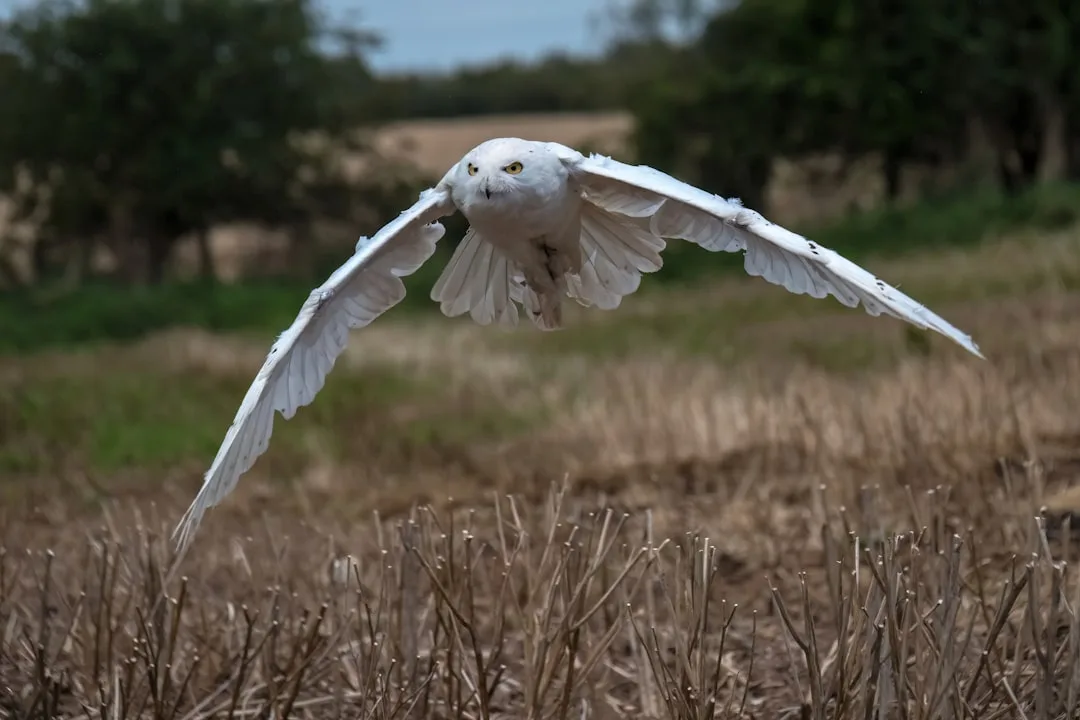
How do snowy owls survive Arctic cold?
Snowy owls (Bubo scandiacus) have the thickest feather insulation of any bird, allowing them to survive Arctic temperatures down to -50°C (-58°F). Their bodies are covered in dense feathers including feathered legs, feet, and toes - features found in few other birds. Their feather density reaches approximately 3 times that of similar-sized birds in temperate climates.
Hedwig's Real-World Counterpart
A snowy owl perches on a snow-covered boulder in Arctic tundra. Wind chill is -40°C. Snow crusts the ground in every direction. The owl barely moves, conserving energy. Its feathered feet grip the cold rock without discomfort. Its white plumage makes it nearly invisible against the snow.
A lemming briefly emerges from its snow tunnel 50 meters away. The owl sees it instantly. Wings unfold. The 2-kilogram bird launches into flight, glides silently over the snow, and grasps the lemming with feathered talons before it can react.
This is the snowy owl (Bubo scandiacus), one of Earth's most specialized cold-climate predators and the real-life bird that inspired Hedwig in Harry Potter.
The Cold Adaptation System
Snowy owls survive some of the harshest conditions on Earth.
Temperature tolerance:
- Can survive down to -50°C (-58°F)
- Active and hunting in -40°C weather
- Found in areas with 24-hour darkness in winter
- Found in areas with 24-hour sunlight in summer
The feather system:
Snowy owls have the thickest feather insulation of any bird:
Density:
- Approximately 3 times denser than temperate-climate birds of similar size
- Layers upon layers trap air
Coverage:
- Feathers cover legs (rare in birds)
- Feathers cover feet (very rare)
- Feathers cover toes (almost unique)
- Only the beak and small areas around eyes are featherless
Structure:
- Dense down layer close to body
- Outer guard feathers for weather protection
- Specialized contour feathers minimize wind penetration
Trapped air:
Between feather layers, trapped air provides the primary insulation. This is the same principle that makes down jackets warm.
Heat conservation:
Additional adaptations:
- Round body shape minimizes surface-to-volume ratio
- Counter-current blood circulation in legs
- Insulated nasal passages warm incoming air
- Specialized eye membranes prevent freezing tears
- Can reduce body temperature slightly during extreme cold
Size and Appearance
Snowy owls are large and distinctive.
Size:
- Length: 52-71 cm
- Weight: males 1.6-2.4 kg, females 1.6-2.9 kg
- Wingspan: 125-150 cm
Reverse sexual dimorphism:
Unlike most birds, female snowy owls are larger than males:
- Females: up to 2.9 kg, heavily marked with dark barring
- Males: up to 2.4 kg, nearly pure white with minimal marks
Color pattern:
- Pure white: adult males (oldest males have fewest dark marks)
- Barred/spotted: females and juveniles
- Most common appearance: spotted females and juveniles
The "pure white" Hedwig:
The archetypal snowy owl in Harry Potter (Hedwig) is an adult male, which are the whitest. Most snowy owls seen in the wild show at least some black spots or bars.
Where They Live
Snowy owls have a distinctive Arctic distribution.
Breeding range:
- Alaska
- Northern Canada
- Greenland
- Scandinavia (especially northern Norway)
- Northern Russia
- Tundra above Arctic Circle
Winter range:
- Southern Canada
- Northern United States
- Central Asia
- Some remain in Arctic year-round
Habitat:
- Open tundra (primary habitat)
- Arctic coasts
- Winter: grasslands, prairie, agricultural fields, airports
Why open terrain:
Snowy owls hunt visually, unlike barn owls. Open ground allows:
- Maximum visibility of prey
- Unobstructed flight paths for attacks
- No cover for prey
- Perching opportunities on elevated points
The Lemming Connection
Snowy owl lives revolve around lemmings.
Lemmings:
Small Arctic rodents (genus Lemmus and Dicrostonyx) that:
- Tunnel through snow
- Live in high-density colonies
- Undergo dramatic population cycles (3-4 year periods)
- Form primary food source for Arctic predators
Dependency:
Snowy owl breeding success depends almost entirely on lemming abundance:
- Peak lemming years: 9-13 chicks per nest, high survival
- Average lemming years: 3-7 chicks per nest
- Crash lemming years: many snowy owls don't breed at all
Consumption:
- 3-5 lemmings per day for active adults
- 1,600 lemmings per year estimated intake
- Single snowy owl family (parents + chicks) may eat 3,000-4,000 lemmings in a breeding season
Hunting Strategy
Snowy owls hunt differently than other owls.
Diurnal hunting:
Unlike most owls (nocturnal), snowy owls hunt during daytime. This is necessary because:
- Arctic summer has 24-hour daylight
- Winter darkness at high latitudes is too extreme for ambient light hunting
- Lemming activity follows daylight patterns
Hunting technique:
- Perch on high point (boulder, mound, airport light)
- Scan surrounding terrain for prey activity
- When prey spotted, launch silent gliding flight
- Intercept prey with talons extended
- Kill with grip pressure and tail lift
Visual acuity:
Snowy owl vision is excellent, enabling prey detection at considerable distance. Combined with their elevated perches, they can cover large territories.
Under-snow hunting:
In winter, when lemmings tunnel under snow, snowy owls can detect them by:
- Sound (subtle rustling)
- Slight snow movement
- Steam vents from lemming tunnels
They dive through snow to catch unseen prey below.
Migration and Irruptions
Snowy owl movements are dramatic and unpredictable.
Regular migration:
Most snowy owls migrate south for winter:
- Females tend to migrate further than males
- Young birds often travel farthest
- Some individuals remain in the Arctic year-round
Typical winter range:
- Southern Canada
- Northern US states (Dakotas, Montana, Minnesota)
- Upper Midwest
- Occasionally northern New England
Irruption years:
Every few years, snowy owls appear far south of normal range in huge numbers. These "irruptions" occur when:
- Lemming populations crash
- Young snowy owls disperse widely
- Thousands arrive in temperate regions
The 2013-2014 irruption:
One of the largest irruptions in recorded history:
- Snowy owls documented in Florida
- Reports from Bermuda
- Unusual numbers in southern US
- Major subject of bird-watching interest
Airport attractions:
Airports attract snowy owls during winter:
- Flat terrain similar to tundra
- Rodent populations in grasslands
- High perching on airport structures
- Often cause aviation concerns
Reproduction
Snowy owl reproduction reflects the Arctic environment.
Breeding timing:
- May-August
- Timed to coincide with lemming abundance
- 24-hour daylight enables constant activity
Nest site:
- Ground nests on slight rises
- Chosen for visibility and slight drainage
- Often used for multiple years
Clutch size:
Highly variable based on food abundance:
- Peak lemming years: 9-13 eggs
- Average: 3-7 eggs
- Crash years: 0 (may not breed at all)
Incubation:
- Female incubates
- Male provides food
- 32-35 days incubation
Chick development:
- Asynchronous hatching (3-day intervals)
- Chicks grow rapidly with plentiful food
- Fledge at 6-7 weeks
- Independent at 8-10 weeks
Mortality:
- High juvenile mortality
- First-year birds face severe challenges
- Most snowy owls don't survive to adulthood
Conservation Status
Snowy owl populations face multiple pressures.
IUCN status:
Vulnerable (updated from Least Concern in 2017)
Population:
Estimated 14,000-28,000 breeding adults globally (previous estimates were much higher)
Threats:
Climate change:
- Arctic warming affects lemming cycles
- Altered snow cover
- Disrupted breeding patterns
- Range shifts
Vehicle collisions:
- Wintering owls hunt near roadsides
- Many killed by vehicles
- Airport strikes
Collisions with structures:
- Power lines
- Wind turbines (as these expand into Arctic)
- Communication towers
Rodenticides:
- Secondary poisoning from eating poisoned prey
- Affects wintering owls most
Disturbance:
- Breeding success affected by human activity
- Tourism increasing in some Arctic areas
- Oil and gas development
Cultural Significance
Snowy owls have strong cultural presence.
Indigenous Arctic cultures:
Many Arctic peoples have spiritual connections to snowy owls:
- Inuit traditions feature them prominently
- Stories of owls as spiritual messengers
- Hunting for feathers (traditional use)
Western popular culture:
- Hedwig in Harry Potter (most famous fictional snowy owl)
- Frequent subjects in nature photography
- Popular zoo exhibits
- Wildlife documentaries
State bird status:
Snowy owl is the provincial bird of Quebec, Canada.
Research Interest
Snowy owls are studied for multiple reasons.
Climate change indicators:
Their Arctic dependence makes them sensitive indicators of:
- Lemming population changes
- Temperature effects on tundra
- Snow cover changes
- Arctic ecosystem shifts
Migration ecology:
Tracking studies have revealed:
- Individual owls tracked across oceans
- Some migrations much longer than expected
- Complex decision-making about when and how far to move
Population dynamics:
The boom-and-bust cycles tied to lemmings provide:
- Natural experiment in predator-prey dynamics
- Case study of population oscillation
- Model for understanding specialist predator ecology
The Ghost of the Tundra
Snowy owls represent the Arctic personified, massive, white, silent, adapted to conditions that would kill most animals.
Their survival depends on the specific web of Arctic life: lemmings emerging from snow tunnels, tundra providing open hunting terrain, Arctic cold maintaining the specific ecosystem they evolved with.
As climate change disrupts Arctic cycles, snowy owl populations decline. Their fate is tied to Arctic ecosystem health in a way few other species are. What happens to the Arctic happens to snowy owls first.
Every spring, those that survived winter return north to breed on tundra their ancestors have used for millennia. The cycles continue, lemmings boom, owls breed prolifically. Lemmings crash, owls disperse south in dramatic irruptions. The pattern persists despite climate disruption, but whether it can continue indefinitely is uncertain.
For now, snowy owls still hunt across Arctic tundra. Their white plumage still matches the snow. Their feathered feet still grip cold rock. Hedwig's real-world counterparts still exist, doing what snowy owls have always done - surviving at the extremes of what bird biology allows.
Tracking Snowy Owl Movements
Until the 2000s, the conventional wisdom about snowy owls held that they made relatively predictable north-to-south seasonal migrations. Satellite tracking has destroyed that picture. Project SNOWstorm, a collaboration of researchers at the Powdermill Avian Research Center and dozens of North American banders, has deployed more than a hundred GPS-GSM transmitters on wintering snowy owls since 2013. The resulting tracks show an astonishing range of behavior.
| Movement Pattern | Share of Tracked Birds | Example |
|---|---|---|
| Southbound to US Midwest | ~35% | Baltimore owl stayed from November to March |
| Eastward to Atlantic coast | ~20% | Boston Logan Airport individual roamed between Maine and Long Island |
| Offshore ice-pack use | ~15% | Female "Ramsey" spent 101 days on pack ice off Labrador |
| Short-distance shifts | ~20% | Prairie birds moved less than 500 km all winter |
| Multi-thousand km wandering | ~10% | Great Lakes "Buckeye" covered more than 10,000 km in one winter |
"Snowy owls are the most unpredictable large bird we track. A single individual might spend six weeks on a single farm field, then suddenly move 3,000 kilometers across four state lines in ten days. They seem to follow food and weather cues that we still do not fully understand." - Scott Weidensaul, ornithologist and co-founder of Project SNOWstorm [1]
Perhaps the most startling finding is that a substantial fraction of female snowy owls spend parts of their winter on offshore ice pack, as far as 200 kilometers from the nearest land, apparently hunting eiders, long-tailed ducks, and other sea ducks. This behavior was never documented prior to satellite tracking; winter aerial surveys simply missed the birds because nobody was flying hundreds of kilometers offshore looking for owls.
Lemming Cycles and Climate Sensitivity
The snowy owl's fate is mathematically tied to the lemming cycle of the high Arctic. Classical ecological studies by Charles Krebs at the University of British Columbia showed that lemming populations follow boom-and-bust cycles with roughly four-year periodicity in most North American tundra regions. Peak densities reach hundreds of lemmings per hectare; trough densities can fall below one per hectare.
Snowy owls respond numerically to these cycles with reproductive rates that vary by more than an order of magnitude between peak and trough years.
The problem is that the cycles themselves appear to be weakening in parts of the Arctic. Research by Olivier Gilg and colleagues on Greenland lemming populations documented a collapse of the traditional four-year cycle sometime in the mid-1990s. Since then, lemming densities in northeast Greenland have remained low, with no recovery of the peak years that once supported enormous snowy owl breeding events [2].
"If the lemming cycle fails, the snowy owl fails. There is no substitute prey across the tundra. We are watching, in real time, an ecological chain reaction that starts with snow structure and ends with the breeding success of a bird species that people see on Christmas cards and in children's books." - Olivier Gilg, University of Burgundy, Proceedings of the Royal Society B, 2009 [2]
The mechanism appears to involve the structure of the snow pack. Lemmings live through Arctic winters in the subnivean space - a thin layer between the frozen ground and the overlying snow, kept near freezing by geothermal heat and snow insulation. When warming cycles and rain-on-snow events create ice layers in the snow pack, lemmings cannot tunnel through them. Their winter survival collapses. Their populations stop cycling. And their predators, including snowy owls, run out of food.
Physiological Measurements of Cold Tolerance
Snowy owls maintain normal metabolic function at temperatures where most endothermic animals cannot survive without shelter. Respirometry studies by Juan Gabrielsen and colleagues at the Norwegian Polar Institute measured snowy owl resting metabolic rate across a range of ambient temperatures.
| Ambient Temperature | Metabolic Rate (relative) | Notes |
|---|---|---|
| +20 C (zoo conditions) | 1.0 (baseline) | Significant heat stress above this point |
| 0 C | 1.05 | Below thermoneutral zone edge |
| -20 C | 1.30 | Insulation sufficient; modest elevation |
| -40 C | 1.75 | Active hunting still possible |
| -50 C | 2.20 | Survival threshold for extended exposure |
| -60 C | Untested | Exceeds documented wild temperatures |
The thermoneutral zone of a snowy owl extends from roughly -10 degrees to +10 degrees Celsius. Below the lower critical temperature, metabolic rate rises, but more slowly than in any comparably sized bird. The thick plumage acts as such effective insulation that a snowy owl loses heat only about half as fast as a similar-sized temperate owl at the same temperature.
The Kalenux Team has reviewed the thermal imaging literature on captive snowy owls, which consistently shows heat loss concentrated on the beak and eye area - the small, unavoidable bare patches - while the feathered body surface stays within a few degrees of ambient temperature even in extreme cold.
References
- Weidensaul, S., Brinker, D. F., and Project SNOWstorm. (2019). "Snowy owl winter movement patterns revealed by GPS-GSM telemetry." Journal of Raptor Research, 53(2), 143-157.
- Gilg, O., Sittler, B., and Hanski, I. (2009). "Climate change and cyclic predator-prey population dynamics in the high Arctic." Proceedings of the Royal Society B, 276(1658), 1013-1017.
- Holt, D. W., Larson, M. D., Smith, N., Evans, D. L., and Parmelee, D. F. (2015). "Snowy Owl (Bubo scandiacus)." The Birds of North America, Cornell Lab of Ornithology.
- Therrien, J. F., Gauthier, G., and Bety, J. (2014). "An avian terrestrial predator of the Arctic relies on the marine ecosystem during winter." Journal of Avian Biology, 45(3), 239-245.
- IUCN Red List. (2020). "Bubo scandiacus assessment." International Union for Conservation of Nature.
Related Articles
- Barn Owl: Silent Flight and Darkness Hunting
- Why Owls Can Turn Their Heads 270 Degrees
- Arctic Wildlife: Surviving Earth's Harshest Environment
Frequently Asked Questions
How do snowy owls survive Arctic cold?
Snowy owls (Bubo scandiacus) have the thickest feather insulation of any bird, allowing them to survive Arctic temperatures down to -50°C (-58°F). Their bodies are covered in dense feathers including feathered legs, feet, and toes - features found in few other birds. Their feather density reaches approximately 3 times that of similar-sized birds in temperate climates.
Between their outer feathers and bodies, they trap a layer of air that provides insulation equivalent to a thick down jacket. Their relatively round body shape minimizes surface area-to-volume ratio, reducing heat loss. They have specialized nasal passages that warm and humidify frigid Arctic air before it reaches their lungs.
Their feet have counter-current blood circulation where warm arteries warm cold returning venous blood, maintaining foot temperature even on ice. They can lower their body temperature slightly during severe cold to reduce metabolic demand. These combined adaptations make them one of the few birds that can remain in the Arctic through full polar winters.
Are female snowy owls actually bigger than males?
Yes, female snowy owls are noticeably larger than males, with females weighing up to 2.9 kg versus males at 1.6-2.4 kg. This size difference (reverse sexual dimorphism) is common among raptors but particularly pronounced in snowy owls. Females are also more heavily marked with black or dark brown barring, while males are nearly pure white with only minimal dark marks.
The size difference allows them to specialize on different prey sizes - females taking larger prey while males focus on smaller prey. During breeding, males hunt to provide food while females remain at the nest, so males’ smaller size makes them more agile hunters of small prey. The stark white males are specifically what most people picture as ‘snowy owls’ - including Hedwig from the Harry Potter series.
However, most snowy owl individuals seen in the wild are females, youngsters, or second-year birds with more visible marks. True pure-white snowy owls are older males.
Where do snowy owls live?
Snowy owls breed across Arctic tundra regions in North America, Europe, and Asia - including Alaska, northern Canada, Greenland, Scandinavia, and Russia. During their breeding season (May-August), they inhabit the high Arctic above the tree line. In winter, many migrate south to more temperate regions including southern Canada, northern United States, and central Asia. Some individuals remain in Arctic territories year-round.
Their winter migration patterns are unpredictable and dramatic - some winters bring ‘irruptions’ where thousands of snowy owls appear far south of their normal range. A famous 2013-2014 irruption brought snowy owls as far south as Florida and Bermuda. These irregular southern movements are triggered by Arctic food shortages.
They prefer open habitats including tundra, grasslands, coastal dunes, prairie, and airport fields - always with good visibility for hunting. Airports particularly attract them in winter due to flat terrain reminiscent of tundra and abundant small mammals.
What do snowy owls eat?
Snowy owls primarily eat lemmings - small Arctic rodents. A single snowy owl may consume 3-5 lemmings per day and up to 1,600 per year. This lemming dependence makes snowy owls one of the most specialized predators in the Arctic. Their breeding success and population fluctuations follow lemming abundance cycles. In peak lemming years, snowy owls raise 9-13 chicks per nest. In low lemming years, they often don’t breed at all.
They also eat voles, mice, hares, ground-dwelling birds (especially ptarmigans), and rarely fish. In winter when lemmings are inaccessible under ice, they hunt larger prey including ducks, rodents, and even other owls. Unlike most owls, snowy owls hunt during daytime (necessary during Arctic summer when sun doesn’t set).
Their hunting technique involves perching on high points, scanning for prey, then swooping down silently - a strategy different from the low-altitude acoustic hunting used by barn owls and other darkness-adapted species.
Why do snowy owl populations fluctuate so dramatically?
Snowy owl populations oscillate dramatically because they depend on lemming population cycles. Lemming populations fluctuate in 3-4 year cycles, with peak years producing 100+ times more lemmings than crash years. Snowy owls reproduce prolifically in peak lemming years - sometimes raising 9-13 chicks per nest with enormous survival rates. In crash years, most snowy owls don’t reproduce at all, and many migrate far south of normal range searching for food.
This creates the famous ‘irruption’ events where hundreds or thousands of snowy owls appear unexpectedly in temperate regions. The combined effects create boom-and-bust population dynamics where total snowy owl numbers can vary by factors of 2-5 between peak and crash periods. Climate change is disrupting lemming cycles in some Arctic regions, potentially destabilizing snowy owl populations.
Research is ongoing into how warming Arctic temperatures affect lemming breeding and therefore snowy owl populations. The IUCN currently lists snowy owls as Vulnerable, with population declines observed in several key breeding regions.