
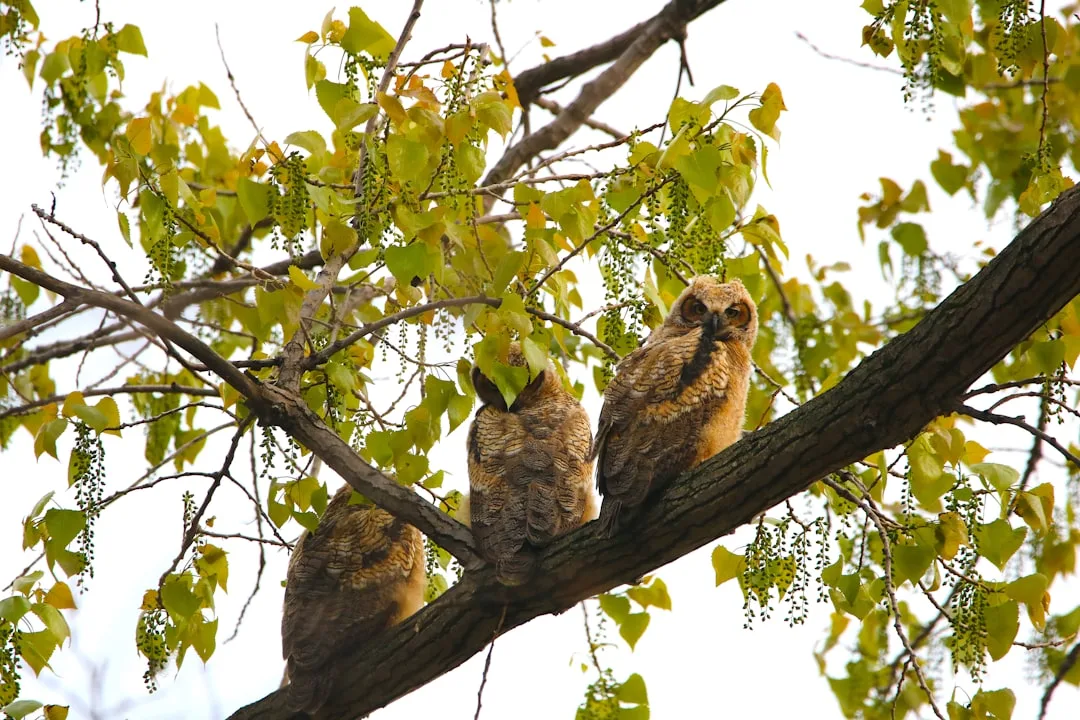
The great horned owl is the most widely distributed owl in the Americas and arguably the most versatile nocturnal predator on either continent. Unlike specialists such as the snowy owl, which lives or dies with lemming cycles, Bubo virginianus has a documented prey list of more than four hundred species and will take anything from a grasshopper to a young porcupine.
It is the only raptor on Earth that regularly kills and eats skunks. It nests in January snowstorms, hunts in utter darkness, and turns its head three-quarters of the way around to watch prey without moving a feather.
This guide covers every major aspect of great horned owl biology and ecology: size and anatomy, silent flight, vision and hearing, diet and hunting, reproduction, vocalisations, range and habitat, conservation status, and the relationship between great horned owls and the humans whose backyards they increasingly share. It is a reference entry, not a summary - so expect specifics: grams, degrees, decibels, pounds per square inch, kilometres, and documented records.
Etymology and Classification
The scientific name Bubo virginianus was coined by the French naturalist Johann Friedrich Gmelin in 1788, based on a specimen collected in the Virginia colonies. The genus name Bubo is the Latin word for a horned or eared owl and is shared with the Eurasian eagle owl and the snowy owl. The species name reflects the Virginia type locality rather than any restriction of range - the bird has since been recorded from Alaska to Argentina.
Common English names include great horned owl, tiger owl (a nod to the barred plumage and aggressive disposition), and hoot owl (from the distinctive low-pitched territorial call). In Spanish-speaking parts of the range it is known as buho cornudo or nacurutu. Several Indigenous languages of North America have their own names, many tied to the bird's ghostly nocturnal call and its role in folklore.
Taxonomists currently recognise between ten and fifteen subspecies, distinguished by size and plumage colour. Northern and high-altitude populations such as B. v. subarcticus are larger and paler, closely resembling snowy owls from a distance. Desert populations like B. v. pallescens are smaller and sandy. Tropical and South American populations are darker and more rufous.
The genus Bubo contains roughly twenty species worldwide, and genetic work suggests the great horned owl is closely related to the snowy owl - so closely that the two can be considered sister species that diverged when ancestral populations were isolated in Arctic refugia during Pleistocene glaciations.
Size and Physical Description
The great horned owl is a large, powerfully built owl with a stocky body, broad wings, a short tail, and the prominent ear tufts that give the species its name. Those "horns" are not ears at all - they are feather tufts used for camouflage and visual communication. The true ear openings are hidden under the facial disc.
Size ranges across the species:
- Length: 43-65 cm from head to tail tip
- Wingspan: 91-153 cm
- Weight: 0.9-2.5 kg
- Tail length: 17-25 cm
- Standing height: roughly 35-45 cm perched
Females are consistently larger and heavier than males, by roughly 10-25 per cent in linear dimensions and up to 30 per cent in body mass. This reverse sexual dimorphism is typical of raptors and is most pronounced in species that take large, active prey.
Several hypotheses attempt to explain it: larger females can defend nests more effectively, smaller males are more agile hunters and thus better providers during the nesting period, or the two sexes partition prey size to reduce competition on a shared territory. The true answer is likely a combination of all three.
Plumage is cryptic and variable. The base colour ranges from dark chocolate brown through grey to almost white in high-latitude subspecies, always overlaid with fine dark barring and mottling that mimics bark and dead leaves. The throat carries a distinctive white patch visible when the bird calls. The facial disc is rusty to grey with a dark border, and the eyes are large and bright yellow - one of the field marks separating it from the dark-eyed barred owl that overlaps its range.
The feet are oversized in proportion to the body and fully feathered down to the toes in most populations - an adaptation for both warmth and protection during prey strikes. The talons are black, sharply curved, and driven by the strongest legs of any North American owl.
Vision, Hearing, and Head Rotation
Great horned owls hunt in conditions that approach the absolute limit of visual perception for any vertebrate. Three sensory systems combine to make this possible: enormous light-gathering eyes, asymmetrical directional hearing, and a neck capable of a near-full rotation.
The eyes. Each eye is roughly the size and light-gathering power of a 10 centimetre telescope objective relative to body size. They are not spheres but elongated tubes, fixed rigidly in the skull by bony sclerotic rings. A human-sized eye scaled to the owl's skull would weigh many times more. This geometry maximises the amount of light reaching the retina but removes any possibility of rolling the eye in its socket.
To look anywhere other than straight ahead the owl must move its entire head. The retina is packed with rod cells, giving extreme low-light sensitivity at the cost of colour vision; great horned owls see the world mostly in shades of grey.
The ears. The ear openings are hidden beneath the feathers of the facial disc, which functions as a large parabolic reflector that funnels sound into the ear canals. The two openings are asymmetrical - one sits higher on the skull than the other, and they point in slightly different directions. A sound reaches one ear fractionally before the other, and at a slightly different loudness.
The owl's auditory cortex uses these differences to build a three-dimensional map of the source, accurate to within roughly one degree in both horizontal and vertical planes. This is precise enough to hit a mouse under leaf litter in total darkness.
Head rotation. To aim this fixed-eye, directional-ear system the owl needs a neck capable of extraordinary movement. Great horned owls can rotate their heads roughly 270 degrees in either direction - three-quarters of a full circle - and tilt them nearly upside down.
Three anatomical adaptations make this safe: fourteen cervical vertebrae (twice as many as humans), vertebral arteries that enter the neck bones in an unusually high position to avoid being pinched by the twist, and small reservoir cavities along those arteries that store blood so the brain is not starved during the turn. Owls cannot rotate their heads a full 360 degrees - that is a myth - but what they can do is remarkable enough.
Silent Flight
The silent flight of great horned owls is one of the most studied examples of biological noise reduction. Three feather specialisations produce it, and aerospace engineers have borrowed the designs for quieter aircraft and wind turbines.
Leading-edge serrations. The outermost primary flight feathers carry a row of stiff comb-like projections along the leading edge. These break up the turbulent airflow that normally rolls off a rigid wing edge and produces a whooshing sound. Instead of one large vortex the serrations create many tiny ones, which dissipate before they can generate audible pressure waves.
Trailing-edge fringe. The back edges of the flight feathers are fringed with soft, flexible barbs. These further dissipate any remaining turbulence as air exits the wing surface.
Velvety upper surface. The top of the wing is covered in a dense pile of micro-feathers that behave acoustically like sound-absorbing foam. Any residual high-frequency noise is soaked up before it can escape.
The combined effect pushes most flight sound below the two kilohertz range - below the frequencies that small rodents and other prey use to detect approaching predators. To a mouse, an attacking great horned owl is effectively silent until it is too close to evade.
The cost is aerodynamic efficiency: soft-edged feathers generate more drag than the stiff primaries of a falcon or hawk, and great horned owls are not built for long sustained flight. They hunt by ambush and short pursuit, not by endurance.
Hunting and Diet
Great horned owls have the broadest documented prey list of any raptor. More than 400 species have been recorded in their diet, covering nearly every group of small and medium-sized vertebrate in the Americas plus a generous supply of invertebrates. The flexibility is one reason the species thrives in habitats from Arctic tree line to cactus desert to city park.
Mammals make up the majority of the diet in most regions. Favoured prey includes rabbits and hares, tree squirrels and ground squirrels, rats, mice, voles, opossums, and young raccoons. In agricultural and suburban areas they take house cats with enough regularity that cat owners in great horned owl territory are sometimes advised to keep pets indoors after dark.
Skunks deserve their own mention. Great horned owls are the only raptor on Earth that routinely kills and eats striped skunks and spotted skunks. Most predators avoid skunks because of the defensive spray. Great horned owls have an almost non-existent sense of smell - like nearly all birds, they rely on sight and hearing - so the spray has no effect on them beyond soaking their feathers.
In regions where skunks are common, they can become a significant seasonal prey item. Field biologists often identify great horned owl nests by smell alone.
Porcupines. Great horned owls also take young porcupines and occasionally adults. Quills commonly embed in the owl's face, chest, and legs during these attacks. Some quills remain lodged permanently in the bird's tissues, visible on X-rays years later. Owls with many embedded quills are not uncommon in rehabilitation centres.
Birds make up a substantial share of the diet. Ducks, geese, grouse, pheasants, crows, and smaller songbirds all appear on the list. Great horned owls are also notorious for killing other raptors - sharp-shinned hawks, Cooper's hawks, red-tailed hawks, peregrine falcons, and several other owl species including barred owls, long-eared owls, short-eared owls, and eastern screech owls. A nesting pair will kill and eat rival owls that intrude on their territory.
Reptiles, amphibians, fish, and invertebrates round out the list. Snakes, lizards, frogs, salamanders, crayfish, scorpions, large beetles, and even occasional fish snatched from shallow water have all been recorded.
Hunting technique. Great horned owls are primarily perch-and-pounce hunters. A bird will sit motionless on a high perch for long periods, using its acute vision and hearing to locate prey on the ground below. When a target is detected the owl launches in near-silent flight, angling down on a long glide that ends with the feet swung forward at the last moment.
The talons close with an estimated grip force of around 500 psi - enough to instantly crush the spine of a rabbit, the skull of a cat, or the rib cage of a goose. Small prey is killed by the strike itself; larger prey is held and compressed until asphyxiated.
Territory, Pair Bonds, and Reproduction
Great horned owls form long-term pair bonds and hold year-round territories that they defend by voice and, when necessary, by combat. A mated pair will occupy the same few square kilometres of forest or mixed habitat for years, often for their whole adult lives.
Breeding timing. Great horned owls begin nesting earlier in the year than almost any other bird in North America. Courtship starts in late autumn, eggs are laid between mid-December and early February across most of the continent, and incubating females routinely sit on clutches buried in snow with ambient temperatures well below freezing.
This unusual schedule ensures that chicks fledge in late spring just as the year's cohort of young rabbits, squirrels, and hatchling birds becomes available - a peak food supply timed perfectly to the demands of growing owlets.
Nests. Great horned owls do not build their own nests. They appropriate stick nests built by red-tailed hawks, crows, ravens, magpies, herons, or squirrels. They also use tree cavities, cliff ledges, caves, abandoned buildings, and the crowns of broken-off large trees. In parts of the range they readily adopt artificial platforms. The same nest is often used for several years by the same pair.
Clutch and incubation. Clutches range from one to four eggs, with two the most common. Eggs are round, dull white, and roughly 55 millimetres long. Incubation lasts 30-37 days and is done almost entirely by the female. The male hunts for both of them during this period, delivering prey to the nest in silent nocturnal visits.
Chick development. Owlets hatch covered in white down, with eyes closed. They grow rapidly, doubling their mass within a week. By two weeks they have opened their eyes; by three weeks they can stand and grasp with their feet; by six to seven weeks they clamber onto nearby branches as "branchers"; by ten to twelve weeks they fledge fully. The parents continue feeding them for several months, and family groups often remain together into the autumn before the young disperse.
Survival and maturity. First-year mortality is roughly 50 per cent. Major causes are starvation, vehicle strikes, electrocution, shooting, and predation. Survivors begin defending their own territories at one to two years old and may first breed at age two. A productive breeding pair may raise one to four young per year for more than a decade.
Range, Habitat, and Density
Great horned owls occupy a larger geographic range than any other owl in the Americas and one of the largest of any bird on either continent. Their breeding range stretches from the tree line in Alaska and northern Canada south to the tip of Argentina and Tierra del Fuego, spanning 22 million square kilometres and more than 80 degrees of latitude.
Habitat tolerance.
| Habitat | Presence |
|---|---|
| Boreal forest | Common resident |
| Deciduous and mixed woodland | Most abundant here in temperate zones |
| Prairie and grassland edges | Common where trees are available |
| Cactus and sagebrush desert | Small pale populations |
| Mangrove and swamp | Regular resident in southern range |
| Mountain slopes to 4,500 m | Present in Andes and Rockies |
| Suburban parks and gardens | Increasingly common |
| Tropical lowland forest | Present but less abundant than in temperate zones |
The species avoids only the deepest closed-canopy tropical rainforest interior, the most barren polar tundra, and entirely treeless high-altitude peaks. Urban adaptability is a notable feature: great horned owls nest on apartment-building balconies, in city cemeteries, and on industrial rooftops in parts of North and South America.
Population. Global population is estimated at around six million mature individuals. Densities in optimal habitat can reach one pair per three to five square kilometres; in marginal habitat densities drop to one pair per several hundred square kilometres. Territories are defended year-round and are large enough to absorb considerable variation in prey supply.
Voice and Communication
The great horned owl's vocal repertoire is one of the most distinctive in the bird world. The territorial hoot - typically four to five deep, resonant notes rendered in birding guides as "who-who-hoo-hooooo" - is the sound most people imagine when they think of an owl.
Hoot structure. Male hoots are lower in pitch than female hoots, a rare reversal of the typical bird pattern in which males sing higher. The hoot is tuned to low frequencies in the 200-400 Hz range - frequencies that travel well through forest and attenuate slowly over distance. On still, cold nights the deep hoot of a calling male is audible to other owls more than 200 metres away, and occasionally much further.
Duets between mated pairs are common during the pre-breeding season, with the male and female alternating calls in a synchronised pattern that reinforces the pair bond and advertises the occupied territory.
Other vocalisations. Great horned owls also produce bark-like alarm calls, hissing defensive displays, bill-snapping when threatened, and a variety of chitters, screeches, and whines. Hungry owlets produce a distinctive raspy begging call that carries remarkably far and is a reliable indicator of a nearby nest.
Conservation Status
The IUCN Red List classifies the great horned owl as Least Concern, with a global population of roughly six million mature individuals, an occupied range of more than 22 million square kilometres, and a generally stable to slightly increasing population trend. The species is one of the most secure large raptors in the Americas.
Local threats. Despite overall security, individual great horned owls face a range of human-caused hazards:
- Vehicle collisions. Owls drop into open roadside verges to catch rodents and are often struck by passing cars. Interstate highways with prey-rich grass shoulders are particularly dangerous.
- Electrocution. Great horned owls roost and perch on power-line crossarms. Contact between the head, wing, or foot and two energised components can kill instantly. Utility retrofits in several countries have reduced but not eliminated the problem.
- Rodenticide poisoning. Second-generation anticoagulant rodenticides accumulate in rats and mice, and owls that eat contaminated prey can die from internal bleeding days later. Rodenticide residues are routinely detected in dead owls submitted to wildlife diagnostic labs.
- Lead poisoning. Owls that scavenge gut piles or wounded animals containing lead shotgun pellets or rifle fragments can absorb toxic amounts of lead. Non-lead ammunition use is increasing but remains far from universal.
- Persecution. Poultry keepers occasionally shoot great horned owls on suspicion of depredation, despite legal protection under national bird treaties. Education programmes and predator-proof coop designs reduce these losses.
- Habitat fragmentation. In tropical parts of the range, deforestation for agriculture removes nesting trees and prey populations. Great horned owls tolerate fragmentation better than most forest raptors, but limits exist.
None of these threats is currently severe enough at a continental scale to push the species out of Least Concern status.
Great Horned Owls and Humans
The great horned owl has been central to folklore across the Americas. Indigenous traditions variously treat it as a spiritual messenger, a harbinger of death, a guardian, or a trickster. In many rural communities the nocturnal hoot is still interpreted as an omen. Modern urban populations hear the same call on winter nights in city parks and occasionally track the resident pair season by season.
Field biologists study great horned owls partly because they are so numerous and partly because they serve as indicators of the health of local food webs. A stable owl pair requires a steady prey base, suitable nest structure, and limited contaminant load. When one or more of those fails, the owls move or their reproduction collapses.
Wildlife rehabilitators see more great horned owls than almost any other raptor, largely because of vehicle strikes and rodenticide poisoning. Survivors released after treatment often reclaim their original territories, which is both a tribute to their resilience and a reminder that the hazards that put them there are unlikely to disappear on their own.
The species is not a good candidate for captivity or falconry in most jurisdictions. Great horned owls are physically dangerous to handle, difficult to train, and prone to imprinting on humans in ways that render them unreleasable. The majority of captive birds are non-releasable rescues held for educational programmes.
Related Reading
- Why Owls Can Turn Their Heads 270 Degrees
- Owls: Silent Hunters of the Night
- Barn Owl: The Silent Flight Specialist
- Snowy Owl
References
Relevant peer-reviewed and governmental sources consulted for this entry include the Birds of the World species account for Bubo virginianus published by the Cornell Lab of Ornithology, the IUCN Red List assessment (most recent update), the Partners in Flight population estimates database, and published research in The Condor, Journal of Raptor Research, The Auk, and Journal of Wildlife Management.
Prey-diversity figures and skunk-predation records draw on diet studies compiled by Arthur Cleveland Bent and subsequent regional dietary analyses across North and South America. Grip-force and silent-flight figures reflect biomechanical and aeroacoustic measurements published in experimental biology and bioinspired engineering literature.
Frequently Asked Questions
How big is a great horned owl?
Great horned owls (Bubo virginianus) measure 43-65 cm from head to tail with a wingspan of 91-153 cm. Weight ranges from 0.9 kg in small desert males to 2.5 kg in large northern females, with females consistently heavier than males - a pattern called reverse sexual dimorphism shared by most owls and many other raptors. Northern and high-altitude populations tend to be larger and paler, while desert and tropical birds are smaller and more rufous.
By mass the great horned owl is the second-largest owl in North America behind the snowy owl, and one of the heaviest strigids anywhere in the Americas.
What do great horned owls eat?
Great horned owls are generalist carnivores with one of the broadest prey lists of any raptor - more than 400 documented species. Mammals dominate the diet: rabbits, hares, squirrels, rats, mice, voles, skunks, opossums, young raccoons, and occasionally house cats. They also take birds up to the size of geese and adult ducks, including other owls and smaller raptors. Reptiles, amphibians, fish, scorpions, crayfish, and large insects round out the list.
They swallow small prey whole and dismember larger animals with their beak and talons. Indigestible fur, bone, and feathers are compacted in the gizzard and coughed up later as pellets, which are often found heaped beneath roost trees.
Where do great horned owls live?
Great horned owls are the most widely distributed owls in the Americas. Their range stretches from the tree line in Alaska and northern Canada south to Tierra del Fuego at the tip of South America, spanning nearly every habitat type in between: boreal forest, deciduous woodland, cactus desert, grassland, swamp, mangrove, suburban park, and city edge.
They avoid only the most extreme polar tundra, closed-canopy tropical rainforest interior, and treeless high mountain peaks. Their flexibility in prey, nest site, and climate tolerance is the main reason they have thrived while more specialised owls have declined. They do not build their own nests - they claim stick nests built by hawks, crows, or squirrels, or they use tree cavities, cliff ledges, and abandoned buildings.
Are great horned owls endangered?
No. The IUCN Red List classifies the great horned owl as Least Concern, with a global population estimated at around 6 million mature individuals and a range exceeding 22 million square kilometres. Populations are stable or even slightly increasing in some regions, helped by the species’ willingness to live alongside humans, its broad diet, and its tolerance of fragmented landscapes.
Local threats still exist: vehicle collisions, electrocution on power lines, rodenticide poisoning from eating contaminated rats, persecution by poultry keepers, and habitat loss in some tropical regions. Lead poisoning from ingested shotgun pellets in scavenged prey has been recorded. Despite these pressures the species remains one of the most numerous large owls on the planet.
How long do great horned owls live?
Wild great horned owls typically live around 13 years once they survive their first year. First-year mortality is brutal - starvation, vehicle strikes, predation, and disease claim roughly half of all fledglings before they reach breeding age. Once established in a territory, adults become harder to kill and some banded wild birds have exceeded 28 years. Captive birds regularly surpass 30 and the oldest documented captive individual was over 38 years old.
Longevity in the wild depends heavily on territory quality. A bird holding a productive territory can defend it for more than a decade, while a floater drifting between poor patches often dies within a year or two.
Why can owls turn their heads so far?
Great horned owls can rotate their heads approximately 270 degrees in either direction, roughly three-quarters of a full circle. They cannot spin their heads all the way around - that is a myth - but the range far exceeds what humans or most mammals can manage. Three anatomical adaptations make this possible. First, owls have 14 cervical vertebrae - twice as many as humans - giving the neck exceptional flexibility.
Second, the vertebral arteries enter the vertebrae higher than in other birds and include reservoirs that store blood, so circulation to the brain is not cut off when the neck twists. Third, the eyes themselves cannot rotate in the skull - they are elongated tubes, not spheres - so the bird compensates by turning its head instead.
How do great horned owls fly silently?
Silent flight is the great horned owl’s signature predatory advantage. Three feather specialisations accomplish it. The leading edge of the outer primary feathers carries comb-like serrations that break up the turbulent airflow that normally produces a whooshing sound. The trailing edges are fringed with soft, flexible barbs that further disrupt eddies.
The upper wing surface is covered in a velvety pile of micro-feathers that absorbs the remaining high-frequency sound. The combined effect pushes most flight noise below 2 kHz, under the hearing threshold that small mammals use to detect approaching predators. The trade-off is efficiency - silent-flight feathers are less aerodynamic than the stiff flight feathers of diurnal raptors - but the ambush advantage at night is worth the drag.
Do great horned owls really eat skunks?
Yes, and they are essentially the only raptor that does so routinely. Most mammalian and avian predators avoid skunks because the defensive spray is intolerable. Great horned owls have a poorly developed sense of smell - like most birds, they rely primarily on sight and hearing - so the spray has little effect on them. Field biologists sometimes smell the owls themselves and their nest sites because the spray saturates their feathers.
Skunks can account for a meaningful share of great horned owl diet in regions where striped skunks are common, and some owls specialise on them. The same olfactory gap allows the owls to take other chemically defended prey like some salamanders and insects that would deter mammals.